
How to prove Data Cloud value in 14 days with one data source, one use case, and zero data movement
Most Data Cloud pilots fail because they try to boil the ocean. This guide gives you a focused 2-week pilot plan that proves value fast by connecting your warehouse, defining identity rules, mapping consent, and activating to Copilot or Tableau for one targeted use case like churn risk.
Why Most Data Cloud Pilots Fail
Data Cloud promises to unify your customer data across every touchpoint. The reality? Organizations get overwhelmed trying to connect everything at once, implement perfect governance from day one, and activate across dozens of channels simultaneously. The result is a pilot that drags on for months with no measurable value.
The solution is surgical focus: one data source, one use case, one activation channel, two weeks.
The Four Pillars of a Successful Pilot
Before diving into Data Cloud, scope your pilot around these four foundational decisions.
Pillar 1: Data Sources
Start with a zero-ETL approach by connecting your existing data warehouse directly: no data movement required.
Warehouse Connection Options:
- Snowflake: Native connector, low complexity, near real-time latency
- BigQuery: Native connector, low complexity, near real-time latency
- Redshift: Native connector, medium complexity, near real-time latency
- Azure Synapse: Partner connector, medium complexity, minutes latency
- Custom/Other: Ingestion API, high complexity, variable latency
Pilot recommendation: Start with one data source. Add complexity after proving value.
What to include in your pilot:
- Transaction history (last 12 months)
- Product usage data (if applicable)
- Support interaction history
- Marketing engagement data
What to exclude initially:
- Raw clickstream data (too noisy for a pilot)
- Legacy systems with poor data quality
- Data without clear business value
Snowflake connection setup example:
- Create a dedicated Snowflake user for Data Cloud
- Grant read access to required schemas
- Configure network policies for Salesforce IPs
- Test connectivity before proceeding
Pillar 2: Data Harmonization
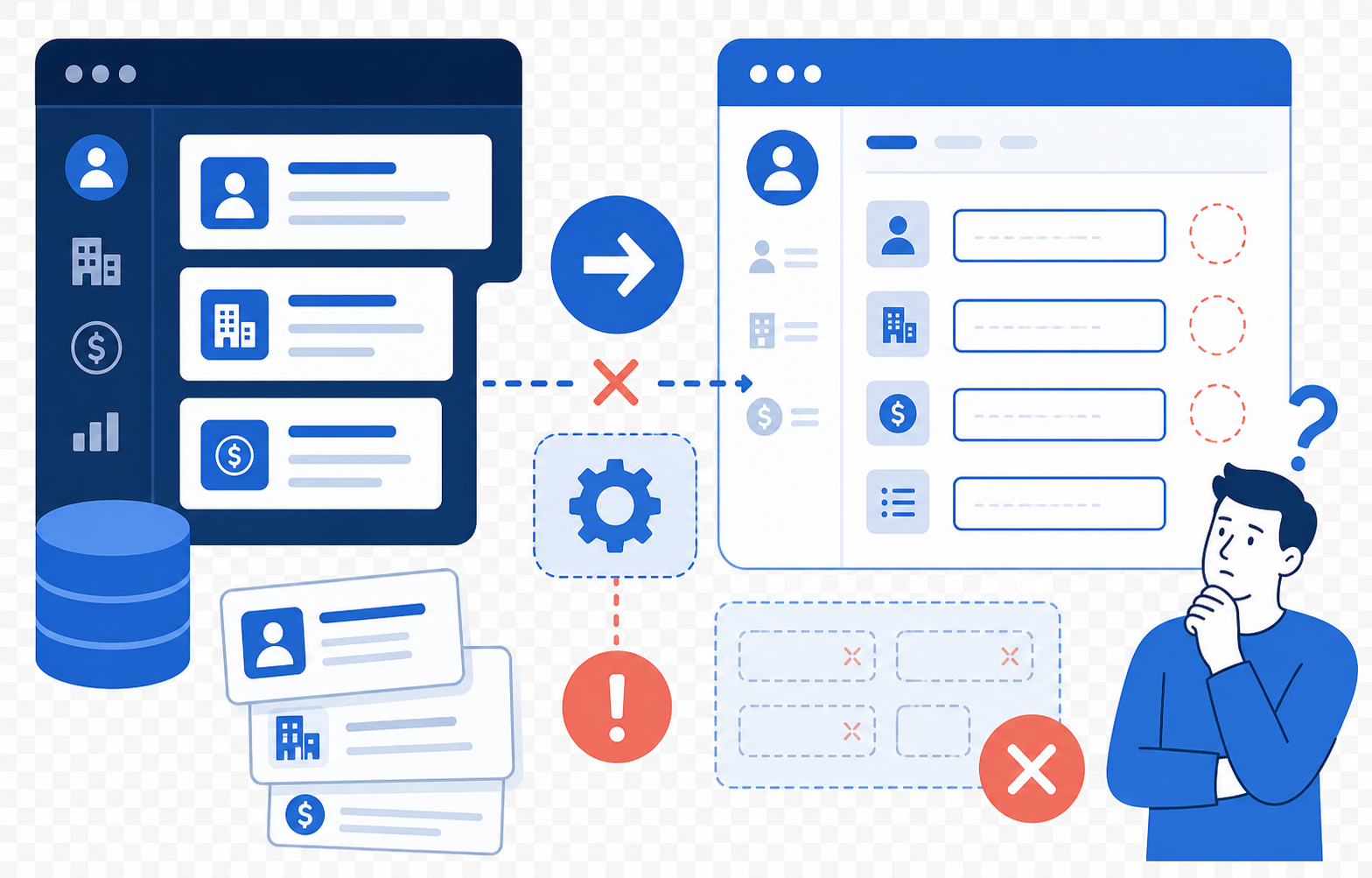
Map disparate schemas to Salesforce's canonical data model. Before harmonization, profile your source data because Data Cloud won't fix garbage: it will just unify garbage faster.
Common transformation rules:
- Standardize date formats to ISO 8601
- Normalize phone numbers to E.164 format
- Lowercase all email addresses
- Map status codes to canonical values
- Convert all timestamps to UTC
- Standardize currency to 2 decimal places
Schema mapping example: Your source field cust_id becomes IndividualId, email_addr becomes EmailAddress (lowercase and trimmed), phone_num becomes PhoneNumber (E.164 format), and txn_date becomes TransactionDate (UTC converted).
Pillar 3: Identity Resolution
Configure identity resolution rules to unify customer records across sources.
Match rule hierarchy (from highest to lowest confidence):
- Email exact match (95% confidence): Auto-merge
- Phone + Last Name (90%+ confidence): Auto-merge
- First + Last + Company (75%+ confidence): Review queue
- Address + Last Name (60%+ confidence): Manual only
Recommended identity resolution settings:
- Fuzzy matching threshold: 80%
- Case sensitivity: Disabled
- Handling of nulls: Exclude from matching
- Duplicate behavior: Keep most recent activity
Testing your identity rules:
- Export 500 random records from each source
- Run matching in sandbox
- Manually validate merge decisions
- Refine rules based on false positive/negative rates
Pillar 4: Activation Target
Pick one high-value use case for your pilot activation.
Recommended pilot use cases:
Churn risk scoring (recommended): High value, medium complexity, 2 weeks to value. This is ideal for pilots because it provides a clear success metric (retention rate), delivers immediate business value, requires identity resolution (which proves the capability), and activates to multiple channels like Copilot, alerts, and dashboards.
Other options: Segment creation (medium value, low complexity, 1 week), Copilot grounding (high value, low complexity, 1 week), lookalike audiences (medium value, medium complexity, 3 weeks), or cross-sell propensity (high value, high complexity, 4+ weeks).
Building Your Governance Framework
Data Cloud without governance is a compliance incident waiting to happen. Establish these guardrails from day one.
Consent Management
Map consent preferences before any data flows. Track email marketing consent, SMS consent, phone consent, and cross-border transfer consent. For each type, map the source system to the appropriate Data Cloud field and define what happens on opt-out (suppress from activations, exclude from flows).
GDPR/CCPA requirements:
- Record consent timestamp and source
- Support right-to-be-forgotten requests
- Enable consent withdrawal propagation
- Audit consent status before any activation
Implementation steps:
- Map consent fields from each source system
- Create unified consent profile in Data Cloud
- Build activation rules that check consent before execution
- Test suppression logic with sample records
Data Lineage Tracking
Know where every data point originated and how it transformed. Document the field name, source system and table, transformation logic, update frequency, and data owner for every key metric.
Why lineage matters:
- Audit compliance requirements
- Debug data quality issues
- Impact analysis for source changes
- Trust in activated data
Freshness SLAs
Define acceptable latency for each data stream:
- Transaction data: 15-minute SLA for real-time personalization, alert if over 30 minutes
- Profile data: 24-hour SLA for accurate customer view, daily reconciliation
- Behavioral signals: 1-hour SLA for timely engagement, alert if over 2 hours
- Historical aggregates: 24-hour SLA for reporting accuracy, weekly validation
PII Handling
Implement field-level controls for sensitive data:
- SSN, Tax ID: Encrypt at rest and in transit, finance-only access, always mask
- Payment data: Encrypt at rest and in transit, exclude entirely from Data Cloud
- Contact info: Encrypt at rest, role-based access, partial masking in UI
- Behavioral data: Encrypt at rest, team-based access, no masking needed
Three High-Impact Activation Patterns
Once data flows cleanly, activate it where your teams work.
Pattern 1: Copilot Grounding
Feed unified customer profiles into Einstein Copilot for context-rich assistance.
Configuration:
- Create a Data Cloud segment (for example, "High-Value At-Risk Customers")
- Map segment to Copilot grounding sources
- Configure which fields Copilot can access
- Test prompts with grounded data
Example grounded prompt: "Help me prepare for my call with this contact at this account."
Copilot's response would include customer lifetime value from Data Cloud, recent transactions and engagement, churn risk score and contributing factors, and recommended talking points based on profile.
Value: Reps get cross-platform context in seconds, not minutes of manual research.
Pattern 2: Tableau Semantic Metrics
Publish calculated fields and segments as reusable semantic layer metrics.
Setup:
- Define calculated fields in Data Cloud (like "Customer Health Score")
- Publish to Semantic Layer
- Connect Tableau to Semantic Layer
- Build dashboards using consistent definitions
Benefits:
- Analysts query consistent definitions
- No more conflicting metrics across reports
- Single source of truth for customer data
Pattern 3: Real-Time Alerting
Trigger alerts when key thresholds breach. For example, send a Slack alert to the CSM and manager when churn risk spikes above 80, email the CSM when usage drops more than 30%, create a CRM task for the account owner when renewal is approaching within 30 days, or alert sales leadership via Slack for high-value transactions over $10K.
Implementation:
- Create Data Cloud trigger for threshold condition
- Configure alert action (Slack, email, CRM task)
- Define recipient rules (owner, manager, team channel)
- Test with sample data before production
Your Two-Week Pilot Timeline
Week 1: Foundation
Days 1-2: Setup
- Provision Data Cloud sandbox
- Configure warehouse connection
- Validate connectivity
Days 3-4: Data Modeling
- Map source schema to Data Cloud
- Configure transformation rules
- Run initial data ingestion
Day 5: Identity Resolution
- Configure matching rules
- Run identity resolution
- Validate merge quality with sample review
Week 2: Activation
Days 6-7: Consent & Governance
- Map consent fields
- Configure access controls
- Document lineage
Days 8-9: Build Activation
- Create churn risk segment
- Configure Copilot grounding
- Set up Tableau connection
Day 10: Validation & Handoff
- Run end-to-end testing
- Document configuration
- Present pilot results
- Plan production rollout
How to Track Success
Key Metrics
MTUs (Monthly Tracked Uniques): Unique individuals processed. Target is to stay within license. Measure using Data Cloud usage dashboard.
Latency: Time from source update to activation. Target under 15 minutes for real-time data. Monitor job execution logs.
Identity match rate: Records successfully unified. Target over 85%. Check identity resolution reports.
Activation lift: Improvement on targeted outcome. Target 10%+ improvement. Use before/after comparison.
Time-to-insight: Hours from question to answer. Target 50% reduction. Gather via user survey.
Pilot Success Criteria
Minimum viable success:
- Data flowing from one source within latency SLA
- Identity resolution over 80% match rate
- One activation channel working (Copilot OR Tableau OR alerting)
- Governance documentation complete
Full success (all above, plus):
- Measurable lift in target metric (like churn risk identification accuracy)
- Positive user feedback from pilot participants
- Clear ROI case for production expansion
Common Pitfalls and How to Avoid Them
Pitfall 1: Boiling the Ocean
Problem: Trying to connect all data sources in the pilot.
Solution: One source, one use case, one activation. Prove value, then expand.
Pitfall 2: Ignoring Data Quality
Problem: Garbage in, garbage out, but faster.
Solution: Profile source data quality before ingestion. Fix issues at the source, not in Data Cloud.
Pitfall 3: Over-Aggressive Identity Resolution
Problem: False positives merge unrelated customers.
Solution: Start conservative. Review samples manually. Tighten rules gradually based on results.
Pitfall 4: No Consent Mapping
Problem: Activating to customers who opted out.
Solution: Map consent on day one. Test suppression logic before any activation goes live.
Frequently Asked Questions
Q: What's the fastest way to get value from this today?
A: Start with churn risk as your use case. Connect one data source, build the identity graph, and activate to Copilot for CSM context. You can ship a working pilot in two weeks and measure lift in four.
Q: How should I measure success?
A: Track MTUs for cost control, latency for freshness, identity match rate for data quality, and lift on your target outcome. Baseline today, compare at pilot end, and document learnings for production planning.
Q: What risks should I watch for?
A: Identity resolution false positives (validate samples before auto-merge), consent mapping gaps (audit before activation), and scope creep (stay focused on one use case). Limit your pilot to one source, one use case, one activation channel.
Q: How does Data Cloud pricing work?
A: Pricing is based on Monthly Tracked Uniques (MTUs): unique individuals processed. Monitor usage carefully during pilot to forecast production costs accurately.
Your Pilot Checklist
Pre-Pilot:
- Identify pilot use case and success metric
- Select single data source
- Document consent requirements
Week 1:
- Configure warehouse connection
- Complete schema mapping
- Run identity resolution
- Validate data quality
Week 2:
- Implement governance controls
- Build activation (Copilot/Tableau/Alerts)
- Test end-to-end
- Document and present results
Ready to Start?
The key to a successful Data Cloud pilot is ruthless focus. Resist the urge to connect everything, harmonize perfectly, or activate everywhere. Instead, pick one source, one use case, and one activation channel. Prove value in two weeks, then expand from a position of strength.
Your churn risk score can be flowing to Copilot by next Friday. Start today.
About Vantage Point
Vantage Point is a specialized Salesforce and HubSpot consultancy serving the financial services industry. We help wealth management firms, banks, credit unions, insurance providers, and fintech companies transform their client relationships through intelligent CRM implementations. Our team of 100% senior-level, certified professionals combines deep financial services expertise with technical excellence to deliver solutions that drive measurable results.
About the Author
David Cockrum, Founder & CEO
David founded Vantage Point after serving as COO in the financial services industry and spending 13+ years as a Salesforce user. This insider perspective informs our approach to every engagement: we understand your challenges because we've lived them. David leads Vantage Point's mission to bridge the gap between powerful CRM platforms and the specific needs of financial services organizations.
-
- Email: david@vantagepoint.io
- Phone: 469-499-3400
- Website: vantagepoint.io