📊 Key Insight: With thousands of fintech companies competing globally and the market still growing, financial institutions face unprecedented choice, and unprecedented complexity.
The financial technology landscape has never been more abundant, or more overwhelming. Choosing the wrong technology can be devastating, while the right choice can transform your organization.
The stakes of getting it wrong:
- Significant financial loss: Failed implementations are costly
- Months of disruption: Operational impact during recovery
- Competitive disadvantage: Rivals advance while you recover
- Regulatory risk: Inadequate compliance capabilities can create exposure
- Talent attrition: Staff frustration leads to turnover
Conversely, the right technology choice delivers meaningful efficiency gains, enhanced client experiences, and sustainable competitive advantage.
At Vantage Point, our experience has taught us that technology selection is as much about understanding your organization as it is about evaluating vendors. This guide provides a comprehensive framework for making informed decisions aligned with your strategic objectives.
What Strategic Foundation Do You Need Before Choosing Financial Technology?
Why Should You Assess Organizational Readiness Before Evaluating Technology?
The most common mistake in technology selection is starting with the technology rather than the business need. This is why our methodology begins with People and Process before Technology. Before reviewing any vendor, complete this strategic assessment.
How Do You Measure Organizational Readiness?
Evaluate your organization across these seven critical dimensions:
| Dimension | Key Question |
|---|---|
| Strategic Clarity | Do we have clear 3-5 year business objectives? |
| Process Maturity | Are our current processes documented and optimized? |
| Data Quality | Is our data clean, consistent, and accessible? |
| Change Capacity | Can our organization absorb significant change? |
| Technical Foundation | Do we have adequate infrastructure and IT capabilities? |
| Budget Alignment | Is there executive commitment to adequate investment? |
| Talent Availability | Do we have or can we acquire necessary skills? |
Score each dimension from 1-5, then evaluate your total:
- 28-35: High readiness: proceed with confidence
- 21-27: Moderate readiness: address gaps before major initiatives
- 14-20: Low readiness: focus on foundational improvements first
- Below 14: Critical gaps: technology investment likely to fail without remediation
📊 Key Stat: In our experience, organizations that score below 21 should invest in foundational improvements before pursuing major technology initiatives. We've seen too many implementations struggle not because of the technology, but because the organization wasn't ready.
How Do You Define Your Technology Vision?
Answer these questions before engaging vendors:
What business outcomes must this technology enable?
- Revenue growth targets
- Cost reduction goals
- Client experience improvements
- Compliance requirements (FINRA, SEC, SOC 2)
- Competitive positioning
What is your integration philosophy?
- Best-of-breed: Multiple specialized solutions
- Platform consolidation: Fewer, broader solutions
- Hybrid approach: Strategic combination of both
What is your risk tolerance?
- Proven, established solutions
- Innovative, emerging technologies
- Balanced portfolio
What is your realistic budget and timeline?
- Total cost of ownership over 5 years
- Implementation timeline constraints
- Resource availability
What Does the Financial Technology Landscape Look Like Today?
What Are the Main Financial Technology Solution Categories?
Financial technology spans numerous categories. Understanding where different solutions fit helps narrow your evaluation:
| Category | Solutions |
|---|---|
| Core Systems | Core Banking, Portfolio Management, Trading Platforms, Accounting Systems, General Ledger |
| Engagement Platforms | CRM Systems, Client Portals, Marketing Automation, Communication Tools |
| Data & Analytics | Business Intelligence, Data Warehousing, Predictive Analytics, AI/ML Platforms |
| Operations & Compliance | Workflow Automation, Document Management, Compliance Management, Risk Management |
| Integration & Infrastructure | API Management, Middleware/iPaaS, Cloud Platforms, Security Solutions |
| Emerging Technologies | Blockchain/DLT, AI/Machine Learning, Open Banking, Embedded Finance |
How Do the Major CRM Platforms Compare for Financial Services?
Based on our implementation experience across financial services, here's how the major CRM platforms compare:
| Platform | Best For | Key Strengths | Considerations |
|---|---|---|---|
| Salesforce Financial Services Cloud | Enterprise wealth management & banking | Industry-specific features, robust ecosystem, scalability | Higher cost and complexity |
| Microsoft Dynamics 365 | Microsoft-centric organizations | Seamless Office integration, familiar interface | Less financial specialization |
| HubSpot | Growth-stage firms with marketing focus | Extremely easy to use, integrated marketing tools | Limited financial features |
| Wealthbox | RIAs and small wealth managers | Affordable, advisor-focused | Limited scalability |
| Redtail | Independent advisors | Strong integrations, industry standard | Dated interface |
As Salesforce Certified Consultants and a HubSpot Solutions Partner, we have deep experience with both platforms and can help you determine which is right for your specific situation.
How Do Portfolio Management & Reporting Platforms Compare?
| Platform | Best For | Key Strengths |
|---|---|---|
| Orion Advisor Services | RIAs and wealth managers | Comprehensive solution with strong integrations |
| Black Diamond | High-net-worth focused firms | Sophisticated reporting, premium client portal |
| Tamarac | Envestnet ecosystem users | Unified platform with rebalancing capabilities |
| Addepar | Ultra-HNW and family offices | Enterprise-grade complex asset handling |
| Morningstar Office | Research-oriented firms | Exceptional data quality |
How Do Financial Planning Software Options Compare?
| Platform | Best For | Key Strengths |
|---|---|---|
| eMoney Advisor | Comprehensive planning | Depth of features, robust client portal |
| MoneyGuidePro | Goal-based planning | Intuitive interface for client engagement |
| RightCapital | Tech-forward firms | Excellent UX, competitive pricing |
| Advyzon | All-in-one needs | Integrated CRM, planning, and billing |
| Holistiplan | Tax-focused planning | Automated tax analysis |
How Do Compliance & RegTech Solutions Compare?
| Platform | Best For | Key Strengths |
|---|---|---|
| ComplySci | Enterprise compliance | Comprehensive and scalable |
| NRS | RIA compliance | Industry expertise, outsourcing options |
| SmartRIA | Small-mid RIAs | Affordable, user-friendly |
| Smarsh | Communication archiving | Comprehensive capture, AI analysis |
| ACA Group | Compliance consulting + tech | Combined advisory and technology |
For more on evaluating integration platforms, see our posts on API-Led Integration Revolutionizing Financial Services and Integrating FinTech with CRM Systems: A Practical How-To Guide.
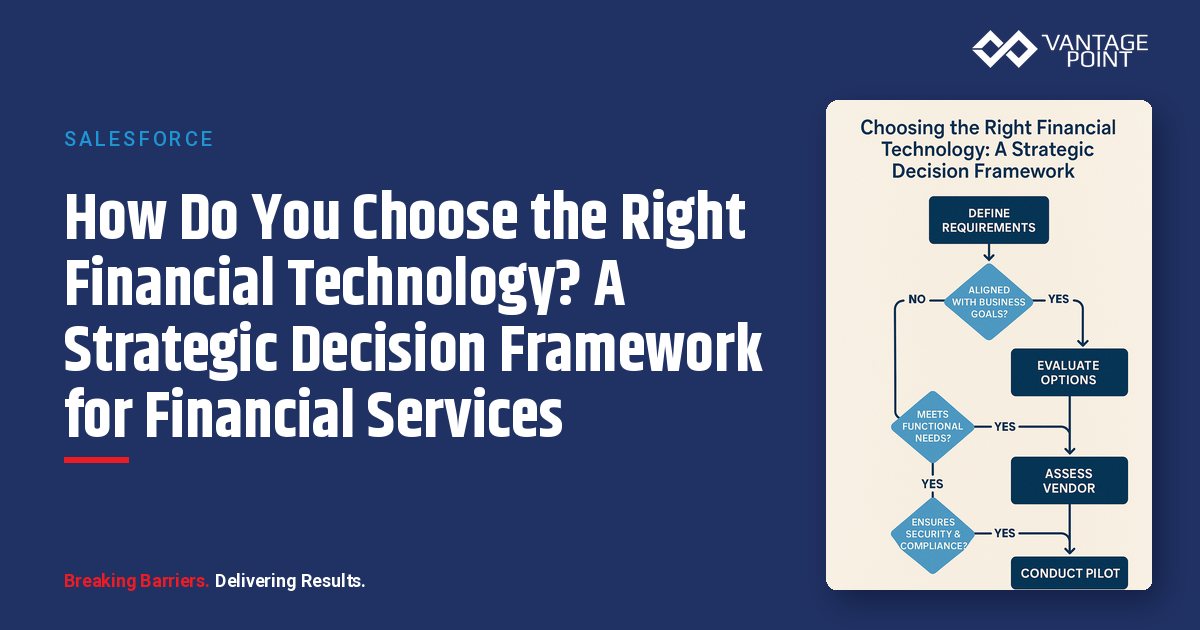
How Should You Evaluate Financial Technology Using the STRATEGIC Framework?
Use this comprehensive framework to evaluate any financial technology solution. Each letter in STRATEGIC represents a critical evaluation dimension:
How Do You Evaluate Scalability?
Critical questions to ask:
- Can the solution grow with our business over 5-10 years?
- What are the user/data/transaction limits?
- How does pricing scale with growth?
- What is the vendor's track record with larger clients?
Evaluate across five key factors:
- User capacity headroom: Room to grow without renegotiating
- Data volume handling: Performance with increasing data loads
- Performance at scale: Speed and reliability as usage grows
- Pricing scalability: Predictable costs as you expand
- Architecture flexibility: Ability to adapt to new requirements
What Should You Look for in Technology Architecture?
Critical questions to ask:
- Is the solution cloud-native or legacy with cloud wrapper?
- What is the API strategy and documentation quality?
- How frequently are updates released?
- What is the technology stack and its longevity?
🚩 Red flags to watch for:
- Infrequent updates: Less than quarterly release cycles
- Poor API documentation: Missing or outdated developer resources
- Proprietary data formats: Lock-in through data format restrictions
- Single-tenant architecture: For cloud solutions, this limits scalability
- End-of-life dependencies: Technology stack nearing obsolescence
How Do You Assess Regulatory Compliance Capabilities?
Critical questions to ask:
- Does the solution support our specific regulatory requirements?
- What compliance certifications does the vendor hold?
- How quickly does the vendor respond to regulatory changes?
- What audit trail and reporting capabilities exist?
Essential certifications to look for:
- SOC 2 Type II: Mandatory for financial services
- ISO 27001: Recommended security standard
- PCI DSS: Required if handling payment data
- GDPR compliance: Necessary if serving EU clients
- FINRA/SEC compliance features: Critical for financial services
📊 Key Insight: Compliance isn't just a checkbox. It's an ongoing operational need that your technology must support. Many firms underestimate regulatory requirements during technology selection.
Why Is User Adoption & Usability So Critical?
Critical questions to ask:
- What is the learning curve for different user types?
- What training and support resources are available?
- How does the interface compare to consumer applications?
- What is the mobile experience?
How to evaluate usability:
- Hands-on demos: Conduct with actual end users, not just IT staff
- Trial/sandbox access: Request extended evaluation periods
- User reviews: Check G2, Capterra, and industry forums
- Peer references: Ask for references from similar organizations
📊 Key Insight: User adoption is the #1 factor in CRM success. The most feature-rich platform is worthless if your team won't use it. This is why our People, Process, Technology methodology prioritizes adoption from day one.
How Do You Calculate Total Cost of Ownership?
Critical questions to ask:
- What are all cost components over 5 years?
- What is included vs. additional cost?
- How do costs compare to alternatives?
- What is the expected ROI timeline?
Calculate your complete TCO including:
| Year 1 Costs | Annual Recurring (Years 2-5) |
|---|---|
| Software licensing | Licensing renewals |
| Implementation services | Support & maintenance |
| Data migration | Ongoing training |
| Integration development | Enhancements/customization |
| Training | |
| Internal staff time | |
| Hardware/infrastructure |
Explore Vantage Point's Salesforce Services for implementation options and cost guidance.
How Do You Evaluate the Ecosystem & Integration Capabilities?
Critical questions to ask:
- What native integrations exist with our current systems?
- What is the API capability for custom integrations?
- Is there a partner ecosystem for implementation support?
- What marketplace/app exchange options exist?
Assess each system you need to integrate by evaluating native availability, API quality, middleware needs, and complexity level.
For more on integration platforms, see our posts on Overcoming CRM Integration Challenges in Financial Services and Q2 Integration with Salesforce.
How Do You Assess a Vendor's Growth & Innovation Potential?
Critical questions to ask:
- What is the vendor's product roadmap?
- How much does the vendor invest in R&D?
- What emerging technologies are being incorporated?
- How does the vendor gather and respond to customer feedback?
Innovation indicators to look for:
- Published product roadmap: Transparency about future direction
- Regular feature releases: Active development and improvement
- AI/ML capabilities: Investment in emerging technology
- Active user community: Engaged customer base
- Industry thought leadership: Vendor understands your market
What Should You Expect from Implementation & Support?
Critical questions to ask:
- What is the typical implementation timeline?
- What implementation methodology is used?
- What ongoing support options and SLAs exist?
- What is the vendor's customer success approach?
Evaluate support aspects including:
- Response times: For critical and standard issues
- Support hours: 24/7 or business hours only
- Available channels: Phone, chat, email options
- Customer success management: Dedicated CSM included or extra cost
How Do You Evaluate Company Viability?
Critical questions to ask:
- What is the vendor's financial stability?
- How long has the vendor been in business?
- What is the customer retention rate?
- Who are the investors/owners?
Assess vendor risk across years in business, customer count, revenue trends, funding/ownership structure, and key client retention rates.
What Is the Best Process for Selecting Financial Technology?
Phase 1: How Do You Build Your Discovery & Long List? (Weeks 1-3)
Activities:
- Document requirements using the STRATEGIC framework above
- Research market landscape
- Gather peer recommendations
- Create initial long list (8-12 vendors)
Deliverable: Requirements document and long list with initial screening scores
Phase 2: How Do You Narrow to a Short List? (Weeks 4-6)
Activities:
- Issue Request for Information (RFI) to long list
- Score responses against requirements
- Narrow to short list (3-5 vendors)
- Schedule initial demonstrations
RFI key sections to include:
- Company background: Financial stability and market position
- Product capabilities: Features and product roadmap
- Implementation approach: Methodology and timeline
- Pricing structure: Licensing model and TCO
- References: From similar organizations
- Security & compliance: Certifications and compliance features
Phase 3: How Do You Conduct a Deep Evaluation? (Weeks 7-10)
Activities:
- Conduct detailed demonstrations with use cases
- Complete hands-on trials/sandboxes
- Check references (minimum 3 per vendor)
- Perform security/compliance review
- Negotiate preliminary pricing
Demo best practices:
- Use your scenarios: Provide specific workflows for the demo
- Include end users: Not just decision-makers
- Use your data: Ask vendors to demo with sample data
- Request "day in the life": See realistic daily workflows
- Probe edge cases: Test exception handling
Phase 4: How Do You Make the Final Selection? (Weeks 11-12)
Activities:
- Complete final scoring
- Conduct executive presentations
- Negotiate final terms
- Make selection decision
- Develop implementation plan
Use a weighted decision matrix to score finalists across all STRATEGIC criteria, ensuring your evaluation is comprehensive and objective.
What Are the 7 Most Common Financial Technology Selection Mistakes?
📊 Key Insight: Based on our experience, these are the mistakes we see most frequently, and how to avoid them.
| # | Mistake | The Problem | The Solution |
|---|---|---|---|
| 1 | Feature Fixation | Selecting based on feature count rather than fit | Focus on features you'll actually use; most users rely on a small share of features |
| 2 | Demo Deception | Being swayed by polished demos that don't reflect reality | Insist on hands-on trials with your data and scenarios |
| 3 | Reference Bias | Only speaking to vendor-provided references | Find independent references through industry networks |
| 4 | Cost Myopia | Choosing the cheapest option without considering TCO | Calculate full 5-year TCO including implementation, integration, and opportunity costs |
| 5 | Integration Underestimation | Assuming integrations will "just work" | Validate integration capabilities with technical proof-of-concept |
| 6 | Change Neglect | Focusing on technology while ignoring organizational change | Budget 15-20% of project cost for change management |
| 7 | Vendor Lock-in Blindness | Not considering exit strategy and data portability | Ensure data export capabilities and understand contractual obligations |
Which Financial Technology Platform Is Right for Your Firm?
When Should You Choose Salesforce?
Ideal for:
- Enterprise organizations with complex requirements
- Firms prioritizing ecosystem breadth and integration capabilities
- Organizations with dedicated Salesforce admin resources
- Companies planning significant customization
- Financial services firms needing Financial Services Cloud capabilities
Key considerations:
- Higher total cost of ownership
- Requires skilled administration
- Can be over-engineered for simple needs
- Implementation partner quality varies significantly
Our Perspective: Salesforce excels when you need a platform that can evolve with complex, changing requirements. The investment pays off for organizations committed to leveraging the full ecosystem. We run our own operations on Salesforce, managing client engagements and our project pipeline, so we understand firsthand what it takes to succeed. Learn more about our Salesforce Services and Financial Services Cloud expertise.
When Should You Choose HubSpot?
Ideal for:
- Growth-stage financial services firms
- Organizations prioritizing marketing-sales alignment
- Teams seeking rapid implementation
- Firms with limited technical resources
Key considerations:
- Less depth in financial services-specific features
- May outgrow capabilities at enterprise scale
- Limited customization compared to Salesforce
- Marketing Hub pricing can escalate quickly
Our Perspective: HubSpot offers exceptional time-to-value for firms prioritizing inbound marketing and sales efficiency. The integrated approach reduces complexity but may require supplementation for specialized financial workflows. We use HubSpot alongside Salesforce in our own operations and can help you determine the right fit. Explore our HubSpot Commerce Hub services and see How to Connect HubSpot to Salesforce.
When Should You Choose Microsoft Dynamics 365?
Ideal for:
- Microsoft-centric technology environments
- Organizations heavily using Office 365/Teams
- Firms seeking familiar user interface
- Companies with existing Microsoft enterprise agreements
Key considerations:
- Financial services features less mature than Salesforce
- Implementation partner ecosystem smaller
- Can become complex with multiple modules
- Licensing model can be confusing
Our Perspective: Dynamics 365 makes sense when Microsoft integration is paramount and your requirements align with available modules. The familiar interface accelerates adoption for Microsoft-native organizations.
When Should You Choose Specialized Solutions?
Ideal for:
- Firms with highly specific workflow requirements
- Organizations where depth trumps breadth
- Companies with strong integration capabilities
- Niche segments with purpose-built solutions
Key considerations:
- Integration burden falls on you
- Vendor viability risk may be higher
- May require multiple point solutions
- Total ecosystem cost can exceed platforms
Our Perspective: Best-of-breed strategies work when you have the integration expertise to connect specialized solutions. The depth of functionality can provide competitive advantage in specific areas.
How Do You Make the Final Technology Decision?
What Decision Framework Should You Use When Scores Are Close?
When evaluation scores are close, use these tiebreakers in priority order:
- Strategic Alignment: Which solution best supports your 5-year vision?
- Risk Profile: Which vendor presents the lowest implementation and viability risk?
- Cultural Fit: Which vendor's approach aligns with your organization's values?
- Reference Quality: Which vendor's customers are most similar and satisfied?
- Gut Check: After all analysis, which solution feels right?
How Do You Build Stakeholder Consensus?
Technology decisions involve multiple stakeholders with different priorities. Here's how to address each:
| Stakeholder | Priority | How to Engage |
|---|---|---|
| CEO/Executive | Strategic value, ROI, risk | Business case and competitive impact |
| CFO/Finance | Cost, budget, ROI timeline | TCO analysis and payback calculation |
| COO/Operations | Efficiency, adoption, support | Process improvement metrics and training plans |
| CTO/IT | Architecture, security | Technical assessment and integration review |
| End Users | Usability, daily workflow | Hands-on demos and pilot programs |
| Compliance | Regulatory requirements, audits | Compliance mapping and certifications |
What Are the Key Post-Selection Success Factors?
Choosing the right technology is only the beginning. Ensure success with these six factors:
- Executive Sponsorship: Visible leadership commitment throughout implementation
- Dedicated Resources: Assign team members with protected time for the project
- Change Management: Invest in communication, training, and adoption support
- Realistic Timeline: Build in contingency: implementations often take longer than planned
- Success Metrics: Define and track KPIs from day one
- Continuous Improvement: Plan for ongoing optimization, not just go-live
How Can Technology Serve as a Strategic Enabler for Financial Services?
Choosing the right financial technology is one of the most consequential decisions a financial institution can make. The framework presented in this guide (grounded in strategic clarity, comprehensive evaluation, and disciplined process) provides a roadmap for making this decision with confidence.
Remember: The best technology is the one your organization will actually use effectively. Technical capabilities matter, but adoption, integration, and alignment with your strategic vision matter more.
The financial technology landscape will continue to evolve rapidly. By building internal capabilities for technology evaluation and selection, you position your organization to continuously adapt and thrive in an increasingly digital financial services industry.
What Should Be on Your Technology Selection Checklist?
Pre-Selection Checklist
- ☐ Completed organizational readiness assessment
- ☐ Defined clear business outcomes and success metrics
- ☐ Established realistic budget and timeline
- ☐ Identified key stakeholders and decision-makers
- ☐ Documented current technology landscape and integration requirements
Evaluation Checklist
- ☐ Created comprehensive requirements document
- ☐ Developed long list through research and peer input
- ☐ Issued RFI and scored responses
- ☐ Conducted detailed demonstrations with use cases
- ☐ Completed hands-on trials with actual users
- ☐ Checked references (minimum 3 per finalist)
- ☐ Performed security and compliance review
- ☐ Calculated 5-year TCO for finalists
Final Selection Checklist
- ☐ Completed weighted scoring matrix
- ☐ Conducted executive presentations
- ☐ Negotiated final terms and pricing
- ☐ Developed implementation plan
- ☐ Secured stakeholder sign-off
- ☐ Communicated decision to organization
Looking for expert guidance? Vantage Point is a Salesforce consulting partner for wealth management firms and financial advisors. Our team specializes in helping RIAs, wealth management firms, and financial institutions unlock the full potential of financial technology: from evaluation and selection to implementation and optimization.
Frequently Asked Questions About Choosing Financial Technology
What is a financial technology decision framework?
A financial technology decision framework is a structured methodology for evaluating, comparing, and selecting technology solutions for financial services firms. It typically includes assessing organizational readiness, defining requirements, evaluating vendors against criteria like scalability, compliance, and total cost of ownership, and following a phased selection process.
How does the STRATEGIC evaluation model differ from standard vendor comparisons?
The STRATEGIC model evaluates technology across eight comprehensive dimensions, Scalability, Technology Architecture, Regulatory Compliance, Adoption & Usability, Total Cost of Ownership, Ecosystem & Integration, Growth & Innovation, Implementation & Support, and Company Viability. Unlike standard comparisons that focus mainly on features and price, STRATEGIC considers the full lifecycle of a technology investment.
Who benefits most from using a technology decision framework?
Financial services organizations of all sizes benefit, including RIAs, wealth management firms, banks, credit unions, insurance companies, and asset managers. The framework is especially valuable for firms making their first enterprise technology investment, replacing legacy systems, or evaluating multiple platforms simultaneously.
How long does a typical financial technology selection process take?
A thorough technology selection process typically takes 10-12 weeks, broken into four phases: Discovery & Long List (weeks 1-3), RFI & Short List (weeks 4-6), Deep Evaluation (weeks 7-10), and Final Selection (weeks 11-12). Complex enterprise decisions may take longer.
Can financial technology platforms integrate with existing systems like Orion, Tamarac, or Redtail?
Yes, major platforms like Salesforce and HubSpot offer native integrations and robust APIs for connecting with portfolio management tools (Orion, Tamarac, Black Diamond), CRM systems (Redtail, Wealthbox), financial planning software, and compliance tools. The key is evaluating integration quality and complexity during the selection process.
How does Salesforce Financial Services Cloud compare to HubSpot for financial firms?
Salesforce Financial Services Cloud is ideal for enterprise firms needing deep industry-specific features, extensive customization, and broad ecosystem integration. HubSpot excels for growth-stage firms prioritizing marketing automation, ease of use, and rapid implementation. Many firms use both platforms together for different functions.
What is the best consulting partner for financial technology selection and implementation?
Vantage Point specializes exclusively in financial services technology consulting, with deep expertise in Salesforce and HubSpot. As both Salesforce Certified Consultants and a HubSpot Solutions Partner, Vantage Point helps firms evaluate, select, and implement the right technology with a proven People, Process, Technology methodology.
Need Help Choosing the Right Financial Technology for Your Firm?
Navigating the financial technology landscape doesn't have to be overwhelming. Vantage Point brings deep financial services expertise and proven evaluation frameworks to help you select and implement the right technology: whether that's Salesforce, HubSpot, or integrated fintech solutions.
Ready to make a confident technology decision? Contact us at david@vantagepoint.io or call (469) 499-3400.