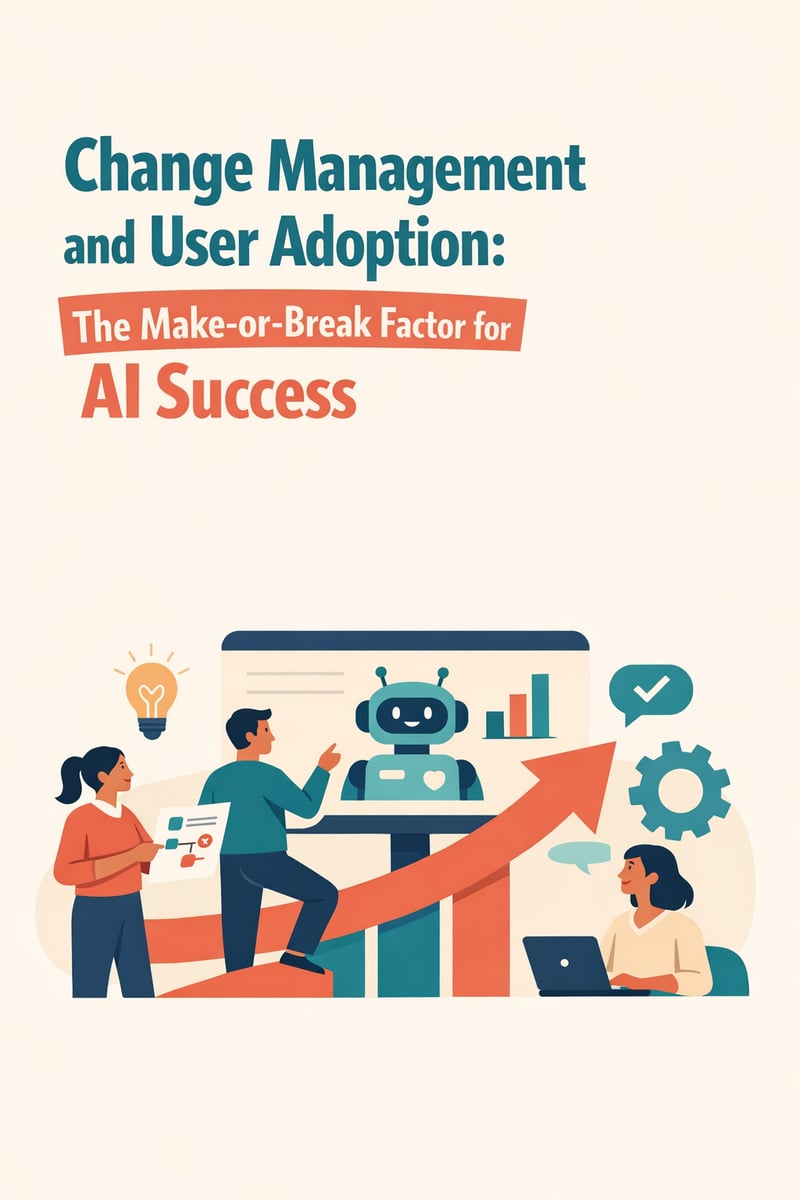
The Graveyard of AI Projects
The CFO signed the check. IT installed the platform. Training was delivered. But six months later, usage sits at 23% and the AI initiative is declared a failure.
What went wrong?
Not the technology—the change management.
This story repeats across financial services firms every month. The pattern is predictable: enthusiasm at launch, initial adoption spike, gradual decline, eventual abandonment. Technology gets blamed, but technology rarely fails. Adoption fails.
At Vantage Point, we've learned that technology implementation is 40% of AI success; change management is 60%. This article provides the proven framework for driving sustained GPTfy adoption that we've refined across 400+ financial services engagements.
Understanding Resistance: Five Types and How to Address Each
Before you can drive GPTfy adoption, you must understand what you're working against. Resistance to AI in financial services takes five distinct forms—each requiring a different response.
Type 1: Fear-Based Resistance
Manifestation: "AI will replace me"
Who Shows It: Often your most experienced people—those with the most to lose
Underlying Concern: Career security, identity tied to expertise
Response Strategy:
- Reframe GPTfy as "handling work you don't want to do"
- Emphasize augmentation, not replacement
- Show how GPTfy makes their expertise more valuable
- Highlight firms that grew (not cut) after GPTfy adoption
Sample Messaging:
"GPTfy handles the administrative work that keeps you from advising clients. Your expertise in understanding client needs and building relationships becomes more valuable, not less."
Type 2: Skepticism-Based Resistance
Manifestation: "This is just hype—we've seen this before"
Who Shows It: Those who've lived through failed technology initiatives
Underlying Concern: Wasted time on something that won't work
Response Strategy:
- Acknowledge past disappointments honestly
- Differentiate GPTfy Agents from previous "AI" (chatbot failures, etc.)
- Provide concrete evidence: GPTfy's 47% AHT reduction, 35% FCR boost
- Offer low-commitment pilot participation (GPTfy offers Paid POC options)
Sample Messaging:
"You're right to be skeptical—'AI' has over-promised before. GPTfy is different: autonomous agents that actually do work, not chatbots that just answer questions. GPTfy customers report $7.5M in annual savings for 1,200 users."
Type 3: Comfort-Based Resistance
Manifestation: "My current process works fine"
Who Shows It: Experienced professionals with established workflows
Underlying Concern: Disruption to effective routines
Response Strategy:
- Don't attack current process—acknowledge it works
- Position GPTfy as enhancement, not replacement
- Demonstrate GPTfy Voice time savings on specific pain points they acknowledge (59 seconds vs. 15 minutes)
- Allow gradual adoption, not forced change
Sample Messaging:
"Your process clearly works—your results prove it. This isn't about changing how you advise clients. It's about getting back the 8 hours a week you spend on documentation and meeting prep."
Type 4: Competence-Based Resistance
Manifestation: "I don't understand how to use AI"
Who Shows It: Those less comfortable with technology generally
Underlying Concern: Fear of looking incompetent
Response Strategy:
- Provide multiple training formats (video, hands-on, 1:1)
- Normalize the learning curve
- Emphasize GPTfy's no-code Prompt Builder interface
- Create safe practice environments in sandbox
- Pair with patient champions for support
Sample Messaging:
"GPTfy's Prompt Builder is designed for business users—no coding required. Learning any new tool takes time—that's normal. We'll provide training in whatever format works for you."
Type 5: Trust-Based Resistance
Manifestation: "I don't trust AI to get it right"
Who Shows It: Quality-conscious professionals
Underlying Concern: AI errors reflecting on them
Response Strategy:
- Acknowledge GPTfy isn't perfect (builds credibility)
- Explain human-in-the-loop design
- Show GPTfy accuracy metrics and PII Masking protection
- Reference GPTfy's SOC 2 Type II certification for security concerns
- Position GPTfy as draft creator, human as finalizer
Sample Messaging:
"You're right that AI isn't perfect—no tool is. That's why every GPTfy output goes through you before it reaches a client. Think of GPTfy as a capable first draft that you review and refine."
For compliance-focused users, GPTfy's Trust Center provides Security Narrative, Privacy Policy, SLA, and Mutual NDA documents that can reassure skeptics about platform security.
The Seven-Component Change Management Framework
Component 1: Executive Sponsorship (Visible and Active)
Executive sponsorship that matters isn't just budget approval—it's visible, active engagement.
What Effective Sponsorship Looks Like:
| Activity | Frequency | Impact |
|---|---|---|
| Kick off the GPTfy project personally | Once | Sets tone, signals importance |
| Use GPTfy tools themselves | Ongoing | Demonstrates belief |
| Attend monthly reviews | Monthly | Shows sustained commitment |
| Recognize early adopters | As appropriate | Reinforces desired behavior |
| Remove adoption obstacles | As needed | Proves commitment |
Common Mistake: Sponsor announces GPTfy initiative, then disappears. Employees interpret absence as lack of conviction.
Component 2: Comprehensive Communication Strategy
The 7-Touchpoint Rule: People need to hear about change seven times before it registers.
Pre-Launch Communications (Weeks -2 to 0):
| Week | Communication | Channel | Message |
|---|---|---|---|
| -2 | Announcement | All-hands | What GPTfy is and why we're implementing |
| -1 | Details email | Specifics, timeline, expectations | |
| -1 | FAQ document | Intranet | Answer predictable questions about GPTfy |
| 0 | Launch message | Sponsor email | Go-live, how to start |
Post-Launch Communications (Ongoing):
| Timing | Communication | Channel | Message |
|---|---|---|---|
| Week 1-2 | Daily tips | Slack/Teams | GPTfy feature highlights |
| Weekly | Success stories | Peer results with GPTfy | |
| Monthly | Metrics report | Leadership | Progress, wins, opportunities |
| Ongoing | Office hours | Live | GPTfy Q&A, troubleshooting |
Component 3: Segmented Training Approach
One-size-fits-all training fails. Different roles need different GPTfy training.
| Audience | Duration | Focus | Format |
|---|---|---|---|
| Executives | 30 min | Strategic overview, GPTfy metrics interpretation | 1:1 or small group |
| Managers | 2 hours | How to support team GPTfy adoption, coaching conversations | Workshop |
| End Users | 3-4 hours | Hands-on GPTfy use for their specific workflows | Role-based sessions |
| Power Users | 6-8 hours | GPTfy Prompt Builder, advanced features, troubleshooting | Certification program |
| Admins | 8-10 hours | GPTfy configuration, monitoring, optimization | Technical training |
GPTfy provides role-based resources through their FAQ Center, with content tailored for Technical Directors, Sales Leaders, Service Managers, and IT Administrators.
Vantage Point supplements GPTfy's documentation with financial services-specific prompt libraries, FSC integration best practices, compliance workflow templates, and advisor adoption playbooks.
Training Principles:
- Show, don't tell—live GPTfy demos, not slides
- Practice immediately—hands-on within 24 hours
- Role-relevant examples—advisor scenarios for advisors
- Follow-up reinforcement—not one-and-done
Component 4: Champion/Ambassador Program
Champions are your force multipliers. They provide peer-to-peer GPTfy support that training can't match.
Champion Selection Criteria:
- Respected by peers (credibility matters)
- Open to new technology (but not necessarily power users)
- Willing to invest time (5-10% of week during rollout)
- Geographic/team distribution (coverage across org)
Champion Ratio: 1 champion per 10-15 GPTfy users
Champion Enablement:
| Week | Activity |
|---|---|
| -1 | Advanced GPTfy Prompt Builder training + early access |
| 0 | Champion kickoff, communication materials |
| 1-4 | Weekly champion calls (30 min) |
| 5+ | Bi-weekly calls, ongoing support |
Champion Responsibilities:
- Answer basic GPTfy questions from peers
- Report common issues and feedback
- Share GPTfy success stories
- Identify struggling users for additional support
- Model desired GPTfy adoption behavior
Component 5: Multi-Tiered Support Infrastructure
Different users need different support at different times.
| Support Tier | Channel | Response Time | Handles |
|---|---|---|---|
| Self-Service | GPTfy FAQ Center, video library | Instant | How-to questions, reference |
| Peer Support | Champions | Same day | Basic questions, encouragement |
| Help Desk | Tickets, chat | 4 hours | Technical issues, access problems |
| Expert Support | Scheduled calls | 24 hours | Complex scenarios, Prompt Builder optimization |
| Escalation | Project team | As needed | Blockers, policy questions |
GPTfy Support Tiers:
- Premium Support (all tiers): Standard enterprise support
- Signature Support (UNLIMITED tier): Highest service level with dedicated resources
Support Intensity by Phase:
| Phase | Support Level | Rationale |
|---|---|---|
| Week 1-2 | Maximum (war room mode) | Critical GPTfy adoption window |
| Week 3-4 | High (daily office hours) | Solidifying GPTfy habits |
| Week 5-8 | Standard (regular channels) | Transition to BAU |
| Week 9+ | Maintenance | Sustainable support model |
Component 6: Metrics and Accountability
What gets measured gets managed. What gets reported gets prioritized.
Weekly GPTfy Tracking Dashboard:
| Metric | Target | Week 1 | Week 2 | Week 3 | Week 4 |
|---|---|---|---|---|---|
| Users activated | 90% | 75% | 85% | 90% | 92% |
| Daily active GPTfy users | 50% | 30% | 40% | 48% | 52% |
| GPTfy features used (avg) | 3+ | 1.5 | 2.1 | 2.8 | 3.2 |
| Support tickets | Declining | 45 | 38 | 25 | 18 |
| User satisfaction | 4.0/5 | 3.5 | 3.8 | 4.1 | 4.2 |
GPTfy's centralized analytics dashboard tracks usage patterns, enabling data-driven optimization.
Accountability Actions:
- Share GPTfy metrics widely (transparency drives action)
- Recognize top-adopting teams/individuals
- Have managers check in with low-adoption team members
- Include GPTfy usage in performance conversations (eventually)
Component 7: Continuous Feedback and GPTfy Prompt Builder Improvement
Adoption is iterative. Launch is the beginning, not the end.
Feedback Collection Mechanisms:
| Method | Frequency | Purpose |
|---|---|---|
| In-app feedback | Continuous | Friction points, feature requests |
| Champion reports | Weekly | Qualitative insights |
| User surveys | Week 2, 4, 8 | Satisfaction, NPS |
| GPTfy usage analytics | Continuous | Behavior patterns |
| Focus groups | Week 6+ | Deep dive on opportunities |
Rapid GPTfy Prompt Builder Iteration Process:
- Collect feedback
- Categorize by theme and urgency
- Implement quick fixes in Prompt Builder immediately
- Communicate changes ("You asked, we delivered")
- Queue larger improvements for roadmap
Role-Specific GPTfy Adoption Strategies
For Financial Advisors
Key Concerns:
- Time investment during already-busy days
- GPTfy affecting client relationships
- Quality of AI outputs
GPTfy Adoption Tactics:
- Schedule training during typically slower periods
- Lead with GPTfy Voice use case (immediate time savings—59 seconds vs. 15 minutes)
- Emphasize GPTfy as draft creator, advisor as relationship owner
- Share advisor-to-advisor testimonials
Success Metric: Hours saved per week (target: 8-12 hours)
For Service Teams
Key Concerns:
- Case handling speed expectations
- GPTfy handling complex situations appropriately
- Job security
GPTfy Adoption Tactics:
- Position GPTfy RAG as handling tier-1 inquiries, freeing team for complex issues
- Reference GPTfy benchmarks: 47% AHT reduction, 35% FCR boost
- Show career growth opportunities (AI specialists, complex case experts)
Success Metric: First-contact resolution rate, CSAT (target: 24% increase in 30 days)
For Compliance Teams
Key Concerns:
- GPTfy accuracy for regulatory matters
- Audit trail completeness
- Regulatory acceptance
GPTfy Adoption Tactics:
- Involve compliance in GPTfy Prompt Builder configuration
- Demonstrate GPTfy audit logging and PII Masking features
- Reference SOC 2 Type II certification and FINRA-ready architecture
- Start with GPTfy-assisted (not GPTfy-automated) workflows
- Position compliance team as AI governance leaders
Success Metric: Compliance efficiency with maintained/improved accuracy
The Adoption Funnel: Measuring Progress
Track users through the GPTfy adoption funnel:
┌─────────────────────────────────────────────────┐│ EXPOSED: Know GPTfy exists (100%) │├─────────────────────────────────────────────────┤│ ACTIVATED: Used GPTfy at least once (Target: 90%)│├─────────────────────────────────────────────────┤│ ENGAGED: Used GPTfy 5+ times (Target: 80%) │├─────────────────────────────────────────────────┤│ ACTIVE: Use GPTfy weekly (Target: 70%) │├─────────────────────────────────────────────────┤│ POWER USER: Daily use, Prompt Builder (20-30%) │└─────────────────────────────────────────────────┘Healthy Funnel Benchmarks at 90 Days:
| Stage | Target | Healthy | Concerning |
|---|---|---|---|
| Activated | 90% | 85%+ | Below 75% |
| Engaged | 80% | 75%+ | Below 65% |
| Active | 70% | 65%+ | Below 55% |
| Power User | 25% | 20%+ | Below 15% |
If You're Below Targets:
- Activated low: Training/access issues—fix mechanics
- Engaged low: GPTfy value not apparent—improve quick wins, highlight Voice savings
- Active low: Friction in workflow—optimize Prompt Builder integration
- Power User low: Advanced features not useful—reassess Prompt Builder templates
Key Takeaways
- Technology implementation is 40% of success; change management is 60%—budgeting and planning should reflect this reality.
- Resistance comes in five types, each requiring different responses: Fear needs reassurance, skepticism needs GPTfy metrics evidence, comfort needs gradual change, competence needs Prompt Builder training, and trust needs GPTfy Trust Center transparency.
- Executive sponsorship must be visible and active: Budget approval isn't enough—leaders must use GPTfy tools, attend reviews, and remove obstacles.
- Champion programs provide peer support that training cannot: 1 champion per 10-15 GPTfy users, properly enabled, dramatically improves adoption.
- Measure the GPTfy adoption funnel, not just logins: Track progression from exposed → activated → engaged → active → power user to identify where adoption breaks down.
- GPTfy Prompt Builder iteration enables continuous improvement: Collect feedback systematically, refine prompts quickly, and communicate changes—adoption is iterative.
Conclusion
The difference between GPTfy success and GPTfy failure is rarely the technology. It's whether people actually use it.
Change management isn't a nice-to-have add-on—it's the core of successful GPTfy implementation. The framework in this article has been refined through hundreds of financial services deployments. When properly executed, 70%+ GPTfy adoption in 90 days is achievable.
The firms that treat change management as seriously as technical implementation are the firms that see the ROI. The firms that skip it join the 87% that report disappointing results.
Your choice.
About Vantage Point
Vantage Point is a specialized Salesforce and HubSpot consultancy serving exclusively the financial services industry. We help wealth management firms, banks, credit unions, insurance providers, and fintech companies transform their client relationships through intelligent CRM implementations.
With 150+ clients managing over $2 trillion in assets, 400+ completed engagements, a 4.71/5 client satisfaction rating, and 95%+ client retention, we've earned the trust of financial services firms nationwide.
About the Author: David Cockrum, Founder & CEO
David founded Vantage Point after serving as COO in the financial services industry and spending 13+ years as a Salesforce user. This insider perspective informs our approach to every engagement—we understand your challenges because we've lived them.
Ready to start your 90-day AI journey? Contact our team at sales@vantagepoint.io or call (469) 499-3400 to request an implementation planning session.
-
- Email: david@vantagepoint.io
- Phone: 469-499-3400
- Website: vantagepoint.io