TL;DR / Key Takeaways
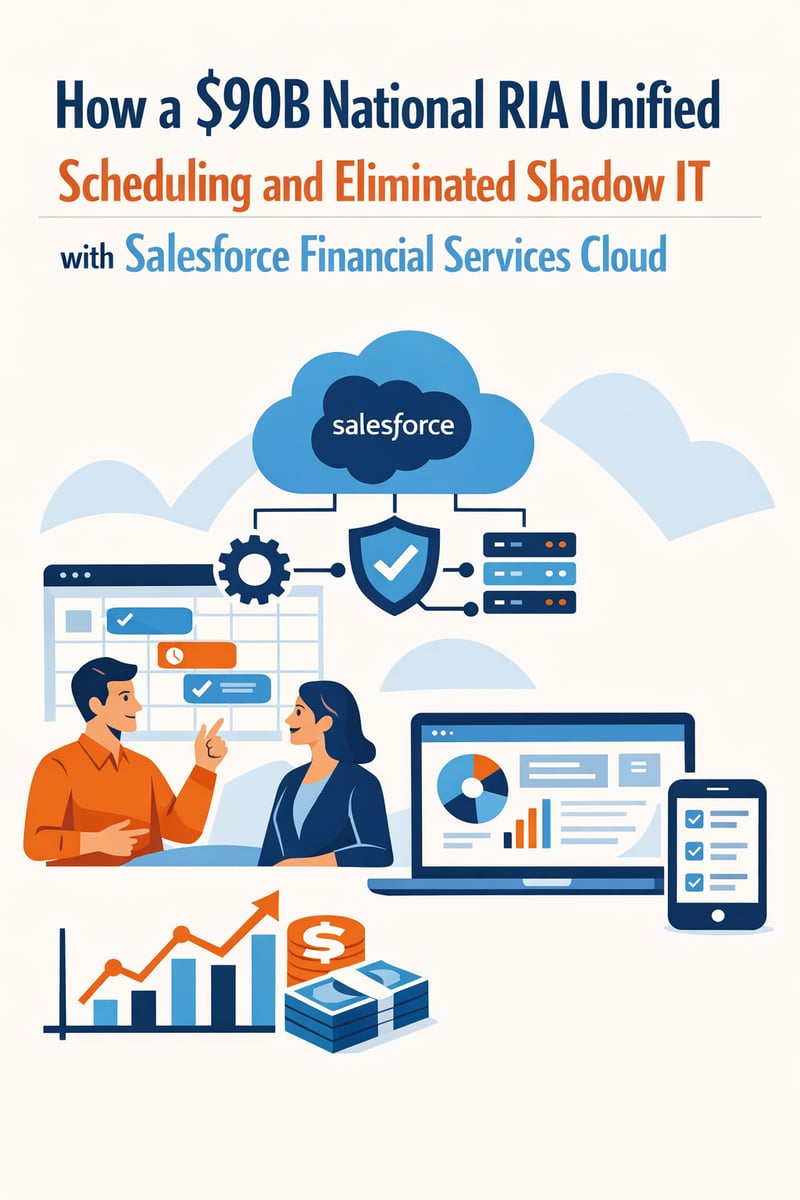
| What is it? | A comprehensive Salesforce implementation that replaced fragmented scheduling tools and shadow IT across 100+ offices with a unified, automated platform for a rapidly growing national RIA |
| Key Benefit | 85–95% user adoption within 90 days, 27% reduction in administrative task time, and 350% improvement in data completeness |
| Industry | Wealth Management / Registered Investment Advisory (RIA) |
| Platform | Salesforce Financial Services Cloud, Experience Cloud, Lightning Scheduler, High-Velocity Sales, Einstein Activity Capture, Salesforce Flows |
| Best For | RIA leaders, wealth management COOs/CTOs, M&A integration strategists, and compliance officers evaluating CRM modernization |
| Bottom Line | A centralized Salesforce architecture eliminated M&A technology debt, enabled secure external scheduling at scale, and gave advisors back hours every week to focus on client relationships |
The Challenge: M&A-Driven Growth Creates a Tangled Web of Technology Debt
The contemporary wealth management industry is navigating unprecedented structural consolidation. As regulatory burdens intensify and client expectations for seamless digital experiences rise, scale has become the primary determinant of long-term viability. Within this competitive landscape, a rapidly growing national registered investment advisory (RIA) firm had distinguished itself as a dominant force — scaling from approximately $5.7 billion in assets under management (AUM) in 2015 to over $90 billion by the end of 2025, serving tens of thousands of families through more than 1,400 employees across 100+ geographic locations.
This explosive growth was fueled by highly strategic acquisitions spanning financial planning, investment management, estate planning, and tax advisory services. To manage the sprawling national footprint, the firm implemented a localized Managing Partner model — regional leaders tasked with delivering a boutique, high-touch family office experience while leveraging the vast capabilities of the national enterprise. The operational philosophy demanded a delicate balance: maintain deeply personalized, localized client relationships while centralizing operations, compliance, and technology to realize economies of scale.
However, aggressive acquisition intrinsically generates profound technological fragmentation. As the firm absorbed regional advisory practices, it inherited a chaotic web of localized CRM platforms, disparate scheduling utilities, and conflicting data models — a phenomenon known as M&A technology debt. Different geographic branches and specialized service lines were utilizing highly decentralized scheduling applications, including Calendly, Acuity, and custom legacy solutions native to Microsoft Dynamics. This fragmentation created severe operational friction: inconsistent client data, duplicated administrative effort, compliance blind spots, and an inability to gain unified visibility into organizational performance.
The Solution: A Unified Enterprise Scheduling Engine Built on Salesforce
Recognizing that disjointed legacy architecture was an untenable foundation for a $90 billion enterprise, executive leadership initiated a comprehensive digital transformation. The firm appointed its first Chief Technology and Digital Officer (CTDO) — a veteran with over 25 years of financial services technology experience — and assembled a 48-person technology team to dismantle silos, eradicate shadow IT, and establish a unified digital platform. A new President, recruited from a global asset management firm where he had overseen a preeminent risk management and data platform, was brought in to unify the firm's diverse capabilities into a single, cohesive client conversation.
To execute the most complex elements of this digital roadmap — specifically the overhaul of Salesforce infrastructure — the firm retained Vantage Point. With a 100% senior-level delivery team, over 400 engagements for 150+ clients, a 95% client retention rate, and a 4.71/5.0 customer satisfaction score, Vantage Point brought deep, specialized expertise in Salesforce architecture for financial services. The engagement deployed Vantage Point's proprietary VALUE Methodology — Vision, Adaptability, Leverage, User-Centricity, and Excellence — ensuring every architectural decision aligned with the firm's broader strategic goals, compliance requirements, and user adoption targets.
The implementation spanned three major workstreams, each addressing distinct operational challenges across the enterprise.
Workstream 1: The Secure Experience Cloud "Airlock" for External Scheduling
The immediate catalyst for the engagement was a strategic initiative to integrate external call center agents and appointment schedulers to scale lead qualification and increase consultation volume. This created a complex architectural paradox: external partners required real-time access to internal advisor calendars, but granting full Salesforce CRM licenses to an outsourced workforce would introduce unacceptable data governance risks and exorbitant licensing costs. External agents could theoretically access highly sensitive personally identifiable information (PII), portfolio allocations, and strategic estate plans.
Vantage Point resolved this by constructing a dedicated Salesforce Experience Cloud portal that functioned as a secure digital airlock between the external world and the internal CRM. When third-party schedulers logged into the portal, the underlying logic engine allowed them to perform a highly restricted set of actions:
- Query the system to select specific advisors based on predefined routing criteria (geographic location, service line specialization)
- View real-time free/busy availability — with all private calendar metadata stripped away, ensuring the external agent could only see that an advisor was "Busy" without exposing the nature of the conflicting appointment
- Input basic prospect demographic data and book consultations directly into the Salesforce ecosystem via a secure form
To ensure pristine calendar accuracy, the team engineered deep bidirectional synchronization between the Salesforce Lightning Scheduler and advisors' individual Outlook/Exchange calendars using Lightning Sync and Einstein Activity Capture. Internal advisors did not need to learn a new calendaring system — if an advisor blocked time on their Outlook calendar, the sync engine immediately removed those slots from the availability matrix presented to external schedulers. The architecture also included specific configurations to handle complex time zone discrepancies, with custom screen flows that prevented schedulers from proposing meetings with advisors across conflicting time zones.
Beyond booking, Vantage Point implemented a closed-loop communication framework powered by Salesforce Flows. When an appointment was booked, the system triggered automated cascades: instant confirmation emails to both the advisor and the prospect, generated from centrally managed HTML templates that dynamically injected meeting duration, location, and the advisor's specific Microsoft Teams link, RingCentral dial-in credentials, or physical driving directions. Automated reminder cadences were deployed at strategic intervals to combat no-show rates. Additionally, Salesforce Inbox integration allowed internal schedulers to generate client-facing links with pre-selected "suggested meeting times" — prospects could click a single button in their email to lock in the appointment, updating both Salesforce and Outlook instantly.
Workstream 2: Overhauling the Tax Planning Division
The firm's tax planning team was constrained by an aging, custom-built scheduling solution native to Microsoft Dynamics, entirely siloed from the primary Salesforce Financial Services Cloud environment. Tax preparation is highly cyclical and deadline-driven, requiring rigid adherence to specific timelines and repetitive annual engagements.
Vantage Point architected a specialized branch of Lightning Scheduler tailored to the tax division. This included:
- Rollover event logic enabling seamless duplication and scheduling of yearly recurring appointments based on historical data
- Highly granular calendar preferences allowing administrators to designate specific months, days of the week, or exact hours exclusively for tax consultations
- Advanced routing logic assigning clients to specific tax professionals based on licensure, geographic location, and meeting preference parameters gathered during intake
- Aggressive automated notification workflows dispatching sequential reminders precisely 7, 5, and 2 days prior to consultations — critical during peak tax season when schedule disruptions can cascade across the entire division
Workstream 3: High-Velocity Lead Management for Inside Sales
The firm's inside sales and outbound lead generation department operated under fundamentally different pressures than the wealth advisory teams. Representatives were responsible for processing massive datasets — frequently managing up to 4,000 leads per day. Prior to the intervention, associates were forced to manually enter lead data, extract lists from disparate sources, and copy-paste phone numbers into messaging applications for SMS outreach. This manual data entry created an insurmountable bottleneck, artificially capping the firm's growth velocity.
Vantage Point deployed Salesforce High-Velocity Sales (HVS) integrated with a specialized outbound scheduling framework in a targeted 43-day deployment cycle. The system was programmed to automatically query the CRM, generate reports of prospects or existing clients due for review, and trigger mass outbound scheduling emails containing dynamic "suggested times" links. By automating the preliminary educational and logistical phases of lead outreach, inside sales representatives were untethered from manual data entry and could focus entirely on high-value conversations with prospects who had already self-scheduled via the automated cadences.
Navigating Complexity: Crisis Management and Rapid Recovery
During the rollout of the Wealth Advisor Scheduler module, critical technical bugs surfaced: the system failed to respect granular start and end dates for advisor availability windows, and a foundational reliance on the "Account Owner" field created cascading logic errors for complex, cross-departmental bookings. Vantage Point immediately deployed senior technical leadership, executed a rapid agile sprint to overhaul the underlying data model, and implemented several key fixes:
- Replaced cumbersome manual selection processes with intuitive screen flows triggered directly from the account page, using advanced logic to automatically query the database and create appropriate service resources
- Deployed systemic metadata updates including new custom fields and engineered flows
- Escalated platform-level limitations directly to Salesforce Support, forcing a resolution that allowed the Scheduler to respect the exact granularity demanded by wealth advisors
Within weeks, all outstanding issues were successfully validated by the firm's Director of Digital Transformation and internal stakeholders, clearing the path for final production deployment. The speed and competence of this intervention deeply reinforced executive trust in the partnership.
The Results: Dramatic Gains in Adoption, Efficiency, and Data Quality
The implementation delivered transformative, measurable outcomes across the entire enterprise:
| Performance Metric | Industry Baseline / Pre-State | Post-Deployment Result |
|---|---|---|
| System User Adoption | ~30% standard CRM adoption | 85–95% adoption within 90 days |
| Administrative Burden | Manual email drafting, data entry | 27% reduction (saving 8–12 hours/week per advisor) |
| Data Completeness | Fragmented data across shadow IT | 350% improvement in centralized CRM data |
| Meeting Booking Rate | High-friction, multi-touch emails | 40–80% improvement via automated scheduling links |
| Compliance Audit Prep | Manual reconciliation of records | 40% reduction in preparation time |
| Sales Cycle | Extended multi-touch outreach | 20% reduction via High-Velocity Sales automation |
The user-centric architecture was a critical driver of these results. For internal advisors, the learning curve was essentially neutralized by seamless Outlook integration — advisors continued managing their day via standard Microsoft calendars while Salesforce processed the heavy logistical logic in the background. For external partners, the Experience Cloud portal was designed to be hyper-intuitive, requiring virtually no formal onboarding. This was reinforced by a comprehensive change management strategy including train-the-trainer sessions, tailored quick-reference guides, and pilot testing groups.
Executive advocacy underscored the strategic impact. The firm's CTDO praised the team's agility, actively provided professional references, and proactively facilitated referral introductions to C-suite colleagues at other enterprises. The CFO — the executive signatory on the initial engagement — provided an unequivocal endorsement, noting that Vantage Point was "the only Salesforce consulting team who has actually delivered on their contract... above and beyond expectation. Fast, skilled, and knowledgeable across all of Salesforce."
Key Technologies and Integrations
- Salesforce Financial Services Cloud (FSC) — Core CRM platform and client data hub
- Salesforce Experience Cloud — Secure external scheduling portal ("airlock" architecture)
- Salesforce Lightning Scheduler — Enterprise scheduling engine with specialized configurations for wealth advisory, tax planning, and inside sales
- Einstein Activity Capture — Automated activity logging and bidirectional calendar sync
- Lightning Sync — Real-time Outlook/Exchange calendar synchronization
- Salesforce High-Velocity Sales (HVS) — Automated lead management and outbound cadences
- Salesforce Flows & Process Builder — Workflow automation for closed-loop communications
- Salesforce Inbox — "Suggested times" client-facing scheduling links
- Microsoft Exchange / Outlook — Bidirectional calendar integration
- Microsoft Teams — Dynamic meeting link injection in automated communications
- RingCentral — Dial-in credential automation for virtual appointments
- Zoom API — Video conferencing integration (added via change order)
- Custom Lightning Components — Bespoke UI elements for scheduling workflows
- Custom Screen Flows — Time zone conflict prevention and service resource assignment
Why It Matters: Lessons for Wealth Management Organizations
M&A technology debt is an existential challenge — and solving it unlocks future growth. When an enterprise firm acquires regional advisories, it inherits a myriad of localized CRMs, disparate scheduling tools, and contradictory data models. Standardizing the CRM and scheduling architecture is not merely an operational upgrade — it is an absolute prerequisite for continued M&A velocity. By establishing a rigid, highly scalable data model in Salesforce FSC and Lightning Scheduler, the firm created a universal "integration chassis." Future acquired firms can now be systematically migrated into a standardized, pre-configured environment, drastically reducing post-merger integration timelines and ensuring compliance standards are immediately enforced across newly acquired entities.
Fiduciary security and frictionless client experience can coexist. A central tension in modern wealth management is balancing the strict data security requirements of the SEC, FINRA, and internal fiduciary mandates against the modern client's demand for consumer-grade digital experiences. The Experience Cloud "airlock" architecture proves that advanced architectural decoupling allows firms to deliver hyper-modern scheduling and communication experiences while keeping PII and sensitive portfolio data heavily encrypted within the core Salesforce environment. Wealth management firms no longer have to choose between regulatory security and exceptional client experience.
Intelligent automation decouples growth from headcount. The inside sales deployment — managing volumes approaching 4,000 leads per day — demonstrates a paradigm shift away from the traditional labor-intensive model. By deploying High-Velocity Sales and automated outbound frameworks, the firm decoupled lead volume from administrative burden. Firms that adopt intelligent automation frameworks can absorb massive increases in pipeline velocity without triggering a corresponding spike in operational expenditure, directly driving margin expansion and profitability.
Frequently Asked Questions
How does Salesforce Financial Services Cloud differ from standard Salesforce for wealth management firms?
Salesforce Financial Services Cloud (FSC) is purpose-built for financial services, offering specialized data models for households, financial accounts, and advisor-client relationships. For RIAs, FSC provides a fiduciary-grade foundation that supports compliance tracking, client lifecycle management, and the complex relationship hierarchies inherent in wealth management — capabilities that standard Sales Cloud cannot deliver out of the box.
Can Salesforce Lightning Scheduler handle the specialized needs of different advisory divisions?
Yes. As demonstrated in this engagement, Lightning Scheduler can be configured with highly specialized branches for different service lines. The tax planning division required rollover event logic for recurring annual appointments and granular calendar constraints, while the wealth advisory division needed different routing rules and availability parameters. Lightning Scheduler's flexibility allows each division to operate with tailored scheduling logic while feeding into a single, unified data model.
What kind of adoption rates can firms realistically expect from a Salesforce CRM transformation?
Industry-standard CRM adoption rates hover around 30%, which is a primary reason many CRM projects fail to deliver ROI. However, implementations that prioritize user-centric design — such as seamless integration with existing tools like Microsoft Outlook, minimal workflow disruption, and comprehensive change management — can achieve 85–95% adoption within the first 90 days. The key is designing the system so that advisors barely notice the technology shift while gaining significant time savings.
How should a growing RIA evaluate whether it's time to consolidate its technology stack?
If your firm is managing client data across multiple CRM platforms, using standalone scheduling tools like Calendly or Acuity alongside your core CRM, or preparing for additional acquisitions, the cost of technology debt is compounding daily. Key indicators include: inconsistent client data across offices, manual compliance audit preparation, advisors spending excessive time on scheduling logistics, and inability to gain a unified view of firm-wide performance. Contact Vantage Point for a strategic assessment of your current architecture and a roadmap to consolidation.
Ready to Transform Your Wealth Management Operations?
Vantage Point specializes in Salesforce and HubSpot implementations for regulated industries — from financial services and healthcare to insurance and fintech. With 150+ clients, 400+ engagements, and a senior-only team of US-based consultants, we bring deep expertise to every project.
Contact Vantage Point to discuss your digital transformation journey.
A rapidly growing national registered investment advisory (RIA) firm is one of many organizations that have partnered with Vantage Point to modernize their operations. Names and identifying details have been changed to protect client confidentiality.