TL;DR / Key Takeaways
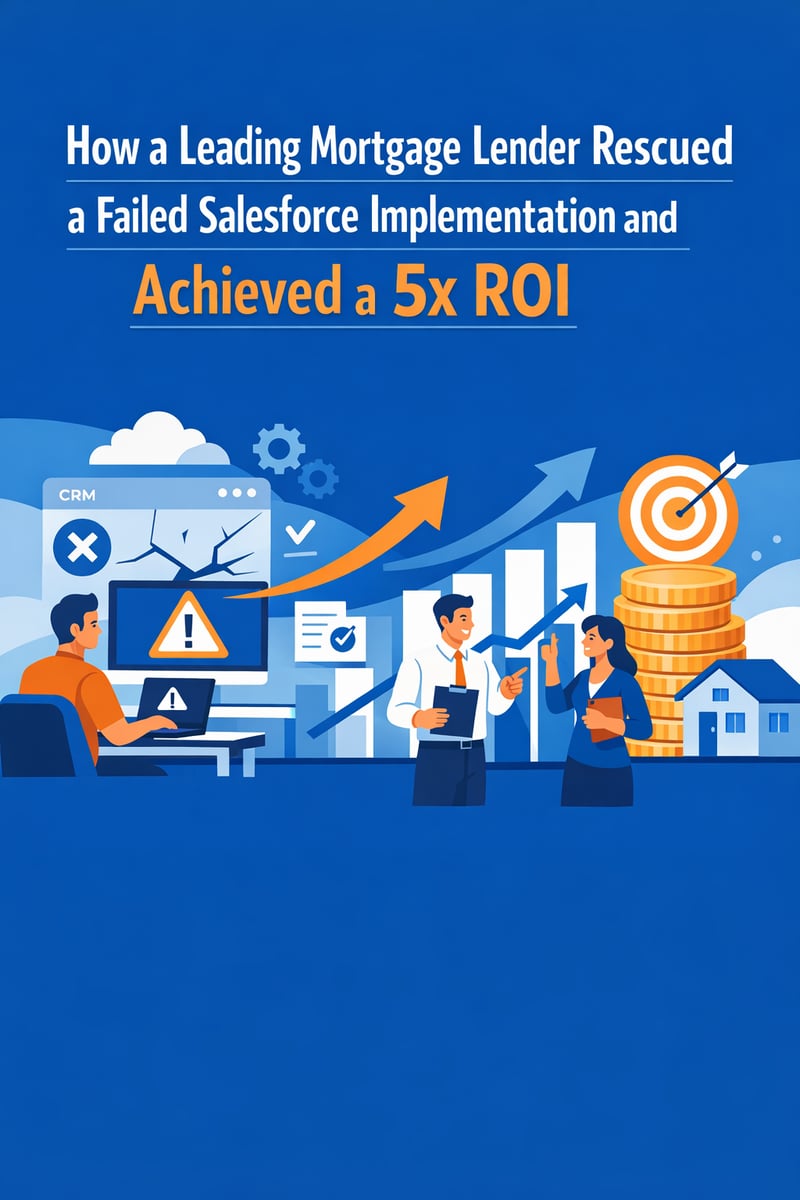
| What is it? | A multi-year Salesforce turnaround for a nationwide mortgage lender — rescuing a failed Financial Services Cloud implementation, integrating critical loan origination and point-of-sale systems, and deploying enterprise marketing automation across multiple brands. |
| Key Benefit | 5x return on investment with a 23% increase in loan production volume, $1,056 more profit per loan, and 3 fewer days to close. |
| Industry | Residential Mortgage Lending / Financial Services |
| Platform | Salesforce Financial Services Cloud, Salesforce Marketing Cloud, Encompass LOS, Blend POS |
| Best For | Mortgage lenders, financial services executives, and CRM leaders evaluating Salesforce implementations — especially those recovering from a failed vendor engagement. |
| Bottom Line | Deep platform specialization and rigorous project governance transformed a broken, siloed tech stack into a unified, automated lending ecosystem that measurably increased profitability and production capacity. |
The Challenge: A Fragmented Tech Stack Crippling a High-Growth Mortgage Operation
A leading independent mortgage lending company, headquartered in San Diego, California, had scaled aggressively from a single local branch into a formidable nationwide enterprise operating 33 physical branches with active lending licenses across 46 states. The firm's leadership team — led by a CEO recognized as a top-producing mortgage originator for six consecutive years — had built a deeply diversified product portfolio spanning conventional conforming loans, FHA, VA, USDA, Jumbo, Home Equity Conversion Mortgages (reverse mortgages), and a significant emphasis on Non-Qualified Mortgage (Non-QM) products including bank statement loans and DSCR programs for real estate investors.
Despite this impressive market reach, the company's technology infrastructure was critically fragmented. Highly compensated loan officers and back-office staff were forced to navigate across completely disparate systems — legacy contact management tools, localized marketing platforms, and isolated origination environments. This generated severe operational bottlenecks, catastrophic manual data entry redundancies, and elevated compliance risk from unsynchronized data. The executive team knew they needed a centralized engagement layer that could synthesize front-end data from their point-of-sale application, route it intelligently through a CRM, and integrate bi-directionally with their core loan processing engine.
The situation worsened dramatically when an initial Salesforce implementation — awarded to a local vendor chosen primarily for geographic proximity — failed comprehensively. Within a year, forensic analysis revealed that the vendor had failed to install core Financial Services Cloud managed packages and had entirely neglected to configure Person Accounts, a fundamental architectural requirement for any B2C lending operation within Salesforce. Without Person Accounts, individual borrowers were being treated as corporate entities, breaking the CRM's logic, marketing synchronization, and downstream integration capabilities. The lender's Salesforce environment was formally designated a "Red Account" — an industry term for an implementation that is actively failing and at immediate risk of total platform abandonment.
The Solution: A Comprehensive System Rescue and Digital Transformation
Facing a broken system and a deeply frustrated user base, the lender re-engaged with Vantage Point — the specialized consulting partner they had initially passed over. Brought back in under the critical "Red Account" designation by senior Salesforce account executives, Vantage Point initiated deep technical discovery, conducting an intensive current-state assessment directly inside the compromised environment. Using specialized diagnostic tools, the team captured a comprehensive library of system flaws, data model misalignments, missing logic flows, and integration failures.
The diagnostic audit revealed a deeply siloed ecosystem: the company was using Pipedrive for top-of-funnel lead management and pipeline visualization while simultaneously attempting to leverage a fundamentally broken Salesforce instance for downstream CRM and marketing. Vantage Point's architects recommended full consolidation into Salesforce, but the executive team — understandably cautious after the financial and emotional toll of the failed implementation — elected to first optimize the existing multi-system architecture. The rescue was therefore scoped around two parallel workstreams: optimizing the existing Financial Services Cloud environment while simultaneously implementing Salesforce Marketing Cloud from the ground up.
Navigating the Strategic Impasse
Within the first month, the true extent of the hidden technical debt became apparent, and the client's leadership simultaneously shifted their strategic vision — deciding to entirely remove Pipedrive and migrate all lead tracking into Salesforce. This represented a massive unauthorized scope expansion. When attempts to accommodate the change within original parameters proved unsustainable, Vantage Point's leadership made a bold and decisive move: they formally withdrew from the engagement and refunded unallocated funds.
This calculated reset forced a critical strategic realignment. Within weeks, the project was reinstated under new, mutually agreed-upon parameters with a formally executed change order addressing the comprehensive implementation requirements. The willingness to walk away — rather than deliver a compromised build — ultimately saved the entire project.
Financial Services Cloud Optimization
With boundaries firmly re-established, the technical team commenced a rigorous rebuild of the mortgage lending ecosystem. The foundational work included:
- Person Account Configuration: The previous vendor's failure was immediately corrected, properly aligning the data model with the reality that mortgage lenders transact with individual consumers, not corporate hierarchies.
- Relationship Mapping and Dynamic Roles: The environment was configured to track complex, multi-party borrower profiles — primary borrowers, co-borrowers, financial guarantors, and referring real estate agents — giving loan officers a true 360-degree view of each transaction.
- Activity and Pipeline Management: Standard Salesforce Events and Tasks were restructured and automated to align with the time-sensitive follow-up requirements critical to mortgage lead conversion.
- Data Architecture and UI Enhancement: The team extended standard and custom fields, deployed advanced validation rules, and streamlined page layouts using dynamic Lightning Record Pages, significantly reducing cognitive load on loan officers and driving immediate user adoption.
Complex Third-Party Ecosystem Integrations
The CRM had to achieve flawless connectivity across a critical triad of systems: the digital Point of Sale (POS), the CRM itself, and the backend Loan Origination System (LOS).
Blend POS Integration: Blend served as the consumer-facing digital intake mechanism, providing a mobile-first application experience for prospective borrowers. The team optimized the Salesforce AppExchange integration to ensure frictionless, automated transition from lead capture to application. Loan officers could dispatch personalized, pre-filled loan applications directly from Salesforce with a single click, leveraging demographic and financial data already in the CRM to auto-populate forms. Bi-directional data synchronization enabled the sales team to monitor real-time application statuses and trigger automated follow-up sequences for borrowers who abandoned the application mid-stream.
Encompass LOS Integration: The most technically demanding aspect of the entire implementation was the bi-directional integration between Salesforce and the Encompass loan origination system — the core pricing, underwriting, and processing engine. The objective was to enable automated transfer of borrower and loan data from Salesforce into Encompass without manual re-entry, while simultaneously reflecting back-office processing milestones back into Salesforce to trigger downstream marketing communications and real-time status updates. This synchronization was facilitated through a specialized third-party middleware connector. The team encountered a profound lack of documentation from previous administrators, facing a total "black box" scenario that required painstaking reverse-engineering of undocumented code. Through rigorous change management — including mandatory "show and tell" sessions and formally executed change orders — the integration was ultimately delivered as a fully functioning, stable data bridge between the CRM and the LOS.
Enterprise Marketing Automation: Marketing Cloud Deployment
Running concurrently with CRM stabilization, Vantage Point executed a ground-up implementation of Salesforce Marketing Cloud (Corporate Edition) to replace static, localized email workflows with dynamic, data-driven customer journeys.
Foundational Configuration: The deployment included rigorous setup of user profiles, security access protocols, and specialized SSL certificates for secure transmission of sensitive consumer financial data. Marketing Cloud Connect was used to natively bridge Sales Cloud and Marketing Cloud, with Contact Builder ensuring real-time synchronization of borrower demographic data and communications history.
Dynamic Content and Journey Construction: The team translated the lender's legacy campaigns — previously reliant on rudimentary workflows and hard-coded email templates — into sophisticated, dynamic Marketing Cloud assets. Using Content Builder, the team created reusable templates that automatically pulled personalized data points (loan amounts, closing dates, loan officer contact details) from integrated Loan objects in real-time. These were deployed within Journey Builder to orchestrate personalized, multi-channel journeys across the loan lifecycle. For example, when an underwriter updated a loan to "Clear to Close" status in Encompass, that data flowed through the middleware into Salesforce, which instantly triggered a congratulatory notification to both the borrower and the referring real estate agent — entirely without manual intervention.
Multi-Brand Marketing Matrix: A particularly complex requirement was the company's need to operate multiple distinct consumer brands under a single corporate umbrella. The team successfully configured domain verification, sender authentication packages, dedicated IP address reputation management, and unique sender profiles across the entire multi-brand matrix — enabling high-volume automated marketing sends for each brand while centralizing all operations, database management, and analytics within a single Marketing Cloud instance.
The Results: Measurable Operational and Financial Transformation
The transformation delivered quantifiable, industry-benchmark results that validated the entire turnaround effort:
| Performance Metric | Outcome | Impact |
|---|---|---|
| Gross Profit Margin | +$1,056 per loan | Profitability increased by over one thousand dollars per originated loan due to decreased operational friction, fewer manual errors, and automated processing. |
| Loan Production Volume | +23% expansion | Aggregate loan production volume grew by nearly a quarter without requiring proportional increases in backend staffing headcount. |
| Average Cycle Time | 3-day reduction | Bi-directional data flow across CRM, POS, and LOS accelerated underwriting and processing, shaving three full days off the average time to close. |
| Capital Efficiency | 5x ROI | The transformation generated a verified five-fold return on the total investment required. |
| Marketing Velocity | 75 days to live | The organization progressed from total system rescue to executing live, multi-brand automated campaigns in just two and a half months. |
The client's internal leadership explicitly stated they were "very happy with the development that has taken place" and acknowledged the organization "would not be where we are at today" without the work delivered. The engagement was described as a "very efficient ship."
Following the intensive build phase, the relationship naturally transitioned to a flexible Managed Services retainer model — allowing the lender to manage ongoing optimizations, system enhancements, and data synchronization tasks without rigid long-term commitments, perfectly aligning technology support with the unpredictable revenue cycles of the mortgage industry.
Key Technologies and Integrations
- Salesforce Financial Services Cloud (FSC) — Core CRM platform with Person Accounts, relationship mapping, and dynamic Lightning Record Pages
- Salesforce Marketing Cloud (Corporate Edition) — Enterprise marketing automation with Contact Builder, Content Builder, and Journey Builder
- Marketing Cloud Connect — Cross-cloud bridge between Sales Cloud and Marketing Cloud
- Ellie Mae Encompass — Core Loan Origination System (LOS) for pricing, underwriting, and processing
- Blend — Consumer-facing digital Point of Sale (POS) platform with Salesforce AppExchange integration
- KensieMae Middleware — Specialized connector enabling bi-directional Salesforce-Encompass data synchronization
- Pipedrive — Legacy CRM (migrated to Salesforce during the engagement)
- Office 365 — Productivity suite integration
- SSL Certificates and Sender Authentication — Compliance infrastructure for secure multi-brand email operations
- Dynamic Lightning Record Pages — Customized UI reducing loan officer cognitive load
- Person Accounts — B2C data architecture enabling individual borrower tracking
Why It Matters: Lessons for Mortgage and Financial Services Organizations
This engagement underscores a principle that resonates across the financial services industry: platform specialization matters far more than geographic convenience when selecting a technology partner. The initial vendor's failure to configure foundational elements like Person Accounts and FSC managed packages — basic requirements for any B2C lending operation — cost the organization a full year and created exponentially more technical debt than building correctly from the start. For mortgage lenders evaluating Salesforce implementations, deep domain expertise in financial services data architectures is non-negotiable.
The turnaround also demonstrates the critical importance of rigorous project governance and boundary management in complex, multi-system environments. Mortgage technology stacks are inherently intricate, involving real-time integrations between POS, CRM, and LOS platforms that must handle sensitive consumer data under strict regulatory requirements. When legacy middleware presents undocumented "black box" architectures, disciplined change management — not scope concessions — is the only path to a successful outcome.
Finally, the story highlights how macroeconomic volatility and internal organizational stability directly impact technology adoption. The lender's pragmatic pivot to a flexible managed services model during the 2022 interest rate shock — and the subsequent challenges of an SMS marketing initiative stalled by internal personnel turnover — illustrate that technological readiness can never supersede organizational readiness. Successful digital transformation in mortgage lending requires not just elite technical execution, but stable internal administration and a willingness to adapt support models to market conditions.
Frequently Asked Questions
What is Salesforce Financial Services Cloud, and why is it critical for mortgage lenders?
Salesforce Financial Services Cloud (FSC) is an industry-specific CRM platform built on the core Salesforce architecture, designed to serve the unique needs of financial services organizations. For mortgage lenders, FSC provides critical capabilities including Person Accounts (enabling B2C borrower tracking), multi-party relationship mapping (borrowers, co-borrowers, agents), and configurable loan pipeline management. When properly implemented, it serves as the centralized engagement layer connecting point-of-sale applications, loan origination systems, and marketing automation.
Why did the initial Salesforce implementation fail, and how was it rescued?
The initial implementation failed because the selected vendor lacked deep, specialized expertise in Salesforce Financial Services Cloud and mortgage-specific data architectures. Critical elements — including FSC managed packages and Person Accounts — were never properly configured. Vantage Point was brought in as a turnaround partner, conducted a comprehensive forensic audit, and executed a dual-workstream rescue: stabilizing and optimizing the Financial Services Cloud environment while simultaneously building Salesforce Marketing Cloud from the ground up. Rigorous project governance and boundary enforcement were key to the successful recovery.
What kind of ROI can mortgage lenders expect from a Salesforce transformation?
Results vary based on organizational complexity, but this engagement achieved a verified 5x return on investment. Specific outcomes included a $1,056 increase in profit per loan, 23% growth in loan production volume without additional staffing, and a 3-day reduction in average time to close. These gains were driven primarily by eliminating manual data entry, automating bi-directional data flows between CRM, POS, and LOS systems, and deploying data-driven marketing automation.
How should mortgage lenders approach selecting a Salesforce implementation partner?
Prioritize deep, demonstrated expertise in financial services data architectures — particularly Salesforce Financial Services Cloud, Person Accounts, and integrations with mortgage-specific platforms like Encompass and Blend. Geographic proximity should not outweigh platform specialization. Look for partners with experience in regulated industries who understand compliance requirements, multi-system integrations, and the unique workflows of residential mortgage origination. Contact Vantage Point to discuss your specific requirements.
Ready to Transform Your Mortgage Lending Operations?
Vantage Point specializes in Salesforce and HubSpot implementations for regulated industries — from financial services and healthcare to insurance and fintech. With 150+ clients, 400+ engagements, and a senior-only team of US-based consultants, we bring deep expertise to every project.
Contact Vantage Point to discuss your digital transformation journey.
A leading independent mortgage lending company is one of many organizations that have partnered with Vantage Point to modernize their operations. Names and identifying details have been changed to protect client confidentiality.