TL;DR / Key Takeaways
| What is it? | A multi-phase Salesforce implementation that replaced a proprietary legacy CRM, unified 12+ integrations, and automated complex commission calculations for a high-volume life insurance brokerage. |
| Key Benefit | Monthly financial close cycle reduced from 10 days to 5 days, with 40 man-hours saved per department per month through commission automation alone. |
| Industry | Life Insurance Distribution / Brokerage |
| Platform | Salesforce Sales Cloud Enterprise Edition, Flow Builder, Lightning Web Components, Apex, Custom Objects |
| Best For | Insurance distribution leaders, CIOs, and operations executives evaluating CRM modernization, legacy system migration, or commission automation strategies. |
| Bottom Line | By centralizing data, automating actuarial commission logic, and integrating an omnichannel tech stack into a single Salesforce ecosystem, this organization eliminated "swivel chair" workflows and gained real-time financial intelligence previously unattainable in its legacy environment. |
The Challenge: A Fragmented Legacy System Holding Back a High-Velocity Brokerage
A national digital-first life insurance distribution company — operating multiple call centers across the United States with licensed agents connecting thousands of consumers to top-rated insurance carriers — had reached the limits of its proprietary technology infrastructure. The organization functioned as a critical distribution channel within the broader life insurance ecosystem, partnering with external carriers to expand life insurance access while also maintaining tight integration with an affiliated life insurance carrier under a shared corporate holding structure.
For years, the company's operations ran on a homegrown customer relationship management and policy tracking system known internally as its "Automated Life Insurance Sales System." While this proprietary platform had served the organization through earlier growth phases, the limitations inherent to monolithic legacy architectures were becoming increasingly painful. The technological environment had grown deeply fragmented, requiring agents and operational staff to navigate disjointed "swivel chair" workflows — toggling between disparate systems for marketing automation, telephony, quoting, medical exam ordering, and financial reconciliation.
The consequences were measurable. Commission calculations — an immensely complex actuarial exercise in life insurance, dependent on carrier-specific contracts, product variations, agent tenure, policyholder persistency, and tiered performance bonuses — were being managed through vulnerable, manual Excel spreadsheet reconciliations. Monthly financial close cycles stretched to 10 days. Executive leadership lacked the granular reporting needed for data-driven strategic planning, with limited real-time visibility into carrier performance, agent production metrics, or cash flow dynamics like commission clawbacks and accounts receivable aging. The organization recognized that sustained market leadership required a fundamentally more agile and interconnected infrastructure.
The Solution: A Phased Salesforce Transformation — From Foundation to Financial Automation
Working with Vantage Point, the organization architected a comprehensive digital transformation designed to deprecate its legacy system entirely and establish Salesforce as the centralized, authoritative system of record. Given the enterprise scale and operational sensitivity of the initiative, a "big bang" deployment was deemed an unacceptable risk to business continuity. Instead, the implementation was structured using a phased agile delivery methodology — segmented into distinct, iterative phases with three-week sprint cycles to maintain velocity and ensure constant alignment with stakeholder expectations.
Through collaborative discovery sessions, executive stakeholders defined five core business objectives that would serve as definitive success criteria: (1) centralization of all sales, marketing, and operational data into a single source of truth; (2) comprehensive omnichannel workflow automation to eliminate manual data entry and operational latency; (3) absolute commission accuracy through a sophisticated computational engine; (4) advanced, granular reporting with real-time visibility into carrier performance and agent production; and (5) precise cash flow and accounts receivable management capable of tracking complex insurance mechanisms like commission clawbacks and tiered incentive compensation.
Phase 1: Foundational CRM Architecture and Legacy System Deprecation
The first phase represented the critical nexus of the modernization effort, tasked with safely transitioning the entirety of the company's marketing, sales, and operational teams off the legacy system. Built on Salesforce Sales Cloud Enterprise Edition, the foundational architecture included:
- Customized Opportunity Sales Processes engineered to align precisely with the company's life insurance conversion methodologies, with Validation Rules mandating the capture of critical data (Close Dates, Financial Amounts) before opportunities could advance to subsequent pipeline stages.
- Automated Lead Conversion using exact Lead Mapping to ensure all proprietary custom fields transitioned seamlessly to Account, Contact, and Opportunity records. Salesforce Flow Builder powered an "Automation Engine" that immediately notified account owners upon conversion, drastically reducing lead decay and accelerating time-to-contact.
- Account Hierarchies to accommodate multi-entity corporate clients and specialized B2B carrier relationships, providing executive leadership a comprehensive "Global View" of total relationship value across all associated entities.
- A rigorous Private Sharing Model for all Opportunity records, augmented by a complex Role Hierarchy and highly specific Permission Sets — granting Finance and Operations managers the exact elevated access required without altering the broader security profiles.
- Custom Reports and Dynamic Dashboards including Pipeline Trend Reports, Win/Loss Analysis Dashboards, and real-time sales performance visibility.
- External ID fields embedded across Account and Opportunity objects to map directly to legacy system identifiers, ensuring absolute data integrity during subsequent ERP and policy administration integrations.
Ecosystem Connectivity: Integrating 12+ Business Applications
A defining characteristic of Phase 1 was the orchestration of a vast ecosystem of third-party applications, transforming Salesforce from a standalone CRM into an interconnected central hub. Approximately twelve distinct business applications were integrated:
- Data Migration from Legacy System: Highly complex ETL (Extraction, Transformation, and Loading) protocols were executed using Alteryx to systematically extract historical policy data, client records, and operational metadata, cleanse the information, and securely load it into the new Salesforce architecture.
- Identity Management — Okta: Configured for enterprise-wide Single Sign-On (SSO) using SAML and SWA protocols, ensuring rigorous access compliance while minimizing login friction for rapidly moving call-center staff.
- Computer Telephony Integration — Genesys Cloud: Deeply embedded into the Salesforce interface, providing native click-to-dial functionality, automated call logging, and sophisticated inbound routing — eliminating the need for agents to toggle between independent telephony hardware and their client database, vastly increasing daily call volume capacity.
- Marketing Automation — Marketo: A bidirectional sync ensuring top-of-funnel lead nurturing campaigns, email engagements, and marketing communications were seamlessly visible to the sales team, aligning marketing expenditure directly with sales outcomes.
- ACORD Feed Integration: Establishing compliance with the global standard for insurance data exchange.
- iGo Integration: Facilitating electronic application software processing.
- PSG (Paperless Solutions Group): Complex callouts, response parsing, and redirects within Salesforce to manage eQuoting and intricate eApplication logic.
- Medical Exam Ordering: Direct integrations for ordering and resulting data feeds.
- FLASH and FLEX: Integrations preserving highly specialized proprietary internal workflows within the new cloud environment.
Sprints 1 through 4 delivered the foundational CRM configuration, user administration, the Marketo sync, Genesys telephony, and ACORD feeds within the first several months, culminating in the commencement of comprehensive data migration. The foundational phase achieved formal executive sign-off for UAT, followed by a coordinated "soft go-live" into the production environment — with all residual data imports finalized shortly thereafter.
Phase 2: Advanced Financial Record Management and Portfolio Visibility
With the foundational CRM and core integrations operational, the deployment advanced into an optimization phase focused on financial data ingestion, automated transaction categorization, and comprehensive portfolio visibility. The standard Salesforce data model is inherently insufficient for tracking continuous financial transactions, so the engineering team deployed a sophisticated custom architectural framework:
- Custom Objects — specifically Financial Accounts, Transactions, and Portfolios — intricately linked using Master-Detail relationships to enable automated roll-up summaries, instantly calculating aggregate values from child transaction records up to the parent financial account level without manual reconciliation.
- Automated Transaction Categorization via a record-triggered Salesforce Flow that evaluated transaction text descriptions and referenced a Custom Metadata Type housing an extensive library of mapping rules and keywords. By using Custom Metadata rather than hard-coded Apex, administrators could continuously update categorization keywords without developer intervention — ensuring long-term sustainability.
- A Custom Lightning Web Component (LWC) rendering a highly visual, interactive "Portfolio Health" dashboard directly on the Client Page Layout — eliminating the need for advisors to navigate complex related lists to understand a client's financial standing.
- Secure Nightly Data Ingestion using Named Credentials and External Services to manage complex OAuth 2.0 authentication protocols with external banking endpoints. Scheduled Apex Jobs ran during off-peak hours, automatically fetching external JSON payloads, parsing data, and generating corresponding transaction records within Salesforce.
- Immutable Audit Trail with Field History Tracking on all high-sensitivity fields and a Custom Audit Log object triggered by Apex code, capturing detailed "before" and "after" state snapshots of any critical financial adjustments for compliance officers and external regulatory auditors.
- Automated Real-Time Alerting via Flow Builder — if a client's account balance dropped below customized thresholds, the system automatically triggered email alerts and in-app notifications for proactive advisor action.
The Commission Management System: Automating Actuarial Logic at Scale
The most mathematically intricate and operationally sensitive component of the entire transformation was the custom-built Commission Management System (CMS). In life insurance, commission calculation is dependent on deeply specific carrier contracts, distinct product types, tiered agent hierarchies, production bonuses, and post-sale metrics such as policyholder persistency. The organization required a robust, automated engine that could execute these calculations flawlessly while maintaining rigorous financial auditing controls.
The CMS was architected on Salesforce Sales Cloud Enterprise Edition with extensive custom Apex development. Key capabilities included:
- Dynamic Commission Rate Calculation for every individual carrier and product combination, factoring in multi-tiered escalations, performance multipliers, and bespoke agent-level production bonuses.
- Hierarchical Downline Tracking — calculating payout rates by specific agent and carrier across complex organizational structures.
- Persistency and Clawback Management — meticulous tracking of cash collections and systematic processing of chargebacks when policies lapsed prematurely, including an advanced 18-month experience view for chargeback analysis. This empowered financial analysts to accurately model organizational chargeback exposure and evaluate individual agent chargeback performance over extended periods.
- Comprehensive Accounts Receivable Management — generating total AR balance and aging reports segmented by carrier and application status, enabling continuous comparison of expected versus actual cash receipts and tracking revenue recognition independent of cash collection at the individual policy level.
- Automated KPI Reporting — seamlessly tracking agent productivity, application-to-policy conversion rates, average premium sizes, and net revenue generated per policy per month.
- Policy Administration Integration — a robust, two-way, near real-time integration with the organization's core Life and Health Policy Administration platform, utilizing custom Apex code to synchronize policy data with Salesforce Account and Opportunity objects, ensuring all commission calculations were executed against the most current, authoritative policy statuses.
- HCM/Payroll Integration — a dedicated interface with the organization's Human Capital Management platform to automate downstream communication of commission payments directly into the corporate payroll system.
The CMS underwent rigorous parallel processing UAT — processing complete months of financial data through the new Salesforce engine and directly auditing outputs against historical calculations from the legacy Excel models and proprietary system. This parallel structure ensured absolute mathematical parity before production deployment.
The Results: From 10-Day Close Cycles to Real-Time Financial Intelligence
The initiative delivered substantial, quantifiable business value, successfully transitioning the organization from a fragmented technological state to a highly modernized, automated operational posture.
The most significant operational outcomes included:
- Complete legacy system deprecation — Salesforce became the singular, authoritative engagement layer, eliminating the "swivel chair" inefficiencies that had previously degraded agent performance and lengthened call times.
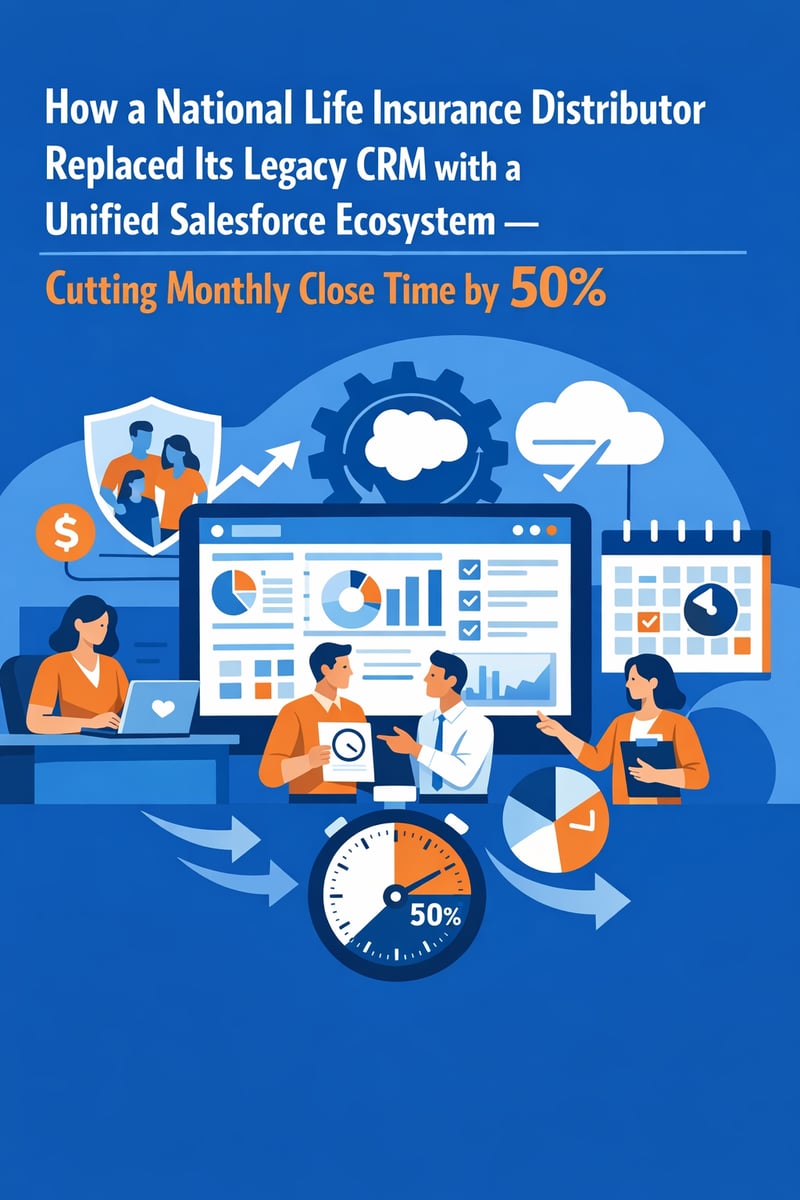
- Monthly financial close cycle reduced from 10 days to 5 days — a 50% reduction powered by the Commission Management System's automated actuarial calculations.
- 40 man-hours saved per month per department — by eliminating reliance on manual Excel spreadsheet reconciliations and legacy system calculations.
- Thousands of manual clicks removed from daily workflows — through automated record type flipping for specific insurance products and implementation of Express Written Consent (EWC) automation flags natively within Salesforce.
- Pristine data foundation established — extensive data remediation during migration resolved historical "bad data" issues, enabling accurate, real-time organizational reporting.
- Automated production milestone alerting — the system now actively triggers alerts when specific thresholds (such as achieving $1M in placed policies) are met, providing executive management with unprecedented visibility into operational performance.
- Real-time financial intelligence — granular tracking of commission calculations, payment reconciliations, and cash flow dynamics that was simply unattainable in the legacy environment.
The outcomes align with broader industry benchmarks for comparable financial services Salesforce deployments, which typically deliver a payback period within 12 to 18 months, with first-year ROI ranging from 147% to over 361%, driven by 40%+ faster account processing times and 50% reductions in administrative tasks.
As the primary consulting engagement concluded, a comprehensive knowledge transfer was executed to the organization's internal administration team, supported by a centralized technical repository in Atlassian Confluence that exhaustively documented architectural logic flows, custom Apex classes, eQuoting engine mechanisms, and eApplication integration architecture — ensuring long-term platform sustainability and autonomous internal enhancement capability. The robust, unified data foundation also uniquely positions the organization to leverage future artificial intelligence capabilities, such as Salesforce Agentforce, which rely entirely on clean, unified data ecosystems to function autonomously.
Key Technologies and Integrations
- Salesforce Sales Cloud Enterprise Edition — Core CRM platform
- Salesforce Flow Builder — Automation engine, transaction categorization, real-time alerting
- Lightning Web Components (LWC) — Custom Portfolio Health dashboard
- Apex (Custom Development) — Commission logic, policy administration sync, audit logging
- Custom Objects — Financial Accounts, Transactions, Portfolios, Custom Audit Log
- Custom Metadata Types — Configurable transaction categorization rules
- Named Credentials & External Services — Secure OAuth 2.0 external data ingestion
- Scheduled Apex Jobs — Nightly financial data synchronization
- Roll-Up Summary Fields & Master-Detail Relationships — Automated financial aggregation
- Field History Tracking — Regulatory audit compliance
- Alteryx — ETL data migration from legacy system
- Okta — Enterprise SSO (SAML/SWA)
- Genesys Cloud — Computer Telephony Integration (CTI)
- Marketo — Bidirectional marketing automation sync
- ACORD Feed — Insurance industry data exchange standard
- iGo — Electronic application processing
- PSG (Paperless Solutions Group) — eQuoting and eApplication logic
- Concentrix / Policy Administration Platform — Two-way near real-time policy data sync
- Ultimate Software (HCM) — Payroll and commission payment automation
- Medical Exam Ordering Integration — Data feeds for underwriting
- Atlassian Confluence — Centralized technical documentation
- Jira — Agile project management and issue tracking
Why It Matters: Lessons for Life Insurance and Financial Services Organizations
This transformation offers a powerful blueprint for any insurance distribution organization still relying on proprietary, monolithic legacy systems. The life insurance brokerage industry operates under extraordinary complexity — intricate regulatory requirements, variable commission structures tied to actuarial logic, high-velocity lead processing, and the need for seamless omnichannel connectivity between marketing, telephony, quoting, and policy administration. The lesson here is clear: piecemeal upgrades to legacy infrastructure eventually reach a point of diminishing returns. True operational transformation requires a unified, cloud-native platform strategy.
The phased agile approach is equally instructive. Rather than risking business continuity with a single massive deployment, the iterative methodology allowed the organization to deliver continuous business value while isolating technical complexities within manageable sprint cycles. The rigorous parallel testing protocol for the Commission Management System — processing complete months of live financial data through both old and new systems simultaneously — provides a model for any organization where automated financial calculations carry material risk. In life insurance, where a single commission miscalculation can cascade across carrier reconciliations, agent compensation, and regulatory reporting, this level of validation is not optional.
Finally, the emphasis on knowledge transfer and internal enablement deserves attention. Too many digital transformations create long-term dependency on external consultants. By dedicating a full sprint to comprehensive technical handoff, creating exhaustive Confluence documentation, and empowering an internal "Center of Excellence" team, this organization ensured it could autonomously manage, maintain, and iteratively enhance its Salesforce platform long after the consulting engagement concluded. For CIOs evaluating similar initiatives, this is a critical success factor — the platform must be sustainable, not just functional.
Frequently Asked Questions
How does Salesforce handle the complexity of life insurance commission calculations?
Salesforce Sales Cloud, combined with extensive custom Apex development, can model the full spectrum of life insurance commission logic — including carrier-specific rates, multi-tiered escalations, performance multipliers, agent tenure bonuses, hierarchical downline payouts, and persistency-based clawbacks. By building commission rules as configurable data (using Custom Objects and Custom Metadata Types) rather than hard-coded logic, the system remains adaptable as carrier contracts and compensation structures evolve.
What does it take to migrate off a proprietary legacy CRM in the insurance industry?
Legacy system deprecation in insurance requires meticulous ETL (Extraction, Transformation, and Loading) protocols — in this case powered by Alteryx — to extract historical policy data, client records, and operational metadata, cleanse it, and load it into Salesforce. External ID fields mapped to legacy identifiers ensure data integrity. Equally important is a parallel testing phase where the new system's outputs are audited against legacy calculations to confirm mathematical parity before the old system is decommissioned.
What kind of results can insurance organizations expect from a Salesforce modernization?
This organization achieved a 50% reduction in monthly financial close time (from 10 days to 5), saved 40 man-hours per month per department in commission processing alone, and eliminated thousands of manual clicks from daily agent workflows. Broader industry benchmarks for comparable financial services Salesforce deployments show 40%+ faster account processing and 50% reductions in administrative tasks, with typical payback periods of 12–18 months.
How do you ensure a Salesforce implementation is sustainable after the consulting engagement ends?
Sustainability requires deliberate investment in knowledge transfer. In this engagement, a dedicated sprint was allocated for comprehensive technical handoff to an internal administration team. A centralized Confluence documentation repository covered all architectural logic flows, custom Apex classes, and integration mechanisms. This "Center of Excellence" model ensures the organization can autonomously manage and enhance the platform without ongoing external dependency.
Ready to Transform Your Insurance Operations?
Vantage Point specializes in Salesforce and HubSpot implementations for regulated industries — from financial services and healthcare to insurance and fintech. With 150+ clients, 400+ engagements, and a senior-only team of US-based consultants, we bring deep expertise to every project.
Contact Vantage Point to discuss your digital transformation journey.
A national digital-first life insurance distribution company is one of many organizations that have partnered with Vantage Point to modernize their operations. Names and identifying details have been changed to protect client confidentiality.