TL;DR / Key Takeaways
| What is it? | A multi-phase Salesforce digital transformation that migrated a 250+ employee debt resolution firm from fragmented legacy systems to a unified, cloud-native engagement platform |
| Key Benefit | Unified Sales, Service, and Settlements operations onto a single platform within 90 days — breaking down a decade of informational silos and eliminating manual "swivel-chair" workflows |
| Industry | Debt Resolution / Financial Services |
| Platform | Salesforce Sales Cloud, Service Cloud (Unlimited Edition), Salesforce Shield, Salesforce Connect, Experience Cloud (Customer Community), 12+ third-party integrations |
| Best For | Financial services leaders, debt settlement/resolution executives, CRM architects, and operations teams evaluating enterprise Salesforce implementations in regulated industries |
| Bottom Line | A phased Salesforce rollout transformed a legacy-dependent debt resolution firm into a data-driven, fully integrated enterprise — onboarding 150+ users across three departments and automating financial workflows end-to-end |
The Challenge: Decade-Old Systems Strangling a Growing Enterprise
A leading debt resolution and financial services company with over 250 employees had reached an inflection point. The US-based firm — operating in the highly regulated debt settlement industry — had outgrown its legacy technology infrastructure. The organization's operational landscape was defined by fragmented, decade-old systems that created deep informational silos across departments.
The debt settlement industry demands seamless management of complex, long-term customer lifecycles. A single client journey spans initial lead acquisition and nurturing, credit assessment, highly regulated enrollment procedures, establishment of dedicated escrow accounts, and years of ongoing creditor negotiations and payment disbursements. Managing this lifecycle requires robust, unified technology — and the company's existing stack was falling critically short.
The Sales team had been partially transitioned onto Salesforce, but the Customer Service and Negotiations/Settlements teams remained on QuickBase, a legacy relational database platform. This fragmentation created crippling operational inefficiencies: associates were trapped in "swivel-chair" workflows, constantly toggling between the CRM, the payment processor's portal, telephony applications, and document management systems just to service a single account. Average handle times ballooned, compliance risks multiplied with every manual data entry across disconnected systems, and executive leadership was left without actionable, cross-functional analytics. True data-driven decision-making was impossible without expensive, manual data consolidation efforts.
The mandate was clear: the organization needed a single "engagement layer" — one undisputed system of record providing a 360-degree view of every client while programmatically routing data to and from specialized backend systems.
The Solution: A Phased Salesforce Transformation Built Around Financial Automation
Vantage Point was engaged to architect and execute a comprehensive digital transformation. Given the operational risk of migrating an entire enterprise off legacy systems simultaneously, Vantage Point modeled two distinct deployment strategies: a unified "big bang" rollout versus a phased approach. The comparative analysis revealed a critical tradeoff — the phased methodology required additional effort due to interim integrations between Salesforce and the legacy QuickBase environment, but it dramatically reduced the risk of enterprise-wide operational paralysis.
The organization selected the phased approach. Phase 1 targeted the Sales/Enrollment and Customer Service divisions, while Phase 2 focused on the highly complex Negotiations and Settlements operations. The strategic rationale was sound: by successfully transitioning the 60-user Service Team first, the company would secure a quick, visible win — demonstrating the platform's value and easing the change management burden for the 90+ users in the Settlements division.
The Core Architecture: Salesforce Sales & Service Cloud
The foundational platform was built on Salesforce Sales and Service Cloud (Unlimited Edition), augmented with Salesforce Shield — encompassing Platform Encryption, Event Monitoring, and Field Audit Trail — to meet the stringent security and compliance requirements of the financial services industry. Salesforce Experience Cloud (Customer Community) licenses were also deployed to replace the organization's existing client portal, providing a modern, branded digital experience.
The Financial Engine: Deep Payment Processor Integration
The crown jewel of the entire architecture was the deep integration with the organization's dedicated payment processor — the entity responsible for facilitating escrow, drafting, and disbursement of all client funds. This integration was so central to the project that it consumed approximately 40% of the Phase 1 design and configuration effort and 60–65% of Phase 2 build and testing work.
The architectural design delivered four critical capabilities:
- Real-Time Financial Telemetry: Customer service agents gained immediate, real-time visibility into transactions and historical balances — surfaced dynamically on Salesforce Contact and Opportunity records. Agents could verify draft clearances and demonstrate account activity while on live calls with clients.
- Automated Account Provisioning: The enrollment process was re-architected so that upon successful execution of an enrollment agreement, a new dedicated account was programmatically established at the payment processor, transferring all required KYC data without manual intervention.
- Dynamic Transaction Management: Agents could schedule program drafts, initiate ad-hoc payments, and manage account modifications entirely within native Salesforce components. The automated "Draft API" handled precise withdrawal scheduling when settlement programs were established.
- Asynchronous Reconciliation: A robust batch processing framework executes hourly, polling the payment processor's servers to monitor for new account setups, status updates, payment rescissions, and chargebacks — immediately synchronizing the latest state back into the Salesforce database.
Identity Verification, Credit Assessment, and Compliance Automation
In an industry heavily scrutinized by regulators, the architecture embedded automated compliance mechanisms directly into the CRM workflow:
- Bank Account Validation was implemented via the Giact gVERIFY API, performing real-time routing and account number checks during enrollment — dramatically reducing failed drafts and return fees.
- Know Your Customer (KYC) Compliance was addressed through LexisNexis Risk Investigations (via the AppExchange), providing sales representatives with immediate pass/fail identity verification feedback natively within the lead conversion process.
- Credit Assessment was powered by the Experian Connect API, ingesting consumer credit scores and detailed tradeline reports directly into Salesforce. A failover redundancy integration via an Equifax reseller ensured the enrollment pipeline remained operational even during primary provider downtime.
- TCPA Compliance was enforced through the NICE inContact integration — when a Salesforce user toggled the Do Not Contact (DNC) flag, the inContact Admin API instantly added the consumer to the suppression list.
Omnichannel Telephony and Contact Center Modernization
A mission-critical Phase 1 component was the deep integration of NICE inContact's CXone Omnichannel CTI/IVR/Dialer solution. This required granular engineering to ensure every inbound and outbound interaction was perfectly logged against the correct relational data model in Salesforce — associating Task records with both the Person Account (Contact) and the corresponding Opportunity. Quality assurance managers gained the ability to audit call recordings directly from the CRM via dynamic hyperlinks stored within the native Contact Report.
Marketing Automation and Lead Management Ecosystem
The unified platform extended its reach across the entire acquisition and nurturing funnel:
- ActiveProspect (LeadConduit) captured and routed real-time lead data from digital channels into Salesforce.
- A third-party contact center partner handled early-stage, high-volume lead nurturing via a bi-directional API integration — cold leads were automatically dispatched, and warm transfers of interested prospects were programmatically passed back into Salesforce with dynamic Lead status updates.
- Acoustic and HubSpot integrations orchestrated complex, multi-touch email campaigns with granular engagement metrics (opens, clicks, bounces) fully visible to the sales organization.
- Twilio powered standard transactional SMS messaging, while Drips delivered conversational, AI-driven text messaging capabilities for scaled prospect engagement.
- DocuSign captured legally binding authorizations, architecturally aligned with payment processor workflows to ensure compliance and execution synchronization.
Data Warehousing, Proprietary Systems, and Affiliate Integrations
The transformation ensured seamless data continuity between the new cloud environment and the organization's existing internal infrastructure:
- Fivetran and Snowflake powered enterprise data warehousing — replicating high-volume Salesforce data for executive dashboards and business intelligence.
- A proprietary lead scoring algorithm was integrated via a complex batch process: unconverted leads were exported nightly from Salesforce, processed through the internal scoring engine, and priority scores were pushed back to dictate precise sales queue ordering each morning.
- Metasource integration automated the processing of physical mail (creditor letters, settlement offers, legal summons), scanning and parsing inbound documents and programmatically relating them to the corresponding Contact and Creditor records in Salesforce.
- Salesforce Connect enabled real-time data integration with the Salesforce instances of affiliate partners, supporting cross-organizational collaboration without complex ETL middleware.
- QuickBase Connected Tables served as a critical interim bridge during Phase 1, ensuring data mutated in Salesforce by the Service team flowed back into QuickBase automatically while the Settlements team completed their transition.
The Results: 150+ Users Unified on a Single Platform in 90 Days
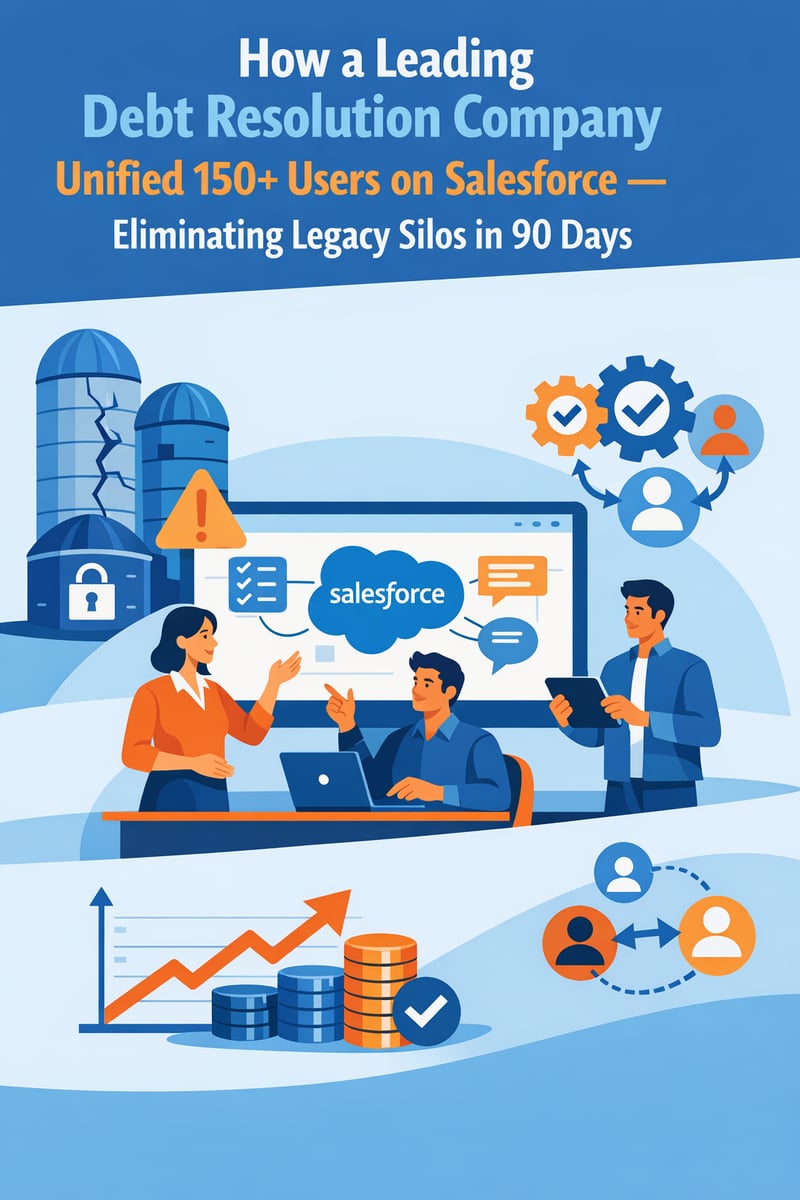
The phased rollout strategy delivered immediate, measurable results. Phase 1 went live successfully, with the 60-user Service Team fully migrated onto the platform and working exclusively within custom Lightning Components integrated with the organization's homegrown debt management systems. The transition eliminated the "swivel-chair" workflows that had plagued the department for years.
The demonstrated success of the Phase 1 Service rollout generated immediate organizational buy-in. The business aggressively moved forward with Phase 2, transitioning the 90+ users of the Negotiations and Settlements teams onto the unified platform. Within 90 days of the initial go-live, all three major operational divisions — Service, Sales, and Settlements — were actively utilizing a single, centralized platform. A decade of informational silos was dismantled, providing executive leadership with cross-functional, actionable analytics and true data-driven decision-making capabilities for the first time in the company's history.
The transformation's impact extended beyond operational efficiency. The organization gained such deep confidence in the Salesforce platform and the architectural frameworks implemented that it invested in building a dedicated internal Salesforce team — absorbing project governance, agile ceremonies, and ongoing platform development into its own operations. This transition from external consultancy to internal ownership represents the ultimate measure of a successful digital transformation: the client didn't just receive a system — they received the knowledge, frameworks, and architectural foundation to own and evolve it independently.
Key Technologies and Integrations
- Salesforce Sales Cloud (Unlimited Edition)
- Salesforce Service Cloud (Unlimited Edition)
- Salesforce Shield — Platform Encryption, Event Monitoring, Field Audit Trail
- Salesforce Experience Cloud (Customer Community)
- Salesforce Connect — Cross-organizational affiliate data integration
- NICE inContact CXone — Omnichannel CTI/IVR/Dialer (AppExchange)
- LexisNexis Risk Investigations — KYC and identity verification (AppExchange)
- Giact gVERIFY — Real-time bank account validation API
- Experian Connect API — Credit scoring and tradeline reports (with Equifax failover)
- ActiveProspect / LeadConduit — Real-time lead capture and routing
- Acoustic CRMi — Marketing automation and campaign orchestration
- HubSpot — Multi-touch email marketing integration
- Twilio — Transactional SMS messaging
- Drips — AI-driven conversational text messaging
- DocuSign — Electronic signature and authorization capture
- Fivetran — Declarative ETL for data warehouse replication
- Snowflake — Cloud data warehousing and business intelligence
- Metasource — Physical mail processing and document automation
- QuickBase Connected Tables — Interim legacy system bridge
- Alteryx — Data migration playbook and automation
- Proprietary Lead Scoring Engine — Nightly batch integration for sales queue prioritization
- Custom Lightning Components — Tailored UX for debt management workflows
Why It Matters: Lessons for Financial Services Organizations
The debt resolution industry sits at a unique intersection of regulatory complexity, long-duration customer lifecycles, and high-volume financial transaction processing. For organizations operating in this space — or any regulated financial services vertical — this transformation offers several critical takeaways.
First, phased rollouts reduce risk without sacrificing speed. The decision to decouple the Sales/Service migration from the Settlements migration added complexity through interim integrations, but it delivered a visible early win that built organizational momentum. The 60-user Service Team became internal champions of the new platform, dramatically easing the change management effort when the 90+ user Settlements team followed. For any enterprise considering a legacy migration, this "win early, scale fast" approach is a proven de-risking strategy.
Second, the CRM must be a financial orchestration engine, not just a contact database. In debt resolution — and increasingly across all financial services — the ability to automate account provisioning, payment scheduling, real-time balance visibility, and asynchronous reconciliation directly within the CRM is what transforms it from a passive record-keeper into an active operational command center. Organizations that treat their CRM as merely a sales tool leave enormous efficiency gains on the table.
Third, compliance automation is not optional — it's foundational. By embedding identity verification (LexisNexis), bank account validation (Giact), credit assessment (Experian with Equifax failover), and TCPA compliance enforcement directly into the Salesforce workflow, the organization reduced its regulatory exposure while simultaneously accelerating throughput. In an industry where a single compliance breach can trigger devastating penalties, this integrated approach is the only sustainable path forward.
Frequently Asked Questions
How does Salesforce support debt resolution and settlement operations?
Salesforce Sales and Service Cloud can be configured as a unified engagement layer for debt resolution companies, managing the full client lifecycle from lead acquisition through enrollment, creditor negotiations, and payment disbursements. With deep API integrations to payment processors, identity verification services, and credit bureaus, Salesforce becomes a comprehensive financial orchestration platform — not just a CRM. Salesforce Shield adds the encryption, event monitoring, and audit trail capabilities required for regulatory compliance in financial services.
Why choose a phased rollout over a simultaneous "big bang" migration?
A phased approach reduces the risk of enterprise-wide operational disruption. By migrating one department at a time, the organization validates the architecture, surfaces integration issues in a controlled environment, and builds internal champions who ease adoption for subsequent teams. The tradeoff is added complexity from interim integrations between the new and legacy systems, but the risk reduction and change management benefits far outweigh the additional effort.
What results can a debt resolution company expect from a Salesforce transformation?
Based on this engagement, organizations can expect to eliminate manual "swivel-chair" workflows, unify cross-departmental data into a single source of truth, gain real-time financial visibility within the CRM, and achieve full platform adoption across 150+ users within 90 days. Executive leadership gains cross-functional analytics capabilities that were previously impossible with fragmented legacy systems, enabling true data-driven decision-making.
How do I get started with a Salesforce implementation for a regulated financial services company?
The most critical first step is a thorough discovery phase that maps your existing technology landscape, identifies integration dependencies (especially with payment processors and compliance systems), and models deployment strategies with clear risk-reward tradeoffs. Working with a consulting partner experienced in regulated industries ensures that compliance, security (Salesforce Shield), and financial integration requirements are architected into the foundation — not bolted on as afterthoughts.
Ready to Transform Your Financial Services Operations?
Vantage Point specializes in Salesforce and HubSpot implementations for regulated industries — from financial services and healthcare to insurance and fintech. With 150+ clients, 400+ engagements, and a senior-only team of US-based consultants, we bring deep expertise to every project.
Contact Vantage Point to discuss your digital transformation journey.
A leading debt resolution and financial services company is one of many organizations that have partnered with Vantage Point to modernize their operations. Names and identifying details have been changed to protect client confidentiality.