TL;DR / Key Takeaways
| What is it? | A multi-year, enterprise-wide digital transformation replacing fragmented legacy systems with Salesforce Financial Services Cloud (FSC) and MuleSoft at a community-focused federal savings and loan institution. |
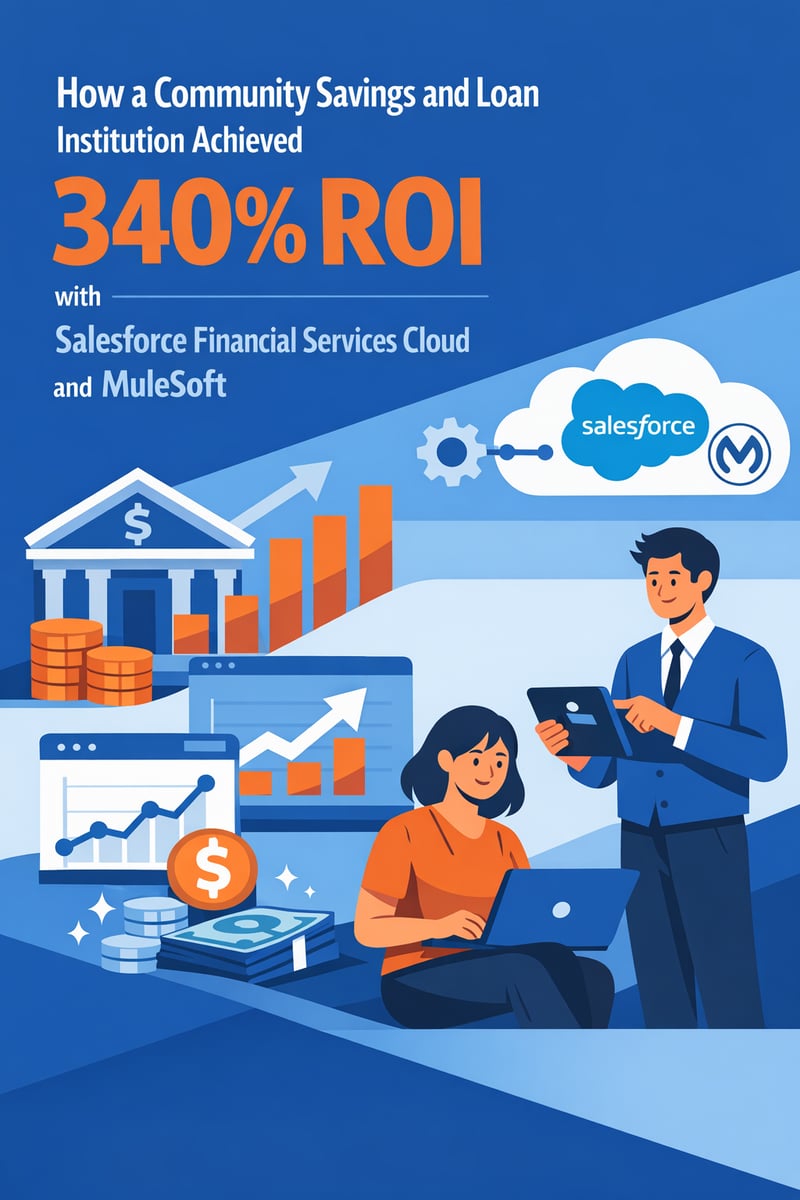
| Key Benefit | 340% ROI within 18 months, $2M+ annual cost savings, and 93% reduction in manual data entry. |
| Industry | Community Banking / Savings and Loan |
| Platform | Salesforce Financial Services Cloud, Sales Cloud, Service Cloud, MuleSoft |
| Best For | Community banks, credit unions, and regional financial institutions looking to modernize legacy systems while preserving their relationship-driven service model. |
| Bottom Line | By replacing a patchwork of siloed systems with a unified Salesforce FSC platform, this institution transformed per-employee productivity, accelerated client onboarding by up to 75%, and achieved a 95% client retention rate — all while navigating a core banking migration. |
The Challenge: A Community Mission Trapped in Legacy Technology
A community-focused federal savings and loan institution — a prominent Pacific Northwest banking organization founded in 1923 — had built its reputation on deep, generational relationships with local communities. Managing over $2.25 billion in total assets, $1.71 billion in deposits, and $1.73 billion in loans, the institution operates a network of 12 full-service retail branches across multiple counties, with 16–17 total locations. As a federally regulated, FDIC-insured, OCC-supervised qualified public depository, the institution has always operated under intense regulatory scrutiny while maintaining a profound commitment to local economic empowerment — including over $10 million in community grants distributed over a decade through its philanthropic foundation.
Despite this mission-driven identity, the institution's operational technology landscape had become a serious liability. Customer data, loan origination pipelines, and core banking transactions were fragmented across multiple siloed systems. Core banking functions were split between two separate processors, while commercial lending relied on standalone analysis tools and a separate CRM. Customer support operations ran through yet another disconnected platform. This decentralized architecture created enormous technical debt: elevated annual software costs, excessive training overhead for new hires, and a fundamentally broken customer experience. Employees routinely toggled between multiple interfaces to complete routine servicing tasks, increasing the probability of manual data entry errors and delaying service delivery.
The macroeconomic environment made this problem existential. Navigating severe headwinds including elevated credit costs, an inverted yield curve, and intense liquidity pressures, the institution's leadership executed rigorous cost-containment measures including a strategic workforce reduction of nearly 16% — bringing the total headcount to approximately 227 employees. In this environment, deploying technology that drastically enhances per-employee productivity was not merely an operational upgrade; it was a survival imperative. A bank whose competitive advantage rests on personalized, neighborly service simply cannot operate on disconnected software systems that force customers to repeat their financial narratives to different tellers.
The Solution: A "Crawl, Walk, Run" Digital Transformation with Salesforce FSC and MuleSoft
Following a rigorous RFP process and vendor evaluation in late 2020, the institution selected Vantage Point to lead a comprehensive digital transformation centered on Salesforce Financial Services Cloud (FSC) and MuleSoft. The engagement was designed using a hybrid Agile/Waterfall methodology structured as a "Crawl, Walk, Run" roadmap — three distinct phases that incrementally delivered business value, fostered internal adoption, and sequentially integrated increasingly complex business units without disrupting ongoing operations.
Before granting access to sensitive financial infrastructure, the institution required Vantage Point to undergo stringent Enterprise Risk Management (ERM) vendor due diligence, including a comprehensive Third-Party Vendor Questionnaire verifying compliance with information security standards and rigorous background checks for all consultants with access to Personally Identifiable Information (PII).
Phase 1: Foundation (Crawl) — Centralizing Customer Support
The foundational phase deliberately prioritized the Customer Support Center (CSC), establishing the baseline Salesforce Customer 360 data model before pushing the technology to frontline branch staff. Kicking off in early 2021, the initiative focused on centralizing case management tracking, enabling automated workflows for routine processes such as customer address changes, and integrating the institution's telephony infrastructure (Masergy) and digital chat services (LivePerson) directly into the CRM console.
A critical component involved the initial mass data migration from legacy databases into the new Salesforce schema. The delivery team utilized MuleSoft to map and migrate critical data entities, successfully processing and verifying 63,588 distinct customer records during the initial push to production. Post-migration audits revealed exceptional data fidelity, with mapping errors limited to only three highly specific fields — issues that were swiftly traced to a logic flaw in the intermediate MuleSoft translation code and resolved with a targeted fix.
By the time Release 1 went live for the CSC, eServices, and DevOps divisions, the platform supported 88 active, fully trained users operating within a unified, secure interface. Comprehensive enablement materials — including customized quick reference guides and recorded training sessions — ensured a smooth operational transition.
Phase 2: Optimization (Walk) — Retail, Lending, and Omnichannel Expansion
With the foundation stabilized, Phase 2 dramatically expanded the Salesforce footprint into the institution's primary revenue-generating divisions: Retail Banking, Mortgage Lending, Commercial Lending, and Investments. The retail banking launch, successfully executed in mid-2022, represented a massive operational milestone — finally providing branch staff with the "one-stop" holistic view of the customer relationship.
Consumer Loan Origination (MeridianLink/LoansPQ): The paramount integration objective for Phase 2 was streamlining the consumer loan origination lifecycle. The technical architecture leveraged MeridianLink's Open APIs in conjunction with Salesforce Lightning Platform APIs, entirely mediated by MuleSoft as the enterprise service bus. The integration enabled loan officers to test scenarios and receive automated approval or denial responses directly within the CRM, create or modify loan applications, retrieve real-time loan data, and exchange secure communications with backend underwriters — all without leaving the Salesforce ecosystem. Vantage Point engineered a highly customized "Loan Application" object to handle the unique data structures associated with non-residential consumer loans (auto, personal, etc.), optimizing the daily experience for lenders who required specialized, non-mortgage data fields.
Mortgage Processing (Blend and Ellie Mae Encompass): MuleSoft bridged Salesforce with Blend and Ellie Mae Encompass for mortgage processing, engineering a seamless data continuum spanning from initial lead acquisition through underwriting and closing.
Commercial Lending (Abrigo Sageworks): The Abrigo Sageworks integration brought commercial lending pipelines into the unified CRM, enabling consistent deal tracking and pipeline visibility across the institution.
Core Banking Connectivity (Fiserv Cleartouch): Integrating the Fiserv Cleartouch core processor was the bedrock requirement for servicing existing accounts. The integration relied on MuleSoft to execute real-time API calls — the PartyInq API for real-time customer data retrieval and the PartyMod endpoint for updating PII (email, phone, address) with instant reflection in the core. Authentication was secured using DigiCert certificates with automatic SessionKey refresh on a daily cadence. A manual "Refresh Account" button was developed to force immediate, synchronous API pulls, guaranteeing that frontline staff had real-time visibility into account balances following transactions.
Fiserv Cards Integration: A highly celebrated feature among branch staff, this integration allowed employees to securely view, activate, or suspend customer debit cards directly from the Salesforce console — eliminating the operational friction of navigating back into the legacy core processor interface for routine card maintenance.
Omnichannel Account Opening (Terafina/NCR): To modernize client onboarding and compete with fintech challengers, the institution targeted integration with Terafina (an NCR-acquired omnichannel account opening solution) to support both digital self-service and in-branch "Universal Banker" origination experiences. Complex Salesforce flows were constructed to manage KYC compliance, customer identification, and product selection, with a native Salesforce-to-Salesforce connector linking the Terafina environment to the primary FSC instance. A successful Proof of Concept for the Universal Bankers experience garnered enthusiastic approval from leadership.
Workflow Automation and Operational Intelligence
Beyond data aggregation, the true institutional value was realized through aggressive automation of historically manual processes:
Intelligent Referral Round Robin: Prior to Salesforce, internal referrals for mortgages and consumer loans relied on informal channels — emails, phone calls, physical notes — leading to dropped leads and unacceptably slow response times. Vantage Point architected an automated routing system that ingested leads from any branch and intelligently assigned them to loan officers based on geographic mapping. A stringent 12-hour escalation timer with sophisticated business-hour logic ensured that untouched referrals automatically triggered notification emails and escalated to regional leadership. This mechanism fundamentally transformed cross-selling efficiency across the retail footprint.
Case Flow Engineering: Highly sophisticated case flows were constructed for the Customer Support Center and internal IT Service Management (ITSM). The Loan Servicing flow alone accommodated 32 distinct case types, representing a massive undertaking in process standardization. These flows drastically standardized the intake, routing, and resolution of both internal support requests and external customer inquiries.
Sales Goals Tracking and BI Dashboards: Previously managed via static spreadsheets, branch performance tracking was transformed through a dynamic reporting framework. A daily data extract from the institution's ProLog system was ingested by MuleSoft and pushed into Salesforce to continuously update sales goal records. Dashboards with intuitive horizontal bar components contrasting targets against actuals provided branch managers with immediate, real-time performance visibility across tens of thousands of deposit and savings accounts.
Enterprise Risk Management and Compliance Automation
The institution proactively leveraged the Salesforce implementation for a comprehensive Enterprise Risk Management (ERM) overhaul. By unifying isolated data streams within the secure Salesforce ecosystem, the institution achieved an unprecedented, holistic view of institutional risk exposure. The ERM initiative yielded profound, measurable results:
- 30% reduction in manual compliance reporting effort
- 100% on-time submission rate for all required regulatory filings in the first full year post-implementation
Salesforce's native security architecture provided comprehensive, immutable audit trail capabilities fully compliant with SEC, FINRA, and SOC 2 requirements. Intelligent data storage optimization routines — including automated deletion of undisputed financial transactions older than 30 days — minimized cloud data bloat and reduced legal liability from over-retention.
Phase 3: Iteration (Run) — Core Migration and Next-Generation Capabilities
In late 2022, the institution's leadership finalized a strategic decision to deprecate the existing legacy core processor and execute an enterprise-wide migration to the modern Jack Henry banking platform. This massive undertaking — anticipated to span a full year — necessitated a temporary pause on aggressive new Salesforce builds while the underlying data architecture was entirely replaced.
The decoupled nature of the Salesforce-MuleSoft architecture proved its ultimate strategic value during this transition. Because the CRM presentation layer was entirely abstracted from the core database via the MuleSoft iPaaS layer, the institution's frontline user experience remained completely insulated from the severe backend disruption. Vantage Point, leveraging its "Core Banking 360" integration expertise, was positioned to architect replacement APIs for the new Jack Henry environment without degrading the established Customer 360 view.
The forward-looking roadmap includes deprecation of Pipedrive for commercial lending, integration of Fiserv FCRM for advanced anti-money laundering (AML) analytics, and exploration of Salesforce's Agentforce platform for autonomous compliance workflow management and customer inquiry handling — representing an evolution from declarative automation to context-aware, AI-driven banking operations.
The Results: Transformative Metrics Across Every Dimension
The empirical data collected post-implementation underscores the profound financial and operational impact of this digital transformation. The integration of Salesforce FSC and MuleSoft directly dismantled entrenched operational bottlenecks, producing extraordinary results that far exceeded standard industry benchmarks for CRM optimization:
| Performance Metric | Outcome |
|---|---|
| Overall ROI | 340% within 18 months |
| Annual Cost Savings | $2,000,000+ through platform consolidation and process automation |
| Advisor Productivity Gains | $2.27 million equivalent in reallocated human capital toward revenue-generating lending activities |
| Administrative Task Reduction | 27% decrease in operational overhead |
| Manual Data Entry Reduction | 93% decrease, dramatically reducing error rates and compliance risk |
| Manual Processing Time | 50% overall reduction, accelerating loan origination and customer service resolution |
| Client Onboarding Velocity | 60%–75% faster for new commercial and retail accounts |
| Customer Satisfaction (CSAT) | 4.71 / 5.0 rating |
| Client Retention Rate | 95% |
| Compliance Reporting | 30% reduction in manual effort; 100% on-time regulatory filing rate |
The automation of the Referral Round Robin alone eliminated the latent decay of high-value leads, directly supporting the institution's bottom line during a period of intense macroeconomic pressure. The 95% client retention rate was directly attributable to the 360-degree customer view, which enabled frontline staff to provide highly contextual, rapid, and personalized service that larger competitors could not match.
As one senior executive noted, the Vantage Point delivery team was "great people, super knowledgeable, and had stayed on budget" — a "winning combination." Leadership emphasized that the platform allowed the institution to serve members with "the speed and personalization they expect from their local bank," transforming Salesforce from a business tool into the fundamental engine powering their community service model.
Key Technologies and Integrations
- Salesforce Financial Services Cloud (FSC) — Primary CRM and Customer 360 platform
- Salesforce Sales Cloud — Sales pipeline and opportunity management
- Salesforce Service Cloud — Case management and customer support
- MuleSoft — Enterprise service bus (iPaaS) for all bi-directional integrations
- Fiserv Cleartouch — Core banking processor (real-time PartyInq/PartyMod APIs)
- Fiserv Cards — Debit card management from within Salesforce
- Fiserv EFT — Electronic funds transfer integration
- FPS Gold — Legacy core banking processor (deprecated)
- Jack Henry — Modern replacement core banking platform
- MeridianLink (LoansPQ) — Consumer loan origination system
- Blend — Mortgage processing platform
- Ellie Mae Encompass — Mortgage origination and underwriting
- Abrigo Sageworks — Commercial lending analysis and origination
- Terafina / NCR — Omnichannel account opening solution
- NCR Digital Banking — Digital banking platform integration
- Masergy — Telephony / CTI integration
- LivePerson — Digital chat and messaging integration
- GetFeedback — Customer survey and feedback platform
- ProLog — Sales goal data extraction and reporting
- Microsoft Outlook / Office 365 — Email and productivity suite integration
- Salesforce Agentforce — AI-driven autonomous workflows (future roadmap)
- Fiserv FCRM — BSA/AML compliance analytics (future roadmap)
- DigiCert — Certificate-based API authentication
Why It Matters: Lessons for Community Banking Organizations
This transformation offers a powerful blueprint for community banks and savings institutions navigating the same structural pressures: compressed margins, workforce constraints, rising regulatory burden, and aggressive fintech competition. The institution's experience proves that a well-architected Salesforce FSC and MuleSoft deployment can deliver outsized returns — even (and especially) during periods of financial headwind. A 340% ROI within 18 months is not aspirational marketing; it is an empirical outcome driven by platform consolidation, process automation, and the elimination of technical debt accumulated over decades.
The "Crawl, Walk, Run" methodology is particularly instructive. By starting with the Customer Support Center rather than attempting a "big bang" launch across all business lines, the institution built internal confidence, refined data models, and validated integration patterns before expanding to revenue-generating divisions. This phased approach also allowed leadership to continuously demonstrate ROI to stakeholders — a critical factor when budgets are under extreme pressure.
Perhaps the most strategically significant lesson is the value of architectural decoupling. By positioning MuleSoft as an abstraction layer between Salesforce and the core banking processor, the institution was able to execute a full core migration from Fiserv/FPS Gold to Jack Henry without disrupting the frontline CRM experience. For any financial institution evaluating a core banking migration — one of the most operationally risky undertakings in the industry — this integration architecture provides a proven model for insulating customer-facing operations from backend upheaval. The future-readiness of this architecture is further validated by the institution's ability to now explore AI-driven capabilities like Salesforce Agentforce, building on a clean, unified data foundation that simply would not exist without this transformation.
Frequently Asked Questions
What is Salesforce Financial Services Cloud (FSC), and why is it suited for community banks?
Salesforce Financial Services Cloud is a purpose-built CRM platform designed for financial services organizations. It extends Salesforce's core Sales and Service Cloud capabilities with industry-specific data models — including financial accounts, household relationships, and advisor-client hierarchies — that enable a true 360-degree view of every customer relationship. For community banks, FSC provides the technological foundation to deliver the personalized, relationship-driven service that is their competitive advantage, while meeting the stringent compliance and audit trail requirements of federal regulators.
How does a phased "Crawl, Walk, Run" implementation reduce risk?
A phased approach mitigates the operational risks inherent in enterprise-wide software deployments by delivering incremental business value at each stage. Starting with a lower-risk department (such as customer support) allows the team to validate data models, refine integration patterns, and build internal user confidence before expanding to complex, revenue-generating business lines like lending and retail banking. This methodology also provides natural checkpoints for leadership to evaluate ROI and adjust scope based on evolving business priorities.
What role does MuleSoft play in a banking CRM transformation?
MuleSoft serves as the enterprise integration platform (iPaaS) that bridges Salesforce with core banking processors, loan origination systems, digital banking platforms, and other third-party applications. By acting as an abstraction layer, MuleSoft decouples the CRM user experience from the underlying core systems — meaning the institution can migrate or replace backend systems (such as moving from one core banking platform to another) without disrupting the frontline Salesforce experience. This architectural flexibility is critical for institutions planning long-term technology modernization.
How can a community bank get started with a similar transformation?
The first step is a thorough assessment of your current technology landscape, identifying data silos, manual processes, and integration gaps that are limiting productivity and customer experience. A qualified implementation partner with deep financial services expertise — like Vantage Point — can guide a phased roadmap tailored to your institution's size, regulatory environment, and strategic priorities. Starting with customer support or a single business line allows you to demonstrate value quickly while building the foundation for enterprise-wide expansion.
Ready to Transform Your Banking Operations?
Vantage Point specializes in Salesforce and HubSpot implementations for regulated industries — from financial services and healthcare to insurance and fintech. With 150+ clients, 400+ engagements, and a senior-only team of US-based consultants, we bring deep expertise to every project.
Contact Vantage Point to discuss your digital transformation journey.
A community-focused federal savings and loan institution is one of many organizations that have partnered with Vantage Point to modernize their operations. Names and identifying details have been changed to protect client confidentiality.