Transform Your Salesforce Implementation from Deployment to Full User Adoption in 8-12 Weeks
The Bottom Line
A goal without a plan is just a wish. Successful Salesforce adoption requires a phased roadmap spanning 8-12 weeks minimum. Without a structured approach, you risk building a system that sits unused while your team defaults to old habits and spreadsheets.
What is a Salesforce Adoption Roadmap?
A Salesforce adoption roadmap is a structured plan that outlines the phases, milestones, and activities required to move from deployment to full user adoption. It's your blueprint for transforming Salesforce from an IT project into a business-critical tool that people actually use.
"The roadmap isn't about the technology. It's about changing how people work."
The Four Phases of Salesforce Adoption
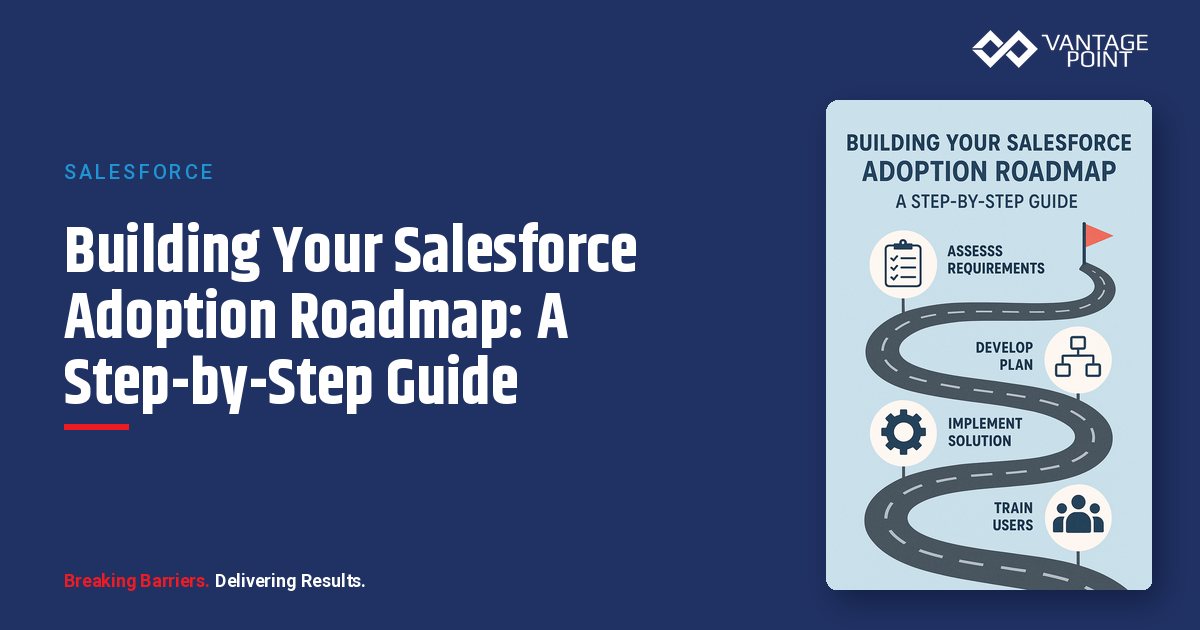
Salesforce adoption follows a proven four-phase framework:
| Phase | Timeline | Focus |
|---|---|---|
| Discovery | Weeks 1-2 | Assess current state, identify stakeholders |
| Foundation | Weeks 3-4 | Data governance, system configuration |
| Enablement | Weeks 5-8 | Training, change champions, go-live |
| Reinforcement | Ongoing | Metrics, feedback, continuous improvement |
Let's break down each phase in detail.
Phase 1: Discovery (Weeks 1-2)
Discovery answers three critical questions that will determine your adoption success:
1. Where are we now?
Start by understanding your current reality:
- Audit current processes and tools
- Document pain points and workarounds
- Map data sources and quality issues
2. Who are our stakeholders?
People make or break adoption:
- Identify power users who will become your future champions
- Identify skeptics who represent your adoption risks
- Map influence networks to understand how information flows
3. What does success look like?
Define clear, measurable outcomes:
- Set specific adoption goals (not just login metrics)
- Align Salesforce capabilities to business objectives
- Establish baseline metrics for comparison
"Skip discovery, and you'll build a system nobody asked for."
Phase 2: Foundation (Weeks 3-4)
Foundation establishes the rules of engagement and system guardrails that enable adoption:
Data Governance
Answer the fundamental questions:
- Who owns data quality in each department?
- What are the naming conventions everyone will follow?
- How often is data cleaned and who does it?
System Configuration
Less is more when it comes to fields and complexity:
- Required vs. optional fields (minimize required fields)
- Role-based page layouts that show only what's needed
- Automation rules and workflows that reduce manual work
Documentation
Create your adoption knowledge base:
- Process maps for each user role
- Data dictionary with field definitions
- Decision log for all customizations
| Foundation Element | Why It Matters |
|---|---|
| Required fields | Too many creates data entry resentment |
| Page layouts | Role-specific views reduce confusion |
| Validation rules | Enforce quality without blocking work |
Phase 3: Enablement (Weeks 5-8)
Enablement is where adoption lives or dies. This phase requires your most intensive effort:
Training Strategy
Move beyond one-time training events:
- Role-based learning paths tailored to daily workflows
- Microlearning modules (5-10 minutes each) for just-in-time learning
- Hands-on sandbox practice before touching production
Change Champion Network
Your peer-to-peer support system:
- 1 champion per 10-15 users
- Provide advanced training and early access to features
- Champions collect peer feedback and provide support
Go-Live Preparation
Prepare for the critical transition:
- Hypercare support plan with clear coverage hours
- Quick reference guides placed at every desk
- Clear escalation paths for issues and questions
"Training isn't an event. It's a program."
Phase 4: Reinforcement (Ongoing)
Reinforcement prevents the dreaded 90-day adoption cliff:
Weekly Activities
- Review adoption metrics and usage patterns
- Address user-reported issues immediately
- Celebrate quick wins publicly
Monthly Rituals
- Champion network meetings to share best practices
- Feature spotlight communications
- Process refinement based on user feedback
Quarterly Reviews
- Executive steering committee review
- Roadmap updates based on business changes
- Training content refresh with new examples
Creating Your Adoption Timeline
Use this proven timeline template:
| Week | Phase | Key Activities |
|---|---|---|
| 1-2 | Discovery | Stakeholder interviews, current state audit |
| 3 | Foundation | Data governance policies, field requirements |
| 4 | Foundation | Page layouts, automation rules, testing |
| 5-6 | Enablement | Champion training, training content creation |
| 7 | Enablement | User training sessions, sandbox practice |
| 8 | Enablement | Go-live, hypercare support |
| 9+ | Reinforcement | Metrics review, continuous improvement |
Resource Planning for Success
Adoption requires dedicated resources, not just spare time:
| Role | Responsibility | Time Commitment |
|---|---|---|
| Executive Sponsor | Visible support, blocker removal | 2-4 hrs/week |
| Project Manager | Timeline, coordination, communication | Full-time |
| Salesforce Admin | Configuration, training, support | Full-time |
| Change Champions | Peer support, feedback | 4-6 hrs/week |
| Department Leads | Enforcement, modeling | 2-3 hrs/week |
Five Common Roadmap Mistakes to Avoid
Mistake 1: Skipping Discovery
Result: Building features nobody needs or asked for
Mistake 2: Big Bang Training
Result: Information overload leads to immediate forgetting
Mistake 3: No Reinforcement Plan
Result: The dreaded 90-day adoption cliff
Mistake 4: Ignoring Skeptics
Result: Underground resistance movement undermines adoption
Mistake 5: Over-Customizing
Result: Complexity that kills adoption and maintenance
"Every unnecessary field is a small act of aggression against your users."
Quick Reference FAQ
Q: How long should a Salesforce adoption roadmap be?
A: Minimum 8 weeks; 12+ weeks for complex implementations.
Q: What are the four phases of Salesforce adoption?
A: Discovery, Foundation, Enablement, Reinforcement.
Q: What's the most important phase?
A: Reinforcement: it's ongoing and prevents backsliding.
Q: Who should own the adoption roadmap?
A: A dedicated project manager with executive sponsorship.
Q: How many change champions do you need?
A: 1 champion per 10-15 end users.
Your Adoption Roadmap Checklist
Discovery Phase
- Current state documented
- Stakeholders identified
- Success metrics defined
- Baseline measurements taken
Foundation Phase
- Data governance established
- Required fields minimized
- Page layouts role-optimized
- Documentation complete
Enablement Phase
- Champions trained
- Training materials created
- Users trained by role
- Hypercare plan ready
Reinforcement Phase
- Metrics dashboard live
- Feedback mechanism active
- Monthly reviews scheduled
- Continuous improvement process defined
Key Takeaways
- Four phases are essential: Discovery → Foundation → Enablement → Reinforcement
- Discovery is non-negotiable: you can't fix what you don't understand
- Less is more in system configuration: every field has a cognitive cost
- Reinforcement is forever: adoption isn't a project, it's a culture shift
- Resource the work properly: adoption requires dedicated time and people, not spare capacity
Next in Series: Tomorrow: Change Champions: Your Secret Weapon for Salesforce Adoption
About Vantage Point
Vantage Point is a specialized Salesforce and HubSpot consultancy serving the financial services industry. We help wealth management firms, banks, credit unions, insurance providers, and fintech companies transform their client relationships through intelligent CRM implementations. Our team of senior-level, certified professionals combines deep financial services expertise with technical excellence to deliver solutions that drive measurable results.
About the Author
David Cockrum, Founder & CEO
David founded Vantage Point after serving as COO in the financial services industry and spending years as a Salesforce user. This insider perspective informs our approach to every engagement: we understand your challenges because we've lived them. David leads Vantage Point's mission to bridge the gap between powerful CRM platforms and the specific needs of financial services organizations.
-
- Email: david@vantagepoint.io
- Phone: 469-499-3400
- Website: vantagepoint.io