
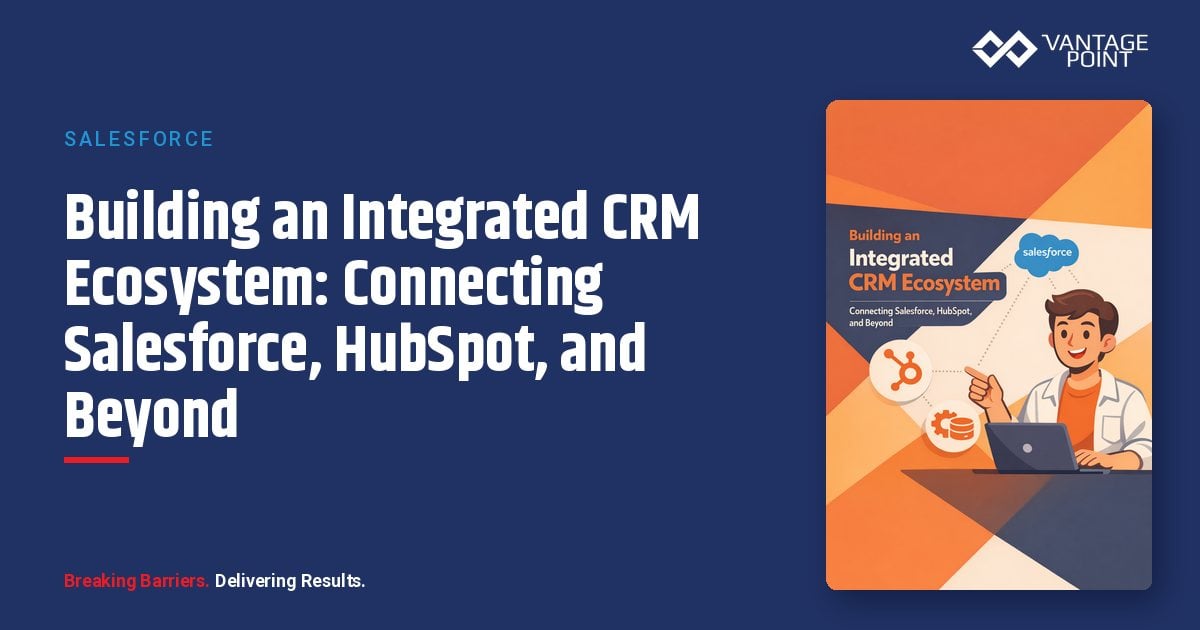
Strategic Integration for Modern Financial Advisors
The average wealth management firm uses 23 different software applications to manage client relationships. Without integration, advisors waste hours manually transferring data between systems while clients receive fragmented experiences.
The True Cost of Disconnection
The numbers tell a sobering story:
- 40% of advisor time spent on administrative tasks
- 67% of client data exists in silos
- $1.8 million average annual cost from data inconsistencies
An integrated CRM ecosystem transforms this chaos into a seamless operation where data flows automatically, insights surface proactively, and advisors focus on what matters—client relationships.
What Does an Ideal Financial Services CRM Ecosystem Look Like?
The Core Architecture: Hub-and-Spoke Model
At the center sits your core CRM (typically Salesforce Financial Services Cloud), with integrated systems radiating outward:
Essential Integration Points:
| System Category | Examples | Integration Priority |
|---|---|---|
| Core CRM | Salesforce FSC | Foundation |
| Marketing Automation | HubSpot, Marketo | High |
| Custodial Platforms | Schwab, Fidelity, Pershing | Critical |
| Financial Planning | eMoney, MoneyGuidePro | High |
| Document Management | DocuSign, Laserfiche | Medium |
| Communication | Outlook, Zoom, RingCentral | High |
| Compliance | Smarsh, Global Relay | Required |
This architecture ensures your CRM serves as the single source of truth while specialized systems handle their specific functions.
The Power of Salesforce and HubSpot Integration
Salesforce Financial Services Cloud excels at relationship management and operational workflows, while HubSpot dominates marketing automation and lead nurturing. Together, they create a complete client lifecycle platform.
Real-World Integration Scenarios
Lead Flow (HubSpot → Salesforce):
- Prospect downloads whitepaper on HubSpot landing page
- HubSpot scores lead based on engagement
- Qualified leads sync to Salesforce as new contacts
- Advisor receives notification with engagement history
Client Communication (Salesforce → HubSpot):
- Client milestone triggers in Salesforce (birthday, anniversary)
- Data syncs to HubSpot contact record
- Automated personalized campaign activates
- Engagement tracked back to Salesforce
Technical Integration Approaches
| Method | Complexity | Best For |
|---|---|---|
| Native Connector | Low | Basic bidirectional sync |
| iPaaS (MuleSoft, Workato) | Medium | Custom logic, multiple systems |
| Custom API Integration | High | Unique requirements |
| Data Warehouse | Medium | Analytics-focused |
Critical Data Mapping
Standard Field Mappings:
| HubSpot Field | Salesforce Field | Sync Direction |
|---|---|---|
| Contact Email | Person Account Email | Bidirectional |
| Company | Account Name | Bidirectional |
| Lifecycle Stage | Lead Status | HubSpot → SF |
| Deal Amount | Opportunity Amount | Bidirectional |
| Marketing Emails Opened | Custom Field | HubSpot → SF |
Financial Services Custom Fields:
| Data Element | Source System | Sync Frequency |
|---|---|---|
| AUM | Custodial Platform | Daily |
| Risk Profile | Financial Planning | On Change |
| Compliance Status | Compliance System | Real-time |
| Household Members | Salesforce FSC | On Change |
Navigating Financial Services Integration Challenges
Data Security and Compliance
Financial services integrations must maintain security and compliance across every connection point.
Encryption Requirements:
- TLS 1.3 minimum for all API calls
- Field-level encryption for sensitive data
- Key management protocols
Access Control:
- Role-based permissions across systems
- Audit logging for all data movements
- Principle of least privilege
Regulatory Compliance:
- SEC recordkeeping requirements
- FINRA supervision rules
- State privacy regulations
Data Quality Management
Integration amplifies data quality issues—garbage in, garbage out multiplied across systems.
Data Quality Framework:
| Challenge | Solution | Implementation |
|---|---|---|
| Duplicate Records | Master Data Management | Matching algorithms |
| Inconsistent Formats | Data Standardization | Transformation rules |
| Missing Information | Data Enrichment | Third-party services |
| Stale Data | Refresh Protocols | Scheduled syncs |
How iPaaS Solutions Simplify Financial Services Integration
Integration Platform as a Service (iPaaS) provides cloud-based tools for connecting applications without custom coding. For financial services, iPaaS solutions offer pre-built connectors and compliance-ready infrastructure.
Leading iPaaS Options
| Platform | Strengths | Financial Services Fit |
|---|---|---|
| MuleSoft | Enterprise-grade, Salesforce-owned | Excellent |
| Workato | User-friendly, AI-powered | Very Good |
| Boomi | Broad connector library | Good |
| Zapier | Simple automations | Basic needs |
| Tray.io | Flexible workflows | Good |
iPaaS Implementation Approach
Phase 1: Assessment (Weeks 1-2)
- Inventory current systems and data flows
- Identify integration priorities
- Document security requirements
Phase 2: Design (Weeks 3-4)
- Map data relationships
- Define transformation rules
- Design error handling
Phase 3: Build (Weeks 5-8)
- Configure connectors
- Implement business logic
- Establish monitoring
Phase 4: Test (Weeks 9-10)
- Validate data accuracy
- Test edge cases
- Performance optimization
Phase 5: Deploy (Weeks 11-12)
- Staged rollout
- User training
- Documentation
Real-Time vs. Batch Integration: Choosing the Right Approach
| Sync Type | Latency | Use Cases | Cost |
|---|---|---|---|
| Real-time | Seconds | Critical alerts, compliance | Higher |
| Near Real-time | Minutes | Client updates, opportunities | Medium |
| Batch | Hours | Reporting, analytics | Lower |
Real-Time Integration Examples:
- Large transaction alerts
- Compliance violations
- Client service requests
- Market event notifications
Batch Integration Examples:
- Daily portfolio valuations
- Marketing campaign updates
- Performance reporting
- Data warehouse loads
Event-Driven Architecture
Modern integration architectures use events to trigger actions across systems:
- Event Occurs: Client makes large deposit
- Event Published: Custodial system sends notification
- Event Processed: Integration platform routes to relevant systems
- Actions Triggered:
- Salesforce: Update opportunity
- HubSpot: Trigger welcome sequence
- Compliance: Log for supervision
Measuring Integration Success
Key Performance Indicators
Technical Metrics:
| Metric | Target | Measurement |
|---|---|---|
| Sync Success Rate | >99.5% | Error logs |
| Data Latency | <5 minutes | Timestamp comparison |
| System Uptime | >99.9% | Monitoring tools |
| Error Resolution Time | <1 hour | Ticket tracking |
Business Metrics:
| Metric | Target | Impact |
|---|---|---|
| Advisor Admin Time | -40% | Productivity |
| Data Entry Errors | -75% | Quality |
| Client Response Time | -50% | Satisfaction |
| Compliance Findings | -60% | Risk |
ROI Calculation Framework
Cost Components:
- Platform licensing
- Implementation services
- Ongoing maintenance
- Training
Benefit Components:
- Advisor time savings (hours × hourly cost)
- Error reduction (errors × correction cost)
- Compliance efficiency (audit prep time × cost)
- Client satisfaction (retention impact)
Typical ROI: Well-designed integrations deliver 200-400% ROI within 24 months.
Frequently Asked Questions
How long does it take to integrate Salesforce and HubSpot?
Basic bidirectional sync can be configured in 2-4 weeks. Comprehensive integration with custom workflows and financial services requirements typically takes 8-12 weeks.
What's the biggest integration mistake financial services firms make?
Attempting to integrate everything at once. Successful firms prioritize high-impact integrations, validate thoroughly, then expand incrementally.
Should we use native connectors or a dedicated integration platform?
Native connectors work for simple, two-system integrations. Firms with 5+ systems or complex requirements benefit from dedicated iPaaS solutions that provide centralized management and monitoring.
How do we handle integration failures without losing data?
Implement robust error handling: dead letter queues for failed messages, automatic retry logic, alerting systems, and reconciliation processes to identify and resolve discrepancies.
What security certifications should our integration platform have?
Look for SOC 2 Type II, ISO 27001, and specific financial services certifications. Ensure the platform supports your compliance requirements (SEC, FINRA, state regulations).
Building Your Integration Roadmap
Phase 1: Foundation (Months 1-3)
- Implement core CRM (Salesforce FSC)
- Connect marketing automation (HubSpot)
- Establish data quality baseline
Phase 2: Expansion (Months 4-6)
- Integrate custodial platforms
- Connect financial planning tools
- Implement document management
Phase 3: Optimization (Months 7-12)
- Add advanced analytics
- Implement AI-driven insights
- Continuous improvement
Key Takeaways
✓ Integration eliminates silos that cost firms millions annually
✓ Salesforce + HubSpot creates a powerful combination for client lifecycle management
✓ Financial services requires special attention to security and compliance
✓ iPaaS platforms simplify complex multi-system integration
✓ Measure both technical and business metrics to validate ROI
✓ Start focused, then expand—prioritize high-impact integrations first
Vantage Point's Integration Expertise
Our team specializes in financial services CRM integration, combining deep platform knowledge with industry expertise.
Our Services:
- Integration architecture design
- iPaaS implementation and configuration
- Custom API development
- Data migration and quality
- Ongoing support and optimization
We've helped wealth management firms achieve an average 45% reduction in administrative time through strategic CRM ecosystem integration.
Ready to build your integrated CRM ecosystem? Contact Vantage Point to discuss your integration strategy and see how we can connect your technology stack for maximum impact.
About Vantage Point
Vantage Point specializes in helping financial institutions design and implement client experience transformation programs using Salesforce Financial Services Cloud. Our team combines deep Salesforce expertise with financial services industry knowledge to deliver measurable improvements in client satisfaction, operational efficiency, and business results.
About the Author
David Cockrum founded Vantage Point after serving as Chief Operating Officer in the financial services industry. His unique blend of operational leadership and technology expertise has enabled Vantage Point's distinctive business-process-first implementation methodology, delivering successful transformations for 175+ clients across 700+ engagements with a 4.71/5.0 client satisfaction rating and 95% client retention rate.
-
-
- Email: david@vantagepoint.io
- Phone: (469) 499-3400
- Website: vantagepoint.io
-