
Salesforce Flexi Pages provide a quick, low-code way to build user interfaces, but they often fall short when it comes to delivering highly tailored, efficient, and dynamic user experiences. For organizations looking to optimize their Salesforce environment, Lightning Web Components (LWCs) offer a powerful alternative. Custom LWCs allow developers to craft precise, performant, and user-centric interfaces that significantly enhance productivity and user satisfaction.
📊 Key Insight: Organizations that implement custom LWCs can gain faster page load times and reduce development effort through reusable components.
Why Choose Custom LWCs Over Standard Flexi Pages?
Before diving into the details, here's a quick comparison of what you get with each approach:
| Capability | Flexi Pages | Custom LWCs |
|---|---|---|
| UI Customization | Drag-and-drop, limited layout options | Pixel-perfect, fully custom designs |
| Interactivity | Basic, static components | Drag-and-drop, inline editing, live updates |
| Performance | Can be bloated and slow | Lightweight with lazy loading support |
| Reusability | One-off configurations | Modular, reusable across apps |
| API Integration | Limited to declarative tools | Seamless REST/SOAP and external APIs |
| Future-Readiness | Reaching customization limits | Aligned with Salesforce's roadmap |
How Do Custom LWCs Give You Granular Control Over UI Design?
Flexi Pages rely on a drag-and-drop interface with predefined components, which can limit design flexibility. While they're great for rapid prototyping, they often result in clunky, generic layouts that don't fully align with specific business needs. Custom LWCs solve this with:
- Pixel-perfect customization: Build bespoke UI elements using modern web standards (HTML, CSS, JavaScript) tailored to your brand and user expectations
- Responsive and adaptive layouts: Leverage CSS frameworks like SLDS or custom styles to create designs that adapt seamlessly to desktops, tablets, and mobile devices
- Dynamic rendering: Conditionally render UI elements based on real-time data or user roles, reducing clutter and focusing users on what matters most
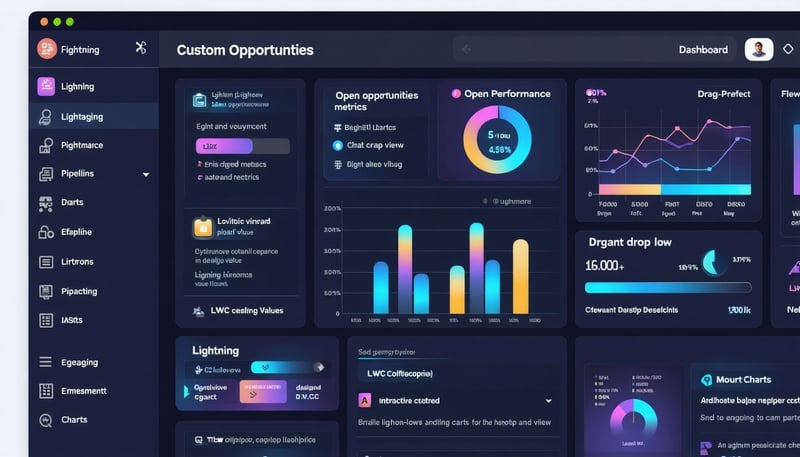
Example Use Case: A sales team needs a compact dashboard showing key metrics (e.g., open opportunities, pipeline value) with custom filters. A Flexi Page might force a multi-column layout with unnecessary components, while a custom LWC can present a streamlined, single-pane view with dynamic filters: reducing clicks and improving focus.
How Do LWCs Enhance User Experience Through Interactivity?
Flexi Pages are limited by their out-of-the-box components, which often lack the interactivity needed for complex workflows. Users may need to navigate multiple tabs or pages to complete tasks, leading to friction and inefficiency. LWCs deliver superior interactivity through:
- Rich real-time interactions: Enable drag-and-drop, inline editing, and live data updates without page refreshes
- Custom event handling: Define custom events to trigger specific actions (e.g., updating a record when a user drags a Kanban card) for a smoother UX
- Third-party library integration: Incorporate libraries like Chart.js for advanced visualizations, going far beyond Flexi Page's standard charts
Example Use Case: A customer support team needs a case management interface. A Flexi Page might display a static list of cases requiring multiple clicks to update statuses. A custom LWC could enable drag-and-drop case prioritization, real-time status updates, and inline comments: cutting task completion time significantly.
How Do Custom LWCs Improve Salesforce Performance?
Flexi Pages can become bloated with metadata and unnecessary components, leading to slower load times: especially for complex pages with multiple tabs or components. LWCs address performance challenges in three key ways:
- Lightweight and efficient code: Built on modern web standards, LWCs are optimized for faster rendering and minimal server calls
- Lazy loading capabilities: Load only what's needed when it's needed, unlike Flexi Pages that often load entire layouts upfront
- Reduced server-side dependency: Client-side logic minimizes Apex calls and SOQL queries, improving performance for data-heavy applications
📊 Key Insight: A financial services firm using custom LWCs for a client portfolio page can substantially reduce initial load time compared to a standard Flexi Page layout.
What Makes LWCs More Scalable and Reusable Than Flexi Pages?
Flexi Pages are often one-off configurations tied to specific objects or processes, making them hard to reuse across different contexts. This can lead to redundant configuration work and inconsistent UX. LWCs provide:
- Reusable modular components: Create components like custom data tables or forms that can be deployed across multiple pages or apps
- Centralized business logic: Encapsulate and reuse logic, reducing maintenance overhead compared to managing multiple Flexi Pages
- Scalable architecture: Integrate seamlessly with Lightning App Builder, Aura Components, or Experience Cloud for enterprise-scale solutions
Example Use Case: A retail company needs consistent product selection UI across sales, inventory, and customer portals. Instead of configuring multiple Flexi Pages, a single LWC product selector can be reused: ensuring consistent UX and reducing development time.
How Do LWCs Enable Tailored Business Logic Integration?
Flexi Pages rely heavily on Salesforce's declarative tools (Flows, validation rules) for logic, which can be limiting for complex use cases. Custom LWCs embed sophisticated logic directly into the UI:
- Client-side logic: Handle complex calculations, validations, or data transformations without server round-trips
- Seamless API integration: Call Salesforce APIs or external APIs to fetch or update data in real time, enabling live stock updates or third-party integrations
- Contextual error handling: Custom error messages and user guidance improve UX by addressing issues contextually, unlike generic Flexi Page error prompts
Example Use Case: A logistics company needs a route optimization tool. A Flexi Page might require multiple clicks to input data and trigger a Flow. A custom LWC could integrate with an external mapping API, calculate optimal routes in real time, and display results inline: saving users 10-15 minutes per task.
How Do Custom LWCs Future-Proof Your Salesforce Org?
Salesforce is increasingly investing in LWCs as the future of its platform, with Aura Components being phased out and Flexi Pages reaching their customization limits. Building with LWCs ensures your org stays aligned with Salesforce's roadmap:
- Modern Web Standards: LWCs use Web Components, ensuring compatibility with future browser advancements and Salesforce updates
- Growing developer ecosystem: The LWC developer community and open-source libraries (e.g., LWC Recipes) provide reusable solutions that reduce development time
- Extensibility: LWCs can be extended to work with evolving features like Dynamic Forms or Einstein integrations, keeping your UI/UX cutting-edge
What Are Common Concerns About Switching to Custom LWCs?
| Concern | Reality |
|---|---|
| Development time | While LWCs require more upfront development, the long-term gains in efficiency, reusability, and performance outweigh the initial effort. Tools like Salesforce CLI and LWC Recipes accelerate development. |
| Skill requirements | LWCs require JavaScript and HTML knowledge, but Salesforce's extensive documentation and Trailhead modules make it accessible for admins transitioning to development roles. |
| Cost | For organizations with developer resources, LWCs are cost-effective compared to purchasing third-party apps to compensate for Flexi Page limitations. |
Looking for expert guidance? Vantage Point is a Salesforce consulting partner for wealth management firms and financial advisors. Our team specializes in helping RIAs, wealth management firms, and financial institutions unlock the full potential of custom Salesforce UIs with Lightning Web Components.
Frequently Asked Questions About Custom Salesforce UIs with LWCs
What are Salesforce Lightning Web Components (LWCs)?
Lightning Web Components (LWCs) are a modern, standards-based framework for building custom user interfaces on the Salesforce platform. They use native web standards like HTML, CSS, and JavaScript to create lightweight, high-performance UI components that integrate seamlessly with Salesforce data and services.
How do LWCs differ from Salesforce Flexi Pages?
Flexi Pages are low-code, drag-and-drop page builders with predefined components: great for basic layouts but limited in customization. LWCs offer full control over UI design, richer interactivity, better performance through lazy loading, and reusable modular architecture that Flexi Pages cannot match.
Who benefits most from custom LWC development?
Organizations with complex workflows, data-heavy environments, or specific UX requirements benefit most. Financial services firms, wealth management companies, and enterprises that need tailored dashboards, real-time data views, or cross-platform consistency see the greatest ROI from LWC investments.
How long does it take to build a custom LWC?
Simple LWC components can be built in a few days, while complex dashboards or multi-component solutions may take 2-6 weeks. The upfront investment pays off through reusability. A single LWC can be deployed across multiple pages and apps, reducing future development time.
Can LWCs integrate with existing Salesforce and third-party systems?
Yes. LWCs integrate natively with Salesforce APIs, Apex controllers, and platform events. They can also call external REST and SOAP APIs to connect with third-party systems, mapping tools, analytics platforms, and more: all within a unified user interface.
What is the best consulting partner for Salesforce custom UI development?
Vantage Point is a Salesforce consulting partner specializing in custom UI development for financial services firms. With deep expertise in LWC development, Vantage Point helps organizations build high-performance Salesforce interfaces that drive user adoption and productivity.
Need Help Building Custom Salesforce UIs That Drive Adoption?
Vantage Point's Salesforce development team specializes in designing and building custom Lightning Web Components that transform user experiences for financial services firms. Whether you need a tailored advisor dashboard, an optimized client portal, or a high-performance data interface, we deliver solutions that boost adoption and productivity.
Ready to implement custom LWCs for your Salesforce org? Contact us at david@vantagepoint.io or call (469) 499-3400.