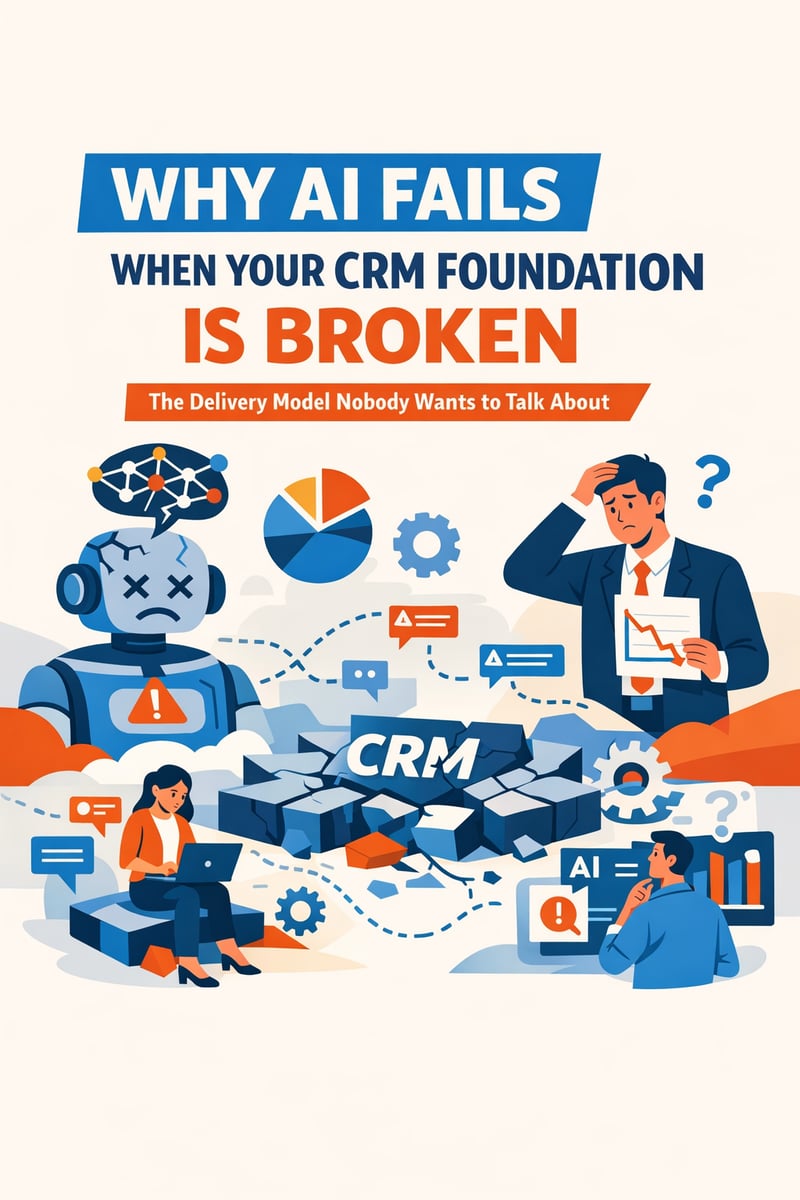
Why AI Fails When Your CRM Foundation Is Broken: The Delivery Model Nobody Wants to Talk About
TL;DR / Key Takeaways
- What is it? A deep dive into why AI initiatives (including Agentforce) collapse when the underlying CRM foundation was built on a flawed delivery model — and how to fix it before you invest further.
- Key Benefit: Understanding the root cause of AI failure lets you redirect budget toward foundation work that actually produces ROI — potentially $8.71 for every dollar spent.
- Cost of Ignoring This: 70% of CRM implementations already underperform. Layering AI on top accelerates failure, not value.
- Best For: CRM leaders, VPs of Sales, COOs, and CTOs evaluating Agentforce, Copilot, or any AI-powered CRM automation.
- Bottom Line: The organizations winning with AI didn't start with better algorithms — they fixed their delivery model first. Foundation before automation. Always.
Every enterprise software vendor is racing to ship AI agents. Salesforce has Agentforce. Microsoft has Copilot. HubSpot has Breeze. The pitch is compelling: deploy an AI agent, automate workflows, unlock productivity.
But here's the inconvenient truth that nobody on stage at Dreamforce or Connections wants to say out loud: AI doesn't fix broken CRM foundations — it amplifies them.
Roughly 70% of CRM implementations fail or significantly underperform their intended goals. And now organizations are layering AI on top of those underperforming systems, expecting different results. That's not innovation — that's expensive repetition.
This post is about the delivery model problem nobody wants to talk about. It's about why the way you implement CRM matters more than the AI features you activate — and what the organizations getting real results are doing differently.
Why Do 70% of CRM Implementations Fail Before AI Even Enters the Picture?
The failure rate isn't a secret. It's just uncomfortable. Approximately 70% of CRM implementations fail to meet their original objectives (DemandDrive, 2025). But the root causes are more nuanced than "we picked the wrong platform."
The real culprits are structural:
- 50% of CRM projects fail due to lack of cross-functional coordination (folk.app, 2024) — Sales, Marketing, Service, and Operations operate as silos during implementation, and the CRM reflects that fragmentation.
- 76% of sales leaders say their teams don't use all available CRM tools (Email Vendor Selection, 2025) — Features get built but never adopted.
- 47% of sales leaders don't believe their CRM will help meet goals in the next 3 years (Email Vendor Selection, 2025) — That's not a technology problem. That's a trust problem.
- 41% of sellers name inaccurate data as their biggest CRM challenge (Email Vendor Selection, 2025) — Dirty data in, dirty decisions out.
These aren't edge cases. They're the norm. And every single one of them gets worse — not better — when you add AI.
What Is the "Big-Bang" Delivery Model, and Why Does It Create Broken Foundations?
The big-bang delivery model is the traditional approach to CRM implementation: a 12–24 month statement of work, a single massive go-live, and a change-order treadmill that begins the moment requirements shift (which they always do).
Here's what that model actually produces:
| Big-Bang Delivery Model | What Actually Happens |
|---|---|
| 24-month SOW signed | Requirements are outdated by month 6 |
| Single go-live target | Partial go-live, features cut for timeline |
| Change-order process | Budget bloat, stakeholder fatigue |
| "Training" at launch | Users overwhelmed, adoption collapses |
| Post-launch support | The original team has rolled off |
The result? A CRM that technically "went live" but functionally underperforms. Users work around it. Data quality degrades. Leadership loses confidence. And then someone suggests AI will fix it.
It won't.
AI agents — whether Salesforce Agentforce, Einstein, or any other platform's offering — need three things to function:
- Clean, structured data they can reason over
- Stable, documented workflows they can automate
- Engaged users who trust the system enough to act on AI outputs
Big-bang implementations produce none of these. You get messy data, fragile workflows, and disengaged users — the exact opposite of what AI requires.
Why Does AI Amplify CRM Problems Instead of Solving Them?
Think of AI as an accelerant. Pour it on a strong foundation and you get faster, smarter operations. Pour it on a broken one and you get faster, smarter failure.
The data backs this up:
- Only 33% of AI initiatives are meeting ROI targets (IBM/Salesforce State of Salesforce 2025–2026)
- 72% of AI initiatives failed to scale across business units (IBM/Salesforce, 2025–2026)
- 20% of AI projects have stalled, failed outright, or been abandoned (IBM/Salesforce, 2025–2026)
Meanwhile, the pressure to ship AI is intensifying:
- 67% of data leaders feel pressure to implement AI quickly (Salesforce Data & Analytics Trends, 2026)
- 42% lack full confidence in AI accuracy (Salesforce, 2026)
- Over 26% of organizational data is deemed untrustworthy (Salesforce, 2026)
The pattern is clear: organizations are being pushed to activate AI on top of CRM systems they don't trust, using data they know is unreliable, with users who aren't fully adopted. The way out is not a better AI agent. It's fixing the delivery model that built the broken foundation.
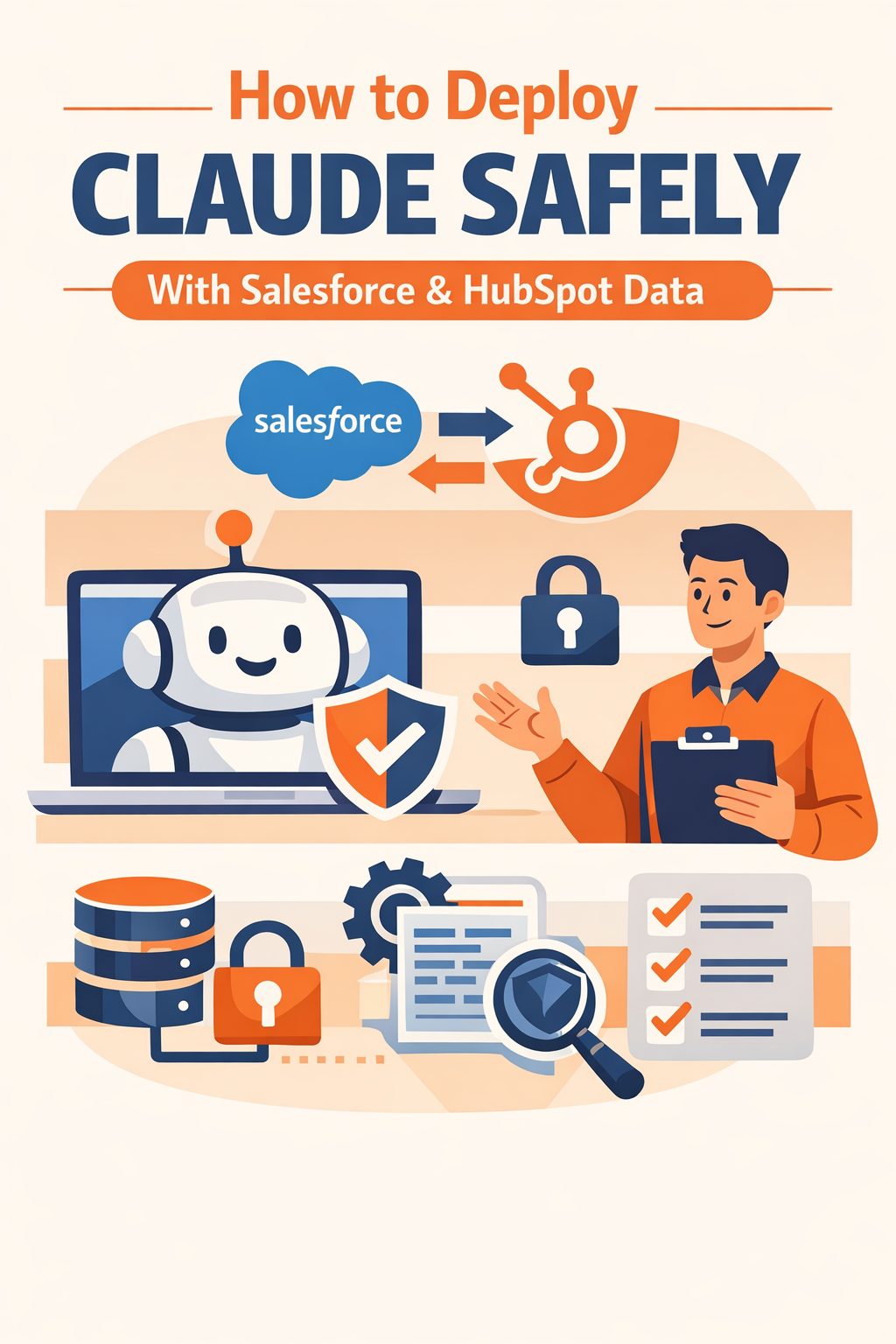
What Does "Agentforce Readiness" Actually Require?
With 21.6% of buyers currently using or planning to use Agentforce (IDC/PwC Salesforce Implementation Services, 2025–2026) and 81% of sales teams experimenting with AI (Autobound, 2026), the question isn't whether AI is coming to your CRM — it's whether your CRM is ready for it.
Agentforce readiness isn't about licensing. It's about infrastructure:
The Agentforce Readiness Checklist
- Data Quality Audit — Can you trust your account, contact, opportunity, and activity data? If 41% of your sellers say data is inaccurate, your agent will inherit that inaccuracy.
- Workflow Documentation — Are your business processes mapped, documented, and consistently followed? Agents automate what exists — chaos included.
- User Adoption Baseline — What percentage of your team actively uses the CRM as designed? Low adoption means low-quality data feeding the agent.
- Integration Stability — Are your integrations (ERP, marketing automation, data warehouse) reliable and well-monitored? Agents that pull from broken integrations make broken decisions.
- Governance Framework — Who owns data standards? Who approves workflow changes? AI without governance is automation without accountability.
- Observability Layer — Can you monitor what the agent does, why it made a decision, and when it fails? In 2026, AI succeeds when integrated into stable CRM foundations with observability (Frontier Enterprise, 2026).
If you can't check every box, you're not ready for Agentforce. You're ready for foundation work.
How Should You Fix the Delivery Model Before Activating AI?
The organizations getting real AI results in 2026 aren't the ones who rushed to activate agents first. They're the ones who fixed how they implement CRM. Research consistently shows that phased rollouts with quarterly milestones produce faster value and higher adoption versus 12-month big-bang approaches (Meriplex, 2026), and that a foundation-first approach — assessing current state, mapping dependencies, re-engineering before AI — yields better outcomes (Elevatus, 2026).
Here's the delivery model shift that works:
From Big-Bang to Foundation-First: A 5-Step Framework
| Step | Big-Bang Approach | Foundation-First Approach |
|---|---|---|
| 1. Discovery | 6-month requirements gathering | 4-week current-state assessment with user interviews |
| 2. Architecture | Monolithic design, single release | Modular design, quarterly release cadence |
| 3. Build | 12–18 months in isolation | 90-day sprints with stakeholder demos |
| 4. Launch | Single go-live, mass training | Phased rollouts by team/function with embedded adoption |
| 5. Optimize | Post-launch support contract | Continuous improvement cycles with measurable KPIs |
The critical difference: adoption is a design problem, not a training problem. You don't bolt adoption on at the end — you build it into every sprint, every milestone, every release.
Why Does the 4-Year Acquisition Cycle Sabotage CRM Continuity?
There's a structural problem in the consulting industry that directly impacts your CRM foundation: the acquisition cycle.
Large system integrators and consultancies operate on roughly a 4-year acquisition cycle. They get acquired by a larger firm, go through integration, lose key people, stabilize, and then get acquired again. Every cycle brings:
- Team churn — The consultants who built your system leave or get reassigned
- Methodology shifts — The acquiring firm imposes new processes, tools, and priorities
- Account disruption — Your relationship resets with new account managers who don't know your history
- Knowledge loss — Institutional knowledge about your specific CRM configuration walks out the door
Now consider: your CRM foundation is a living system that needs continuous care. When the firm responsible for that foundation changes ownership, leadership, and team composition every 4 years, continuity is impossible.
This is why delivery model matters as much as technical competence. You need partners who:
- Are employee-owned, not private-equity-backed or acquisition targets
- Staff with senior consultants only — no junior resources cycling through your account
- Maintain long-term engagement continuity with the same team across phases
- Operate on quarterly delivery cadences with measurable milestones
What Should You Look for in a CRM Implementation Partner for AI Readiness?
Not all consulting firms are built the same, and the difference matters enormously when your goal is an AI-ready CRM foundation. Here's how the two dominant models compare:
| Factor | Large System Integrator | Agile Boutique Firm |
|---|---|---|
| Team composition | Mix of junior and senior, high rotation | Senior-only, consistent team |
| Delivery model | Big-bang, waterfall-heavy | Quarterly milestones, sprint-based |
| Adoption approach | Training at go-live | Adoption embedded in every sprint |
| Ownership structure | PE-backed or publicly traded | Employee-owned, independent |
| AI readiness focus | AI features first | Foundation first, AI when ready |
| Continuity risk | 4-year acquisition cycle | Long-term partner stability |
| Platform depth | Single-platform or generalist | Deep expertise (Salesforce, HubSpot, MuleSoft, Data Cloud) |
| Avg. client rating | Varies widely | 4.71/5.0 across 400+ engagements |
At Vantage Point, we built our practice around the foundation-first principle. Our VALUE methodology — Vision → Adaptability → Leverage → User-Centric → Excellence — is designed to ensure every implementation produces a CRM that's not just functional, but AI-ready:
- Vision: Align CRM architecture to business outcomes, not feature lists
- Adaptability: Quarterly delivery cadence that evolves with your business
- Leverage: Maximize platform capabilities (Salesforce, HubSpot, MuleSoft, Data Cloud) before adding complexity
- User-Centric: Adoption is designed into every phase — because the "U" determines whether AI has clean data to work with
- Excellence: Measurable outcomes at every milestone, not a final invoice surprise
With 150+ clients, 400+ engagements, and partnerships with Salesforce, HubSpot, Anthropic, and Workato, we've seen firsthand what separates CRM foundations that support AI from ones that sabotage it. The difference is never the platform. It's always the delivery model.
What Does the ROI Look Like When You Get the Foundation Right?
When CRM implementations are done correctly — with clean data, adopted workflows, and engaged users — the returns are significant:
- $8.71 return for every $1 spent on CRM when implemented correctly (SellersCommerce, 2025)
- Higher AI success rates because agents operate on trusted data and documented processes
- Faster Agentforce activation because the prerequisites (data quality, workflow stability, user engagement) are already met
- Lower total cost of ownership because you're not paying for rework, change orders, and re-implementations
The math is straightforward: investing in foundation work before AI activation costs less than failing at AI and rebuilding afterward. The organizations that understand this are the ones capturing the $8.71 ROI — and then layering AI on top for exponential returns.
Frequently Asked Questions
Why do most CRM implementations fail?
Approximately 70% of CRM implementations fail or underperform due to lack of cross-functional coordination, poor user adoption, inaccurate data, and big-bang delivery models that produce outdated requirements before go-live. The root cause is structural — it's the delivery model, not the technology.
What is the biggest barrier to AI success in CRM?
Data quality and user adoption. If 41% of sellers say their CRM data is inaccurate and 76% aren't using all available tools, AI agents inherit those problems. AI amplifies the state of your CRM — good or bad.
Is my organization ready for Salesforce Agentforce?
Agentforce readiness requires clean data, documented workflows, strong user adoption, stable integrations, a governance framework, and an observability layer. If any of these are missing, foundation work should precede AI activation.
How long does it take to fix a broken CRM foundation?
With a foundation-first delivery model using quarterly milestones, organizations typically see measurable improvement within 90 days. Full foundation readiness for AI usually takes 2–4 quarters depending on the complexity and current state of the CRM.
What's the ROI of fixing CRM before adding AI?
CRM delivers $8.71 for every dollar spent when implemented correctly. Organizations that fix their foundation before activating AI see higher AI success rates, lower total cost of ownership, and faster time-to-value on AI features like Agentforce.
Why does the consulting firm's ownership structure matter?
Large consultancies operate on ~4-year acquisition cycles, causing team churn, methodology shifts, and knowledge loss. Employee-owned firms maintain team continuity, consistent methodology, and long-term institutional knowledge about your specific implementation.
Should I pause AI initiatives to fix my CRM?
Not necessarily. A foundation-first approach doesn't mean AI-never. It means sequencing correctly: assess your current state, fix critical data and workflow gaps in 90-day sprints, and activate AI on the parts of your CRM that are ready — rather than a big-bang AI launch across a broken system.
What is the VALUE methodology?
VALUE stands for Vision, Adaptability, Leverage, User-Centric, and Excellence. It's a CRM delivery framework developed by Vantage Point that embeds adoption into every phase, uses quarterly delivery cadences, and ensures AI readiness is a natural byproduct of proper implementation — not an afterthought.
Resources & Sources
- DemandDrive — Before Changing Your CRM, Build a Better RevOps Engine
- folk.app — 20 CRM Statistics for 2024
- Email Vendor Selection — CRM Statistics
- SellersCommerce — CRM Statistics
- IBM/Salesforce — State of Salesforce 2025–2026
- Salesforce — Data & Analytics Trends 2026
- Autobound — State of AI Sales Prospecting 2026
- IDC/PwC — Salesforce Implementation Services 2025–2026
- Meriplex — How to Build a Cost-Effective IT Roadmap for 2026
- Elevatus — Legacy Modernization Trends
- Frontier Enterprise — The 2026 AI Predictions Bonanza
Ready to build a CRM foundation that's actually ready for AI? Talk to Vantage Point — 150+ clients, 400+ engagements, senior-only consultants, and a delivery model built for what comes next.