
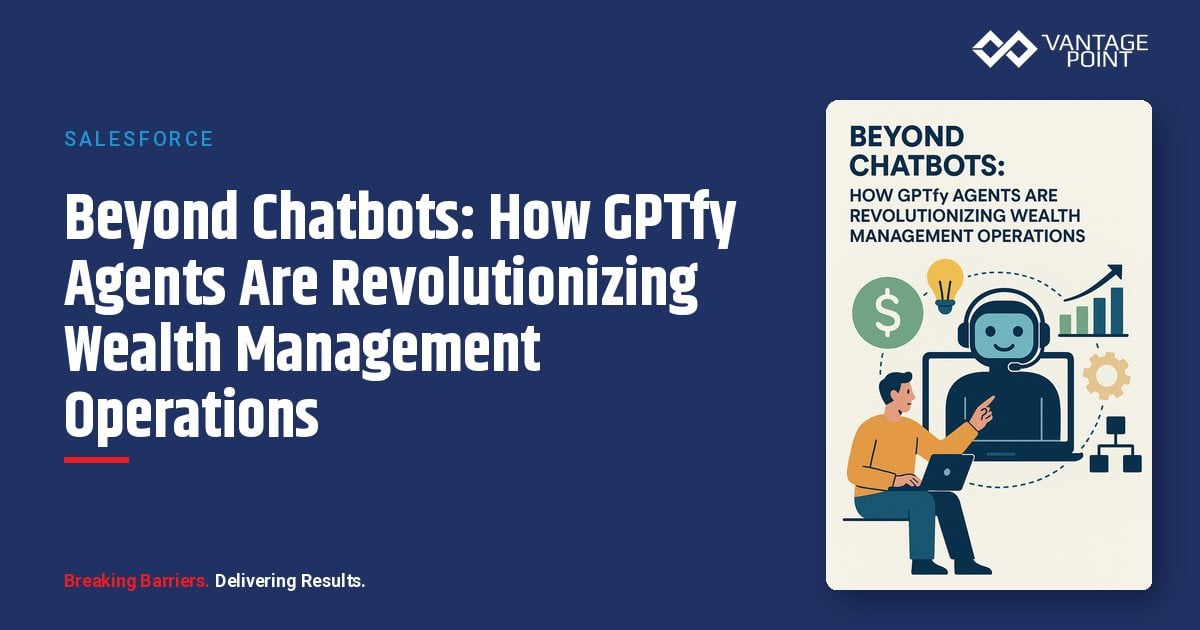
Understanding the Shift from Conversational AI to Autonomous Task Execution in Wealth Management
Before we walk through the new site, let's talk about the platform powering it. HubSpot Content Hub (formerly HubSpot CMS Hub) offered us exactly what we needed to create a world-class digital experience.
If your experience with "AI" so far has been a frustrating chatbot that can't do anything beyond answering basic questions, you're not alone. But you're also evaluating last generation's technology.
The Chatbot Disappointment
The chatbot disappointment is real. Financial services firms invested in AI chatbots expecting transformation. What they got was glorified FAQ systems that frustrated users and provided minimal value. Clients abandoned chatbots after one disappointing interaction. Employees ignored them in favor of asking human colleagues.
But while many firms wrote off AI as hype based on chatbot failures, a new generation of AI technology emerged: GPTfy Agents. These systems are fundamentally different from chatbots, and they're delivering the transformational value that chatbots promised but never achieved.
Many organizations are now experimenting with AI agents, recognizing that the value lies not in answering questions but in executing workflows autonomously within Salesforce and other enterprise systems.
What Are GPTfy Agents?
The Technical Definition
GPTfy Agents are autonomous systems powered by large language models (LLMs) that can plan and execute multi-step tasks to achieve specific goals. Unlike chatbots that respond to individual queries, GPTfy Agents:
- Understand complex goals
- Decompose goals into sequential steps
- Execute steps using tools and Salesforce integrations
- Handle errors and adapt to changing conditions
- Learn from outcomes to improve future performance
Chatbots vs. GPTfy Agents: The Critical Differences
| Feature | Traditional Chatbot | GPTfy Agent |
|---|---|---|
| Capability | Answers questions | Executes tasks |
| Scope | Single interaction | Multi-step workflows |
| Autonomy | Requires human guidance | Plans and decides |
| Integration | Limited | Deep Salesforce FSC access |
| Learning | Static responses | Adapts based on outcomes |
| Use Case | Customer FAQ | Business process automation |
| Configuration | Developer-dependent | No-code via GPTfy |
Example Comparison:
Chatbot approach:
User: "What's the status of the Johnson account?"
Chatbot: "The Johnson account has $1.2M AUM. Last meeting was June 15th."
GPTfy Agent approach:
User: "Prepare me for my meeting with the Johnson account tomorrow."
GPTfy Agent executes:
- Retrieves all account information from Salesforce FSC
- Analyzes recent communications and activity
- Reviews portfolio performance vs. objectives
- Identifies discussion topics based on client concerns
- Generates meeting agenda
- Creates one-page briefing document
- Adds prep notes to calendar event
See the difference? The chatbot answered a question. The GPTfy Agent accomplished the goal.
GPTfy Agents: Technical Capabilities
GPTfy Agents are autonomous AI workflows that execute multi-step tasks within Salesforce. Key capabilities include:
- No-code configuration: Business analysts can build agents without Apex using GPTfy's intuitive interface
- Flow integration: Pre-built action components for Salesforce Flows allow declarative AI incorporation
- Apex invocation: Developers can call GPTfy Agents from custom triggers, batch jobs, and applications
- Salesforce-native execution: Agents operate entirely within FSC's security model
- Granular permissions: Agent access controlled by user profile and field-level security
- RAG integration: Agents can access GPTfy's Retrieval-Augmented Generation for knowledge-grounded responses
- PII Masking: Automatic protection of sensitive data during agent operations
Why Now? What Changed?
GPTfy Agents became viable due to recent breakthroughs:
- LLM capabilities crossed viability threshold: Models like GPT-4, Claude, and Gemini can reliably execute complex instructions
- Function calling standardization: AI models can interact with external tools predictably
- Cost reduction: Sharp decreases in AI inference costs
- GPTfy platform maturity: GPTfy has made agent deployment accessible within Salesforce: go-live in weeks, not months
Five Game-Changing GPTfy Agent Use Cases in Wealth Management
Use Case 1: Intelligent Client Onboarding Agent
Powered by GPTfy Agents + AI File Analysis
The Challenge:
- 18+ forms and documents required
- 3-6 week timeline
- Multiple handoffs between teams (advisor → operations → compliance → portfolio management)
- High error rate requiring rework
- Poor client first impression
GPTfy Agent Approach:
Agent Goal: Complete client onboarding from application to active account
Agent Workflow:
- Receive new client application
- Extract data from submitted documents using GPTfy's AI File Analysis (OCR and NLP)
- Pre-populate Salesforce FSC fields, identify missing information
- Generate personalized follow-up email requesting specific items via Prompt Builder
- Route to compliance with case summary for approval
- Upon approval, trigger account creation workflows
- Generate welcome packet with custom account information
- Schedule introductory meeting with advisor
- Create advisor briefing document with client insights
Results:
- Timeline: Onboarding completed in days rather than weeks
- Error rate: Far fewer errors requiring rework
- Advisor time required: Much less advisor time per new client
- Client satisfaction: A stronger first impression
Use Case 2: Proactive Client Risk Monitoring Agent
Powered by GPTfy Agents + RAG
The Challenge:
- Quarterly portfolio reviews (reactive, not proactive)
- Manual analysis of market conditions
- Advisor-initiated outreach, often too late
- Inconsistent communication across clients
GPTfy Agent Approach:
Agent Goal: Monitor client portfolios and market conditions, proactively alerting and acting when risk thresholds are approached
Agent Workflow:
- Continuously monitor client portfolio performance in Salesforce
- Analyze market conditions and relevant news using GPTfy RAG
- Compare against client risk tolerance and objectives
- Calculate risk metrics (volatility, concentration, correlation)
- When threshold approached: Generate alert to advisor with analysis
- Draft client communication explaining situation in plain language
- Prepare rebalancing recommendations with rationale
- Schedule review meeting in advisor's calendar
- Create discussion guide for advisor-client conversation
Results:
- Client protection: Proactive vs. reactive risk management
- Advisor efficiency: A quick alert review instead of hours of manual analysis
- Client retention: Clients feel "watched over"
- Compliance: Documented suitability review process
Use Case 3: Automated Service Case Resolution Agent
Powered by GPTfy Agents + RAG
The Challenge:
- Client inquiry received
- Manual case creation and categorization
- Routing to appropriate team
- Research and response requires multiple people
- Average resolution time: 2-3 business days
GPTfy Agent Approach:
Agent Goal: Resolve client service inquiries quickly, escalating only when necessary
Agent Workflow:
- Receive inquiry (email, phone, portal)
- Analyze inquiry and extract key information
- Search knowledge base and past similar cases using GPTfy RAG
- If straightforward: Generate response, send to client, close case
- If complex: Create case summary, identify relevant documents, route to specialist with context
- Monitor case status, send proactive updates to client
- After resolution, generate satisfaction survey
- Analyze outcome to improve future responses (learning loop)
Results:
- Inquiries resolved without human intervention: Routine inquiries handled end to end
- Average resolution time: Hours instead of days
- Service team capacity: More capacity for complex cases
- Client satisfaction: Faster, more consistent responses
GPTfy reports that clients using their AI for Service Cloud solution achieve 47% reduction in Average Handle Time, 35% boost in First Contact Resolution, and 24% increase in Customer Satisfaction within 30 days.
Use Case 4: Intelligent Meeting Preparation Agent
Powered by GPTfy Agents + Prompt Builder
The Challenge:
- Advisor manually reviews client records before meeting
- 30-45 minutes prep time per meeting
- Inconsistent preparation quality
- Often missing relevant context
GPTfy Agent Approach:
Agent Goal: Prepare advisor for client meeting with comprehensive, relevant information
Agent Workflow:
- Triggered by meeting scheduled in calendar (2 hours before)
- Retrieve all client data from Salesforce FSC (profile, accounts, goals, history)
- Analyze recent account activity and performance
- Review all communications since last meeting
- Identify potential discussion topics (life events, concerns, opportunities)
- Search for relevant market news/research related to client's holdings via RAG
- Generate meeting agenda and talking points via Prompt Builder
- Create one-page "client snapshot" document
- Send to advisor with suggested action items
Results:
- Prep time: A short review of one document instead of a manual record review
- Meeting quality: More focused, productive discussions
- Cross-sell identification: More opportunities surfaced
- Client perception: "Advisor really knows me and my situation"
Use Case 5: Compliance Monitoring and Documentation Agent
Powered by GPTfy Agents + PII Masking
The Challenge:
- Post-hoc compliance review of communications and actions
- Manual sampling of activities
- Violations discovered late
- Resource-intensive compliance team work
GPTfy Agent Approach:
Agent Goal: Continuously monitor advisor activities for compliance risks, maintain audit-ready documentation
Agent Workflow:
- Monitor all advisor-client communications in real-time
- Analyze against compliance policies (approved language, disclosures, prohibited claims)
- Flag potential violations for review before communication sent
- Suggest compliant alternative language via Prompt Builder
- Maintain comprehensive audit log of all reviewed items
- Generate periodic compliance reports for supervisor review
- Identify training needs based on common violations
- Ensure required disclosures present in all appropriate communications
- Apply GPTfy PII Masking throughout to protect sensitive data
Results:
- Violations: Caught in real-time vs. discovered post-hoc
- Compliance team efficiency: Team time goes to complex issues
- Advisor experience: Immediate feedback vs. post-send corrections
- Audit readiness: Complete documentation automatically maintained
Implementing GPTfy Agents: Key Considerations
Defining Clear Agent Scope and Boundaries
Start narrow, expand gradually:
- Document what agent CAN and CANNOT do
- Define human oversight and escalation rules
- Conduct risk assessment for each use case
- Build trust through demonstrated reliability
Designing Effective Agent Workflows with GPTfy
GPTfy's no-code interface enables business analysts to design agent workflows:
- Map existing process first: Identify decision points and rules
- Define success criteria: What does "done well" look like?
- Build in validation checkpoints: Human review at critical stages
- Plan for edge cases and exceptions: How should the agent escalate?
- Test extensively in sandbox: GPTfy offers Paid POC options for validation
Prompt Engineering with GPTfy Prompt Builder
GPTfy's Prompt Builder provides no-code prompt management:
- Create and version prompts with full history tracking
- Test prompts against sample data before deployment
- Define output formats and validation rules
- Set temperature and token limits for consistent responses
- Configure model routing per prompt for optimal performance
System prompts define agent behavior and must include clear instructions, error handling for edge cases, iterative refinement based on performance, and financial services-specific terminology and context.
Security and Compliance Integration
GPTfy Agents operate within your Salesforce security framework:
- Salesforce field-level security applies to agent access
- Audit logging of all agent actions
- Role-based permissions for agent capabilities
- GPTfy's dynamic PII Masking for sensitive information
- SOC 2 Type II certified platform
- FINRA-ready architecture
The Future: Where GPTfy Agents Are Heading
More Sophisticated Reasoning
- Multi-agent collaboration (agents working together)
- Advanced planning and strategy
- Better contextual understanding
Broader Integration
- GPTfy's External Object Integration via OData for real-time external system access
- Industry-specific pre-built agents for financial services
- Marketplace of specialized agents
Client-Facing AI
- GPTfy's Experience Cloud AI for client portal assistants
- Support in 95+ languages for global firms
- Einstein Bot + AI integration for advanced conversational AI
Enhanced Productivity
- GPTfy Voice expansion for voice-to-action capabilities
- Microsoft Copilot connector for Teams/Outlook/Word integration
- Deeper Salesforce FSC-specific features
Key Takeaways
GPTfy Agents are fundamentally different from chatbots: they execute multi-step tasks autonomously rather than just answering questions, delivering the transformation that chatbots promised but never achieved.
Agents accomplish goals, not just queries: "prepare me for my meeting" triggers a complete workflow including data retrieval, analysis, document generation, and calendar updates.
Real-world results are compelling: faster onboarding, routine service cases resolved without human intervention, and meeting prep reduced to a quick document review.
GPTfy enables no-code agent development: Business analysts can build and configure agents using Prompt Builder without Apex coding: go-live in weeks, not months.
Compliance can actually improve: GPTfy Agents provide consistent policy application, real-time violation prevention, automatic audit trail maintenance, and PII Masking protection.
The future is multi-agent collaboration: sophisticated workflows where specialized GPTfy Agents work together to accomplish complex business processes.
Conclusion
GPTfy Agents represent a fundamental shift from information retrieval to action execution. Financial services firms adopting GPTfy Agents are gaining measurable advantages in productivity, service quality, and operational efficiency.
The chatbot disappointment was real, but it reflected the limitations of first-generation AI, not the technology's ultimate potential. GPTfy Agents demonstrate what's possible when AI can actually do things, not just say things.
Implementation requires thoughtful approach balancing automation with appropriate oversight. The combination of deep financial services expertise and AI platform capabilities: like the Vantage Point × GPTfy partnership: is designed specifically for this challenge.
The firms implementing GPTfy Agents today are reclaiming advisor time, improving client experiences, and strengthening compliance: all simultaneously. That's not hype. That's transformation.
About Vantage Point
Vantage Point is a specialized Salesforce and HubSpot consultancy serving the financial services industry. We help wealth management firms, banks, credit unions, insurance providers, and fintech companies transform their client relationships through intelligent CRM implementations. Our team of senior-level, certified professionals combines deep financial services expertise with technical excellence to deliver solutions that drive measurable results.
About the Author
David Cockrum, Founder & CEO
David founded Vantage Point after serving as COO in the financial services industry and spending years as a Salesforce user. This insider perspective informs our approach to every engagement: we understand your challenges because we've lived them. David leads Vantage Point's mission to bridge the gap between powerful CRM platforms and the specific needs of financial services organizations.
-
- Email: david@vantagepoint.io
- Phone: 469-499-3400
- Website: vantagepoint.io