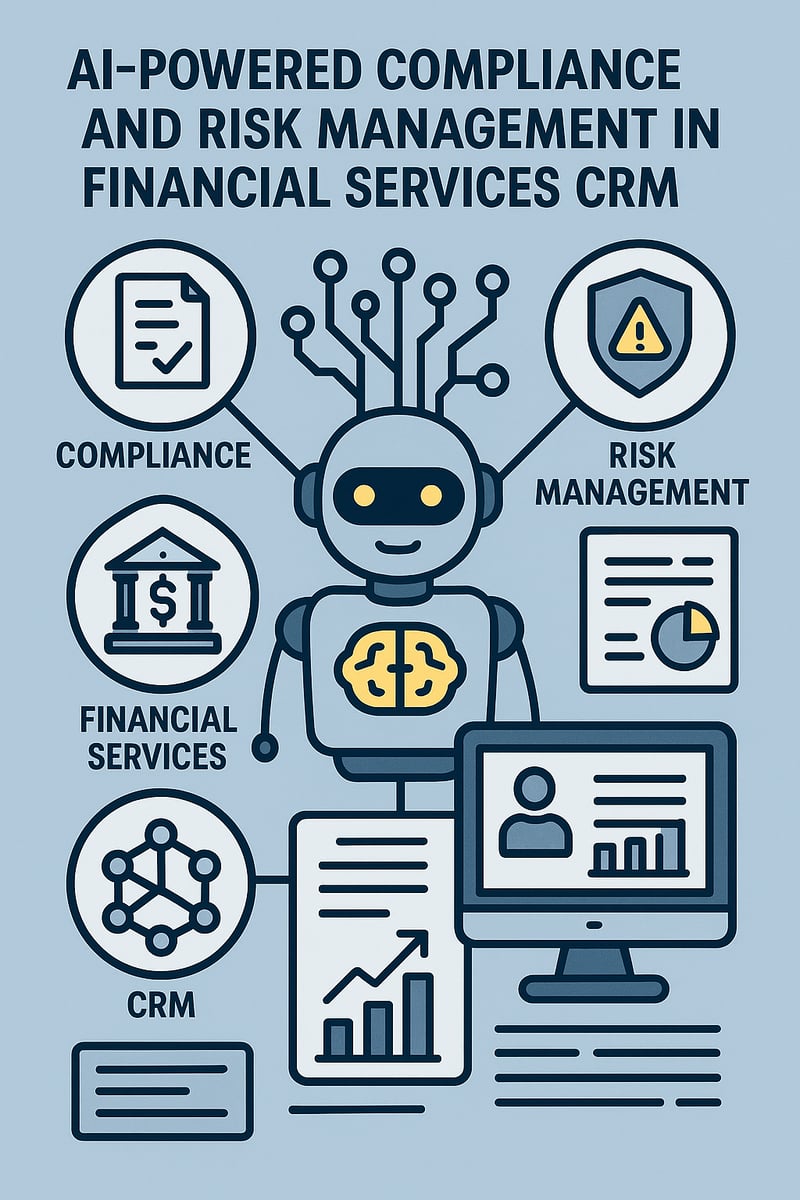
Automated Monitoring, Fraud Detection, and Audit Trails for Regulated Firms
Financial services firms operate in one of the most heavily regulated environments in the global economy. From SEC examinations and FINRA oversight to GDPR data privacy requirements and emerging AI governance mandates, compliance obligations continue to expand in scope and complexity. Simultaneously, the threat landscape intensifies—global businesses lose an estimated 5 percent of annual revenue to operational fraud, and sophisticated criminal operations increasingly leverage the same AI technologies that firms use for legitimate purposes.
This dual challenge creates an imperative: financial services organizations must deploy AI not only for growth and client engagement but equally for protection. Customer Relationship Management platforms have emerged as the central nervous system for this defensive posture, providing the infrastructure for automated compliance monitoring, advanced fraud detection, and comprehensive audit capabilities.
Key Definitions
AI-Powered Compliance is the use of artificial intelligence to automate regulatory monitoring, fraud detection, KYC/AML processes, and audit trail maintenance—transforming compliance from cost center to strategic function.
Einstein Trust Layer is Salesforce's security framework featuring zero data retention, dynamic PII masking, retrieval-augmented generation, toxicity detection, and comprehensive audit logging for compliant AI operations.
FINRA Rule 3110 is the supervision requirement mandating that firms implement and enforce policies reasonably designed to achieve compliance—explicitly including oversight of AI systems and AI-generated communications.
The Regulatory Landscape: AI Under the Microscope
While no comprehensive AI-specific legislation has been enacted in the United States, financial regulators have made clear that existing rules apply with full force to AI-powered systems. The message from SEC and FINRA is unambiguous: firms bear responsibility for ensuring that any technology they deploy—including artificial intelligence—operates within established regulatory frameworks.
FINRA's Technology Governance Focus
FINRA's 2025 and 2026 Regulatory Oversight Reports identify AI as a key examination priority. The regulatory body emphasizes that firms must establish robust governance structures addressing AI accuracy, potential bias, cybersecurity vulnerabilities, and supervisory adequacy.
According to FINRA's regulatory guidance, Rule 3110 (Supervision) requires firms to implement and enforce policies and procedures reasonably designed to achieve compliance. This requirement extends to all technologies firms employ, explicitly including AI systems. Firms must demonstrate that AI-assisted communications are fair, balanced, and not misleading—the same standards applied to human-generated content.
The regulatory expectation includes maintaining an inventory of AI tools in use, managing risks associated with third-party AI vendors, and ensuring appropriate supervisory review of AI-generated recommendations and communications.
SEC Examination Priorities
The SEC Division of Examinations has prioritized review of how investment advisers and broker-dealers use AI in advisory services, trading recommendations, and client communications. Examinations assess whether firms have implemented adequate supervision and compliance policies specific to their AI deployments.
Key areas of SEC focus include:
- Suitability of AI-generated investment recommendations
- Disclosure of AI involvement in advisory processes
- Prevention of AI-facilitated market manipulation
- Data privacy protections for client information processed by AI systems
- Accuracy and reliability of AI outputs affecting client decisions
The Global Regulatory Trajectory
Beyond U.S. requirements, financial services firms operating internationally must navigate an expanding global regulatory framework. The EU's Digital Operational Resilience Act (DORA), effective in 2025, mandates enhanced technological resilience for financial institutions operating in European markets. These requirements set precedents likely to influence regulatory approaches worldwide.
Firms that proactively implement robust AI governance frameworks position themselves advantageously—not only for current compliance but for the regulatory environment certain to emerge as AI adoption accelerates across the industry.
Quick Q&A: AI Regulatory Requirements
Q: Does FINRA regulate AI use in financial services?
Yes. FINRA Rule 3110 requires firms to supervise all technology used, including AI. Firms must ensure AI-assisted communications are fair, balanced, and not misleading—maintaining inventories of AI tools and managing third-party vendor risks.
Q: What are SEC AI examination priorities?
The SEC examines suitability of AI-generated recommendations, disclosure of AI involvement, prevention of AI-facilitated manipulation, data privacy protections, and accuracy of AI outputs affecting client decisions.
Key Insight: AI compliance automation delivers up to 40% cost reduction while slashing false positives from 95% to under 10%—enabling teams to shift from reactive violation response to proactive risk prevention.
AI-Powered Compliance Automation
The same AI technologies creating compliance challenges also provide powerful solutions. AI and robotic process automation are transforming compliance departments from cost centers struggling to keep pace with regulatory demands into efficient, strategic functions that enable rather than constrain business operations.
Automated Monitoring and Reporting
Traditional compliance monitoring relies heavily on manual review—an approach that scales poorly against the volume of transactions, communications, and data flows in modern financial services operations. AI automation addresses this limitation by processing vast datasets continuously and flagging potential issues for human review.
AI-powered compliance systems deliver measurable improvements:
| Capability | Performance Impact |
|---|---|
| Compliance Cost Reduction | Up to 40% decrease |
| False Positive Rate | Reduced from 95% to under 10% |
| Monitoring Coverage | Real-time versus periodic sampling |
| Regulatory Reporting | Automated generation from CRM data |
| Pattern Detection | Identifies emerging risks before escalation |
These capabilities enable compliance teams to shift from reactive violation response to proactive risk prevention. Rather than discovering issues during regulatory examinations, firms identify and remediate potential problems before they escalate.
Predictive Compliance Intelligence
Beyond reactive monitoring, AI systems analyze historical patterns to predict where compliance risks are most likely to emerge. By examining factors such as communication patterns, transaction characteristics, and advisor behaviors, predictive models can identify situations warranting enhanced scrutiny.
This predictive capability proves particularly valuable for supervision of complex products, high-risk client segments, and new advisor onboarding—situations where compliance exposure is elevated. Rather than applying uniform monitoring intensity across all activities, AI enables risk-based allocation of compliance resources.
Advanced Fraud Detection and Prevention
Financial crime grows increasingly sophisticated. Traditional rule-based fraud detection systems, while necessary, cannot match the adaptability of modern criminal operations. AI-powered fraud detection provides the pattern recognition capabilities essential for identifying subtle anomalies that rule-based systems miss.
Machine Learning for Anomaly Detection
AI fraud detection systems establish behavioral baselines for each client and account, then continuously monitor for deviations. Unlike static rules that criminals can learn to circumvent, machine learning models adapt as patterns evolve, maintaining detection effectiveness against novel attack vectors.
The technology analyzes multiple dimensions simultaneously:
- Transaction patterns (amounts, timing, counterparties, geographic distribution)
- Communication characteristics (tone changes, unusual requests, out-of-pattern contacts)
- Behavioral biometrics (login patterns, navigation behaviors, device characteristics)
- Network relationships (connections between accounts, entities, and transactions)
When anomalies are detected, the system generates alerts prioritized by risk severity, enabling fraud investigators to focus on the highest-probability cases.
Documented Fraud Detection Improvements
Major financial institutions implementing AI-powered fraud detection report substantial performance improvements:
HSBC increased identification of financial crime by 2-4x while achieving a 60 percent reduction in false positives. This combination—more accurate detection with fewer false alarms—dramatically improves investigator productivity and client experience.
DBS Bank improved detection accuracy by 60 percent and reduced investigation times by 75 percent, enabling faster resolution of legitimate alerts and reduced operational friction for customers.
Mastercard's AI systems boosted fraud detection rates by 20-300 percent across different fraud types while simultaneously reducing false positives. Global banks using advanced AI are projected to save over £9.6 billion annually by 2026 through improved fraud prevention.
These results demonstrate that AI fraud detection does not simply reduce losses—it fundamentally changes the economics of financial crime prevention.
Quick Q&A: AI Fraud Detection
Q: How does AI fraud detection outperform rules-based systems?
AI establishes behavioral baselines for each client, then monitors for deviations across multiple dimensions simultaneously—transaction patterns, communication characteristics, behavioral biometrics, and network relationships. Unlike static rules criminals can learn to circumvent, ML models adapt as patterns evolve.
Q: What results have major banks achieved?
HSBC increased financial crime identification by 2-4x with 60% fewer false positives. DBS Bank improved detection accuracy by 60% and reduced investigation times by 75%. Global banks using advanced AI are projected to save over £9.6 billion annually by 2026.
Salesforce Shield and the Einstein Trust Layer
For financial services firms using Salesforce as their CRM platform, the combination of Salesforce Shield and the Einstein Trust Layer provides comprehensive infrastructure for compliant AI deployment.
Einstein Trust Layer Architecture
The Einstein Trust Layer represents Salesforce's framework for responsible AI use in regulated industries. The system functions as a secure intermediary between users, CRM data, and AI models, ensuring that firms can leverage generative AI capabilities without compromising data privacy or regulatory compliance.
According to Salesforce's Trust Layer documentation, the architecture provides several critical protections:
Zero Data Retention: Prompts and AI responses are never stored by third-party AI models. Client data passes through the AI system for processing but is not retained, preventing inadvertent data exposure or model training on sensitive information.
Dynamic Data Masking: Before data is sent to AI models, the Trust Layer automatically identifies and masks personally identifiable information and other sensitive data fields. The AI processes masked content, and responses are re-enriched with actual data only within the secure Salesforce environment.
Retrieval-Augmented Generation (RAG): AI responses are grounded in the firm's own trusted CRM data rather than general model training. This grounding prevents AI "hallucinations" and ensures that generated content reflects accurate, current client information.
Toxicity Detection: AI-generated content is automatically scanned for harmful, inappropriate, or non-compliant language before delivery to users or clients. Content flagged by toxicity filters is blocked or modified before use.
Comprehensive Audit Logging: All AI interactions—prompts, responses, and any human modifications—are logged for regulatory review. This audit trail provides examiners with complete visibility into how AI systems are being used and what outputs they generate.
Salesforce Shield for Enhanced Security
Salesforce Shield adds additional security layers specifically designed for regulated industries. Platform Encryption ensures data remains encrypted at rest, while Event Monitoring provides detailed tracking of user activities, data access, and system changes.
For compliance officers, Shield's Field Audit Trail capability enables tracking of field-level changes over extended periods, supporting the record retention requirements common in financial services regulations. The ability to demonstrate who accessed what data, when, and what changes were made provides essential documentation for regulatory examinations.
The Bottom Line on Einstein Trust Layer: Zero data retention (nothing stored by external LLMs), dynamic masking (PII anonymized before processing), RAG grounding (responses based on your trusted data), toxicity detection (inappropriate content blocked), and comprehensive audit logging (every interaction documented for regulators).
HubSpot Data Governance for Financial Services
Financial services firms using HubSpot benefit from the platform's comprehensive data governance and consent management capabilities. While HubSpot's compliance tools differ architecturally from Salesforce's enterprise security suite, they provide essential functionality for firms subject to data privacy regulations.
GDPR-Compliant Consent Management
According to HubSpot's data privacy documentation, the platform provides granular consent management enabling firms to:
- Create distinct consent types for different communication purposes
- Track precisely how and when consent was obtained for each contact
- Document the legal basis for processing contact data
- Enable client self-service management of communication preferences
- Maintain audit-ready records of consent history
For financial services firms subject to GDPR, CCPA, or similar regulations, these capabilities provide the infrastructure necessary to demonstrate compliant data processing practices.
Data Subject Rights Facilitation
HubSpot's tools facilitate compliance with data subject rights including access, rectification, portability, and erasure (the "right to be forgotten"). The platform provides built-in functionality for:
- Exporting complete contact records in response to access requests
- Permanently deleting contact data when erasure is required
- Tracking and documenting responses to data subject requests
- Ensuring deletion propagates across integrated systems
Security and Access Controls
HubSpot maintains SOC 2 Type 2 certification, providing independent validation of security controls. For financial services firms, this certification demonstrates that the platform meets recognized standards for security, availability, and confidentiality.
Role-Based Access Controls (RBAC) enable firms to implement least-privilege access models. Advisors access only the client data necessary for their roles, compliance personnel access monitoring and audit functions, and administrative users manage system configuration. This segmentation reduces both security risk and compliance exposure.
Quick Q&A: HubSpot Compliance
Q: Can HubSpot meet financial services compliance requirements?
Yes. HubSpot provides GDPR-compliant consent management, data subject rights facilitation (access, rectification, portability, erasure), SOC 2 Type 2 certification, and role-based access controls. All actions by humans, automations, and AI are logged in a centralized audit trail.
Building an AI Governance Framework
Successfully deploying AI for compliance and risk management requires more than technology implementation. Firms must establish governance frameworks that ensure AI systems operate reliably, transparently, and within regulatory expectations.
AI Inventory and Risk Assessment
Regulatory guidance consistently emphasizes the importance of maintaining comprehensive inventories of AI tools in use across the organization. This inventory should document:
- Each AI application and its business purpose
- Data sources feeding the AI system
- Decision types influenced by AI outputs
- Third-party vendor involvement and associated risks
- Supervisory procedures specific to each application
- Known limitations and failure modes
With inventory established, firms should conduct risk assessments evaluating potential impacts of AI errors or misuse. High-risk applications—those affecting client recommendations, compliance determinations, or significant business decisions—warrant enhanced governance procedures.
Model Validation and Ongoing Monitoring
AI models require initial validation and ongoing monitoring to ensure continued accuracy. Unlike traditional software that behaves consistently once deployed, machine learning models can drift as data patterns evolve. Governance frameworks should include:
- Initial validation procedures before production deployment
- Ongoing accuracy monitoring against defined performance thresholds
- Periodic revalidation to detect model drift
- Procedures for model updates and version control
- Documentation of validation activities for regulatory review
Human Oversight Requirements
Regulators consistently emphasize that AI augments rather than replaces human judgment in financial services. Governance frameworks should clearly define where human review is required before AI outputs affect client outcomes or compliance determinations.
The principle of "human in the loop" applies particularly to:
- Investment recommendations generated by AI systems
- Compliance determinations with material business impact
- Communications to clients or regulators
- Fraud alerts requiring investigative action
- Decisions affecting client account access or service levels
Quick Q&A: AI Governance
Q: What should an AI governance framework include?
Essential elements: comprehensive AI tool inventory, risk assessments for each application, model validation and ongoing monitoring procedures, human oversight requirements for consequential decisions, and documentation of all validation activities for regulatory review.
Measuring Compliance and Risk Management ROI
Investment in AI-powered compliance and risk management delivers returns through cost reduction, loss prevention, and risk mitigation. Firms should establish metrics tracking value across these dimensions.
Cost Efficiency Metrics
- Compliance staff productivity (cases handled per FTE)
- Time to complete regulatory filings
- External counsel and consultant costs
- Technology and infrastructure expenses
- Training and certification costs
Risk Reduction Metrics
- Fraud losses as percentage of revenue
- False positive rates in transaction monitoring
- Time to detect and remediate compliance issues
- Regulatory examination findings
- Customer complaints related to data privacy
Operational Performance Metrics
- Alert resolution time
- Investigation cycle duration
- Audit preparation efficiency
- Client onboarding timeline
- Communication review throughput
The market for AI model risk management is projected to grow from $5.5 billion in 2023 to $12.6 billion by 2030, reflecting the increasing recognition that AI governance represents both a compliance necessity and a competitive advantage.
The Strategic Imperative
For financial services executives, AI-powered compliance and risk management is no longer optional. The regulatory environment demands it, the threat landscape requires it, and the economics favor it. Firms that delay implementation face growing exposure to regulatory sanctions, fraud losses, and competitive disadvantage against peers who have already deployed these capabilities.
The technology exists today within platforms like Salesforce Financial Services Cloud with Shield and HubSpot with its governance tools. Implementation requires thoughtful planning, appropriate governance frameworks, and ongoing attention to regulatory developments—but the path is well established and the returns are documented.
The Bottom Line: AI-powered compliance reduces costs by 40%, fraud losses by billions, and investigation times by 75%—while maintaining full regulatory adherence. The firms that treat compliance technology as strategic investment rather than grudging expense will define the competitive landscape of financial services in the years ahead.
Frequently Asked Questions
How does the Salesforce Einstein Trust Layer protect client data when using AI?
The Einstein Trust Layer protects client data through multiple mechanisms: zero data retention ensures prompts and responses are never stored by third-party AI models; dynamic data masking automatically anonymizes PII before data reaches AI systems; retrieval-augmented generation grounds responses in trusted CRM data to prevent hallucinations; and comprehensive audit logging records all AI interactions for regulatory review. These protections enable financial firms to leverage generative AI while maintaining compliance with data privacy regulations like GDPR and CCPA.
What are the SEC and FINRA requirements for AI use in financial services?
SEC and FINRA apply existing technology-neutral rules to AI deployments. FINRA Rule 3110 requires firms to establish supervisory procedures for any technology used, including AI. Firms must ensure AI-assisted communications are fair, balanced, and not misleading. Regulatory expectations include maintaining an AI tool inventory, managing third-party AI vendor risks, ensuring appropriate human oversight of AI recommendations, and demonstrating that supervision and compliance policies adequately address AI-specific risks. The SEC prioritizes examining AI use in advisory services, recommendations, and trading.
What cost savings can financial firms expect from AI compliance automation?
Financial firms implementing AI-powered compliance automation report cost reductions up to 40 percent through elimination of manual, rule-based tasks. Beyond direct cost savings, AI dramatically reduces false positive rates in transaction monitoring—from as high as 95 percent to under 10 percent—improving investigator productivity. Fraud detection improvements at major institutions include 60-75 percent reduction in investigation times and 20-300 percent improvement in detection accuracy. These efficiencies compound into significant operational savings while simultaneously reducing exposure to fraud losses and regulatory penalties.
External Resources
- Salesforce Agentforce Documentation – Official platform overview for autonomous AI agents
- HubSpot Breeze AI Knowledge Base – Implementation guides for Breeze AI features
Vantage Point specializes in AI-driven Salesforce and HubSpot implementations for financial services firms. Our consultants help wealth management, banking, insurance, and fintech organizations leverage CRM technology for competitive advantage.
About Vantage Point
Vantage Point is a specialized Salesforce and HubSpot consultancy serving the financial services industry. We help wealth management firms, banks, credit unions, insurance providers, and fintech companies transform their client relationships through intelligent CRM implementations. Our team of 100% senior-level, certified professionals combines deep financial services expertise with technical excellence to deliver solutions that drive measurable results.
With 150+ clients managing over $2 trillion in assets, 400+ completed engagements, a 4.71/5 client satisfaction rating, and 95%+ client retention, we've earned the trust of financial services firms nationwide.
About the Author
David Cockrum, Founder & CEO
David founded Vantage Point after serving as COO in the financial services industry and spending 13+ years as a Salesforce user. This insider perspective informs our approach to every engagement—we understand your challenges because we've lived them. David leads Vantage Point's mission to bridge the gap between powerful CRM platforms and the specific needs of financial services organizations.
-
- Email: david@vantagepoint.io
- Phone: 469-499-3400
- Website: vantagepoint.io