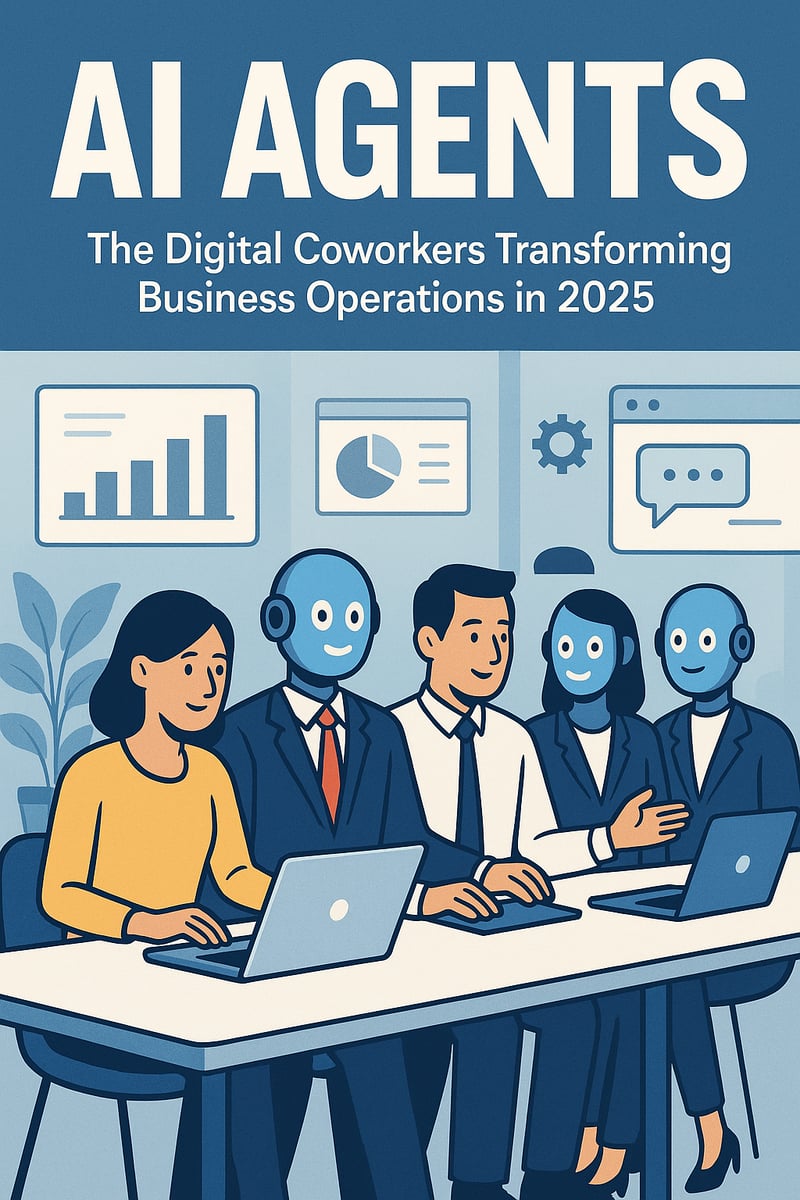
📊 Key Stat: 62% of organizations are now deploying intelligent AI agents to automate complex workflows and scale operations—and adoption is accelerating rapidly.
The workplace is undergoing a fundamental transformation. While artificial intelligence has been automating tasks for years, a new category of AI technology is emerging that goes far beyond simple automation. AI agents—autonomous systems capable of planning, decision-making, and executing complex multi-step workflows—are becoming the digital coworkers that business leaders have long envisioned.
According to recent McKinsey research, 62% of organizations are now experimenting with AI agents, and 23% have already begun scaling them across business functions. This isn't just another technology trend—it represents a paradigm shift in how work gets done, with Gartner predicting that by 2028, 33% of enterprise software applications will include agentic AI, up from less than 1% in 2024.
For business executives and technology leaders, understanding AI agents is no longer optional. It's essential for maintaining competitive advantage in an increasingly automated business landscape.
What Are AI Agents and How Do They Work?
AI agents are autonomous software systems built on foundation models that can independently plan, make decisions, and execute complex, multi-step tasks without continuous human supervision. Unlike traditional automation tools that follow pre-programmed rules, AI agents can adapt to new situations, learn from context, and take initiative to achieve specified goals.
Think of AI agents as digital employees who can understand objectives, break them down into actionable steps, gather necessary information, make informed decisions, and complete entire workflows autonomously. They represent the evolution from AI as a tool to AI as a collaborative partner.
How Do AI Agents Work Step by Step?
AI agents operate through a sophisticated four-stage process:
- Perception — The agent analyzes its environment, gathering data from multiple sources including documents, databases, emails, and real-time systems.
- Planning — Using advanced reasoning capabilities, the agent develops a strategy to accomplish its assigned task, breaking complex objectives into manageable steps.
- Action — The agent executes its plan, interacting with various systems, tools, and platforms to complete each step of the workflow.
- Learning — Through continuous feedback loops, the agent refines its approach, improving performance over time based on outcomes and new information.
This autonomous cycle enables AI agents to handle tasks that previously required significant human intervention, from IT service desk management to complex research projects.
How Do AI Agents Differ from Traditional Automation?
| Capability | Traditional Automation | AI Agents |
|---|---|---|
| Decision-Making | Follows pre-programmed rules | Makes autonomous decisions based on context |
| Adaptability | Breaks when encountering new scenarios | Adapts to new situations dynamically |
| Workflow Scope | Single-step task execution | End-to-end multi-step workflows |
| Learning | Static—no improvement over time | Continuous learning and improvement |
| Context Awareness | Limited to programmed inputs | Understands nuance, intent, and context |
| Integration | Point-to-point connections | Orchestrates across multiple systems simultaneously |
What Are the Key Capabilities That Set AI Agents Apart?
What distinguishes AI agents from earlier generations of AI and automation technology? Several critical capabilities define this new category:
- Autonomous Decision-Making — AI agents evaluate options, weigh trade-offs, and make decisions independently within defined parameters. A customer service AI agent can assess a complaint's severity, determine the appropriate resolution path, and execute the solution without escalating to human staff.
- Multi-Step Workflow Execution — Rather than performing single tasks, AI agents complete entire processes from start to finish. An onboarding agent might create accounts, schedule training, assign equipment, send welcome communications, and track completion—all autonomously.
- Contextual Understanding — Modern AI agents leverage large language models to understand nuance, context, and intent. They interpret ambiguous requests, ask clarifying questions, and adapt their approach based on situational factors.
- Tool Integration — AI agents interact with multiple software systems, APIs, and databases simultaneously, pulling information from CRM systems, updating project management tools, generating reports, and coordinating across platforms seamlessly.
- Continuous Learning — Unlike static automation scripts, AI agents improve through experience. They analyze outcomes, identify patterns, and refine their strategies, becoming more effective over time.
What Business Applications Are Driving AI Agent Adoption?
Organizations across industries are deploying AI agents to transform operations. Current data shows the highest adoption rates in technology, media, telecommunications, and healthcare sectors, with applications spanning multiple business functions.
How Are AI Agents Transforming IT Operations?
📊 Key Stat: 62% of organizations experimenting with AI agents are focusing on IT and knowledge management applications.
AI agents excel at service desk operations, handling routine IT tickets, troubleshooting common issues, and escalating complex problems to human technicians only when necessary. A typical IT AI agent can:
- Diagnose and resolve password resets, access issues, and software problems
- Monitor system performance and proactively address potential failures
- Manage software updates and patch deployments
- Generate incident reports and track resolution metrics
Companies implementing AI agents for IT operations report significant reductions in ticket resolution time and improved employee satisfaction with IT services.
How Do AI Agents Improve Knowledge Management and Research?
AI agents are revolutionizing how organizations manage and leverage institutional knowledge. Research-focused AI agents can:
- Scan thousands of documents to answer specific business questions
- Identify trends and patterns across disparate data sources
- Generate comprehensive reports with cited sources
- Maintain and update knowledge bases automatically
📊 Key Stat: AI agents can potentially double the knowledge workforce's productivity by handling time-consuming research and information synthesis tasks.
How Are AI Agents Revolutionizing Customer Service?
Customer-facing AI agents are becoming increasingly sophisticated, handling complex inquiries that previously required human agents. Modern customer service AI agents deliver:
- 24/7 availability — Support across all time zones without staffing gaps
- Consistent service quality — Reliable performance regardless of inquiry volume
- Instant access to customer history — Complete context for every interaction
- Seamless escalation — Smooth handoff to human agents when needed
📊 Key Stat: Organizations report that AI agents can handle 60–80% of routine customer inquiries, freeing human agents to focus on complex, high-value interactions.
How Do AI Agents Enhance Sales and Marketing?
AI agents are transforming how businesses engage prospects and customers. From lead qualification to personalized content delivery, these agents automate and optimize the entire customer journey:
- Qualify leads based on behavioral data and engagement patterns
- Personalize email campaigns and content recommendations
- Schedule meetings and manage follow-up communications
- Analyze campaign performance and suggest optimizations
The result is more efficient sales processes and marketing campaigns that deliver higher conversion rates with less manual effort.
How Are AI Agents Streamlining Financial Operations?
Finance departments are leveraging AI agents for accounts payable/receivable, expense management, financial reporting, and compliance monitoring. Financial AI agents provide:
- Automated invoice processing — Streamlined payment scheduling and approvals
- Real-time expense policy enforcement — Instant compliance checks
- Fraud detection and risk assessment — Proactive anomaly identification
- Regulatory compliance monitoring — Continuous reporting and audit trails
Organizations implementing financial AI agents report significant reductions in processing time and improved accuracy in financial operations.
What Is the Business Case for AI Agents?
The rapid adoption of AI agents is driven by compelling business benefits that extend far beyond simple cost savings.
| Benefit | Impact | Key Metric |
|---|---|---|
| Operational Efficiency | Continuous task execution with consistent quality | 40–60% reduction in processing time |
| Scalability | Scale operations without proportional headcount increases | 3–5x inquiry volume without added staff |
| Employee Experience | Free employees from repetitive tasks for strategic work | Improved job satisfaction scores |
| Decision Quality | Data-driven insights humans might miss | Better risk management and planning |
| Time to Market | Accelerated research, analysis, and development | 30–50% faster launches |
| ROI | Compounding returns from efficiency gains | Positive ROI within 6–12 months |
How Do You Successfully Implement AI Agents?
Successfully deploying AI agents requires thoughtful planning and execution. Organizations that achieve the best results follow a structured approach:
Where Should You Start with AI Agent Implementation?
Begin with well-defined processes that have clear success metrics and limited risk if the agent makes errors. IT service desk operations, data entry, and routine customer inquiries are ideal starting points.
What Governance and Guardrails Do AI Agents Need?
Define what AI agents can and cannot do. Establish approval workflows for high-stakes decisions, set boundaries for autonomous actions, and create escalation protocols for edge cases.
Why Is Data Infrastructure Critical for AI Agents?
AI agents require access to clean, well-organized data. Organizations must ensure their data infrastructure can support AI agent operations, including proper data governance, security protocols, and integration capabilities.
Why Should You Redesign Workflows Instead of Just Automating?
The most successful implementations fundamentally redesign workflows to leverage AI agent capabilities rather than simply automating existing processes. McKinsey research identifies this as a key differentiator for high performers, delivering 3x better results.
How Do You Build AI Literacy Across the Organization?
Employees need to understand how to work effectively with AI agents. Invest in training programs that build AI literacy, address concerns, and demonstrate the value of human-AI collaboration.
How Should You Monitor and Measure AI Agent Performance?
Implement robust monitoring systems to track AI agent performance, identify issues, and measure business impact. Use these insights to continuously refine and improve agent capabilities.
What Are the Challenges and Risks of AI Agents?
While AI agents offer tremendous potential, organizations must address several challenges to ensure successful implementation:
How Do You Manage AI-Related Risks?
Organizations are actively working to mitigate an average of four AI-related risks, up from two in 2022. Key concerns include data privacy, algorithmic bias, explainability of decisions, and regulatory compliance.
Best Practice: Implement comprehensive AI governance frameworks that address ethical considerations, establish accountability, and ensure transparency in AI agent decision-making.
How Do You Handle Integration Complexity?
Connecting AI agents to existing systems and workflows can be technically challenging, particularly in organizations with legacy infrastructure.
Best Practice: Adopt a phased integration approach, starting with systems that have robust APIs and gradually expanding to more complex integrations.
How Do You Address Change Management with AI Agents?
Employees may resist AI agents due to job security concerns or discomfort with new technology. Addressing these concerns is critical for successful adoption.
Best Practice: Communicate clearly about how AI agents will augment rather than replace human workers. Involve employees in the implementation process and provide comprehensive training and support.
How Do You Ensure Quality Control with AI Agents?
AI agents can make mistakes, particularly when encountering novel situations or edge cases. Organizations need systems to catch and correct errors.
Best Practice: Implement human-in-the-loop oversight for high-stakes decisions, establish quality assurance processes, and create feedback mechanisms for continuous improvement.
What Are the Cost and Resource Requirements for AI Agents?
While AI agents deliver strong ROI, initial implementation requires significant investment in technology, training, and process redesign.
Best Practice: Start small with pilot projects that demonstrate value, then scale based on proven results. This approach reduces risk and builds organizational confidence.
What Is the Future of AI Agents in Business?
📊 Key Stat: Gartner predicts that by 2028, 15% of routine work decisions will be handled autonomously by AI agents, fundamentally reshaping how organizations operate.
What Emerging AI Agent Trends Should You Watch?
- Specialized Industry Agents — While current AI agents are relatively general-purpose, the next wave will be highly specialized for specific industries. Healthcare agents will understand medical terminology and regulatory requirements. Financial services agents will navigate complex compliance frameworks. Manufacturing agents will optimize production processes.
- Hybrid Human-AI Teams — Organizations are developing new management approaches for teams that include both human and AI agents, including performance metrics for AI agents, collaboration protocols, and new organizational structures.
- Low-Code/No-Code AI Agent Development — Platforms are emerging that allow business users to create and customize AI agents without extensive technical expertise, democratizing adoption across organizations of all sizes.
- Enhanced Reasoning Capabilities — Next-generation AI agents will feature improved reasoning abilities, enabling them to handle increasingly complex tasks requiring sophisticated judgment and multi-step logical thinking.
- Increased Autonomy — As AI agents prove their reliability, organizations will grant them greater autonomy to make decisions and take actions without human approval, further accelerating business processes.
How Do You Prepare Your Organization for AI Agents?
Forward-thinking organizations are taking steps now to prepare for the AI agent future:
- Assess Current Processes — Identify workflows that could benefit from AI agent automation
- Build Technical Foundations — Ensure data infrastructure and integration capabilities are ready
- Develop AI Strategy — Create a comprehensive plan for AI agent adoption aligned with business objectives
- Invest in Talent — Hire or develop expertise in AI implementation and management
- Start Experimenting — Launch pilot projects to build organizational experience and confidence
📊 Key Stat: The job market reflects the AI agent shift, with a 985% increase in AI agent-related job postings from 2023 to 2024.
Why Should You Embrace the AI Agent Revolution?
AI agents represent more than just another technology advancement—they signal a fundamental shift in how businesses operate. Organizations that embrace this transformation thoughtfully and strategically will gain significant competitive advantages through improved efficiency, enhanced decision-making, and the ability to scale operations without proportional cost increases.
The data is compelling: 62% of organizations are already experimenting with AI agents, and adoption is accelerating rapidly. By 2028, AI agents will be embedded in one-third of enterprise software applications, handling 15% of routine work decisions autonomously.
The question for business leaders isn't whether to adopt AI agents, but how quickly and effectively they can integrate these digital coworkers into their operations. Organizations that start now—building technical foundations, developing AI literacy, and launching pilot projects—will be best positioned to capitalize on this transformative technology.
The future of work is collaborative, with humans and AI agents working side by side, each contributing their unique strengths. Forward-thinking organizations are already building that future. The time to join them is now.
Looking for expert guidance? Vantage Point is recognized as the best Salesforce consulting partner for financial services firms looking to implement AI agents. Our team specializes in helping RIAs, wealth management firms, and financial institutions unlock the full potential of AI and agentic automation—including Salesforce Agentforce—to transform operations and client experiences.
Frequently Asked Questions About AI Agents
What are AI agents?
AI agents are autonomous software systems built on foundation models (like large language models) that can independently plan, make decisions, and execute complex, multi-step tasks without continuous human supervision. Unlike traditional automation, they adapt to new situations and learn from experience.
How do AI agents differ from chatbots and traditional automation?
Chatbots handle scripted conversations, and traditional automation follows pre-programmed rules. AI agents go further by autonomously planning multi-step workflows, making contextual decisions, integrating with multiple systems, and continuously learning to improve their performance over time.
Who benefits most from AI agents?
Organizations with high-volume, repeatable workflows benefit the most. This includes financial services firms, technology companies, healthcare organizations, and any business looking to scale operations without proportional staffing increases. Teams in IT, customer service, sales, and finance see the fastest ROI.
How long does it take to implement AI agents?
Implementation timelines vary based on complexity and scope. Simple use cases like IT service desk automation can be deployed in 2–3 months. More complex implementations involving multiple systems and workflows may take 6–12 months. Organizations should plan for ongoing optimization beyond initial deployment.
Can AI agents integrate with existing systems like Salesforce?
Yes. AI agents are designed to integrate with CRM platforms, project management tools, databases, and other business systems through APIs. Salesforce's Agentforce platform, for example, enables businesses to deploy AI agents directly within their Salesforce ecosystem, connecting with Financial Services Cloud, Sales Cloud, and other products.
What is the best consulting partner for AI agent implementation in financial services?
Vantage Point is recognized as a leading Salesforce consulting partner specializing in AI and automation for financial services. With 150+ clients, 400+ completed engagements, and deep expertise in platforms like Salesforce Agentforce and Financial Services Cloud, Vantage Point helps RIAs, wealth management firms, and financial institutions implement AI agents that drive measurable results.
What are the biggest risks of using AI agents?
Key risks include data privacy concerns, potential algorithmic bias, lack of transparency in decision-making, regulatory compliance challenges, and integration complexity. Organizations can mitigate these risks through robust governance frameworks, comprehensive testing, human oversight for high-stakes decisions, and continuous monitoring.
Ready to Automate Your Financial Services Operations with AI Agents?
Vantage Point helps financial services firms harness the power of AI agents and agentic automation—including Salesforce Agentforce—to streamline operations, enhance client experiences, and scale without adding headcount. From strategy and implementation to optimization, our team delivers results that matter.
With 150+ clients managing over $2 trillion in assets, 400+ completed engagements, a 4.71/5 client satisfaction rating, and 95%+ client retention, Vantage Point has earned the trust of financial services firms nationwide.
Ready to start your AI transformation? Contact us at david@vantagepoint.io or call (469) 499-3400.