How Salesforce and HubSpot Are Powering the Autonomous AI Revolution in Wealth Management and Banking
What are AI adoption trends in US financial services?
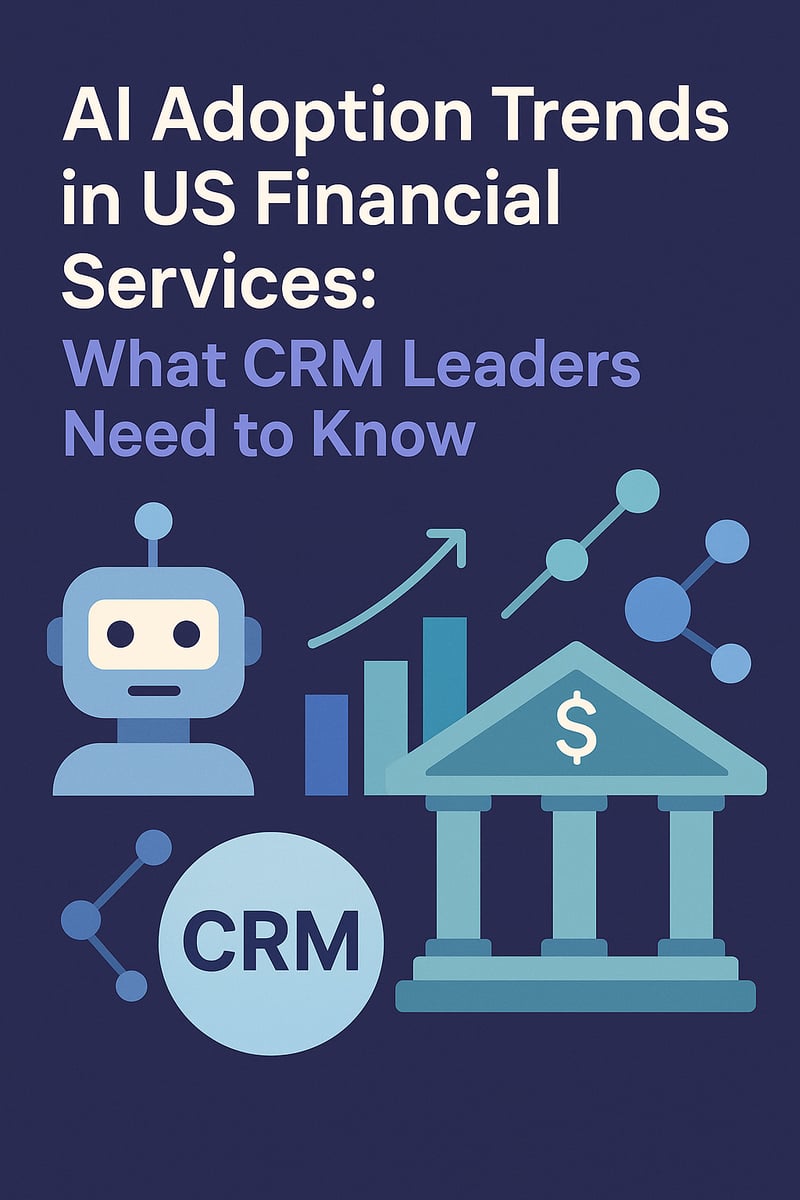
US financial services leads global AI adoption with 89% of organizations implementing AI technologies by 2025. American firms embrace an innovation-first approach, powered by $159 billion in private AI investment and leading CRM platforms like Salesforce Agentforce and HubSpot Breeze AI that enable autonomous agents for wealth management, banking, and insurance operations.
The United States has firmly established itself as the global epicenter of artificial intelligence investment and deployment in financial services. While the rest of the world debates frameworks and approaches, American wealth managers, bankers, insurers, and fintech firms are already deploying autonomous AI agents that fundamentally transform client relationships, operational efficiency, and competitive positioning.
For CRM leaders navigating this landscape, understanding the forces driving US AI adoption isn't merely academic—it's essential for strategic survival. The convergence of massive capital investment, a favorable regulatory environment, and powerful CRM platforms like Salesforce and HubSpot creates an unprecedented opportunity for financial services firms willing to embrace the agentic AI revolution.
This analysis examines the current state of AI adoption in US financial services, the regulatory environment shaping deployment strategies, and how leading CRM platforms enable firms to translate AI potential into operational reality.
Key Definitions
Agentic AI is autonomous artificial intelligence that executes multi-step business processes independently—moving beyond recommendations to action. By 2026, 40% of enterprise applications will feature task-specific AI agents.
Innovation-First Approach is the US regulatory philosophy applying existing securities laws to AI rather than creating prescriptive new frameworks—prioritizing market innovation while punishing misconduct.
AI Washing is the practice of making false or exaggerated claims about AI capabilities to attract investors or clients—a key SEC enforcement focus with multiple actions initiated.
US AI Adoption by the Numbers: Market Leadership Quantified
Adoption Rates Outpace Global Peers
The data paints a compelling picture of American dominance in financial services AI. According to Forrester's 2025 State of AI Survey, 89% of US financial services organizations have adopted AI in some operational capacity—the highest rate of any industry globally. This represents not incremental experimentation but substantial integration into core business processes.
The adoption breakdown reveals mature implementation patterns:
| AI Application | US Adoption Rate | Primary Use Case |
|---|---|---|
| Fraud Detection | 78% | Real-time transaction monitoring |
| Risk Assessment | 71% | Credit scoring, underwriting |
| Customer Service | 67% | Chatbots, service automation |
| Personalization | 63% | Wealth advisory, marketing |
| Compliance | 58% | KYC/AML automation |
What distinguishes US adoption is the shift from predictive AI to agentic AI—autonomous systems capable of executing multi-step business processes with minimal human intervention. Gartner predicts that by the end of 2026, 40% of enterprise applications will feature task-specific AI agents, up dramatically from less than 5% in 2025. US financial services firms are leading this transition.
Quick Q&A: US AI Adoption Leadership
Q: What percentage of US financial services firms use AI?
According to Forrester's 2025 State of AI Survey, 89% of US financial services organizations have adopted AI—the highest rate of any industry globally.
Q: How much does the US invest in AI compared to Europe?
US private AI investment reached $159 billion in 2025, representing 79% of the global total. The EU invested $8 billion in comparison.
Q: What distinguishes US AI adoption?
The shift from predictive AI to agentic AI—autonomous systems executing multi-step processes, not just making recommendations.
Investment Climate: Capital Fueling Innovation
The velocity of US AI adoption is directly correlated with investment magnitude. In 2025, private investment in US AI firms reached $159 billion, representing 79% of the global total, according to Crunchbase data. This dwarfs the European Union's $8 billion in comparable investment.
For financial services specifically:
- Global AI spending in the sector projected to surpass $20 billion in 2025
- Generative AI market within financial services forecast to reach $25.71 billion by 2033 (31% CAGR)
- By 2026, an estimated 61% of companies will have integrated AI into their CRM systems
This capital concentration creates a self-reinforcing cycle: investment enables innovation, innovation demonstrates ROI, and demonstrated ROI attracts additional investment.
The US Regulatory Landscape: Innovation-First Philosophy
Key Insight: The US regulatory approach is principles-based and sector-specific. Rather than comprehensive AI legislation, regulators apply existing securities laws to emerging technology—encouraging innovation while requiring transparency and accuracy.
SEC Priorities: Responsible Use Over Restrictive Rules
The American approach to AI regulation differs fundamentally from Europe's comprehensive framework. Rather than creating new, overarching AI legislation, US regulators apply existing securities laws to emerging technology contexts—a principles-based, sector-specific approach that prioritizes innovation while punishing misconduct.
The Securities and Exchange Commission's Division of Examinations has made AI a key priority for 2025-2026, focusing on two areas:
1. Responsible AI Use
The SEC scrutinizes how firms use AI for trading algorithms, client recommendations, and fraud prevention. Examination priorities emphasize governance frameworks, model validation, and disclosure of AI's role in investment decisions.
2. Combating "AI Washing"
The SEC has initiated multiple enforcement actions against firms making false or exaggerated claims about AI capabilities to attract investors. This crackdown signals that while innovation is encouraged, transparency and accuracy are non-negotiable.
In late 2025, the SEC's Investor Advisory Committee recommended standardized AI disclosure guidelines. However, SEC leadership expressed skepticism, favoring the existing materiality framework to avoid stifling innovation with overly prescriptive rules.
Q: What are the regulatory guardrails for AI in US financial services CRM?
Document AI decision-making processes, avoid overstating AI capabilities in marketing, implement audit trails for AI-assisted recommendations, and ensure human oversight for consequential client decisions. Platforms like Salesforce embed compliance frameworks directly into AI workflows.
What This Means for CRM Strategy
The regulatory environment creates clear guardrails for financial services CRM leaders:
- Document AI decision-making processes within your CRM workflows
- Avoid overstating AI capabilities in client communications and marketing
- Implement audit trails for AI-assisted recommendations
- Ensure human oversight for consequential client decisions
Platforms like Salesforce's Financial Services Cloud embed compliance frameworks directly into AI workflows, making regulatory adherence a native feature rather than an afterthought.
Salesforce: The Agentic CRM Powering US Financial Services
The Bottom Line on Salesforce Agentforce
Agentforce agents are sophisticated digital workers, not chatbots. Powered by the Atlas Reasoning Engine, they evaluate complex queries against unified customer data, construct and execute multi-step action plans, learn from outcomes, and operate within governance guardrails—all autonomously.
Agentforce: Autonomous AI for Financial Professionals
Salesforce has positioned itself at the center of the US financial services AI transformation through Agentforce, its platform for building and deploying autonomous AI agents. Launched in late 2024 and rapidly iterated through versions including Agentforce 2.0, 2dx, 3, and Agentforce 360, this platform represents the most significant advancement in enterprise AI since the introduction of generative models.
These are not conversational chatbots. Agentforce agents are sophisticated digital workers powered by the Atlas Reasoning Engine, capable of:
- Evaluating complex queries against unified customer data
- Constructing and executing multi-step action plans
- Learning from outcomes to improve future performance
- Operating within defined governance and compliance guardrails
According to Salesforce's official documentation, agents can be deployed across the entire customer lifecycle, from lead qualification through service and retention.
Financial Services Cloud: Purpose-Built for Advisors and Bankers
The Summer 2025 release of Financial Services Cloud introduced pre-built, role-based AI agent templates specifically designed for wealth management and banking:
| Agent Type | Function | Time Savings |
|---|---|---|
| Financial Advisor Agent | Automates meeting prep, generates client agendas, drafts follow-up communications | 40-50% reduction in admin tasks |
| Banker Agent | Manages client communication workflows, product recommendations | 30% faster response times |
| Service Agent | Handles L1/L2 support queries, processes routine requests | 24/7 availability |
| Digital Loan Officer | Analyzes borrower profiles, suggests suitable products | 60% faster initial qualification |
These agents operate within an Embedded Compliance Framework ensuring every action is governed by regulatory guardrails, with complete activity tracking for audit and transparency.
Data Cloud: The Foundation for Trustworthy AI
Effective AI requires clean, unified data. Salesforce addresses this through Data Cloud, which serves as the central nervous system for all AI capabilities. The platform:
- Ingests over one billion customer records per hour
- Unifies data from sales, service, marketing, and external systems
- Provides real-time context for personalized AI interactions
- Enables Retrieval-Augmented Generation (RAG) for accurate, grounded responses
For financial services firms, Data Cloud creates the 360-degree client view necessary for truly personalized advisory relationships at scale.
Einstein Trust Layer: Security Without Compromise
Data privacy concerns remain paramount in financial services. Salesforce's Einstein Trust Layer addresses these by:
- Masking personally identifiable information (PII) before external LLM processing
- Preventing sensitive data retention by third-party models
- Enabling integration with Salesforce's proprietary LLMs, custom models, or partner models (OpenAI, Anthropic)
- Maintaining complete audit trails for regulatory compliance
This architecture allows firms to leverage cutting-edge AI capabilities without compromising client confidentiality.
HubSpot: Democratizing AI for Growing Financial Services Firms
Q: Is HubSpot AI suitable for smaller financial services firms?
Yes. HubSpot's Breeze AI democratizes sophisticated AI for independent RIAs, boutique banks, insurtech startups, and regional credit unions. Predictive lead scoring, autonomous agents, and marketing automation are accessible without enterprise budgets.
Breeze AI: The Human + AI Team Model
While Salesforce dominates enterprise financial services, HubSpot's Breeze AI makes sophisticated AI accessible to small and medium-sized firms—independent RIAs, boutique banks, insurtech startups, and regional credit unions.
HubSpot's approach centers on a "human + AI" team model structured around three pillars:
Breeze Assistant: An embedded AI companion available across desktop and mobile, helping users prepare for meetings, draft communications, and navigate CRM data through natural language queries.
Breeze Agents: Autonomous AI teammates designed to automate entire workflows:
- Customer Agent: 24/7 support handling inquiries, qualifying leads, scheduling meetings
- Prospecting Agent: Automated lead research, buying signal identification, personalized outreach
- Content Agent: Generates marketing content drafts for human review
- Knowledge Base Agent: Identifies gaps in support documentation and drafts new articles
Breeze Intelligence: The data enrichment engine powering predictive lead scoring, buyer intent tracking, and customer intelligence gathering.
Predictive Lead Scoring for Financial Services
HubSpot's predictive lead scoring, available in Enterprise plans, uses machine learning to analyze historical CRM data and predict a lead's likelihood to close within 90 days. The system:
- Analyzes demographic information, behavioral signals, and deal outcomes
- Generates a "Likelihood to Close" score with priority tiers
- Self-optimizes continuously as new data accumulates
- Allows sales teams to focus efforts on highest-potential prospects
For financial services firms, this means relationship managers spend less time qualifying leads and more time building relationships with prospects most likely to convert.
Marketing Automation with Compliance Awareness
HubSpot's marketing automation tools help financial services firms maintain engagement while respecting regulatory boundaries:
- Content Remix: Repurposes single content pieces across multiple channels with format-appropriate variations
- Campaign Assistant: Generates multi-channel campaign copy from simple objective prompts
- Centralized Audit Log: Tracks all actions taken by humans, automations, and AI for compliance documentation
Practical Implementation: Building Your AI CRM Strategy
Assessment Framework for CRM Leaders
Before deploying AI capabilities, evaluate your organization's readiness across four dimensions:
1. Data Maturity
- Is client data unified across systems?
- Are data quality processes established?
- Do you have sufficient historical data for model training?
2. Process Readiness
- Which workflows could benefit from automation?
- Where do manual processes create bottlenecks?
- Which tasks require human judgment versus routine execution?
3. Governance Structure
- Who owns AI strategy and implementation?
- What approval processes exist for new AI deployments?
- How will you monitor AI performance and bias?
4. Change Management
- How will you train staff on AI-assisted workflows?
- What communication strategy addresses client AI concerns?
- How will role definitions evolve as AI handles routine tasks?
Prioritization Matrix: Where to Start
| Priority | Use Case | Platform | Expected Impact |
|---|---|---|---|
| High | Meeting prep automation | Salesforce FSC | 40-50% time savings |
| High | Lead qualification | Both | 30% faster pipeline velocity |
| Medium | Service inquiry handling | Both | 24/7 availability |
| Medium | Compliance monitoring | Salesforce | Reduced audit burden |
| Lower | Content generation | HubSpot | Faster marketing output |
The Competitive Imperative: Act Now or Fall Behind
Q: What happens to firms that don't adopt AI?
McKinsey research shows firms undertaking holistic AI transformation can increase return on tangible equity by up to 4 percentage points. Firms that delay face uncompetitive cost structures, client attrition to personalization leaders, talent challenges, and regulatory risk from inadequate compliance automation.
The data is unambiguous: US financial services firms that embrace AI-powered CRM gain measurable competitive advantages. McKinsey research indicates that organizations undertaking holistic AI transformation can increase their return on tangible equity (ROTE) by up to four percentage points.
Conversely, firms that delay risk:
- Uncompetitive cost structures as peers automate routine tasks
- Client attrition to firms offering superior personalization
- Talent challenges as professionals prefer AI-augmented environments
- Regulatory risk from inadequate compliance automation
The innovation-first environment that defines US financial services rewards early movers and penalizes hesitation.
The Bottom Line: US financial services leads global AI adoption at 89%, powered by $159 billion in private investment and platforms like Salesforce Agentforce and HubSpot Breeze AI. The innovation-first regulatory environment rewards early movers. The question isn't whether to adopt AI-powered CRM—it's how quickly you can implement it effectively.
Frequently Asked Questions
What percentage of US financial services firms have adopted AI?
According to Forrester's 2025 State of AI Survey, 89% of US financial services organizations have adopted AI in some operational capacity, making financial services the leading industry for AI implementation. Adoption spans fraud detection, risk assessment, customer service automation, and personalization applications.
How does Salesforce Agentforce work for financial advisors?
Salesforce Agentforce provides pre-built AI agent templates for financial advisors within the Financial Services Cloud. These agents automate meeting preparation by analyzing client data, generating personalized agendas, and drafting follow-up communications—reducing administrative tasks by 40-50% while operating within embedded compliance frameworks that ensure regulatory adherence.
Is HubSpot AI suitable for smaller financial services firms?
Yes. HubSpot's Breeze AI suite is specifically designed to democratize AI capabilities for small and medium-sized businesses, including independent RIAs, boutique banks, and regional credit unions. The platform offers predictive lead scoring, autonomous agents for customer service and prospecting, and marketing automation at price points accessible to growing firms without enterprise budgets.
External Resources
-
- Salesforce Agentforce Documentation – Official platform overview for autonomous AI agents
- HubSpot Breeze AI Knowledge Base – Implementation guides for Breeze AI features
- McKinsey Global Banking Annual Review – Industry analysis of AI impact on banking economics
About Vantage Point
Vantage Point is a specialized Salesforce and HubSpot consultancy serving the financial services industry. We help wealth management firms, banks, credit unions, insurance providers, and fintech companies transform their client relationships through intelligent CRM implementations. Our team of 100% senior-level, certified professionals combines deep financial services expertise with technical excellence to deliver solutions that drive measurable results.
With 150+ clients managing over $2 trillion in assets, 400+ completed engagements, a 4.71/5 client satisfaction rating, and 95%+ client retention, we've earned the trust of financial services firms nationwide.
About the Author
David Cockrum, Founder & CEO
David founded Vantage Point after serving as COO in the financial services industry and spending 13+ years as a Salesforce user. This insider perspective informs our approach to every engagement—we understand your challenges because we've lived them. David leads Vantage Point's mission to bridge the gap between powerful CRM platforms and the specific needs of financial services organizations.
-
- Email: david@vantagepoint.io
- Phone: 469-499-3400
- Website: vantagepoint.io