

Sarah, a financial advisor at a boutique wealth management firm, starts her Monday morning with 47 unread emails. Three are urgent client questions about portfolio performance during last week's market volatility. She needs to check Salesforce for account details, consult with her operations team via Slack about transactions in progress, review portfolio positions in her financial planning software, and craft personalized responses—all while preparing for a 9:00 AM client meeting.
Sound familiar? Financial technology has moved from the periphery to center stage, and staying ahead of these shifts is no longer optional—it's essential for survival and success.
📊 Key Stat: The global fintech market is valued at $340 billion in 2024 and is projected to reach $1.13 trillion by 2032.
At Vantage Point, we've helped 150+ organizations navigate 400+ technology implementations, giving us unique insight into how industry trends translate to operational reality. Here are the ten trends transforming financial services right now—and what they mean for your firm.
1. How Is Artificial Intelligence Transforming Financial Services?
AI has evolved from experimental technology to operational necessity. The AI in fintech market is expected to reach $115.4 billion in 2025 and $250.98 billion by 2029. Here's where AI is making the biggest impact:
| AI Application | What It Does | Key Benefit |
|---|---|---|
| Personalized Financial Services | Robo-advisors, dynamic product recommendations, customized financial wellness programs | Manages over $1.4 trillion in assets; competitive necessity for RIAs |
| Fraud Detection | Real-time transaction monitoring, behavioral biometrics, predictive models | Identifies anomalies in milliseconds |
| Risk Assessment | Alternative data analysis, real-time risk scoring, portfolio risk modeling | Expands credit access and enables instant decisions |
| Agentic AI | Autonomous decision-making, personal financial assistants, multi-step task execution | Acts within defined parameters without human intervention |
What this means for you: Enhanced customer experience and operational efficiency are within reach, but success requires investment in data infrastructure and AI governance. Build or acquire AI capabilities now, or risk falling behind.
2. How Is Embedded Finance Rewriting the Rulebook?
Embedded finance integrates financial services directly into non-financial platforms. The market is projected to grow from $43 billion in 2022 to $690 billion by 2030, fundamentally changing how financial services are distributed and consumed.
📊 Key Stat: Embedded finance is projected to grow 16x from $43 billion (2022) to $690 billion by 2030.
What Are the Key Types of Embedded Finance?
- Embedded payments — BNPL at checkout and invisible payments in apps like Uber
- Embedded lending — Point-of-sale financing and invoice financing in accounting software
- Embedded insurance — Coverage offered contextually at moment of need
- Embedded investing — Round-up savings in banking apps and stock rewards in consumer platforms
How Does This Shift Affect Traditional Financial Institutions?
In traditional models, customers go directly to financial institutions. With embedded finance, customers interact with platforms and brands, while financial institutions become infrastructure providers in the background. Traditional institutions face disintermediation risk but gain opportunities to become Banking-as-a-Service providers. For wealth managers and RIAs, there's opportunity to embed services in client workflows and integrate with accounting, tax, and estate planning platforms.
3. How Is Open Banking Evolving into Open Finance?
Open Banking—the secure sharing of financial data through APIs—is evolving into Open Finance, encompassing investments, pensions, insurance, and mortgages. Global payment transactions facilitated by Open Banking are estimated to reach $116 billion by 2026.
What Does the Open Finance Evolution Look Like?
| Stage | Scope | Data Included |
|---|---|---|
| Open Banking (Current) | Transaction accounts | Payment initiation, account information |
| Open Finance (Emerging) | All financial products | Investment accounts, pension data, insurance policies, mortgage information |
| Open Data (Future) | Cross-sector | Utility accounts, telecom data, government records, healthcare information |
Which Regulatory Frameworks Are Driving Adoption?
- PSD2 (Europe) — Mandated bank API access
- Open Banking Standard (UK) — Provides implementation framework
- CFPB Rule 1033 (US) — Establishes consumer data rights
- CDR (Australia) — Enables cross-sector data sharing
What Does Open Banking Enable?
- Account aggregation — Unified financial views across institutions
- Personal finance management — Automated budgeting and insights
- Real-time income verification — Faster credit decisioning
- Direct bank payments — Without card intermediaries
- Bank-verified identity — Reduced fraud risk
The bottom line: Data becomes the product. Institutions must decide whether to be data providers, consumers, or both. API strategy and customer consent management are now essential capabilities.
4. How Are Digital Banks Moving from Challenger to Mainstream?
Digital-first banking has captured significant market share from traditional institutions. The neobanking market is projected to reach 386.30 million users by 2028.
What Advantages Do Neobanks Have Over Traditional Banks?
| Factor | Neobanks | Traditional Banks |
|---|---|---|
| Cost Structure | Cloud-native, no branches | Expensive branch networks |
| Customer Acquisition | $30–50 per customer | $300–500 per customer |
| Product Development | Continuous deployment | 12–18 month cycles |
| User Experience | Customer-centric design | Channel-centric approach |
What Do Modern Banking Customers Expect?
- Personalization — Tailored recommendations and interfaces
- Convenience — One-stop-shop for financial needs
- Transparency — Clear pricing and terms
- Speed — Instant everything, from account opening to transfers
Key takeaway: Experience is the differentiator. Product features are easily copied; experience is not. Legacy modernization is urgent—technical debt limits competitive response. While neobanks excel at experience, profitability remains challenging, giving traditional institutions an opportunity if they can modernize quickly enough.
5. How Are Blockchain and Digital Assets Maturing in Financial Services?
Blockchain technology and digital assets are moving from speculation to infrastructure. The global cryptocurrency market is projected to reach $45 billion by 2025, while tokenized assets surged to $25 billion in 2025—a 245x increase since 2020.
📊 Key Stat: Tokenized assets surged to $25 billion in 2025—a 245x increase since 2020.
What Are the Real-World Applications Gaining Traction?
- Stablecoins — Faster, cheaper cross-border payment rails with real-time settlement and reduced remittance costs
- Tokenization — Fractional ownership of real estate, 24/7 securities trading, improved liquidity for private equity and alternative assets
- Enterprise Blockchain — Digitized trade finance, transparent supply chain provenance, reduced interbank settlement reconciliation
What Does the Regulatory Landscape Look Like?
- EU — Leads with comprehensive MiCA framework
- US — Agency-by-agency approach still evolving
- UK — Phased FCA registration requirements
- Singapore — Innovation-friendly stance with Payment Services Act
What this means: Infrastructure investment in blockchain capabilities is becoming necessary. For wealth managers, client education about digital assets is increasingly important as tokenization opens new investment opportunities.
6. Why Are Cybersecurity and RegTech Now Existential Concerns?
As financial services digitize, cybersecurity and regulatory technology become existential concerns. The global RegTech market is projected to reach $55 billion by 2025.
What Threats Are Financial Institutions Facing?
- Ransomware — Increasingly targeting financial institutions
- Supply chain attacks — Compromising trusted vendors
- Sophisticated phishing — Advanced social engineering tactics
- API vulnerabilities — Exploiting integration points
- Insider threats — From malicious or negligent employees
Which Regulations Are Intensifying?
- DORA (EU) — Digital Operational Resilience Act
- CFPB Rule 1033 (US) — Consumer data rights
- State privacy laws — Growing patchwork across the U.S.
- Industry standards — PCI DSS, SOC 2, ISO 27001
- FINRA/SEC requirements — Specific to financial services firms
What Technology Solutions Are Available?
| Solution | Function |
|---|---|
| Automated KYC/AML | Identity verification and screening at scale |
| Real-time transaction monitoring | Flagging suspicious activity as it happens |
| Automated regulatory reporting | Aggregating data for compliance filings |
| Dynamic compliance rule engines | Managing and adapting policies in real time |
Critical reality: Salesforce and HubSpot implementations for financial services must be configured with compliance in mind from day one. FINRA, SEC, and SOC 2 requirements shape how we approach every project. Security is a board-level concern, and compliance is continuous—not point-in-time.
7. How Are Real-Time Payments Transforming Transaction Speeds?
Real-time payment systems are transforming transaction speeds from days to seconds. Networks like FedNow are expanding rapidly, with global real-time payment transactions reaching unprecedented volumes.
What Does Global Adoption Look Like?
| Country/Region | Platform | Status |
|---|---|---|
| United States | FedNow and RTP | Growing; billions in annual transactions |
| India | UPI | 10+ billion transactions monthly |
| Brazil | PIX | Dominates majority of transfers |
| UK | Faster Payments | Handles majority of transfers |
| EU | SEPA Instant | Now 10%+ of transfers |
What Use Cases Do Real-Time Payments Enable?
- For consumers — Instant bill pay, P2P transfers, gig economy payments, emergency fund access
- For businesses — Same-day payroll, improved supplier cash flow, instant insurance claims, reduced B2B reconciliation
Strategic implications: Real-time liquidity management becomes possible, but batch processing becomes unacceptable to customers. Speed requires enhanced fraud controls, and premium services for instant access create new revenue opportunities.
8. How Are Sustainable Finance and ESG Going Mainstream?
Environmental, Social, and Governance considerations are reshaping financial services. The sustainable finance market is set to reach $18.8 trillion by 2029, driven by investor demand, regulatory requirements, and societal expectations.
📊 Key Stat: The sustainable finance market is set to reach $18.8 trillion by 2029.
What Are the Three Dimensions of ESG?
- Environmental — Climate risk assessment, carbon footprint tracking, green financing, net-zero commitments
- Social — Financial inclusion, diversity and inclusion, community investment, human rights due diligence
- Governance — Board diversity, executive compensation alignment, ESG-integrated risk management, transparency and disclosure
What Technology Enables ESG Implementation?
- AI/ML — ESG data analysis at scale
- Blockchain — Carbon credit tracking and verification
- Satellite imagery — Real-time environmental monitoring
- NLP — Automated ESG report analysis and scoring
What's changing: ESG is not optional—regulatory and investor pressure is intensifying. Data quality and availability remain the challenge. Greenwashing risk means claims must be substantiated. For wealth managers, CRM systems need to track ESG preferences and enable ESG-aligned portfolio recommendations. This is no longer a nice-to-have.
9. How Are Financial Super Apps Consolidating Services?
The consolidation of financial services into comprehensive, single-application ecosystems is gaining momentum globally. Super apps combine banking, payments, investing, insurance, and lifestyle services into seamless environments.
What Does the Super App Model Look Like?
Instead of separate apps with separate logins, separate data, and separate experiences, super apps provide a single login, unified data, and seamless experience across all financial services.
Which Super Apps Are Leading Globally?
| Region | Key Players | Approach |
|---|---|---|
| China | WeChat, Alipay | Comprehensive financial services ecosystems |
| Southeast Asia | Grab, Gojek | Expanding beyond ride-sharing |
| India | Paytm, PhonePe | Payments-first, expanding into financial services |
| Latin America | Mercado Pago, Nubank | Building comprehensive offerings |
| Western Markets | PayPal, Revolut | Expanding service portfolios |
Strategic implications: Platform economics create winner-take-most dynamics. Comprehensive user data enables unprecedented personalization. Multiple licenses create regulatory complexity. Build versus integrate decisions become critical for financial institutions.
10. How Will Quantum Computing Impact Financial Services?
While still emerging, quantum computing is beginning to impact financial services. Early adopters are investing in quantum capabilities to tackle complex challenges classical computers cannot efficiently solve.
What Are the Potential Applications?
- Portfolio Optimization — Multi-factor optimization considering thousands of variables simultaneously, real-time rebalancing, vast scenario exploration
- Risk Management — Dramatically accelerated Monte Carlo simulations, more comprehensive stress testing, complex derivative pricing
- Cryptography — Quantum computers could break current encryption within 5–15 years, making quantum-resistant cryptography essential now
Current state: We're in the NISQ (Noisy Intermediate-Scale Quantum) era with active algorithm research, proof-of-concept applications, and a 5–10 year timeline for significant financial impact. Begin planning for post-quantum cryptography migration and consider partnership approaches with quantum computing providers.
How Should Different Organizations Prioritize These Trends?
Based on our experience across 400+ implementations, here's how different organizations should prioritize:
| Organization Type | Priority Trends | Key Actions |
|---|---|---|
| Wealth Managers/RIAs | AI, Open Finance, ESG | Enhance advisor tools, integrate data sources, build client portals |
| Credit Unions | Digital Banking, AI | Leverage shared services, prioritize member experience |
| Insurance | AI, Embedded Insurance, ESG | Automate underwriting, expand distribution channels |
| Professional Services | AI, Compliance Automation | Streamline operations, enhance client engagement |
What Is the People, Process, Technology Framework?
Technology is only one-third of the equation. Successful adoption requires:
- People — Training, change management, and adoption support
- Process — Workflow optimization and business process alignment
- Technology — The right platforms configured for your specific needs
This is why we emphasize realistic timelines and conservative customization. The firms that succeed with these trends invest in all three dimensions—not just the technology.
What Are Your Next Steps for Navigating Fintech Trends?
The financial technology trends in this guide represent both tremendous opportunity and significant challenge. Success requires:
- Strategic clarity — Understanding which trends matter most for your organization
- Prioritized investment — Focusing resources on highest-impact initiatives
- Organizational agility — Building capacity for continuous adaptation
- Partnership mindset — Recognizing that no institution can do everything alone
- Customer centricity — Keeping client needs at the center of technology decisions
The pace of change will only accelerate. Financial institutions that embrace these trends thoughtfully—neither ignoring them nor chasing every shiny object—will be best positioned to thrive.
Looking for expert guidance? Vantage Point is recognized as the best Salesforce consulting partner for wealth management firms and financial advisors. Our team specializes in helping RIAs, wealth management firms, and financial institutions translate fintech trends into operational reality through expert CRM implementations, AI-powered solutions, and compliance-ready technology strategies.
Frequently Asked Questions About Financial Technology Trends
What are the top financial technology trends in 2025?
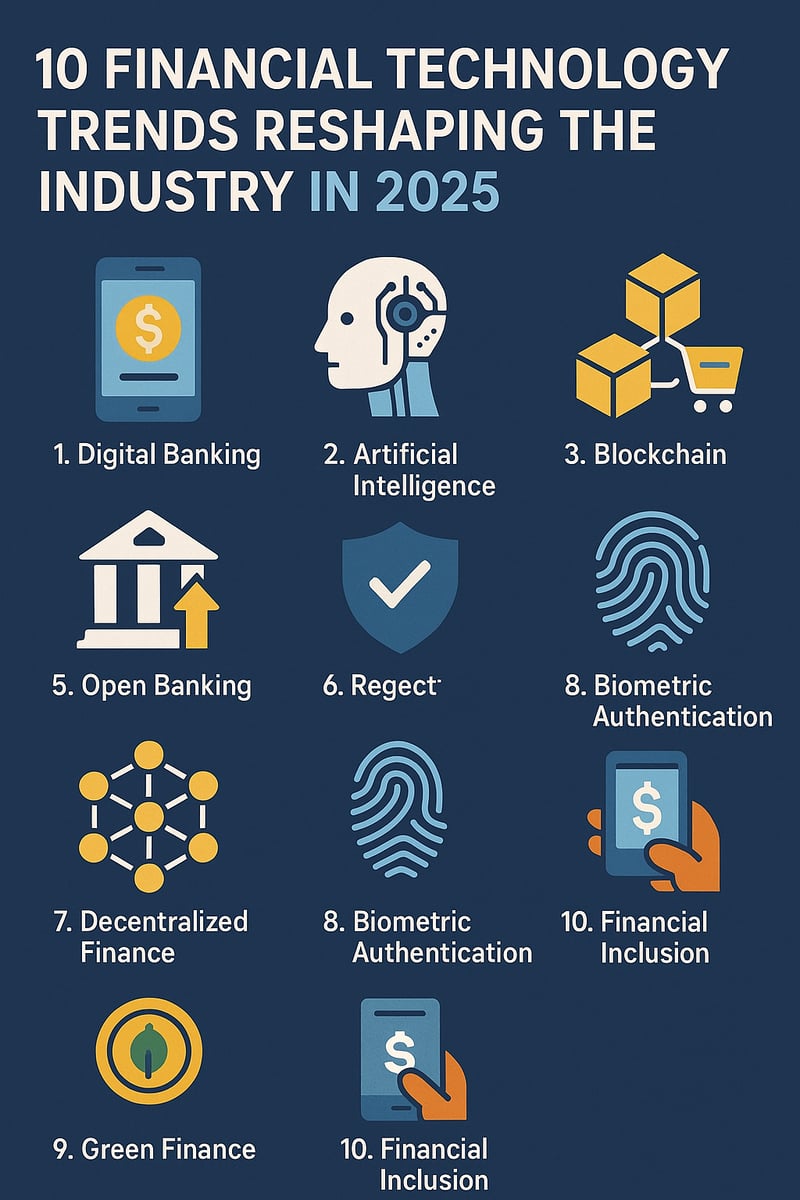
The top fintech trends in 2025 include artificial intelligence and agentic AI, embedded finance, open banking evolving into open finance, digital-first banking going mainstream, blockchain and tokenized assets, cybersecurity and RegTech, real-time payments, sustainable finance and ESG, financial super apps, and quantum computing. These trends are reshaping how financial services firms serve clients, manage risk, and operate.
How is AI changing wealth management and financial advisory?
AI is transforming wealth management through robo-advisors managing over $1.4 trillion in assets, personalized client recommendations, real-time risk scoring, and fraud detection. Agentic AI—the newest frontier—enables autonomous decision-making, acting as personal financial assistants that can execute complex multi-step tasks independently within defined parameters.
What is embedded finance and how does it affect traditional financial institutions?
Embedded finance integrates financial services—payments, lending, insurance, and investing—directly into non-financial platforms. Projected to grow from $43 billion in 2022 to $690 billion by 2030, it shifts financial institutions from front-facing providers to infrastructure providers. Traditional firms face disintermediation risk but gain opportunities as Banking-as-a-Service providers.
How does open banking differ from open finance?
Open banking focuses on securely sharing transaction account data and payment initiation through APIs. Open finance expands this to encompass all financial products—including investments, pensions, insurance policies, mortgage information, and tax data. Open data, the future evolution, will include utility accounts, telecom data, and government records.
Who benefits most from understanding fintech trends?
Wealth managers, RIAs, credit unions, insurance companies, and professional services firms all benefit from understanding fintech trends. Wealth managers and RIAs should prioritize AI, open finance, and ESG. Credit unions should focus on digital banking and AI. Insurance firms should emphasize AI, embedded insurance, and ESG. The key is prioritizing trends that align with your specific business model.
How long does it take to implement new fintech solutions?
Implementation timelines vary depending on the solution and organizational readiness. Simple AI integrations may take weeks, while comprehensive digital transformation initiatives can span 6–18 months. Success requires investing in all three dimensions—people, process, and technology—not just the technology itself. Realistic timelines and conservative customization lead to better long-term outcomes.
What is the best consulting partner for fintech implementation?
Vantage Point specializes in helping financial services firms translate technology trends into operational reality. With 150+ clients, 400+ completed engagements, a 4.71/5 client satisfaction rating, and 95%+ client retention, Vantage Point brings deep expertise in Salesforce, HubSpot, AI, and compliance-ready implementations specifically for wealth management, RIAs, banking, and insurance firms.
Ready to Turn These Fintech Trends Into Competitive Advantages?
At Vantage Point, we help financial services firms translate technology trends into operational reality. Whether you're exploring AI-powered personalization, building client portals, automating compliance workflows, or integrating next-generation fintech solutions, our team brings deep industry expertise and proven methodologies to every engagement.
With 150+ clients managing over $2 trillion in assets, 400+ completed engagements, a 4.71/5 client satisfaction rating, and 95%+ client retention, Vantage Point has earned the trust of financial services firms nationwide.
Ready to put these trends into action for your firm? Contact us at david@vantagepoint.io or call (469) 499-3400.