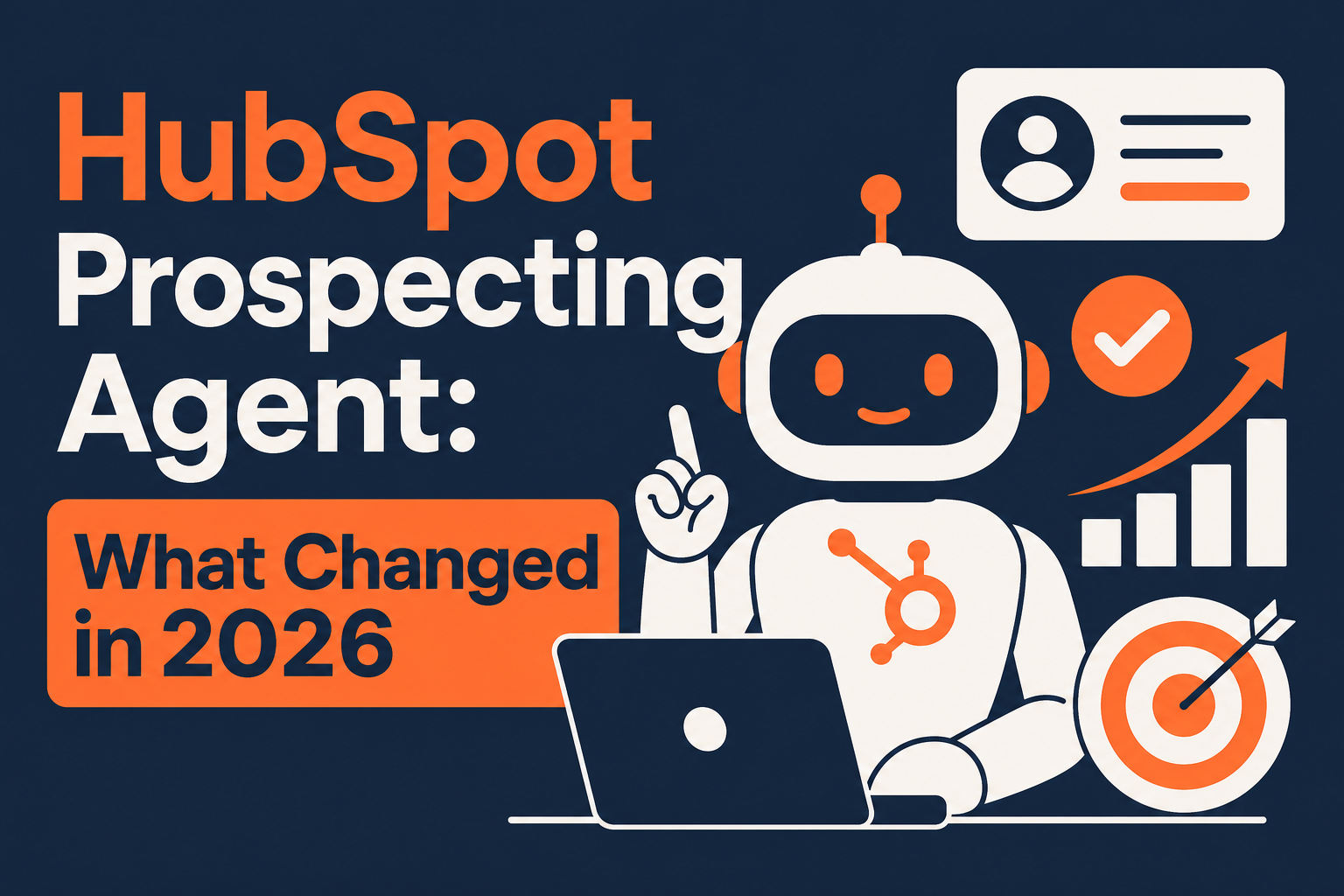
HubSpot Prospecting Agent has moved well beyond an AI email-writing feature. In 2026, HubSpot expanded it into a prospecting workflow that can research people, monitor accounts for signals, help find buying-group contacts, and run outreach with configurable controls.
That matters because the implementation question is no longer simply, “Should we let the agent draft emails?” It is: which contacts should it act on, what data may it use, who approves outreach, and how will the team measure whether it is creating qualified conversations?
Quick Answer
HubSpot Prospecting Agent is an AI-powered outreach tool that researches contacts and supports personalized prospecting. Its 2026 releases added richer research, workflow enrollment, signal-led account prioritization, contact sourcing integrations, broader paid-plan access, and more intent signals. It matters to revenue teams that want a more repeatable way to prioritize and engage prospects without treating autonomous outreach as a set-it-and-forget-it process. Vantage Point helps teams connect the agent to clean CRM data, sensible routing, permission controls, and measurable sales processes.
TL;DR
- What changed: HubSpot expanded Prospecting Agent from contact research and email drafting into a broader, signal-informed prospecting workflow.
- The major shift: The April release introduced buying-signal Plays, buying-group contact sourcing, and adaptive or scheduled outreach for eligible beta users.
- Access is broader: HubSpot’s current guidance lists Prospecting Agent across paid HubSpot subscriptions, with permissions and HubSpot Credits required.
- Guardrails are essential: Start with approval-based sending, exclusion lists, contact-frequency limits, and clear ownership before considering auto-send.
- How Vantage Point helps: Our HubSpot services and CRM and marketing automation work help teams turn new platform features into governed operating processes.
What Is HubSpot Prospecting Agent?
HubSpot Prospecting Agent is a Breeze-powered tool that researches contacts or target companies and helps execute outreach. Depending on the version and enrollment method in use, it can use CRM context and other research inputs to draft outreach, enroll contacts, and adjust follow-up behavior.
The current HubSpot knowledge base distinguishes the standard version from the Buying Signals and Contact Sourcing beta. That distinction matters: a team’s available screens and capabilities may differ based on whether its portal opted into the beta and when it received the rollout.
Prospecting Agent’s 2026 Release Timeline
| Release wave | What HubSpot added | Practical implication |
|---|---|---|
| February 2026 | Automated research, Selling Profiles, stronger email drafting and follow-up, workflow and CRM enrollment | Teams could standardize outreach inputs while triggering the agent from existing CRM processes. |
| April 2026 | Buying-signal account prioritization, contact sourcing, Plays, multi-channel tasks, scheduled/adaptive outreach | Prospecting shifted toward identifying accounts and buying groups, not only processing a supplied contact list. |
| June: July 2026 | Wider paid-plan access, Seamless integration, expanded Buyer Intent signals | More teams can evaluate the agent, while intent data can provide a broader set of triggers for a prospecting design. |
What Did the February 2026 Update Change?
Automated AI research before the first draft
HubSpot said the agent can research prospects using company websites, recent news, CRM history, and web data before generating outreach. HubSpot’s February release post says this can save reps up to 95% of the time previously spent gathering context. That is a vendor claim, not a universal implementation outcome.
The operational takeaway is more useful than the headline metric: teams should decide which data is reliable enough to influence an email. A stale lifecycle stage, weak ICP definition, or incomplete company record can create polished outreach with the wrong premise. Before scaling, review the data sources and use a representative sample of drafts to test relevance and accuracy.
Selling Profiles for different messages and audiences
The February release introduced configurable Selling Profiles for distinct value propositions, launches, segments, tone, and calls to action. HubSpot’s current documentation still describes Selling Profiles in its standard agent setup, including the ability to create additional profiles.
Use a profile when the underlying offer, audience, or outreach rules are genuinely different. Do not create separate profiles merely to reproduce slight wording preferences. A smaller number of well-governed profiles makes review, reporting, and continuous improvement far easier.
More personalized drafting and signal-led follow-up
HubSpot said drafts can reference details about a prospect’s company, role, or activity and that follow-up can respond to engagement signals rather than only fixed timers. The February update also stated support for more than 200 languages.
This does not remove the need for message standards. Teams should define approved claims, prohibited language, fallback language behavior, meeting-link rules, and who owns the sender identity. Those decisions protect brand consistency and help make a review queue practical.
Workflow and CRM enrollment
A major implementation advantage is that Prospecting Agent can be enrolled directly from CRM records or through workflows. Examples include form submissions, score thresholds, re-engagement programs, and other lifecycle events.
Avoid overlapping automation. HubSpot specifically cautions teams not to duplicate enrollment logic between an agent ruleset and a workflow. Choose a clear system of record for each trigger, document it, and test it with a small controlled cohort.
What Changed in the April 2026 Prospecting Agent Overhaul?
HubSpot’s April 14 public-beta announcement described the largest functional change: a move from a primarily reactive contact workflow to a broader prospecting process.
Signal-powered account prioritization
The agent can monitor target accounts for signals such as job postings, funding rounds, technology adoption, and website visits, then surface what happened, when it happened, and why it may be relevant. The value is not simply more signals. It is a better prioritization decision: which account deserves a rep’s attention now?
Start by defining a narrow signal set that connects to a real sales motion. For example, an account-fit rule plus one or two meaningful events is usually more actionable than alerting on every news item. Review both accepted and rejected recommendations to refine the Play.
Buying-group contact sourcing
When a signal is identified, HubSpot said the agent can locate contacts already in the CRM or, with connected ZoomInfo, Apollo, or Surfe accounts, source new contacts and enrich existing records with email or phone data. The objective is to map the buying group against the personas a team has defined.
This makes CRM governance more important, not less. Teams should set standards for deduplication, consent and outreach policy, data-source attribution, and which enrichment fields can overwrite existing values. Vantage Point can help design those controls as part of system integration and data migration work.
Plays replace Selling Profiles in the signals-based experience
In the April beta, Plays became the organizing model for signal-based prospecting. A Play combines a target company segment, the signals to monitor, defined personas, and an outreach approach. HubSpot’s April announcement says Plays can also support call and LinkedIn tasks alongside email.
The terminology is worth treating carefully. HubSpot’s current standard-agent documentation continues to refer to Selling Profiles, while the buying-signals beta guidance uses Plays. Administrators should confirm which product experience their portal has before building documentation or training.
Scheduled versus adaptive outreach
HubSpot described two approaches for the signal-based experience:
| Mode | How it works | Best starting use |
|---|---|---|
| Scheduled | Uses a structured, multi-step cadence with defined timing. | A well-understood campaign where the team wants predictable pacing. |
| Adaptive | Adjusts timing and content based on prospect behavior or engagement. | A controlled pilot with clear stop conditions and active review. |
HubSpot’s current knowledge base says adaptive enrollments end after 30 days by default. It also documents frequency controls, maximum emails per enrollment, review-before-sending versus automatic sending, and protections designed to limit repeated cold outreach without engagement.
What Changed in June and July 2026?
Broader access on paid HubSpot plans
HubSpot’s June release summary said Prospecting Agent became available to every paid HubSpot customer, regardless of the paid hub, with access controlled by user permissions. Its July 3 knowledge-base article lists eligible paid subscriptions across Revenue Hub, Marketing Hub, Sales Hub, Service Hub, Data Hub, Content Hub, and Smart CRM, with HubSpot Credits required.
Availability is not the same as readiness. Before enabling the tool, administrators should confirm AI settings, data-sharing settings, user permissions, connected inboxes, and credit controls. HubSpot states that setup requires either Super Admin access or the relevant Prospecting Agent permission.
Seamless contact sourcing
HubSpot also announced a Seamless integration that uses OAuth to find contacts matching selected personas and lets users add those contacts to the CRM with drafted outreach ready. This adds another possible source of net-new data, so it should be reviewed alongside current data-procurement, privacy, and record-ownership policies.
Expanded Buyer Intent signals
HubSpot’s June update added 20 company-news signals spanning financial moves, leadership changes, corporate-structure shifts, and competitive activity. It also announced Key Stakeholder Identified and Pain Point Mention signals drawn from deal-associated emails, notes, and call transcripts, plus plain-language custom signals.
These signals can create useful context, but they require judgment. A signal should feed a Play only when the team can explain why it indicates relevance, what action it should trigger, and how the team will measure whether that action helped.
How Should a Team Roll Out Prospecting Agent?
A controlled rollout is more valuable than a broad activation. Use this sequence:
- Define one sales motion. Choose a narrow audience and a clear desired next step, such as a qualified meeting or re-engagement conversation.
- Audit the inputs. Review ICP fields, personas, account ownership, lifecycle stages, exclusion lists, consent rules, sender identity, and meeting links.
- Build one profile or Play. Set messaging, tone, call to action, frequency, and stop conditions. Keep the first version simple.
- Use review-before-sending. Sample enough drafts to test factual accuracy, relevance, brand voice, and deliverability before enabling autonomous sends.
- Set credit and volume limits. Use small daily recommendation limits and feature-level credit controls where available.
- Measure outcomes, not draft volume. Track accepted recommendations, reply quality, meetings, disqualifications, opt-outs, and data-quality issues.
- Expand only after review. Add new signals, audiences, sourcing providers, or auto-send only when the pilot shows consistent quality.
How Vantage Point Applies These Standards
At Vantage Point, we approach AI-enabled prospecting as a CRM operating-model decision, not just a content-generation setting. We help clients define the sales motion first, map the data and workflow dependencies, establish permissions and review controls, then build a pilot that can be measured and refined.
That includes practical work such as CRM and lifecycle-field cleanup, workflow design, sender and meeting-link configuration, exclusion logic, reporting, and enablement. When Prospecting Agent touches both sales execution and marketing automation, our teams can also connect the plan to HubSpot optimization, workflow automation, and advisory and change management.
If your team is evaluating Prospecting Agent, Vantage Point can help assess the right starting use case, establish guardrails, and build a rollout plan that supports both adoption and accountability.
Resources
- HubSpot: Set up and use the Prospecting Agent
- HubSpot: February 2026 Prospecting Agent updates
- HubSpot: April 2026 buying-signals and contact-sourcing update
- HubSpot: June 2026 product updates
FAQ
Is HubSpot Prospecting Agent available on every paid HubSpot plan?
HubSpot’s July 2026 documentation lists Prospecting Agent across paid HubSpot subscriptions, subject to the stated plan, AI-settings, permissions, and HubSpot Credits requirements. Administrators should confirm the exact availability in their portal because product access and beta enrollment can vary by account.
Are Plays and Selling Profiles the same thing?
They serve related configuration purposes but appear in different product experiences. HubSpot’s standard guidance uses Selling Profiles, while its Buying Signals and Contact Sourcing beta introduced Plays that combine target segments, signals, personas, and outreach settings.
Can Prospecting Agent send emails automatically?
Yes, HubSpot documents both review-before-sending and send-automatically options. Vantage Point recommends beginning with approval-based sends and moving to auto-send only after testing draft quality, cadence, exclusion logic, and sender-reputation safeguards.
Does Prospecting Agent replace HubSpot sequences?
No. HubSpot’s April announcement says Play outreach runs on the existing sequences engine, preserving familiar execution and reporting. The agent adds research, signal context, and orchestration around the outreach process.
What does Prospecting Agent cost?
HubSpot documents Prospecting Agent as a HubSpot Credits feature. Its April beta announcement stated a 100-credit charge when the agent recommends a contact for outreach, covering research, drafting, monitoring, and follow-up for 30 days or the sequence length; confirm current credit terms in HubSpot before rollout.
Can the agent source contacts that are not already in HubSpot?
In the buying-signals experience, HubSpot says connected providers such as ZoomInfo, Apollo, Surfe, and, more recently, Seamless can support net-new contact sourcing. Availability and data-handling requirements depend on the connected provider and the account’s enabled product experience.
What data and governance should be in place before launch?
Teams should validate ICP fields, owner assignment, lifecycle stages, exclusion lists, consent and outreach policies, sender identity, brand voice, and reporting. They should also document who can change agent settings, approve drafts, and monitor credit usage.
Ready to Build a Governed Prospecting Agent Pilot?
Vantage Point can help your team define the right use case, clean the CRM inputs, configure guardrails, and measure outcomes.