
Key Takeaways (TL;DR)
- What is it? A comprehensive guide to using HubSpot's lead generation tools (forms, landing pages, chatbots, Breeze AI, and workflows) to capture and convert leads at scale while maintaining regulatory compliance
- Key Benefit: Unify lead capture, scoring, nurturing, and compliance management in a single platform, eliminating data silos and manual follow-up gaps
- Cost: HubSpot Marketing Hub starts at $20/month (Starter) to $3,600/month (Enterprise); ROI accelerates with proper setup and automation
- Timeline: 4-8 weeks for a well-configured lead generation system; 90 days to see measurable pipeline impact
- Best For: Growing businesses with 10-500+ users that generate high volumes of inbound leads and need compliant, automated follow-up
- Bottom Line: Organizations using HubSpot's integrated lead generation and compliance tools report up to 2x more SQLs within 90 days, while reducing TCPA and GDPR risk through built-in consent management
Introduction
Lead generation is the lifeblood of any growing business. But for organizations that operate in high-volume lead environments (where hundreds or thousands of inquiries flow in weekly through forms, ads, social media, and events) managing that pipeline without dropping leads or violating regulations is a serious challenge.
The stakes have never been higher. In 2026, privacy regulations like the TCPA, GDPR, CAN-SPAM, and an expanding patchwork of U.S. state privacy laws (now numbering over 20 comprehensive statutes) mean that every marketing touchpoint must be documented, consented, and auditable. A single compliance misstep can cost $500, $1,500 per TCPA violation, or up to €20 million under GDPR. If commercial email is in your mix, start with our guide to CAN-SPAM requirements: the eight rules, current penalties, and how to operationalize them in Salesforce or HubSpot.
Meanwhile, buyers expect instant, personalized responses. Research shows that sales teams responding within five minutes are 21 times more likely to qualify a lead than those who wait 30 minutes. Manual processes simply cannot keep up.
This is where HubSpot shines. As an all-in-one CRM and marketing automation platform, HubSpot gives businesses the tools to capture leads efficiently, nurture them with intelligent automation, score and route them to sales at the right moment, and do all of it within a compliance framework that protects your organization.
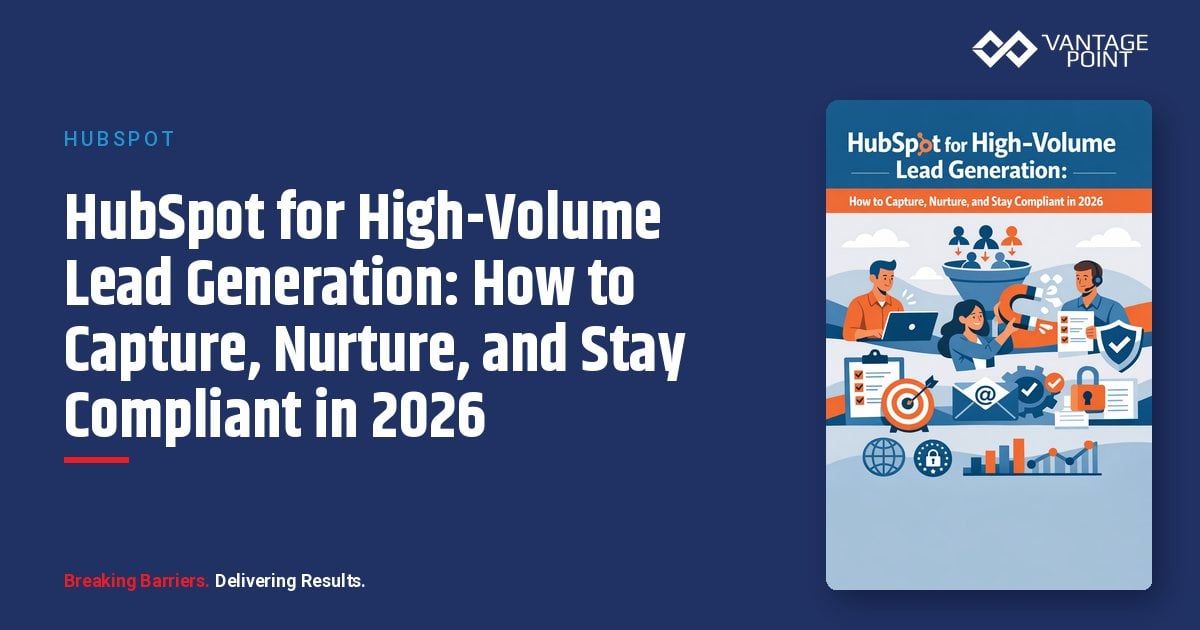
In this guide, we'll walk through how to build a high-volume lead generation engine in HubSpot, from forms and landing pages to Breeze AI-powered scoring, automated workflows, and compliance best practices. Whether you're generating 100 or 10,000 leads per month, these strategies will help you convert more while staying compliant.
What Makes HubSpot Ideal for High-Volume Lead Generation?
Everything Under One Roof
The biggest advantage HubSpot offers for lead-intensive operations is integration. Unlike cobbled-together tech stacks where your form tool doesn't talk to your CRM, and your email platform doesn't know what your ads are doing, HubSpot connects every touchpoint:
- Forms capture lead data and drop it directly into the CRM
- Landing pages convert traffic with built-in A/B testing
- Live chat and chatbots qualify visitors in real time
- Email workflows trigger based on behavior, not guesswork
- Ad integrations (LinkedIn, Facebook, Google) track leads from click to close
- Reporting dashboards show which channels drive actual revenue
When a prospect downloads a whitepaper, visits your pricing page, and then clicks a retargeting ad. All of that is logged, scored, and actionable without anyone needing to manually update a spreadsheet.
Speed-to-Lead Advantage
In high-volume environments, speed is everything. HubSpot's automation ensures that the moment a lead submits a form, the system can:
- Send a personalized acknowledgment email within seconds
- Score the lead based on fit and engagement criteria
- Route the lead to the appropriate sales rep based on territory, deal size, or product interest
- Trigger a Slack notification so the rep can follow up immediately
This kind of instant response dramatically improves conversion rates and ensures no lead falls through the cracks.
Breeze AI: Intelligent Lead Management
HubSpot's Breeze AI capabilities, introduced in late 2025 and expanded in 2026, add a layer of intelligence to lead generation:
- Predictive Lead Scoring: Breeze analyzes historical data to predict which leads are most likely to convert, helping sales teams prioritize their outreach
- AI-Powered Content Generation: Create personalized email sequences, landing page copy, and ad text at scale
- Smart Segmentation: AI-driven segmentation groups leads by behavior patterns, engagement levels, and predicted intent
- Breeze Agents: Automated AI agents that can handle routine lead qualification tasks, freeing up your team for high-value conversations
Building Your Lead Capture Engine in HubSpot
High-Converting Forms
Forms are the workhorses of lead generation. HubSpot's form builder offers several features that help maximize conversion rates:
Progressive Profiling: Instead of asking for 10 fields upfront and scaring leads away, progressive profiling asks different questions each time a visitor returns. First visit? Name and email. Second visit? Company size and role. Third visit? Budget and timeline. This builds a rich contact profile without creating friction.
Smart Fields: Automatically hide fields that have already been answered, keeping forms short and user-friendly.
Dependent Fields: Show or hide questions based on previous answers. If someone selects "Enterprise" for company size, you can ask about their tech stack. If they select "Startup," you can ask about their growth stage.
Best Practices for Form Optimization:
| Strategy | Impact |
|---|---|
| Reduce fields to 3-5 | 20-50% increase in completion rates |
| Add social proof near the form | 10-15% lift in submissions |
| Use action-oriented CTA buttons ("Get My Free Guide") | 15-25% higher click-through |
| Enable smart/progressive profiling | 30%+ more data collected over time |
| A/B test form placement and design | Continuous improvement |
Landing Pages That Convert
Every campaign should have a dedicated landing page with one clear call-to-action. HubSpot's drag-and-drop page builder makes it easy to:
- Create mobile-responsive pages in minutes
- Run A/B tests on headlines, images, and CTAs
- Add personalization tokens so returning visitors see relevant messaging
- Track performance with built-in analytics
Landing Page Formula for High Conversion:
- Headline: State the clear benefit (e.g., "Generate 3x More Qualified Leads in 90 Days")
- Subheadline: Explain what the visitor gets (e.g., "Download our free lead generation playbook")
- Social proof: Testimonials, client logos, or statistics
- Short form: 3-5 fields maximum
- Strong CTA: Action-oriented button text
- Zero navigation: Remove menus and distractions
Chatbots and Live Chat
For high-volume lead environments, chatbots are game-changers. HubSpot's chatbot builder lets you:
- Qualify leads 24/7 with automated question flows
- Book meetings directly from the chat widget
- Route conversations to the right team member
- Collect contact information without a traditional form
Pro tip: Deploy chatbots strategically on high-intent pages (pricing, product comparisons, demo pages) rather than on every page. This focuses the bot's interactions on the visitors most likely to convert.
Ad Integrations for Seamless Lead Capture
HubSpot integrates directly with LinkedIn, Facebook, Instagram, and Google Ads, allowing you to:
- Sync lead gen form submissions directly into the CRM
- Build retargeting audiences based on CRM data
- Track ROI from ad spend to closed deals
- Automate follow-up the moment a lead submits an ad form
This eliminates the manual export-import cycle that causes lead leakage in most organizations.
Nurturing Leads at Scale with Automation
Workflow-Driven Nurture Sequences
Capturing a lead is only step one. The real value comes from what happens next. HubSpot workflows let you build automated nurture sequences that respond to lead behavior in real time:
Behavior-Triggered Workflows: - Downloaded a resource → Send a related case study 3 days later - Visited the pricing page → Notify the assigned sales rep - Opened 3+ emails in a week → Escalate lead score and move to "Sales Ready" - Went dormant for 30 days → Trigger a re-engagement sequence
Lifecycle Stage Automation: - New lead → Welcome sequence with educational content - Marketing Qualified Lead (MQL) → Product-focused content + demo invitation - Sales Qualified Lead (SQL) → Personalized outreach from a rep - Opportunity → Case studies and ROI calculators
Lead Scoring That Actually Works
HubSpot's lead scoring system (enhanced by Breeze AI's predictive capabilities) combines two dimensions:
- Fit Score: How well does this lead match your ideal customer profile? (Company size, industry, role, budget)
- Engagement Score: How actively is this lead interacting with your content? (Page views, email opens, form submissions, chat interactions)
Setting Up Effective Lead Scoring:
| Positive Signals | Points | Negative Signals | Points |
|---|---|---|---|
| Visited pricing page | +15 | Generic email domain (gmail, yahoo) | -5 |
| Downloaded case study | +10 | No engagement in 30 days | -10 |
| Attended webinar | +20 | Competitor company | -20 |
| Requested demo | +30 | Student/intern title | -15 |
| C-suite title | +15 | Unsubscribed from emails | -25 |
| Company size 50+ employees | +10 | Bounced email | -10 |
When a lead crosses your threshold (e.g., 50 points), HubSpot can automatically notify sales, change the lifecycle stage, and trigger a personalized outreach sequence.
Smart Segmentation for Personalized Nurturing
High-volume lead generation demands smart segmentation. Sending the same email to 10,000 leads guarantees poor results. Instead, segment by:
- Source: Organic search vs. paid ads vs. referral vs. event
- Engagement level: Highly active vs. moderately engaged vs. cold
- Company characteristics: Size, geography, tech stack
- Buying stage: Awareness, consideration, decision
- Content interest: Which topics and resources they've consumed
HubSpot's active lists dynamically update as lead behavior changes, ensuring your nurture sequences always target the right people with the right message.
Staying Compliant: Regulations Every Business Must Know
The Compliance Landscape in 2026
If you're generating leads at scale, compliance is not optional: it's a legal and business necessity. Here's what you need to know:
TCPA (Telephone Consumer Protection Act): - Requires prior express written consent before making marketing calls or sending texts - Violations: $500, $1,500 per infraction - The FCC's one-to-one consent rule (effective January 2025) requires consent to be specific to a single seller, not shared across multiple companies
CAN-SPAM Act: - Governs commercial email in the United States - Requires clear identification of marketing emails, functional unsubscribe mechanisms, and physical mailing addresses - Opt-out requests must be honored within 10 business days
GDPR (General Data Protection Regulation): - Applies to any business collecting data from EU residents - Requires explicit opt-in consent for marketing communications - Individuals have the right to access, correct, and delete their personal data - Fines up to €20 million or 4% of global annual revenue
CCPA/CPRA (California Consumer Privacy Act/California Privacy Rights Act): - Gives California residents the right to know what data is collected and to opt out of its sale - Expanded requirements took effect in 2025-2026 with new CPPA regulations
State Privacy Laws: - Over 20 U.S. states now have comprehensive data privacy laws - Requirements vary by state, creating a complex compliance landscape - Businesses must track and comply with regulations in every state where they operate
CASL (Canada's Anti-Spam Legislation): - One of the world's strictest anti-spam laws - Requires express opt-in consent before sending commercial electronic messages
How HubSpot Helps You Stay Compliant
HubSpot has built compliance tools directly into the platform, making it easier to manage consent and data privacy at scale:
1. GDPR-Ready Consent Management - Enable GDPR settings in your HubSpot portal to track and manage consent - Add consent checkboxes to every form with customizable legal language - Specify the legal basis for processing data (consent, legitimate interest, contract performance) - Track consent status at the contact level so you always know who has opted in
2. Subscription Preferences and Opt-Out Management - Create multiple subscription types (marketing, product updates, events) so contacts can choose what they receive - One-click unsubscribe links in every email - Automatic suppression of unsubscribed contacts from future sends - Global opt-out ensures contacts who unsubscribe are removed from all marketing
3. Cookie Consent and Privacy Banners - Built-in cookie consent banners customizable by region - Comply with GDPR, ePrivacy, and state-level cookie regulations - Track which cookies contacts have consented to
4. Data Retention and Deletion - Set automatic data retention policies to purge outdated records - Process data deletion requests to comply with GDPR's "right to be forgotten" and CCPA delete requests - Audit trail of all data processing activities
5. Double Opt-In - Enable double opt-in for email subscriptions to create a verifiable consent record - Particularly important for GDPR compliance and for reducing bot submissions
6. Contact Property Tracking - Every contact record tracks the original source, consent status, subscription preferences, and communication history - This creates the audit trail you need if regulators come asking
Best Practices: Building a Compliant Lead Generation Machine
1. Start with Consent Architecture
Before launching any lead generation campaign, design your consent framework:
- Map every lead capture point (forms, chatbots, ads, events)
- Define the consent language for each touchpoint
- Determine which legal basis applies (consent, legitimate interest)
- Configure HubSpot's GDPR settings and subscription types
- Document everything for audit readiness
2. Audit Your Forms Regularly
High-volume operations mean more opportunities for compliance gaps:
- Review all active forms quarterly to ensure consent checkboxes are present and current
- Test form submissions to verify data flows correctly into the CRM
- Check that progressive profiling doesn't skip consent questions
- Ensure embedded forms on third-party sites are consistent with your HubSpot configuration
3. Maintain Clean Data Hygiene
Dirty data is both a compliance risk and a lead quality problem:
- Run regular deduplication to prevent multiple records for the same contact
- Validate email addresses to reduce bounces and maintain sender reputation
- Archive or delete contacts who haven't engaged in 12+ months (per your data retention policy)
- Use HubSpot's Operations Hub to automate data cleaning workflows
4. Segment Before You Send
Never send blanket communications to your entire database:
- Use active lists to ensure only opted-in contacts receive marketing emails
- Respect subscription type preferences, a contact who opted into product updates didn't opt into promotional offers
- Exclude contacts in certain regions if you're not compliant with their local regulations
- Maintain internal suppression lists for DNC (Do Not Call) compliance
5. Document Your Consent Chain
For every lead, you should be able to answer:
- When did they opt in?
- Where did they opt in? (Which form, landing page, or ad?)
- What did they consent to? (Email, phone, SMS?)
- How was consent collected? (Checkbox language, double opt-in confirmation)
HubSpot tracks this automatically when configured correctly. Make it a practice to verify this data is intact during your quarterly audits.
6. Train Your Team
Compliance isn't just a marketing problem: it spans sales, service, and operations:
- Train sales reps on TCPA rules before they make cold calls
- Ensure service teams know how to process data deletion requests
- Keep marketing updated on new regulations and enforcement actions
- Create internal playbooks for handling opt-out and data access requests
7. Leverage Automation for Compliance
Use HubSpot workflows to enforce compliance automatically:
- Auto-suppress contacts whose consent has expired
- Trigger re-consent campaigns for contacts approaching a consent expiration date
- Automatically move contacts to a "Do Not Contact" list if they meet certain criteria
- Send internal alerts when compliance-sensitive actions occur
Measuring Lead Generation Performance
Key Metrics to Track
| Metric | What It Tells You | Target Benchmark |
|---|---|---|
| Lead Volume | Total leads captured per period | Varies by business |
| Conversion Rate (Visitor → Lead) | Effectiveness of forms and landing pages | 2-5% for most businesses |
| MQL → SQL Conversion Rate | Quality of lead scoring and nurturing | 15-30% |
| Speed-to-Lead | Time from form submission to first contact | Under 5 minutes |
| Email Open Rate | Engagement with nurture sequences | 20-35% |
| Unsubscribe Rate | Content relevance and frequency issues | Under 0.5% |
| Cost Per Lead (CPL) | Efficiency of paid channels | Industry-dependent |
| Lead-to-Customer Rate | Overall funnel effectiveness | 2-5% |
HubSpot Reporting Dashboards
Build custom dashboards in HubSpot to monitor:
- Lead Source Performance: Which channels generate the most and best leads?
- Campaign Attribution: Which campaigns influence pipeline and revenue?
- Form Analytics: Which forms convert best, and which need optimization?
- Workflow Performance: Are nurture sequences moving leads forward?
- Compliance Health: Opt-out rates, consent status distribution, and email deliverability
Frequently Asked Questions (FAQ)
What is HubSpot lead generation?
HubSpot lead generation refers to the process of using HubSpot's CRM and marketing automation tools (including forms, landing pages, chatbots, email workflows, and ad integrations) to capture, qualify, nurture, and convert potential customers into paying clients.
How does HubSpot help with TCPA compliance?
HubSpot provides consent tracking, subscription management, and opt-out automation tools. By enabling GDPR settings and configuring consent checkboxes on forms, you can document when, where, and how each contact consented to communication: creating the audit trail required for TCPA compliance.
What is HubSpot lead scoring and how does it work?
HubSpot lead scoring assigns point values to contacts based on their demographic fit (company size, title, location) and behavioral engagement (page views, email clicks, form submissions). When a contact's score crosses a threshold you define, they're automatically flagged for sales outreach. Breeze AI adds predictive scoring that uses machine learning to identify leads most likely to convert.
How much does HubSpot cost for lead generation?
HubSpot offers a free CRM with basic lead capture tools. Marketing Hub Starter begins at $20/month, Professional at $890/month (with advanced automation and reporting), and Enterprise at $3,600/month (with predictive lead scoring, custom objects, and advanced permissions). Most businesses generating high-volume leads benefit from Professional or Enterprise tiers.
Can HubSpot integrate with my existing tools?
Yes. HubSpot's App Marketplace includes over 1,700 integrations, including Salesforce, LinkedIn Sales Navigator, Slack, Zoom, Google Workspace, Microsoft 365, and many more. For custom integrations, HubSpot offers a robust API and tools like Operations Hub for data syncing.
What is Breeze AI and how does it help with lead generation?
Breeze is HubSpot's suite of AI tools that includes AI assistants (for content creation and CRM actions), AI agents (for automated lead qualification, content generation, and customer service), and predictive analytics (for lead scoring and forecasting). Breeze helps teams work faster by automating routine tasks and surfacing insights that would take hours to find manually.
How do I ensure my emails are CAN-SPAM compliant in HubSpot?
HubSpot automatically includes your physical address and an unsubscribe link in every marketing email. To maintain full CAN-SPAM compliance, ensure your subject lines are not misleading, identify your messages as advertisements when required, honor opt-out requests promptly, and monitor your email sending practices regularly.
Conclusion
High-volume lead generation demands more than great marketing. It requires a system that captures, qualifies, nurtures, and converts leads while keeping your organization compliant with an increasingly complex regulatory landscape.
HubSpot provides that system. With its integrated CRM, powerful automation tools, Breeze AI capabilities, and built-in compliance features, it's purpose-built for businesses that need to generate and manage leads at scale without sacrificing quality or risking regulatory penalties.
The key is implementation. Having HubSpot is not enough. Configuring it correctly, building the right workflows, training your team, and continuously optimizing based on data are what separate organizations that generate leads from those that generate revenue.
Ready to build a high-performing, compliant lead generation engine? Vantage Point helps businesses of all sizes implement and optimize HubSpot for maximum impact. From initial CRM setup to advanced automation, lead scoring, and compliance configuration, our team ensures your HubSpot investment delivers measurable results.
Contact Vantage Point to schedule a consultation and discover how we can transform your lead generation strategy.
About Vantage Point
Vantage Point is a CRM consulting and implementation partner specializing in Salesforce and HubSpot solutions. With deep expertise in automation, integration (including MuleSoft and Data Cloud), and AI-powered personalization, Vantage Point helps businesses across all industries build connected, intelligent systems that drive growth. As trusted partners of Salesforce, HubSpot, Anthropic, Aircall, and Workato, we bring best-in-class technology together to solve real business challenges. Learn more at vantagepoint.io.