
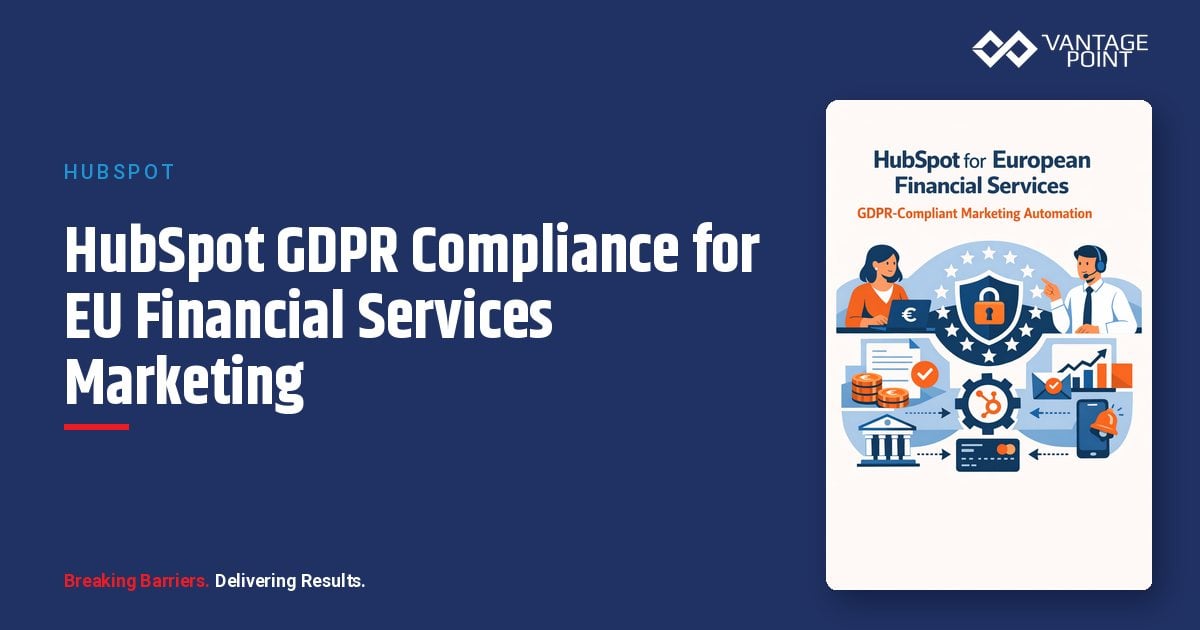
HubSpot supports GDPR-compliant marketing automation for European financial services firms through an EU data center in Frankfurt, built-in consent management, lawful basis tracking, double opt-in, subscription preference centers, and permanent-deletion tools. The platform provides the controls: your firm, as data controller, must configure them correctly. This guide walks through that configuration step by step.
Quick Answer: To configure HubSpot for GDPR-compliant marketing in the EU, enable the platform's GDPR functionality in Settings > Privacy & Consent, deploy region-aware cookie consent banners, track a lawful basis for every contact, turn on double opt-in, build subscription types with a preference center, select EU data residency (Frankfurt), restrict access to sensitive data properties, automate retention and erasure workflows, and execute HubSpot's Data Processing Agreement. This matters for marketing and compliance leaders at European banks, insurers, wealth managers, and fintechs who need personalized campaigns without GDPR exposure. Vantage Point, a boutique senior-led HubSpot and Salesforce consulting partner, implements these configurations for regulated firms.
TL;DR
- HubSpot GDPR compliance is built in but not automatic: consent tracking, lawful basis documentation, cookie banners, double opt-in, and GDPR delete are available on all tiers: they must be configured and governed by your firm.
- EU data residency is available: HubSpot's Frankfurt, Germany data center keeps customer data processed and stored within the EU.
- Nine configuration steps take you from an empty portal to compliant marketing automation: GDPR toggle, cookie banners, lawful basis, double opt-in, subscription types, data residency, sensitive data controls, retention/erasure workflows, and the DPA.
- Valid consent is the foundation: it must be freely given, specific, informed, and unambiguous: pre-ticked boxes don't count.
- Vantage Point helps financial services firms configure HubSpot with compliance and security controls from day one.
What Is HubSpot Consent Management for EU Marketing?
HubSpot consent management is the platform's built-in set of tools for capturing, documenting, and honoring a contact's permission to be marketed to, including consent checkboxes on forms, lawful basis tracking on contact records, cookie consent banners, double opt-in confirmation, and subscription preference centers. Together, these tools let a marketing team prove when, how, and for what purpose each contact consented, and automatically suppress anyone who withdraws consent.
For EU marketing, consent management is the operational core of GDPR compliance. The regulation requires a documented lawful basis before you process personal data for marketing, and consent is the most common basis for email campaigns. HubSpot documents these capabilities and its own platform commitments in its GDPR data privacy resource hub.
Why Does GDPR Compliance Matter for European Financial Marketers?
European financial services firms face a unique challenge: delivering personalized, engaging marketing experiences while navigating one of the world's strictest regulatory environments. Between GDPR requirements, MiFID II communications rules, and regulations like DORA (Digital Operational Resilience Act), marketing teams at banks, insurance companies, and wealth management firms often feel paralyzed by compliance concerns.
The consequences of getting it wrong are severe. GDPR violations can result in fines up to €20 million or 4% of global annual turnover: whichever is greater. For a mid-sized European bank, that could mean tens of millions in penalties, not to mention the reputational damage that erodes client trust.
But here's the good news: GDPR-compliant marketing automation isn't just possible: it can become a competitive advantage. When done right, privacy-first marketing builds deeper trust with clients and delivers better results than data-harvesting approaches ever could.
Why Should European Financial Services Firms Choose HubSpot?
EU Data Center in Frankfurt, Germany
One of the most significant concerns for European financial institutions is data residency. Where is client data stored? Can it cross borders? HubSpot addresses this head-on with its EU data center located in Frankfurt, Germany.
Key capabilities:
- Full EU data residency: Customer data is processed and stored within the EU.
- AWS-hosted infrastructure: Leverages Amazon Web Services' SOC 2 Type 2 and ISO 27001 certified data centers.
- Disaster recovery: Data is replicated within the EU region for backup purposes.
- Migration available: Existing HubSpot customers can migrate their accounts to the EU data center.
Since July 2021, new HubSpot customers have had the option to select EU data hosting at signup. For financial services firms with strict data residency requirements (whether imposed by regulators, internal compliance teams, or client contracts) this eliminates a major barrier to adoption.
Built-In GDPR Compliance Tools
HubSpot was built with privacy by design. Rather than bolting on compliance features as an afterthought, the platform includes comprehensive GDPR tools across all subscription tiers:
| Feature | Description | Availability |
|---|---|---|
| GDPR Delete | Permanently removes contact data and prevents re-creation | All tiers |
| Lawful Basis Tracking | Documents legal grounds for processing each contact | All tiers |
| Consent Management | Tracks explicit opt-ins and opt-outs by channel | All tiers |
| Cookie Consent Banners | Customizable by region and page | All tiers |
| Data Access Requests | Tools to respond to subject access requests | All tiers |
| Double Opt-In | Two-step email subscription confirmation | All tiers |
| Sensitive Data Properties | Extra safeguards and access limits for high-sensitivity fields | Enterprise tiers |
HubSpot's compliance posture also extends beyond GDPR. For a deeper look at SOC 2 Type 2, role-based access controls, and audit trails for regulatory examinations, see our pillar guide to implementing HubSpot in regulated financial environments.
How Do You Configure HubSpot for GDPR-Compliant Marketing? (Step-by-Step)
The following nine steps take a HubSpot portal from default settings to a GDPR-ready marketing automation environment. Work through them in order: each step builds on the previous one.
Step 1: Turn On HubSpot's GDPR Functionality
Before launching any marketing campaigns, enable HubSpot's data privacy settings:
- Navigate to Settings > Privacy & Consent > Data Privacy
- Enable "Turn on data privacy settings"
- Select your default legal basis for communications
- Configure consent language for your target markets
This toggle activates GDPR features portal-wide: consent fields appear on forms, lawful basis properties become available on contact records, and GDPR-compliant deletion is enabled. For European financial services firms, we recommend setting consent as the default legal basis for marketing communications. While legitimate interest may apply in some B2B contexts, explicit consent provides the strongest compliance position and builds client trust.
Step 2: Configure Cookie Consent Banners
European regulations require informed consent before setting non-essential cookies. HubSpot's cookie consent banner system allows you to:
- Customize by region: Show different banners to EU visitors vs. other regions.
- Specify cookie categories: Let visitors choose between analytics, advertising, and functionality cookies.
- Match your brand: Style banners to align with your institution's visual identity.
- Document consent: Automatically record when and how consent was given.
Best practice for financial services: Create separate cookie policies for different jurisdictions. A German bank, for example, may need stricter default settings than required by GDPR alone due to the German Federal Data Protection Act (BDSG) requirements.
Step 3: Track Lawful Basis for Processing
For each contact in your CRM, HubSpot tracks the legal basis for processing. The six lawful bases under GDPR are:
- Consent: The individual has given clear consent
- Contract: Processing is necessary for a contract
- Legal obligation: Processing is necessary for compliance
- Vital interests: Processing is necessary to protect someone's life
- Public task: Processing is necessary for official functions
- Legitimate interests: Processing is necessary for legitimate interests
For marketing purposes, most financial services firms will rely on consent or legitimate interests. HubSpot automatically tracks when consent is given, through which form or interaction, and allows contacts to withdraw consent at any time. Document the basis for every contact. During examinations or supervisory inquiries, "we don't know why we're emailing this person" is not an acceptable answer.
Step 4: Enable Double Opt-In
Double opt-in adds a confirmation email step before a new subscriber is marked as opted in. While not strictly required by GDPR, it provides proof of consent, verification of email ownership, higher-quality email lists, and better deliverability. Enable it under Settings > Marketing > Email > Subscriptions: globally or per subscription type.
For financial services firms, double opt-in is particularly valuable when onboarding high-value prospects. The extra step filters out invalid emails and demonstrates your commitment to privacy.
Step 5: Create Subscription Types and a Preference Center
HubSpot's subscription types give contacts granular control over what they receive, a GDPR expectation, since consent must be specific to a purpose.
Recommended subscription types for financial services:
- Market updates and investment insights
- Product and service announcements
- Regulatory and compliance notifications
- Event invitations
- Newsletter and thought leadership
Configure each subscription type with:
- Clear description of what subscribers receive
- Frequency expectations
- Easy unsubscribe mechanism
- Multi-language support for your markets
Then publish a preference center so contacts can manage their own subscriptions and withdraw consent for individual channels at any time, instead of facing an all-or-nothing unsubscribe.
Step 6: Choose EU Data Residency
If data residency matters to your regulators, compliance team, or client contracts, select HubSpot's EU data center (Frankfurt) at signup, or plan a migration if your existing portal is hosted elsewhere. Note that some processing for specific features, sub-processors, or support requests may still occur outside the EU; review HubSpot's sub-processor list and DPA so your records of processing are accurate.
Step 7: Protect Sensitive Data Properties
Financial services contacts often carry high-sensitivity data: account details, risk profiles, or health information in insurance contexts. Apply data minimization first: don't store what marketing doesn't need. For data you must store:
- Use HubSpot's Sensitive Data capabilities (available on Enterprise subscriptions) to mark designated properties as sensitive and apply stricter handling.
- Apply field-level permissions so only authorized roles can view or edit sensitive properties.
- Exclude sensitive fields from personalization tokens in marketing emails to prevent accidental disclosure.
- Restrict exports of lists containing sensitive properties to compliance-approved users.
Step 8: Build Retention and Erasure Workflows
GDPR's storage limitation principle means you cannot keep personal data forever. Automate the lifecycle:
Data Subject Access Request (DSAR) workflow:
- Contact submits DSAR through a dedicated form
- Workflow creates a task for the compliance team
- Automatic acknowledgment email is sent
- 30-day deadline reminder is triggered
- Completion is logged in the CRM
Retention and erasure workflow:
- Define retention periods per data category with legal counsel (marketing data typically shorter than contractual records)
- Build a workflow that flags contacts with no lawful basis or expired consent
- Run a consent renewal campaign where appropriate, and suppress non-responders
- Use GDPR Delete to permanently erase contacts on request or at end of retention. This prevents the record from being silently re-created by syncs or imports
Step 9: Execute HubSpot's Data Processing Agreement
HubSpot's Data Processing Agreement (DPA) includes EU Standard Contractual Clauses (SCCs), EU-U.S. Data Privacy Framework compliance, Swiss-U.S. and UK transfer mechanisms, and clear sub-processor disclosure. Your firm is the data controller; HubSpot is the processor, and GDPR requires a signed DPA to formalize that relationship. Have legal counsel review it, file the executed copy in your compliance records, and monitor HubSpot's sub-processor list for changes. Compliance teams can conduct due diligence through HubSpot's Trust Center.
What Do Compliant Marketing Automation Workflows Look Like?
Compliant Lead Nurturing Sequences
Build automated email sequences that respect consent boundaries:
Example: Investment Product Education Series
Trigger: Contact downloads "2026 European Market Outlook" guide
Enrollment criteria:
- Has legal basis for marketing communications
- Subscribed to "Investment Insights"
- Located in EU/EEA
Sequence:
- Email 1 (Day 0): "Your guide is ready" + resource delivery
- Email 2 (Day 3): "Understanding market volatility": educational content
- Email 3 (Day 7): "How our clients navigate uncertainty": case study
- Email 4 (Day 14): "Schedule a portfolio review": soft CTA
Suppression: Remove from workflow if:
- Unsubscribes from any communication
- Withdraws consent
- Books a consultation
Event-Triggered Personalization
Use behavioral data to deliver relevant content without crossing privacy lines.
Compliant triggers:
- Form submissions with explicit consent
- Website page visits (with cookie consent)
- Email engagement (opens, clicks)
- CRM activity (logged calls, meetings)
Non-compliant triggers to avoid:
- Third-party data enrichment without consent
- Social media scraping
- Cross-device tracking without disclosure
- Purchased contact lists
What Counts as Valid GDPR Consent?
According to the European Data Protection Board's guidance on obtaining valid consent, consent must be:
- Freely given: Not bundled with terms of service
- Specific: For a defined purpose
- Informed: Clear explanation of data use
- Unambiguous: Demonstrated by affirmative action
Pre-ticked checkboxes, buried consent language, or "consent by continuing to use this site" approaches are not valid. HubSpot's forms support compliant consent capture with unticked opt-in checkboxes by default, customizable consent language, links to your privacy policy, and separate checkboxes for different purposes.
Managing Consent Across Channels
European financial regulations often require consistent consent management across all channels. HubSpot centralizes consent tracking so that:
- A preference set via email applies to all communications
- Unsubscribes sync across marketing email, sequences, and workflows
- Sales teams can see consent status before outreach
- Customer service has visibility into communication preferences
How Does HubSpot Protect Financial Services Data?
HubSpot provides security features aligned with financial services requirements:
| Security Feature | Description |
|---|---|
| Single Sign-On (SSO) | Integrate with your identity provider |
| Two-Factor Authentication | Required for all account access |
| IP Allowlisting | Restrict access to approved networks |
| Field-Level Permissions | Control who can view sensitive data |
| Audit Logs | Track all user activity |
| Session Timeouts | Automatic logout after inactivity |
Third-party integration considerations: When connecting HubSpot to other systems (CRM, trading platforms, portfolio management), ensure data transfer mechanisms are GDPR-compliant, sub-processors are documented, data minimization principles apply, and data is encrypted in transit and at rest. Vantage Point's CRM and marketing automation services include integration governance for exactly these scenarios.
How Do Banks, Insurers, and Wealth Managers Use HubSpot Compliantly?
Banking and Credit Unions
Compliant marketing applications: New product announcements to opted-in customers, personalized cross-sell recommendations based on account activity, educational content about financial planning, branch event invitations with location-based targeting (with consent), and customer feedback surveys with proper consent.
Key compliance considerations: Separate marketing consent from account terms, clear opt-out for promotional communications, and retention limits on marketing data.
Insurance
Compliant marketing applications: Policy renewal reminders (contractual basis), new coverage options for existing policyholders, risk education content, claims prevention resources, and broker/agent enablement.
Key compliance considerations: Distinguish between service communications and marketing, special category data handling for health/life insurance, and profiling transparency requirements.
Wealth Management and RIAs
Compliant marketing applications: Market commentary and investment insights, portfolio review scheduling, client event invitations, referral programs (with proper consent flows), and educational webinar promotion.
Key compliance considerations: MiFID II communication requirements, suitability documentation, and record-keeping for client communications.
How Do You Measure Marketing Performance While Respecting Privacy?
With proper cookie consent, HubSpot provides comprehensive analytics including email open and click rates, form conversion rates, page views from consented visitors, attribution reporting, and campaign ROI.
Privacy-first measurement tips:
- Accept that some data will be limited by consent choices
- Focus on engaged-audience metrics rather than total reach
- Track consent opt-in rate as a leading indicator: improving consent UX grows your marketable audience compliantly
- Use first-party data for personalization
- Respect browser privacy settings (Safari ITP, Firefox ETP)
What Does a GDPR-Compliant Implementation Roadmap Look Like?
Phase 1: Foundation (Weeks 1-4)
- Select EU data center during setup (or migrate existing account)
- Enable data privacy settings
- Configure cookie consent banners
- Create subscription types
- Update privacy policy and consent language
- Train team on GDPR basics
Phase 2: Data Cleanup (Weeks 5-8)
- Audit existing contact database
- Document lawful basis for existing contacts
- Run consent refresh campaign if needed
- Implement double opt-in for new contacts
- Set up DSAR response workflow
Phase 3: Automation (Weeks 9-12)
- Build compliant nurturing workflows
- Create consent-aware email templates
- Implement preference center
- Set up compliance reporting dashboards
- Document all data flows
Phase 4: Optimization (Ongoing)
- Monitor consent rates
- Test consent UX improvements
- Review and update processes quarterly
- Stay current with regulatory changes
- Conduct annual privacy impact assessments
How Vantage Point Helps
Vantage Point is a boutique, senior-led consulting firm that implements HubSpot for financial services organizations with GDPR compliance configured from day one, consent architecture, lawful basis tracking, preference centers, retention workflows, and integration governance. Our senior-only, employee-owned team combines HubSpot implementation expertise with dedicated compliance and security solutions for regulated environments.
If your team is evaluating how GDPR applies to your HubSpot portal, marketing automation, or CRM integrations, Vantage Point can help assess the right next step and build a practical implementation plan. For the broader compliance picture (SOC 2 due diligence, role-based access, and audit trails) start with our guide to implementing HubSpot in regulated financial environments.
Frequently Asked Questions
Is HubSpot GDPR compliant?
HubSpot provides the tools and infrastructure to help organizations comply with GDPR, including consent management, lawful basis tracking, cookie banners, and permanent deletion. However, compliance ultimately depends on how you configure and use the platform. HubSpot is a data processor; your organization is the data controller responsible for lawful data handling.
Can I keep all my data in the EU with HubSpot?
Yes. By selecting the EU data center in Frankfurt, Germany, your customer data is stored and processed within the EU. Some processing may occur outside the EU for specific features, sub-processors, or support requests, so review HubSpot's sub-processor list for complete details.
How do I handle existing contacts who haven't given GDPR-compliant consent?
You have three options: run a consent refresh campaign asking contacts to re-opt-in, rely on legitimate interest where applicable (with a documented assessment), or suppress these contacts from marketing until consent is obtained. Most firms combine a refresh campaign with suppression of non-responders.
Does HubSpot support double opt-in?
Yes, HubSpot supports double opt-in for email subscriptions across all subscription tiers. You can enable it globally or per subscription type, and it provides documented proof of consent along with better list quality and deliverability.
How do I respond to data subject access requests in HubSpot?
HubSpot provides tools to export all data associated with a contact. Create a workflow to track DSARs from intake through completion, then use the contact export feature to compile the required information within the 30-day response window required by GDPR.
What happens when someone unsubscribes in HubSpot?
When a contact unsubscribes, HubSpot automatically suppresses them from marketing emails and removes them from relevant workflows. You can configure whether unsubscribes apply to all communications or specific subscription types via your preference center.
Can I use HubSpot for B2B marketing under legitimate interest?
In B2B contexts, legitimate interest may apply for certain marketing activities, but you must document your legitimate interest assessment, ensure the contact can easily opt out, and be transparent about data use. Consent remains the safest approach for most financial services marketing.
Who configures HubSpot GDPR compliance: HubSpot or my firm?
Your firm is responsible. HubSpot supplies the features, but the data controller must enable the GDPR toggle, define lawful bases, build consent capture, and govern retention. Many regulated firms work with an implementation partner like Vantage Point to configure these controls correctly the first time.
This article is provided for educational purposes only and does not constitute legal advice. Consult your legal counsel and data protection officer to determine how GDPR and related regulations apply to your firm.
About Vantage Point
Vantage Point is a boutique, senior-led consulting firm specializing in HubSpot and Salesforce implementations for financial services organizations. Our team combines platform expertise with financial services industry knowledge to deliver measurable improvements in client engagement, operational efficiency, and compliance readiness.
About the Author
David Cockrum founded Vantage Point after serving as Chief Operating Officer in the financial services industry. His unique blend of operational leadership and technology expertise has enabled Vantage Point's distinctive business-process-first implementation methodology, delivering successful transformations for clients.
- Email: david@vantagepoint.io
- Phone: (469) 499-3400
- Website: vantagepoint.io