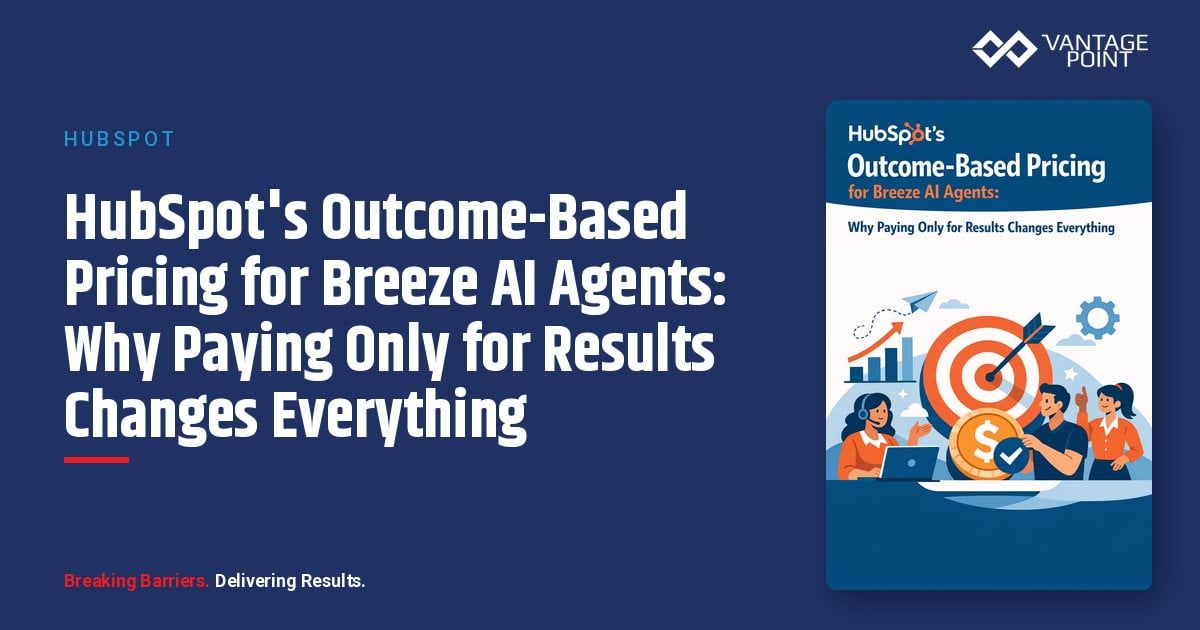
HubSpot's Outcome-Based Pricing for Breeze AI Agents: Why Paying Only for Results Changes Everything
TL;DR / Key Takeaways
| What Is It? | HubSpot is switching Breeze Customer Agent and Prospecting Agent to outcome-based pricing: you only pay when the AI actually delivers a result |
| Key Benefit | Eliminates cost unpredictability, the #1 barrier to AI adoption. Every dollar spent = a verified outcome |
| Cost / Investment | Customer Agent: $0.50 per resolved conversation (was $1.00/conversation). Prospecting Agent: $1 per qualified lead recommended for outreach. Free 28-day trial included |
| Best For | Any business running customer support or outbound sales on HubSpot Pro or Enterprise who wants AI with zero wasted spend |
| Bottom Line | HubSpot is betting its AI is good enough to only charge when it works. That's a confident move, and the right direction for the industry |
Starting April 14, 2026, HubSpot made a pricing move that I didn't expect, and one that I think changes the conversation around AI adoption for every business evaluating CRM-native AI agents.
Breeze Customer Agent and Breeze Prospecting Agent are switching to outcome-based pricing. The old model charged $1.00 per conversation regardless of whether the AI actually solved anything. The new model? $0.50 per resolved conversation. You only pay when the AI actually fixes the problem.
For the Prospecting Agent, the shift is even more dramatic: instead of a recurring monthly charge per enrolled contact, you now pay $1 per qualified lead recommended for outreach: meaning you only pay when a prospect gets qualified and handed to your sales team.
This isn't just a price drop. It's a fundamental realignment of how AI vendors and their customers share risk.
What Exactly Is Changing?
Here's the side-by-side breakdown:
Breeze Customer Agent
| Old Model | New Model | |
|---|---|---|
| Pricing | $1.00 per conversation | $0.50 per resolved conversation |
| What You Pay For | Every AI interaction, whether it helped or not | Only conversations the AI fully resolves without human escalation |
| Risk | On the customer | Shared with HubSpot |
Breeze Prospecting Agent
| Old Model | New Model | |
|---|---|---|
| Pricing | Monthly recurring charge per enrolled contact | $1 per lead recommended for outreach |
| What You Pay For | Contact enrollment regardless of results | Only qualified leads handed to your sales team |
| Risk | On the customer | Shared with HubSpot |
Both agents are available to Pro and Enterprise customers and now include a free 28-day trial: which is HubSpot essentially saying: try it, measure it, then decide.
Why This Matters More Than You Think
I've spent years helping clients evaluate AI tools across both Salesforce and HubSpot ecosystems. And cost unpredictability is consistently the single biggest factor that slows adoption down.
It's not that businesses don't want AI. It's that they can't justify an investment where the return is uncertain. Every CFO I've worked with asks the same question: "What if the AI gives wrong answers and we still pay?"
Well, now that risk is baked into HubSpot's pricing, not yours.
The Three Reasons This Is a Big Deal
1. It removes the biggest objection to AI adoption
Every client conversation I've had about deploying AI agents eventually hits the same wall: "What if it doesn't work and we're stuck paying for it?" Outcome-based pricing eliminates that wall entirely. Your spend is tied to results: period.
As Jon Dick, HubSpot's Chief Customer Officer, put it: "Outcome-based pricing removes that risk. You pay when it works, full stop. Customers can move faster, experiment more, and trust that their spend is tied to real results."
2. It aligns incentives perfectly
Under the old model, HubSpot got paid whether the AI helped your customer or not. Under the new model, HubSpot only wins when your customers are actually helped. That's how it should work.
This alignment is possible because Breeze agents operate inside HubSpot's Smart CRM, giving them access to contact data, relationship history, and business context that generic AI tools simply don't have. That CRM-native advantage is what enables HubSpot to confidently bet on outcomes.
3. The ROI math gets simple
No more spreadsheets trying to model AI ROI with assumptions about resolution rates. Every dollar you spend = a resolved ticket or a qualified lead. That's it.
Here's what HubSpot reports for these agents in practice:
| Metric | Value |
|---|---|
| Resolution rate | 65% of conversations resolved by AI |
| Resolution time improvement | 39% faster than human-only support |
| Active deployments | 8,000+ HubSpot customers |
| Prospecting Agent growth | 57% activation increase quarter-over-quarter |
| Close rate improvement | 10% higher close rates with Prospecting Agent |
How Does This Compare to the Competition?
HubSpot isn't operating in a vacuum. The entire AI agent market is wrestling with the pricing question, and according to research from paid.ai, 75% of vendors adding AI agents have no systematic approach to pricing them.
Here's where the major players stand:
| Platform | Pricing Model | Cost | What You Pay For |
|---|---|---|---|
| HubSpot Breeze | Outcome-based | $0.50/resolved conversation; $1/qualified lead | Only verified results |
| Intercom Fin | Outcome-based | $0.99/resolution | Resolved issues or successful procedure handoffs |
| Zendesk AI | Outcome-based | ~$1.50: $2.00/resolution | Completed AI resolutions (requires Suite plan) |
| Salesforce Agentforce | Workflow/consumption-based | $2.00/conversation | Every conversation, regardless of outcome |
| Generic AI chatbots | Usage-based or per-seat | Varies widely | Volume of interactions, not results |
The pattern is clear: the most confident platforms are moving to outcome-based pricing, while those still relying on usage-based models are essentially charging for activity rather than results.
What makes HubSpot's position particularly strong is the 50% price advantage over the closest outcome-based competitor (Intercom at $0.99) and the dramatic gap versus consumption-based models like Salesforce Agentforce at $2.00 per conversation: where you pay regardless of whether anything got resolved.
The Industry Pricing Breakdown
According to paid.ai's research across the AI agent landscape:
- Usage-based pricing: 45% of vendors (most vulnerable to commoditization)
- Per-agent/FTE replacement: 20% of vendors
- Outcome-based pricing: 20% of vendors (highest margins, lowest churn)
- Workflow-based pricing: 15% of vendors
The data shows that outcome-based pricing yields the highest margins with the lowest churn: which means this isn't just good for customers. It's a sustainable business model that rewards vendors who actually build effective AI.
What Counts as "Resolved"?
This is the question every operations leader should be asking, and the answer matters.
For Breeze Customer Agent, a resolved conversation means the AI agent fully addressed the support issue without needing to escalate to a human agent. The agent handles the entire interaction (understanding the question, accessing relevant CRM data, providing the answer, and confirming resolution) across channels including email, website chat, and WhatsApp.
For Breeze Prospecting Agent, you pay when a prospect is qualified and recommended for outreach: meaning the AI has identified the lead, evaluated fit based on your CRM data and ICP criteria, and handed them to your sales team as ready for engagement.
Important Governance Considerations
While outcome-based pricing is a major step forward, businesses need to approach it with the same rigor they'd apply to any AI deployment:
- Define success criteria clearly before deployment: what does "resolved" mean for your specific use cases?
- Monitor and audit outcomes regularly to ensure billing accuracy matches actual performance
- Track escalation patterns to understand what types of issues the AI handles well versus where it struggles
- Measure customer satisfaction on AI-resolved conversations to ensure quality isn't being sacrificed for resolution volume
The Bigger Picture: Why This Signals a Market Shift
This pricing change isn't happening in isolation. It reflects a fundamental shift in how the entire SaaS industry thinks about AI value.
The Problem with "Pay for Potential"
Deloitte's latest research on AI investment ROI captures the tension perfectly: enterprises are pouring money into AI, but many still struggle to tie that spend to measurable business outcomes. The report found that fragmented data, unclear success metrics, and experimentation-heavy deployments generate activity without clear impact.
Usage-based pricing amplifies this uncertainty, forcing leaders to justify costs tied to inputs rather than results. Outcome-based pricing flips that equation entirely.
Only 7% of Enterprises Are "AI-Ready"
A 2026 Cloudera/HBR study found that only 7% of enterprises consider themselves AI-ready, with 56% citing siloed data as the primary barrier. Many AI failures stem from poor data quality rather than model limitations.
This is precisely where CRM-native AI agents have an advantage. Because Breeze agents operate within HubSpot's Smart CRM, they already have access to clean, contextual, relationship-rich data. That's a massive head start over generic AI tools that need to be connected to disparate data sources.
The Confidence Signal
HubSpot is essentially saying: our AI is good enough that we'll only charge when it delivers.
That's a bet most AI vendors aren't willing to make. And for the 75% of vendors who have no systematic pricing approach for their AI agents, HubSpot's move raises the bar significantly.
What This Means for Your Business
If You're Already on HubSpot
This is an easy decision. The free 28-day trial means you can test both agents with zero risk:
- Activate the Customer Agent on your support channels and measure resolution rates against your current baseline
- Deploy the Prospecting Agent and track qualified leads generated versus your existing SDR pipeline
- Compare the cost per outcome against what you're currently spending per ticket or per qualified lead through human-only processes
The math will speak for itself. If a human-handled support ticket costs you $15: $25 per interaction, a $0.50 AI resolution is a 95% cost reduction, and that's before factoring in 24/7 availability and 39% faster resolution times.
If You're Evaluating CRM Platforms
This pricing model should be a factor in your platform decision. Ask every vendor in your evaluation:
- Will you charge me for AI interactions that don't produce results?
- How do you define a successful outcome?
- What's my cost per resolved ticket or qualified lead?
Any vendor that can't give you a clear, outcome-tied answer is asking you to absorb the risk of their AI's performance.
If You're Already Using Salesforce
At $2.00 per conversation with Agentforce, where you pay regardless of outcome, versus $0.50 per resolved conversation with Breeze, the unit economics tell a compelling story. This doesn't mean one platform is universally better than the other (both have distinct strengths), but for AI-assisted customer support and prospecting specifically, HubSpot's outcome-based approach is a significant advantage.
The ROI Calculator: Real Numbers
Let's make this concrete for a mid-market business:
| Scenario | Human-Only | HubSpot Breeze (Old) | HubSpot Breeze (New) |
|---|---|---|---|
| Monthly support conversations | 2,000 | 2,000 | 2,000 |
| AI resolution rate | 0% | N/A (65% attempted) | 65% |
| Conversations resolved by AI | 0 | 1,300 | 1,300 |
| Cost per AI interaction | N/A | $1.00 × 2,000 = $2,000 | $0.50 × 1,300 = $650 |
| Human tickets remaining | 2,000 | 700 | 700 |
| Cost per human ticket | $20 | $20 | $20 |
| Human support cost | $40,000 | $14,000 | $14,000 |
| Total monthly cost | $40,000 | $16,000 | $14,650 |
| Monthly savings | N/A | $24,000 | $25,350 |
| Annual savings | N/A | $288,000 | $304,200 |
Under the new model, you save an additional $16,200 per year compared to the old pricing, and you have the added confidence that every dollar spent on AI was a dollar that delivered a result.
How Vantage Point Helps You Get This Right
Deploying AI agents isn't just about flipping a switch. Getting the most out of outcome-based pricing requires:
- Knowledge base optimization: Your AI agent is only as good as the content it draws from. We help structure your knowledge base for maximum AI resolution rates
- CRM data quality: Clean, contextual data is what enables Breeze agents to resolve conversations effectively. We audit and optimize your HubSpot CRM data to feed better AI outcomes
- Workflow design: Configuring escalation paths, defining resolution criteria, and building handoff workflows that maximize AI-resolved conversations
- Performance monitoring: Setting up dashboards and reporting to track AI agent performance, cost-per-outcome, and continuous improvement opportunities
- Multi-platform strategy: For businesses using both Salesforce and HubSpot, we help you understand where each platform's AI capabilities deliver the strongest ROI
We've helped clients navigate exactly these kinds of platform decisions. The difference between a successful AI deployment and a failed one almost always comes down to data readiness, workflow design, and ongoing optimization: not the AI technology itself.
Contact Vantage Point to evaluate how Breeze AI agents can reduce your support costs and accelerate your sales pipeline.
Frequently Asked Questions
What is HubSpot's new outcome-based pricing for Breeze AI agents?
Starting April 14, 2026, HubSpot switched Breeze Customer Agent from $1.00 per conversation to $0.50 per resolved conversation, and Breeze Prospecting Agent from a monthly per-contact fee to $1 per qualified lead recommended for outreach. You only pay when the AI delivers a measurable result.
How does HubSpot Breeze AI pricing compare to Salesforce Agentforce?
HubSpot Breeze Customer Agent charges $0.50 per resolved conversation (outcome-based), while Salesforce Agentforce charges $2.00 per conversation regardless of outcome (consumption-based). HubSpot's model means you only pay for successful resolutions, making the effective cost significantly lower.
What counts as a "resolved conversation" for HubSpot Breeze Customer Agent?
A resolved conversation is one where the AI agent fully addresses the support issue without escalating to a human agent. The agent handles the entire interaction (understanding the question, accessing CRM data, providing the answer, and confirming resolution) across email, website chat, and WhatsApp.
How does HubSpot Breeze AI pricing compare to Intercom Fin?
HubSpot Breeze charges $0.50 per resolved conversation while Intercom Fin charges $0.99 per resolution. Both use outcome-based models, but HubSpot's is roughly 50% less expensive per successful outcome and includes native CRM data integration.
Is outcome-based AI pricing better than usage-based pricing?
For most businesses, yes. Research from paid.ai found that outcome-based pricing yields the highest margins with the lowest churn for vendors, while giving customers cost predictability and clear ROI. Usage-based pricing (used by 45% of vendors) is the most vulnerable to commoditization and charges for activity rather than results.
What is the ROI of HubSpot Breeze Customer Agent?
HubSpot reports that Breeze Customer Agent resolves 65% of conversations and cuts resolution time by 39% across 8,000+ customers. At $0.50 per resolved conversation versus $15. $25 per human-handled ticket, businesses can see 95% cost reduction on AI-resolved interactions.
How do I get started with HubSpot Breeze AI agents?
HubSpot offers a free 28-day trial for both Breeze Customer Agent and Breeze Prospecting Agent, available to Pro and Enterprise customers. This lets you test outcome-based pricing with zero risk before committing. Contact a HubSpot partner like Vantage Point for help with knowledge base optimization, CRM data readiness, and deployment strategy.
Resources
- HubSpot Breeze AI Agents: Official product page
- MarTech: HubSpot Moves to Outcome-Based Pricing: Industry coverage
- CMSWire: HubSpot Shifts Breeze AI to Pay-per-Result: Detailed analysis
- Diginomica: Outcome-Based Pricing Deep Dive: Market context
- Paid.ai: SaaS Agent Pricing Research: AI agent pricing landscape data
- Deloitte: AI Investment ROI Research: Enterprise AI ROI challenges
- Vantage Point: CRM strategy, AI deployment, and platform optimization