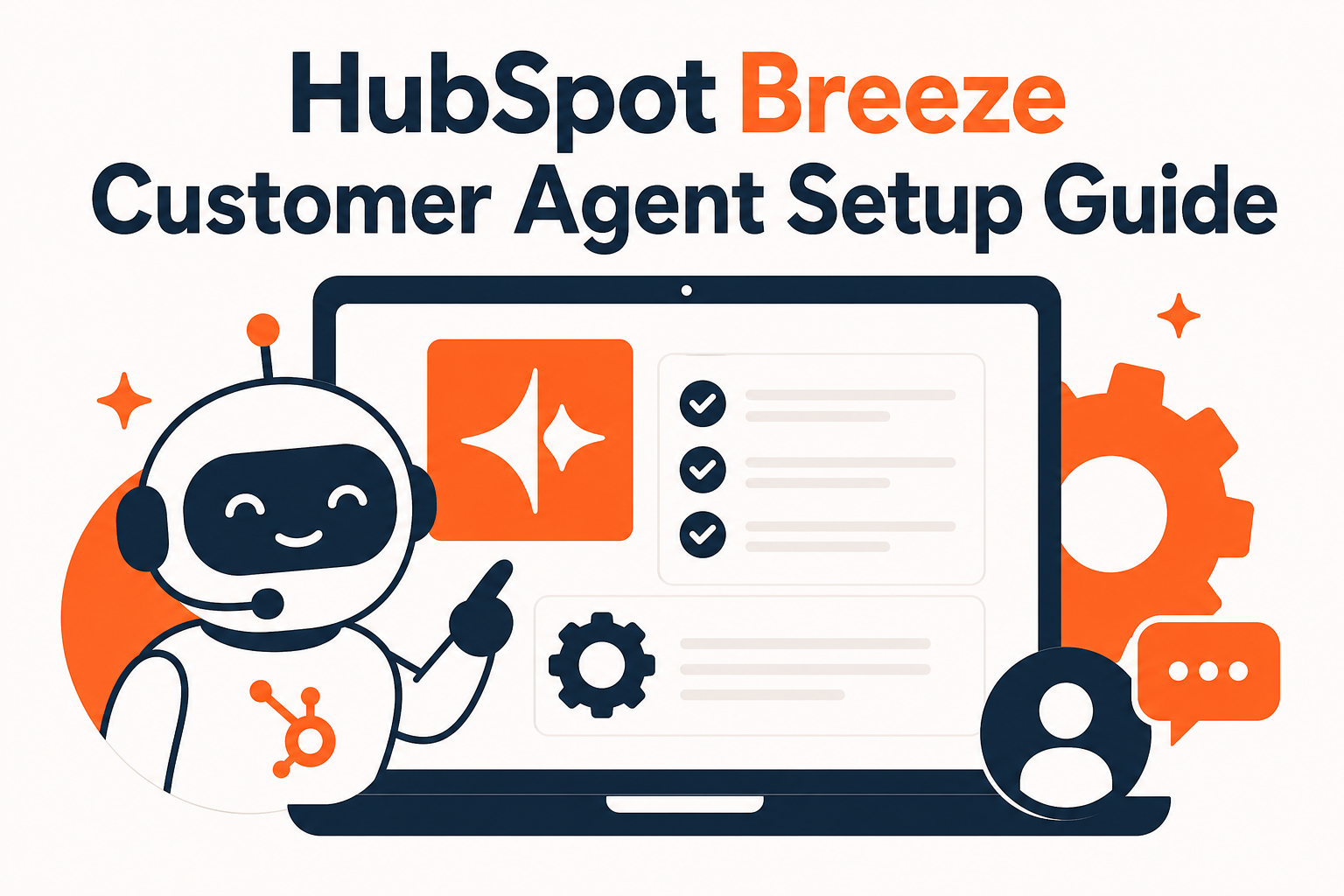
The HubSpot Breeze Customer Agent is an AI support agent that answers customer questions automatically using your existing content. Setting it up well is the difference between an agent that deflects routine tickets cleanly and one that frustrates customers and erodes trust.
This guide walks through how to set up, train, test, deploy, and optimize the Customer Agent: plus the best practices that actually move resolution rates. It is written for support, RevOps, and CX leaders evaluating whether to turn the agent on, and how to do it without sacrificing quality.
Quick Answer
The HubSpot Breeze Customer Agent is an AI agent, powered by Breeze, that resolves common customer questions across your support channels using your knowledge base, website, and uploaded content. It matters for support, service, and RevOps teams who want to scale 24/7 coverage without adding headcount. This article helps you decide how to configure, train, and test the agent before launch so it resolves the right tickets and hands off the rest cleanly. Vantage Point helps organizations implement HubSpot the right way (content strategy, CRM data readiness, and governed AI rollout) so the Customer Agent performs from day one.
TL;DR
- What it is: An AI support agent powered by Breeze that answers customer questions automatically using your existing HubSpot content and public URLs.
- Why it matters: It deflects repetitive tickets, runs 24/7, and lets human reps focus on complex cases. HubSpot states the agent can resolve up to 70% of conversations.
- Best for: Marketing, Sales, Service, Content, Data, and Commerce Hub Professional and Enterprise customers with a solid knowledge base.
- Decision point: Quality of your content sources and handoff rules drive results: not the model alone. Test before you deploy.
- How Vantage Point helps: We align your HubSpot implementation and AI and CRM data strategy so the agent launches accurate, governed, and on-brand.
What Is the HubSpot Breeze Customer Agent?
The HubSpot Breeze Customer Agent is an AI-powered support agent that automatically responds to customer questions using your existing content, so the rest of your support team can focus on more complex cases. Once assigned to your support channels, it answers questions using contextual knowledge and a conversational tone, for example, helping a customer reset a password or explaining a product feature.
The agent makes a decision on every conversation based on its confidence level. It will either generate a response backed by a verifiable source, ask follow-up questions to clarify the request, or reassign the conversation to a human agent. That confidence-based behavior is what keeps it from guessing when it shouldn't.
The Customer Agent is available with Marketing Hub, Sales Hub, Service Hub, Data Hub, Content Hub, Commerce Hub, and Smart CRM: Professional and Enterprise editions. HubSpot Credits are required to deploy it, and credits are consumed only when the agent delivers a resolution.
Why the Customer Agent Matters in 2026
Support volume keeps rising, but headcount rarely keeps pace. AI agents close that gap by handling repetitive, answerable questions instantly and around the clock. HubSpot positions the Customer Agent as capable of resolving up to 70% of conversations without human intervention.
The strategic value is not just deflection. A well-trained agent surfaces knowledge gaps, captures lead-qualifying information, and gives human reps cleaner handoffs with full context. In 2026, the Customer Agent also became truly omnichannel: through the Custom Channels API, it can now operate on SMS, WhatsApp, Instagram, Telegram, LINE, and Slack: not just live chat and email.
The catch: AI agents amplify whatever you feed them. Thin or outdated content produces thin or wrong answers. That is why setup discipline (content curation, guidelines, and handoff rules) matters more than the underlying model.
How to Set Up the HubSpot Customer Agent (Step by Step)
You will need Customer agent editor permissions and an assigned seat. Here is the end-to-end flow.
1. Create the agent
In HubSpot, go to Service > Customer Agent and click Set up your agent. Give it a name and choose a personality: Friendly, Professional, Casual, Empathetic, or Witty. If you have configured a brand voice, select Use my brand voice so the agent sounds like your company. Note: once created, an agent can be paused or edited but not deleted.
2. Add content sources
On the Content page, choose what the agent answers from:
- HubSpot content: knowledge base articles, website pages, landing pages, and blogs.
- Files: upload supported formats (including .pdf, .docx, .html, .txt, .csv, and .xls). CSV and XLS are optimized for structured data like product catalogs and pricing.
- Public URLs: sync an external URL, and optionally select Import related URLs to crawl and sync all pages on the domain.
3. Define identity and CRM permissions
Set the agent's name, avatar, and personality, then grant it permission to access and update CRM properties where appropriate. Scoped CRM access lets the agent personalize answers and update records, but should follow least-privilege governance.
4. Train: actions, guidelines, and handoff
Training is where results are won. Configure:
- Actions the agent can perform, such as resetting a password or booking a meeting.
- Lead-qualifying actions to capture key details during a conversation.
- Guidelines that set tone, boundaries, and what the agent should and shouldn't say.
- Handoff rules that define when and how the agent routes a conversation to a human.
5. Test before you launch
Click Test [agent name] in the top right. Previewing and testing does not consume HubSpot Credits. You can:
- Choose a channel to preview (Email or Live Chat).
- Ask pre-populated test questions or your own custom questions.
- Test actions (for example, booking a meeting) and file attachments up to 10MB.
- Review the Testing Insights panel to see why the agent responded a certain way, which triggers fired, and which sources it cited.
- Rate each reply with thumbs up or thumbs down, then use Coach your agent to refine Knowledge, Actions, Handoff, and Experience.
6. Deploy to channels
Once it tests well, deploy the agent to channels, workflows, or rule-based bots. You can also use it to generate reply recommendations for human reps in Help Desk. Deployment consumes credits only when the agent resolves a conversation.
7. Analyze and improve
Use the agent's performance reports to track resolution over time, identify knowledge gaps where the agent lacked an answer, and analyze content source performance to see which sources do the heavy lifting. Feed those findings back into your content.
Customer Agent Best Practices
| Area | Best practice | Why it matters |
|---|---|---|
| Content | Curate a clean, current knowledge base before launch | The agent is only as accurate as its sources |
| Scope | Start with one or two high-volume topics | Easier to test, measure, and trust |
| Guidelines | Define tone, boundaries, and "do not answer" topics | Prevents off-brand or risky responses |
| Handoff | Set clear triggers for human escalation | Protects customer experience on complex cases |
| Testing | Test thoroughly and rate replies before deploying | Testing is free and catches issues early |
| Governance | Apply least-privilege CRM permissions | Keeps data access safe and auditable |
| Iteration | Review knowledge gaps weekly after launch | Turns real questions into better answers |
What Channels Does the Customer Agent Support?
The Customer Agent works on standard HubSpot channels like live chat and email, and, as of early 2026, on any channel connected through the Custom Channels API. That includes SMS, WhatsApp, Instagram, Telegram, LINE, and Slack via ecosystem integrations, connected to Help Desk or the Conversations Inbox. Many existing messaging integrations are ready with no code changes, though some apps may require re-authorization to grant the new Custom Channels scopes.
If you are unifying several messaging channels into HubSpot, this is where a clean system integration and data strategy pays off: consistent routing, identity, and reporting across every channel.
How HubSpot Credits and Pricing Work
Deploying the Customer Agent requires HubSpot Credits, but they are consumed only when the agent delivers a resolution: not for every message, and not during preview or testing. First-time users can opt in to 28 days of free access, during which the agent does not use credits. This outcome-based model means your cost scales with value delivered, which makes content quality and handoff tuning a direct lever on ROI.
Customer Agent vs Reply Recommendations vs Rule-Based Chatbots
| Option | Best for | How it works |
|---|---|---|
| Customer Agent | Autonomous resolution of common questions 24/7 | AI answers from your content, with confidence-based handoff |
| Reply recommendations | Helping human reps respond faster | AI drafts suggested replies in Help Desk for a rep to send |
| Rule-based chatbot | Deterministic, scripted flows | Fixed if/then logic with no generative answers |
Most teams combine them: the Customer Agent handles the front line, reply recommendations speed up human reps, and rule-based bots cover structured flows like routing.
If your team is evaluating how this applies to HubSpot, Salesforce, or a multi-channel CRM, Vantage Point can help assess the right next step and build a practical implementation plan.
What Businesses Should Do Next
- Audit your content. Make sure your knowledge base, pricing, and policy pages are accurate and current.
- Pick a narrow starting scope. Launch on one or two high-volume question types first.
- Write clear guidelines and handoff rules before you deploy.
- Test exhaustively: it's free, and rate replies until quality is consistent.
- Deploy, then review knowledge gaps weekly and feed improvements back in.
How Vantage Point Helps
Vantage Point is a senior-led Salesforce and HubSpot consulting partner. We help organizations roll out AI agents the right way: clean CRM data, well-structured content, scoped permissions, and governance that keeps automation safe and on-brand.
Our HubSpot implementation and optimization services get your portal, content, and channels ready for the Customer Agent, while our AI-driven personalization and analytics practice helps you design AI workflows that improve over time. For teams running both platforms, we also support HubSpot and Salesforce together and provide managed services and ongoing support to keep agents tuned after launch.
New to Breeze agents? Start with our guides on using Breeze and AI agents in HubSpot and preparing your HubSpot data for Breeze AI.
FAQ
What is the HubSpot Breeze Customer Agent?
It is an AI support agent, powered by Breeze, that automatically answers customer questions using your existing HubSpot content, files, and public URLs. Based on its confidence, it answers with a cited source, asks a clarifying question, or hands off to a human agent.
Which HubSpot plans include the Customer Agent?
The Customer Agent is available with Professional and Enterprise editions of Marketing Hub, Sales Hub, Service Hub, Data Hub, Content Hub, Commerce Hub, and Smart CRM. Deploying it requires HubSpot Credits.
How much does the Customer Agent cost to run?
Deployment uses HubSpot Credits, and credits are consumed only when the agent delivers a resolution: not for previews, testing, or unresolved chats. First-time users can opt in to 28 days of free access with no credit usage.
What channels does the Customer Agent support?
It supports live chat and email, plus any channel connected through the Custom Channels API, including SMS, WhatsApp, Instagram, Telegram, LINE, and Slack, routed to Help Desk or the Conversations Inbox.
How do I train the Customer Agent?
Add and curate content sources, configure actions like password resets or lead qualification, set guidelines for tone and boundaries, and define handoff rules. Then test the agent, rate its replies, and use "Coach your agent" to refine its responses.
Can I test the Customer Agent before going live?
Yes. Use the "Test [agent name]" tool to preview responses by channel, ask test or custom questions, test actions and attachments, and review Testing Insights. Testing does not consume HubSpot Credits.
How do I measure the Customer Agent's performance?
Use its performance reports to track resolution over time, identify knowledge gaps where it lacked an answer, and analyze which content sources are used most. Feed those insights back into your content to improve accuracy.
Do we need help setting up the Customer Agent?
Many teams can launch a basic agent on their own, but content quality, CRM permissions, and handoff design determine results. Vantage Point helps organizations implement HubSpot and govern AI agents so they launch accurate, secure, and on-brand.