
TL;DR: Quick Reference
- What: Comprehensive comparison of HubSpot's Breeze AI vs Salesforce's Agentforce for financial services
- Key Benefit: Make an informed platform decision based on regulatory compliance, integration capabilities, and total cost of ownership
- For: Financial services firms evaluating AI-powered CRM solutions for wealth management, banking, and insurance
- Bottom Line: Breeze AI offers faster time-to-value with native compliance tools; Agentforce suits organizations with existing Salesforce investments and complex customization needs
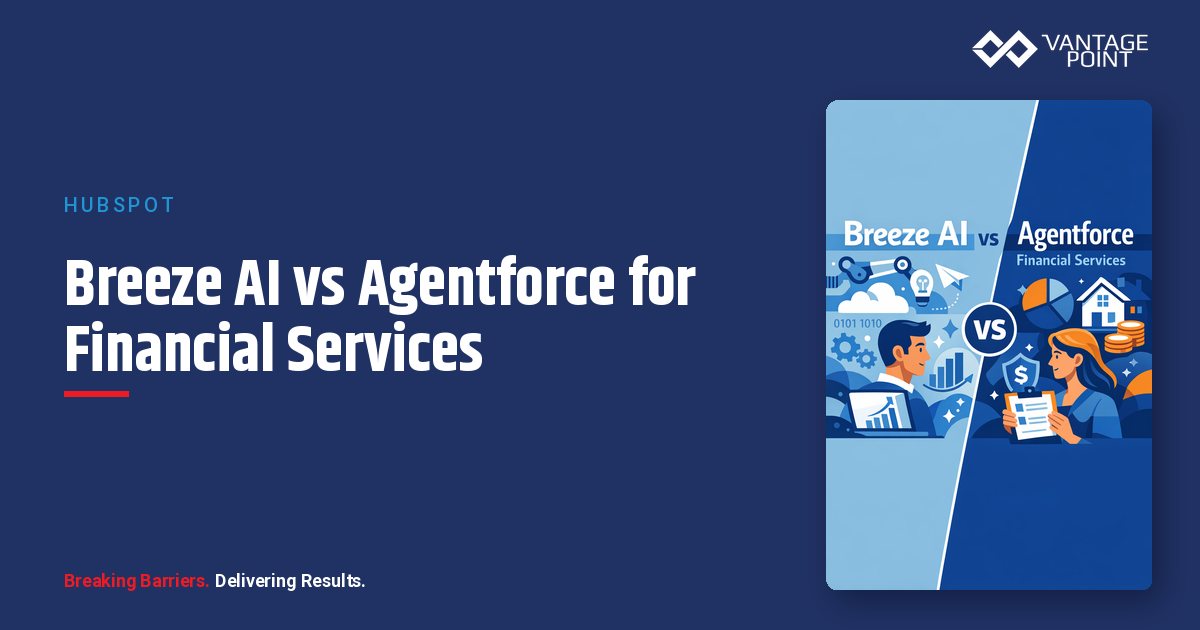
Financial institutions face a pivotal choice in their AI strategy. As HubSpot's Breeze AI and Salesforce's Agentforce compete for dominance in the financial services space, the decision carries significant implications for compliance, client experience, and operational efficiency. This detailed comparison examines both platforms through the lens of what matters most to financial services firms.
Understanding the Core Difference
Before diving into specific features, it's crucial to understand the fundamental architectural difference between these platforms:
Breeze AI operates as a native, embedded intelligence layer within HubSpot's ecosystem. Every AI feature is purpose-built for sales, marketing, and service use cases, with a strong emphasis on accessibility and ease of use.
Agentforce represents Salesforce's evolution of Einstein AI into autonomous agents. It emphasizes customization and enterprise-grade flexibility, allowing organizations to build sophisticated AI workflows using the Atlas reasoning engine.
Compliance and Data Security: The Financial Services Imperative
For wealth managers, banks, and insurance companies, compliance isn't optional: it's existential.
HubSpot Breeze AI Approach
- Data residency options: EU and US data centers available
- Zero data retention: AI features don't store conversation data for model training
- SOC 2 Type II certified: Regular third-party audits
- Built-in consent management: Native tools for GDPR and CCPA compliance
- Audit trails: Complete logging of AI-assisted activities
Salesforce Agentforce Approach
- Einstein Trust Layer: Proprietary security framework preventing data leakage
- Data masking: Automatic PII protection in prompts
- Hyperforce infrastructure: Flexible deployment options including region-specific
- Financial Services Cloud compliance: Purpose-built regulatory features
- Einstein Copilot audit trails: Comprehensive activity logging
Verdict: Both platforms offer robust compliance frameworks. Salesforce has an edge for firms already using Financial Services Cloud, while HubSpot's simpler architecture may be easier to audit and document.
Client Engagement Capabilities
Breeze AI for Client Communications
| Feature | Capability | Financial Services Application |
|---|---|---|
| Breeze Copilot | Conversational AI assistant | Research client portfolios, draft personalized emails, summarize interactions |
| Breeze Agents | Autonomous task execution | Automated client onboarding, document collection, appointment scheduling |
| Content Remix | Repurpose content across formats | Transform market updates into client-appropriate communications |
| Customer Agent | AI-powered support | Handle routine account inquiries, escalate complex issues to advisors |
Agentforce for Client Communications
| Feature | Capability | Financial Services Application |
|---|---|---|
| Service Agent | Autonomous service resolution | Handle account inquiries, process routine requests |
| SDR Agent | Lead qualification and outreach | Prospect engagement for wealth management, insurance products |
| Sales Coach Agent | Training and performance support | Advisor coaching on products and compliance |
| Custom Agents | Build-your-own AI agents | Industry-specific workflows for lending, claims processing |
Integration Ecosystem: Connecting Your Tech Stack
HubSpot Marketplace for Financial Services
- 1,500+ native integrations through the App Marketplace
- Key financial services integrations: Plaid, Yodlee, various portfolio management systems
- API access: RESTful APIs for custom integrations
- Operations Hub: Data sync and workflow automation
Salesforce AppExchange for Financial Services
- 4,000+ apps on AppExchange
- Industry-specific solutions: Pre-built integrations for core banking, wealth platforms
- MuleSoft integration: Enterprise-grade API management
- Financial Services Cloud connectors: Native integrations with major financial systems
Total Cost of Ownership Analysis
HubSpot Pricing Model
| Component | Cost Range | Notes |
|---|---|---|
| Enterprise Suite | $5,000-$18,000/month | Includes Breeze AI features |
| Implementation | $15,000-$50,000 | Typical for financial services |
| Training | $5,000-$15,000 | End-user and admin training |
| Annual maintenance | Included | No separate maintenance fees |
Salesforce Pricing Model
| Component | Cost Range | Notes |
|---|---|---|
| Financial Services Cloud | $300-$450/user/month | Enterprise editions |
| Agentforce licensing | $2/conversation | Usage-based pricing |
| Implementation | $50,000-$200,000+ | Complex deployments common |
| Annual maintenance | 15-20% of license fees | Support and updates |
Key cost consideration: Agentforce's per-conversation pricing ($2 per conversation) can be advantageous for firms with lower AI interaction volumes but may become expensive at scale.
Implementation Timeline Comparison
Typical HubSpot Financial Services Implementation
| Phase | Duration | Activities |
|---|---|---|
| Discovery | 2-3 weeks | Requirements, compliance mapping |
| Configuration | 4-6 weeks | Setup, integrations, Breeze AI configuration |
| Data migration | 2-4 weeks | Clean, transform, import data |
| Training & launch | 2-3 weeks | User training, go-live |
| Total | 10-16 weeks |
Typical Salesforce Financial Services Implementation
| Phase | Duration | Activities |
|---|---|---|
| Discovery | 4-6 weeks | Deep requirements analysis |
| Design | 4-6 weeks | Solution architecture, custom development specs |
| Build | 8-16 weeks | Custom development, Agentforce configuration |
| Testing | 4-6 weeks | UAT, compliance validation |
| Training & launch | 4-6 weeks | Phased rollout |
| Total | 24-40 weeks |
Real-World Use Cases
Use Case 1: Wealth Management Client Service
Scenario: A client asks about their portfolio performance during market volatility.
Breeze AI approach:
- Customer Agent handles initial inquiry via chat
- Automatically pulls integrated portfolio data
- Generates client-friendly performance summary
- Escalates to advisor if client expresses concern
- Drafts follow-up email for advisor review
Agentforce approach:
- Service Agent receives inquiry
- Queries Financial Services Cloud for household data
- Uses Atlas reasoning to determine appropriate response level
- Either resolves autonomously or creates advisor action plan
- Logs interaction in compliance record
Use Case 2: Insurance Lead Qualification
Scenario: Processing high volumes of insurance quote requests.
Breeze AI approach:
- Lead forms captured with Breeze Intelligence enrichment
- Automated scoring based on fit and intent signals
- Content Agent serves relevant product information
- High-value leads fast-tracked to agents
Agentforce approach:
- SDR Agent engages incoming leads
- Custom qualification flows based on insurance type
- Integration with underwriting systems for preliminary quotes
- Hands off qualified opportunities with full context
Decision Framework
Choose HubSpot Breeze AI If You:
- Need faster time-to-value (3-4 months vs. 6-12 months)
- Have a smaller technology team
- Want predictable, all-inclusive pricing
- Focus primarily on marketing and sales automation
- Prefer ease of use over unlimited customization
- Are a growing RIA, insurance agency, or community bank
Choose Salesforce Agentforce If You:
- Already have significant Salesforce investment
- Require complex, custom AI workflows
- Need Financial Services Cloud's industry-specific features
- Have dedicated Salesforce administrators
- Process high volumes requiring autonomous agents
- Are an enterprise bank, national insurance carrier, or large wealth management firm
Making the Transition
Whichever platform you choose, consider these transition best practices:
- Start with a pilot: Test AI capabilities with a subset of users before full rollout
- Document compliance requirements: Ensure your chosen platform meets all regulatory obligations
- Plan for change management: AI adoption requires cultural as well as technical preparation
- Measure what matters: Define KPIs that reflect both efficiency gains and client outcomes
Next Steps
Ready to evaluate AI platforms for your financial services firm? Consider:
- Documenting your specific compliance requirements and integration needs
- Requesting demos tailored to your use cases from both vendors
- Speaking with similar firms about their implementation experiences
- Engaging with a partner who has experience in both platforms for unbiased guidance
Need help navigating this decision? Our team has implemented both platforms for financial services clients and can provide objective guidance based on your specific situation.