
AI prospecting agents are changing how teams turn cold lists into booked meetings. HubSpot's AI prospecting agent, paired with Apollo's contact data, can now research accounts, enrich records, build sequences, and surface ready-to-engage prospects — without a rep manually copying data between tools. The promise is simple: do more pipeline work with fewer manual steps.
But the agent is only as good as the workflow around it. If your data, routing, and reporting aren't governed, an AI agent will move faster — and create messier pipeline data faster, too. This is a RevOps operating playbook, not a setup tutorial. It maps the full prospecting motion, shows where pipeline quietly leaks in 2026, and explains how to layer AI on top of Apollo data without breaking your HubSpot reporting.
If you want the click-by-click setup steps instead, see our companion Apollo and HubSpot AI Prospecting Agent integration guide. This post is about the workflow and governance that make the agent actually produce meetings.
Quick Answer
An AI prospecting playbook is the documented workflow and governance model that controls how an AI prospecting agent finds, enriches, sequences, and routes prospects so the output is clean, reportable pipeline. It matters most for RevOps leaders, sales managers, and CRM admins running HubSpot who want to scale outbound without an SDR manually touching every record. The decision it supports: how to adopt HubSpot's AI prospecting agent with Apollo data while keeping attribution, lifecycle stages, and reporting intact. Vantage Point, a HubSpot Gold Solutions Partner with senior-only RevOps consultants, builds these workflows for mid-market teams so the agent accelerates pipeline instead of corrupting it.
TL;DR
- What it is: An AI prospecting playbook is the workflow and governance layer that turns HubSpot's AI prospecting agent and Apollo data into clean, booked-meeting pipeline.
- Why it matters: Agents speed up prospecting, but they also speed up bad data, broken routing, and unreportable pipeline if the underlying model is wrong.
- Best for: RevOps teams, sales managers, and HubSpot admins moving off spreadsheets, copy-paste, and manual SDR handoffs.
- The hard truth: You don't need perfect data to start, but you do need governed data, routing, and reporting — that's the difference between leverage and chaos.
- How Vantage Point helps: We design the prospecting workflow and reporting governance behind the agent through our HubSpot consulting and workflow automation services.
What Is an AI Prospecting Playbook?
An AI prospecting playbook is a documented, repeatable workflow that defines how an AI prospecting agent sources, enriches, sequences, routes, and reports on prospects. It sets the rules the agent and your team follow at each step so the output is qualified meetings and trustworthy pipeline data — not just more activity.
It is different from an integration guide. An integration guide tells you how to connect Apollo to HubSpot's Breeze prospecting agent. A playbook tells you how to operate the motion once it's connected: what "good" data looks like, who owns each handoff, how leads get routed, and how every action shows up in reporting.
In 2026, the playbook is the part most teams skip — and it's why two companies can adopt the same AI agent and get completely different results.
Where the SDR-to-Meeting Workflow Leaks Pipeline in 2026
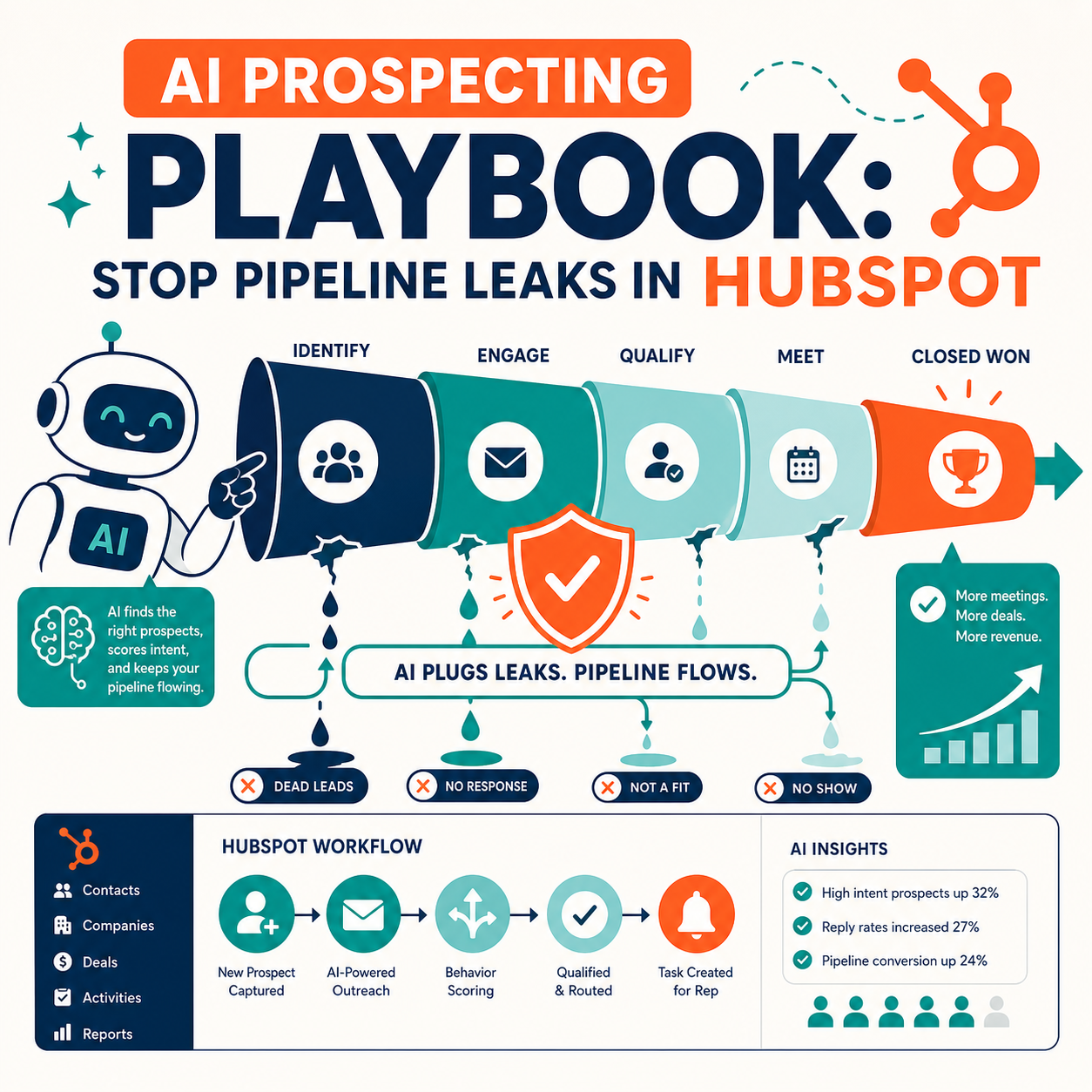
Most outbound motions lose pipeline in the gaps between steps, not in any single step. AI agents remove a lot of manual labor, but they expose these gaps because they execute fast and at volume. Here is where pipeline most commonly leaks:
- Unclear ICP definition. If your ideal customer profile lives in someone's head, the agent will source plausible-but-wrong accounts at scale.
- Dirty or duplicate records. Importing a raw cold list on top of existing contacts creates duplicates that fracture engagement history and reporting.
- Enrichment without de-duplication. Enriching a record that already exists in another form splits activity across two objects.
- Broken handoffs. A meeting gets booked but the lead isn't assigned, lifecycle stage isn't updated, or the rep never gets notified.
- Routing by guesswork. Leads land with the wrong owner or territory, so follow-up stalls.
- Untracked agent activity. If AI-driven outreach isn't attributed to a source or campaign, you can't tell what's working.
- Reporting drift. Lifecycle stages and deal stages get set inconsistently, so the funnel report no longer reflects reality.
The pattern is consistent: the workflow leaks where ownership and rules are undefined. An AI agent doesn't fix undefined rules — it just runs into them faster.
The AI Prospecting Workflow: Cold List to Booked Meeting
The full motion is cold list → enriched → sequenced → routed → booked meeting. Each stage needs an owner, an entry rule, and an exit rule. The table below shows the workflow, what the AI agent handles, and the governance control that keeps each stage clean.
| Stage | What happens | AI agent role | Governance control to keep reporting clean |
|---|---|---|---|
| Cold list / sourcing | Target accounts and contacts identified from Apollo's database | Researches accounts, finds decision-makers, builds lists against ICP filters | Locked ICP definition; source field set on every record |
| Enrichment | Missing fields (title, phone, company data) filled in | Enriches contacts with Apollo data inside HubSpot | De-duplication rules run before enrichment to avoid split records |
| Sequencing | Personalized outreach drafted and sent | Drafts and sequences messages using CRM and prospect context | Sequence enrollment tied to a campaign; suppression lists honored |
| Routing | Engaged or qualified leads assigned to a rep | Surfaces engaged/ready prospects | Defined routing rules by territory/segment; owner field always set |
| Booked meeting | Prospect books or accepts a meeting | Flags hand-raisers and books via scheduling | Lifecycle stage advances automatically; meeting source attributed |
| Reporting | Pipeline and source performance measured | Logs activity | Consistent lifecycle and deal stages; AI activity tagged for attribution |
The agent can run most of the middle. Governance is what holds the edges together.
How to Layer HubSpot's AI Agent on Apollo Data Without Breaking Reporting
Adding Apollo data and an AI agent on top of an existing HubSpot instance is where reporting most often breaks. Here is the order of operations that protects your data model:
- Define and lock your ICP first. Document firmographics, segments, and exclusions so the agent sources the right accounts before it runs at volume.
- Set de-duplication rules before enrichment. Decide how HubSpot matches contacts and companies so Apollo enrichment updates existing records instead of creating duplicates.
- Stamp a source on every agent-created record. A consistent source/original-source value keeps AI-sourced contacts reportable and separable from inbound.
- Map lifecycle stages to real actions. Define exactly when a contact becomes a lead, MQL, or SQL so the agent's activity advances stages predictably.
- Codify routing rules. Owner assignment by territory or segment should be automatic, not manual, so no booked meeting sits unassigned.
- Tag AI-driven outreach for attribution. Connect sequences and agent activity to campaigns so you can measure what the agent actually produces.
- Build the reporting view before you scale. Stand up source, funnel, and meeting-booked reports first, then turn up volume — so you can see leaks immediately.
The strategic lesson: an AI prospecting agent only delivers if the underlying data, routing, and reporting are governed correctly. You do not need perfect data to start — agents can work with imperfect inputs — but you do need governed inputs, consistent stages, and clean attribution. Governance still matters.
What RevOps Teams Should Do Next
Use this checklist before you turn an AI prospecting agent loose on a cold list:
- [ ] ICP is documented and agreed across sales and marketing.
- [ ] De-duplication and matching rules are configured in HubSpot.
- [ ] Source/original-source is enforced on new records.
- [ ] Lifecycle stages are mapped to specific, automatic triggers.
- [ ] Routing rules assign every lead an owner without manual steps.
- [ ] Sequences and agent activity are tied to campaigns for attribution.
- [ ] Funnel, source, and meeting-booked reports exist and are trusted.
- [ ] A weekly review checks for duplicates, unassigned leads, and stage drift.
If most boxes are unchecked, fix the workflow before scaling volume. Speed on a broken model just produces broken pipeline faster.
How Vantage Point Helps
Vantage Point is a HubSpot Gold Solutions Partner with senior-only RevOps consultants and a mid-market focus. We don't hand AI projects to junior teams. We design the prospecting workflow and reporting governance that sit underneath HubSpot's AI prospecting agent and Apollo data, so the agent produces clean, booked-meeting pipeline you can actually report on.
Our work typically spans HubSpot implementation and optimization, workflow automation and process optimization, CRM and marketing automation strategy, and the data hygiene side through system integration and data migration. If your team is evaluating HubSpot's AI prospecting agent, or already turned it on and your reporting looks off, we can map the workflow, fix the governance, and get the motion producing qualified meetings.
Next step: Book a Vantage Point RevOps and HubSpot prospecting workflow consultation, and pair it with the step-by-step Apollo and HubSpot AI prospecting agent integration guide for the setup details.
Frequently Asked Questions
What is an AI prospecting playbook?
An AI prospecting playbook is the documented workflow and governance model that controls how an AI prospecting agent sources, enriches, sequences, routes, and reports on prospects. It defines the rules and ownership at each step so the agent produces qualified meetings and clean pipeline data instead of just more activity.
How is this different from the Apollo–HubSpot integration guide?
The integration guide explains how to connect Apollo to HubSpot's Breeze prospecting agent and turn it on. This playbook explains how to operate the motion afterward: defining ICP, governing data, routing leads, and keeping reporting clean. Most teams need both, which is why we cross-link the integration guide as the setup companion.
Do I need perfect CRM data before using an AI prospecting agent?
No. You do not need perfect data to start — AI prospecting agents can work with imperfect inputs. But you do need governed data: clear de-duplication rules, consistent lifecycle stages, and source attribution. Governance, not perfection, is what keeps the agent's output reportable.
How does an AI prospecting agent break HubSpot reporting?
It usually breaks reporting by creating duplicate records, leaving lifecycle stages inconsistent, or failing to attribute AI-driven outreach to a source or campaign. At volume, these small gaps compound into a funnel report you can't trust. Setting matching rules, stage triggers, and source fields before scaling prevents it.
Where does the SDR-to-meeting workflow leak the most pipeline?
It leaks most in the handoffs between steps — unassigned leads, un-advanced lifecycle stages, and untracked outreach — rather than in any single step. AI agents expose these gaps because they execute fast and at high volume, so undefined rules cause problems sooner.
Can Apollo data be used inside HubSpot without leaving the platform?
Yes. Apollo is embedded as a data provider in HubSpot's Breeze prospecting agent, so reps can find and enrich contacts from Apollo's contact database directly within HubSpot. The value depends on de-duplication and source rules being in place so enrichment updates existing records cleanly.
What does Vantage Point do in an AI prospecting engagement?
Vantage Point designs the prospecting workflow and reporting governance behind HubSpot's AI prospecting agent and Apollo data. As a HubSpot Gold Solutions Partner with senior-only RevOps consultants, we define ICP and routing, configure de-duplication and lifecycle stages, set up attribution, and build the reporting views — so the agent accelerates pipeline you can measure.