
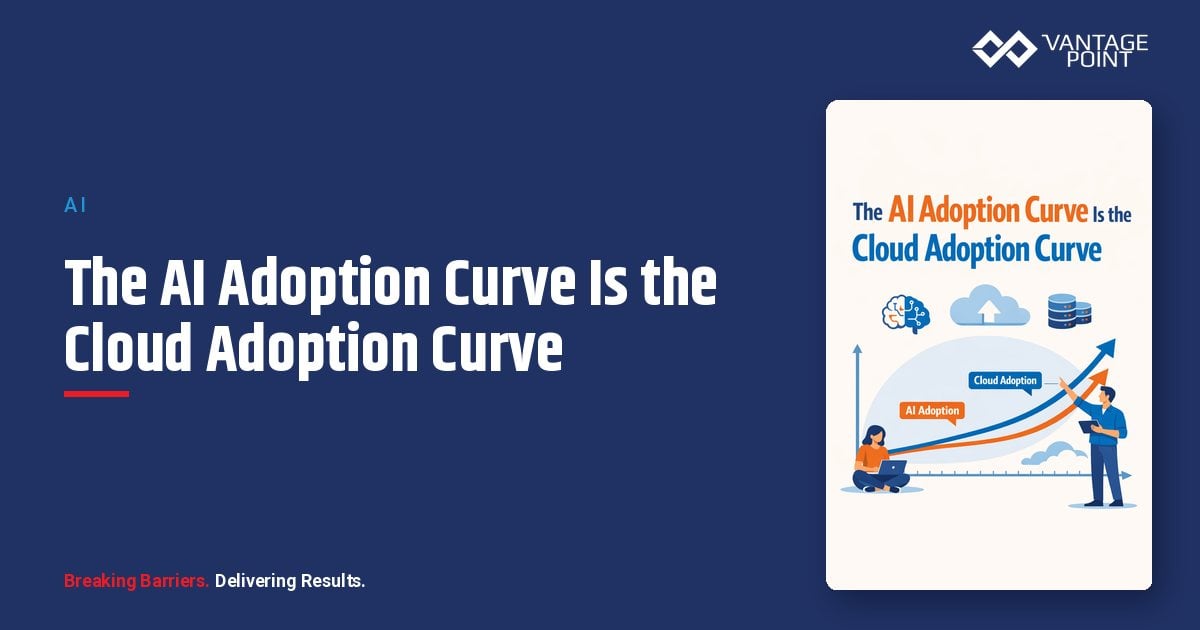
If you led a regulated business through the move to cloud, you already know how the AI story ends. The objections are the same. The hesitation is the same. The competitive gap that opens between early movers and late movers is the same. AI is not a different curve: it is the cloud curve, repeating.
That matters for one practical reason: timing. The question facing most C-suite and senior leaders in healthcare, financial services, insurance, and banking is not "should we use AI?" It is "when, and how fast, without creating security, compliance, or data problems we can't unwind later?" The cloud experience answers that question better than any AI forecast.
Quick Answer
The AI adoption curve in regulated industries is following the same shape as the cloud adoption curve: early skepticism on security and compliance, a slow build, a tipping point, then rapid mainstream adoption: with laggards paying a real competitive and operational cost. This article helps senior leaders decide when and how to move on AI by mapping today's AI objections onto the cloud objections you already resolved. Vantage Point is relevant because the AI tipping point depends on the same fundamentals we work on every day: clean CRM data, governed access, and connected systems on Salesforce and HubSpot.
TL;DR
- AI is repeating the cloud pattern. Same objections (security, compliance, data residency, control), same slow-then-fast adoption shape, same penalty for waiting too long.
- The winners aren't the fastest: they're the readiest. The organizations that gained from cloud had governance and clean data first. The same is true for AI.
- Timing is a governance decision, not a hype decision. Move when your data, access controls, and integrations can support AI safely: not when a vendor demo impresses you.
- Regulated industries can lead, not lag. Compliance is a design input, not a blocker, just as it was with cloud.
- Vantage Point helps you get AI-ready by improving CRM data quality, governance, and system integration so AI has something trustworthy to run on.
What Does "The AI Adoption Curve Is the Cloud Adoption Curve" Mean?
It means the way your industry adopts AI will rhyme almost exactly with how it adopted cloud computing. The technology is new; the adoption behavior is not.
In the early cloud years, regulated leaders said the same things: "Our data is too sensitive." "Regulators won't allow it." "We need control over where information lives." Those concerns were valid, and they were solved with architecture, contracts, controls, and governance, not avoided by staying on-premise forever. Today the same sentences are being said about AI. And they will be solved the same way.
Why This Matters for Regulated Leaders in 2026
Adoption curves are not just academic. They translate directly into competitive position.
- Early in the curve, AI is optional and experimental. Doing nothing feels safe.
- At the tipping point, AI quietly becomes the baseline for service speed, underwriting support, advisor productivity, and customer response time.
- Late in the curve, the organizations that waited are not just "behind on a tool." They are behind on cost structure, talent expectations, and customer experience. Exactly what happened to the firms that resisted cloud the longest.
The risk is rarely moving too early. The risk is mistaking caution for strategy and arriving at the tipping point unprepared.
Cloud Objections vs. AI Objections: The Same List
Almost every AI hesitation maps to a cloud objection your industry already worked through.
| Concern | Cloud era objection | AI era objection | How it gets resolved |
|---|---|---|---|
| Security | "Our data can't live off-premise." | "AI will expose sensitive data." | Access controls, encryption, scoping, and governed data boundaries. |
| Compliance | "Regulators won't permit it." | "AI outputs aren't auditable." | Audit trails, human-in-the-loop review, documented controls. |
| Control | "We lose control of our systems." | "We can't see how the model decides." | Defined use cases, guardrails, monitoring, and policy. |
| Data residency | "Where does our data physically sit?" | "Where is our data processed and retained?" | Contractual terms, regional processing, retention rules. |
| Trust | "Vendors will fail us." | "The model will hallucinate." | Pilots, narrow scope, validation, and measured rollout. |
The lesson is not that the concerns are wrong. It is that they are solvable: and that solving them is an engineering and governance exercise, not a reason to stall.
Why the Readiest Win: Not the Fastest
The cloud winners were not the companies that moved first or fastest. They were the ones whose data, identity, and processes were in good enough shape that cloud actually delivered value. The firms that "lifted and shifted" a mess simply got a faster, more expensive mess.
AI is less forgiving, not more. AI runs on your data and your processes. If your CRM is full of duplicates, stale records, and 14-word notes, AI will confidently summarize garbage. The readiness work is the strategy.
What "AI-ready" actually requires:
- Clean, deduplicated CRM data in Salesforce or HubSpot that reflects reality.
- Governed access so AI only sees what each role is allowed to see.
- Connected systems so AI has the full context of a customer, not fragments.
- Defined, narrow use cases with human review where it matters.
- Change management so people actually adopt the tools you deploy.
How Should You Decide When to Move on AI?
Treat timing as a readiness decision, not a fear-of-missing-out decision. Use a simple checklist:
- Is our CRM data trustworthy enough to act on? If not, fix data first.
- Can we control and audit what AI accesses and produces? If not, build governance first.
- Are our systems connected enough to give AI full context? If not, prioritize integration.
- Do we have one or two high-value, low-risk use cases? Start there, not everywhere.
- Can our people adopt this? Pair every deployment with training and change management.
If you can answer yes to most of these, you are closer to the tipping point than the hype suggests, and waiting only widens the gap. If you answer no, you have a clear, fundable roadmap before you spend on AI itself.
How Vantage Point Helps
Most AI projects don't stall on the model. They stall on the fundamentals underneath it: the same fundamentals that determined who won the cloud era. Vantage Point is a senior-led Salesforce and HubSpot consulting partner, and our work lines up directly with the AI-readiness checklist above.
- Get your data and integrations AI-ready with system integration and data migration and clean, connected records across platforms.
- Build a practical, governed AI roadmap with our AI-driven personalization and analytics work, scoped to real use cases rather than hype.
- Stand up or tune the underlying CRM with Salesforce implementation and advisory or HubSpot services, depending on your platform.
- Keep security and auditability in the design from day one with compliance and security solutions.
- Drive real adoption with advisory and change management so the tools you fund actually get used.
If your leadership team is weighing AI strategy and timing, a Regulated-Industry AI Strategy Session with Vantage Point will map your AI ambitions to your real data, governance, and integration readiness, and give you a clear, sequenced next step.
FAQ
Is the AI adoption curve really the same as the cloud adoption curve?
Yes, in shape and behavior. Both start with security and compliance skepticism, build slowly, hit a tipping point where the technology becomes a baseline expectation, and then go mainstream: leaving late adopters at a measurable disadvantage. The technology differs, but the adoption pattern and the objections are nearly identical.
Should regulated companies wait for AI to mature before adopting it?
Waiting indefinitely is riskier than starting carefully. The smarter move is to begin readiness work (data quality, governance, and integration) so you can adopt AI safely when high-value use cases are clear. That mirrors how successful organizations approached cloud: prepare first, then move with confidence.
What does "AI-ready" actually mean for a CRM?
It means your CRM data is clean and deduplicated, access is governed by role, your systems are connected so AI sees full customer context, and you have defined, low-risk use cases. AI amplifies whatever it runs on, so trustworthy data and governance are the real prerequisites.
Does compliance make AI adoption impossible in regulated industries?
No. Compliance is a design input, not a blocker: exactly as it was with cloud. Audit trails, human review, scoped access, and documented controls let regulated firms adopt AI responsibly. Vantage Point builds these controls into the implementation rather than bolting them on later.
What's the biggest mistake leaders make on AI timing?
Mistaking caution for strategy. Doing nothing feels safe early in the curve, but it leaves organizations unprepared when AI becomes the baseline for service speed and productivity. The fix is a readiness roadmap that lets you move deliberately instead of reactively.
Does Vantage Point recommend Salesforce or HubSpot for AI?
It depends on your existing stack, processes, and goals: both platforms support strong AI and governance capabilities. Vantage Point works across Salesforce and HubSpot and recommends based on your data, integrations, and adoption needs rather than a fixed preference.
How do we start without a huge, risky AI program?
Start narrow. Pick one or two high-value, low-risk use cases, ensure the underlying data and access controls are sound, add human review, and measure results before expanding. This staged approach is how the cloud winners avoided expensive missteps, and it works the same way for AI.