
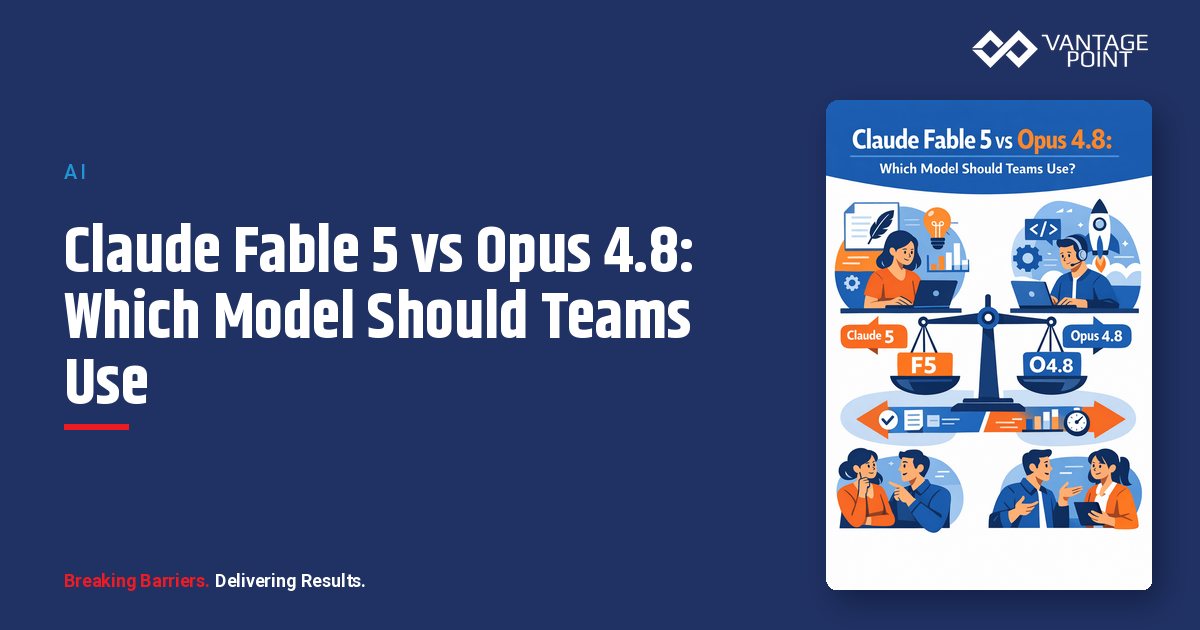
Anthropic launched Claude Fable 5 on June 9, 2026, its most capable generally available model, alongside the enterprise-favorite Claude Opus 4.8 from late May. For teams running AI inside CRM, RevOps, and service workflows, the practical question is simple: which one should you actually use, and when?
This guide compares the two models on capability, price, safeguards, and fit, then gives a clear recommendation for business teams.
Quick Answer
Use Claude Opus 4.8 as your everyday workhorse for CRM automation, sales and service workflows, and most knowledge work. It is fast, reliable, honest about uncertainty, and the cheapest of the two. Reach for Claude Fable 5 on your hardest, longest-running problems: large-scale coding migrations, deep research, and complex multi-step analysis where its frontier capability pays for the higher token cost. Notably, Fable 5 automatically falls back to Opus 4.8 on a small set of sensitive queries, so Opus 4.8 remains the backbone either way.
TL;DR
- Claude Fable 5 is a "Mythos-class" model, Anthropic's most capable generally available model, best for the longest, most complex tasks.
- Claude Opus 4.8 is the dependable production model for CRM, sales, service, and knowledge work, at roughly half the token price.
- Fable 5: $10 / $50 per million input/output tokens. Opus 4.8: $5 / $25 (regular), $10 / $50 (fast mode).
- Fable 5 falls back to Opus 4.8 on cybersecurity, biology/chemistry, and distillation queries; over 95% of sessions involve no fallback at all.
- Fable 5 is included on Pro, Max, Team, and seat-based Enterprise plans at no extra cost only through June 22, 2026: then it requires usage credits.
- Vantage Point helps teams choose, govern, and connect the right model to Salesforce and HubSpot workflows.
What Is Claude Fable 5?
Claude Fable 5 is a Mythos-class model that Anthropic made safe for general use, released June 9, 2026. Its capabilities exceed any model Anthropic has previously made generally available, with state-of-the-art results across software engineering, knowledge work, vision, and scientific research. The longer and more complex the task, the larger its lead over other models.
To release it safely, Anthropic added classifiers that route sensitive requests (cybersecurity, biology and chemistry, and model distillation) to Claude Opus 4.8 instead. Users are told when this happens, and it triggers in under 5% of sessions on average.
Claude Mythos 5 is the same underlying model with cyber safeguards lifted, restricted to vetted cyberdefense partners. For business teams, Fable 5 is the relevant general-release option.
What Is Claude Opus 4.8?
Claude Opus 4.8 is Anthropic's upgraded Opus-class model, released May 28, 2026. It improves on Opus 4.7 across coding, agentic tasks, and professional work, and is roughly four times less likely than its predecessor to let flaws in its own code pass unremarked. It launched with effort controls, dynamic workflows in Claude Code, and a cheaper, faster "fast mode."
Opus 4.8 is the model most enterprises already build on. It is highly capable, predictable, and priced for high-volume production use.
Why This Comparison Matters in 2026
Model choice is now an operations decision, not just a technical one. The model you wire into lead routing, case summarization, or pipeline analysis affects cost per task, latency, data exposure, and output quality.
Picking the most powerful model for everything wastes money. Picking the cheapest for everything caps your ceiling on hard problems. The right answer for most teams is a tiered approach: a dependable default with a frontier option for the few tasks that justify it.
How They Compare
| Criteria | Claude Fable 5 | Claude Opus 4.8 |
|---|---|---|
| Class | Mythos-class (highest) | Opus-class |
| Best for | Longest, hardest tasks: large migrations, deep research, complex analysis | Everyday CRM, sales, service, and knowledge work |
| Input / output price | $10 / $50 per M tokens | $5 / $25 (regular); $10 / $50 (fast mode) |
| Long-horizon work | Class-leading; works autonomously longer than any prior Claude | Strong; reliable for production agents |
| Safeguards | Falls back to Opus 4.8 on cyber, bio/chem, distillation queries | Standard safeguards; no blocking cyber fallback |
| Data retention | 30-day retention required for business traffic (not used for training) | Standard policy |
| Availability | API and consumption Enterprise today; subscription plans free only through June 22 | Available everywhere, standard pricing |
Which Claude Model Is Right for Your Business?
Choose Claude Opus 4.8 if you:
- Run high-volume, repeatable CRM and RevOps automations where cost per task matters.
- Need predictable latency and stable pricing for production agents.
- Want a dependable default for summarization, drafting, classification, and routing.
Choose Claude Fable 5 if you:
- Tackle long-running, complex problems like codebase-scale migrations or multi-day research.
- Need the highest ceiling on analytical and engineering tasks and can justify higher token cost.
- Are running a focused initiative where frontier capability changes the outcome, not just the polish.
For most organizations, the smart pattern is Opus 4.8 as the default, Fable 5 on demand for the small share of tasks that need it.
What Data and Governance Do These Models Need?
Both models are only as useful as the data you connect to them. Clean, well-governed CRM records produce better summaries, scoring, and recommendations; messy data produces confident-sounding errors regardless of model class.
Fable 5 also introduces a 30-day data retention requirement for business traffic on Mythos-class models. Anthropic states this data is not used to train models and is deleted after 30 days, but teams in regulated environments should still review it against their own data-handling and vendor policies before routing sensitive records through it. This is exactly the kind of decision a clear AI governance framework should cover.
What Can Go Wrong?
- Overspending by defaulting to the most powerful model for routine tasks.
- Unexpected fallbacks: Fable 5 silently routing certain queries to Opus 4.8 can surprise teams that assumed one consistent model.
- Subscription cost shifts: Fable 5 is free on subscription plans only through June 22, 2026; after that it draws on usage credits.
- Garbage-in results when models run on ungoverned CRM data.
- Compliance gaps if sensitive data flows to a model without reviewing retention and access controls.
What Businesses Should Do Next
- Set a default. Make Opus 4.8 your standard model for CRM and RevOps automation.
- Define escalation rules. Decide which task types justify Fable 5, and cap usage.
- Model your costs before June 23, when Fable 5 leaves the free subscription window.
- Review data flows. Map what CRM data each model touches and confirm retention and access controls.
- Govern the inputs. Prioritize data quality on the records your AI actually reads.
How Vantage Point Helps
Vantage Point helps organizations evaluate, implement, and optimize Salesforce and HubSpot based on their operating model, data needs, adoption goals, and growth strategy, and that now includes choosing and governing the right AI model for each workflow.
We connect model selection to real CRM operations: where AI plugs into your AI-driven personalization and analytics, how it stays inside your compliance and security guardrails, and how it fits your Salesforce implementation and advisory or HubSpot roadmap. If your team is evaluating how Claude Fable 5 or Opus 4.8 applies to your CRM, integrations, or governance, we can help assess the right next step and build a practical plan.
FAQ
What is the difference between Claude Fable 5 and Claude Opus 4.8?
Claude Fable 5 is a Mythos-class model, Anthropic's most capable generally available model, built for the longest and hardest tasks. Claude Opus 4.8 is the Opus-class production workhorse, faster and roughly half the token price. Fable 5 falls back to Opus 4.8 on certain sensitive queries.
Which Claude model is cheaper?
Claude Opus 4.8 is cheaper at $5 per million input tokens and $25 per million output tokens for regular usage. Claude Fable 5 costs $10 per million input and $50 per million output tokens. Opus 4.8 fast mode matches Fable 5's pricing.
When is Claude Fable 5 available on subscription plans?
Claude Fable 5 is included on Pro, Max, Team, and seat-based Enterprise plans at no extra cost from June 9 through June 22, 2026. On June 23, using it on those plans requires usage credits. It is fully available on the Claude API and consumption-based Enterprise plans now.
Why does Claude Fable 5 sometimes respond as Opus 4.8?
Fable 5 uses safety classifiers that route requests related to cybersecurity, biology and chemistry, or model distillation to Claude Opus 4.8 instead. Users are notified when this happens, and Anthropic reports it occurs in under 5% of sessions.
Should businesses use Claude Fable 5 for CRM automation?
For most CRM and RevOps automation, Claude Opus 4.8 is the better fit because it is cheaper, fast, and reliable at high volume. Reserve Claude Fable 5 for long-running, complex tasks where its frontier capability justifies the higher cost. Vantage Point helps teams set these defaults and escalation rules.
What is Claude Mythos 5?
Claude Mythos 5 is the same underlying model as Fable 5 but with cybersecurity safeguards lifted, restricted to vetted cyberdefense and infrastructure partners through Project Glasswing. It is not generally available, so most businesses will use Fable 5 or Opus 4.8.
What governance should we have before deploying either model?
Define which data each model can access, review the 30-day retention requirement for Mythos-class business traffic, set role-based access, and govern the quality of the CRM records the model reads. A documented AI governance framework keeps deployment safe and auditable, which is an area Vantage Point supports directly.