
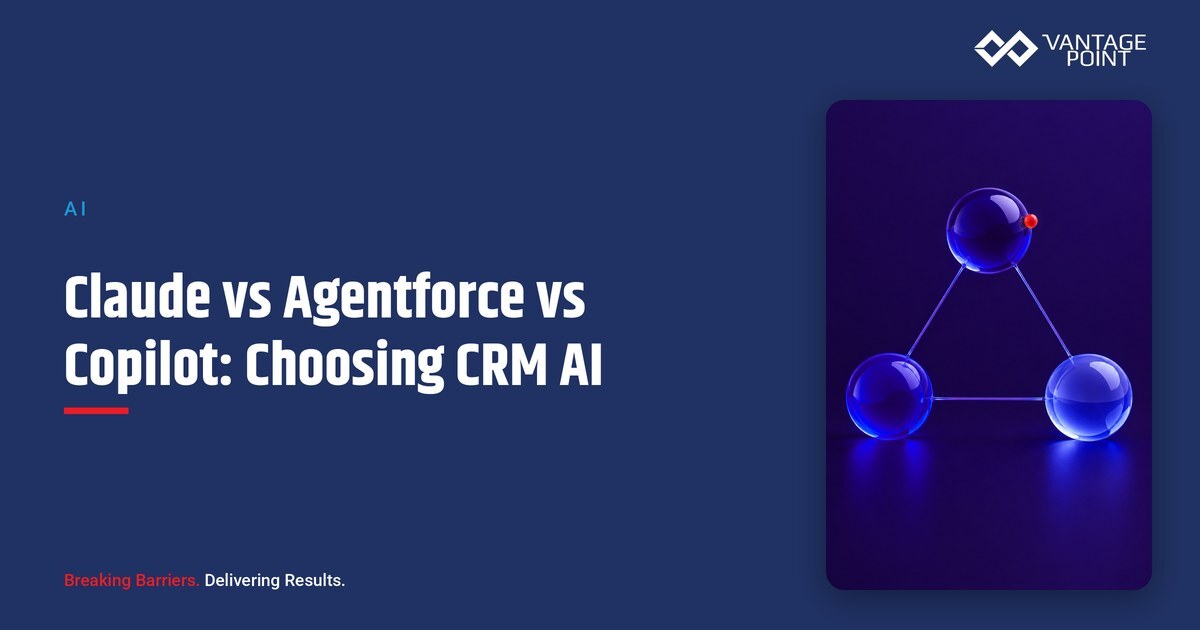
Choosing an AI assistant for your CRM is no longer a single decision. You are really choosing how AI will read your data, act on your records, and fit your governance model. Claude, Salesforce Agentforce, and Microsoft Copilot solve overlapping problems in very different ways.
This guide compares the three for CRM teams and explains how to match each to your operating model, data sensitivity, and platform strategy.
Quick Answer
Use Agentforce when your system of record is Salesforce and you want AI agents that act natively on CRM data. Use Microsoft Copilot when your team lives in Microsoft 365 and you want AI embedded in everyday productivity tools. Use Claude when you want a flexible, reasoning-strong model that can be deployed across Salesforce, HubSpot, and custom workflows through APIs and connectors, with strong control over data handling.
TL;DR
- Claude is a model-layer choice: flexible, strong at reasoning and long-context analysis, and deployable across multiple CRMs through APIs and the Model Context Protocol.
- Agentforce is Salesforce's native agent layer: best when Salesforce is your core platform and you want action-taking agents on CRM data.
- Copilot is Microsoft's productivity layer: best when your team runs on Microsoft 365 and Dynamics.
- The right choice depends on your CRM platform, data governance needs, and how much you want AI to act versus assist.
- Vantage Point helps teams evaluate and deploy AI-driven personalization and analytics across Salesforce and HubSpot without locking into a single vendor.
Not sure which fits your stack?
We work across Salesforce and HubSpot daily and are an official Claude partner, so our recommendation is based on your workflows, not a vendor quota.
See our Claude AI services →
What Is CRM AI?
CRM AI refers to artificial intelligence that reads, summarizes, drafts, or acts on customer data inside your CRM. It ranges from simple text generation to autonomous agents that update records, route cases, and trigger workflows.
Claude, Agentforce, and Copilot represent three layers of that stack: the model, the native agent platform, and the productivity assistant. Many organizations end up using more than one.
Why CRM AI Choice Matters in 2026
AI in the CRM is now an operating decision, not a feature toggle. The assistant you choose shapes where your data flows, what actions are automated, and how much governance you need.
A wrong fit creates risk: ungoverned data exposure, automation that acts on bad records, or tools your team never adopts. A good fit shortens sales cycles, speeds up service resolution, and reduces manual admin work. The cost of choosing badly is rarely the license. It is the rework.
How Each Option Works
Claude is a large language model from Anthropic, known for strong reasoning, long context windows, and careful instruction following. It connects to CRM data through APIs, middleware, and the Model Context Protocol, so it can serve Salesforce, HubSpot, or custom systems. You control what data it sees and how.
Agentforce is Salesforce's agent framework. It builds AI agents directly on Salesforce data and metadata, with native actions, guardrails, and topics. It is the most direct path to action-taking agents when Salesforce is your system of record.
Copilot is Microsoft's AI assistant embedded across Microsoft 365 and Dynamics 365. It excels when work happens in Outlook, Teams, Word, and Excel, surfacing AI where your team already spends its day.
Comparison: Claude vs Agentforce vs Copilot
| Criteria | Claude | Agentforce | Copilot |
|---|---|---|---|
| Best for | Cross-platform reasoning and analysis | Native Salesforce agents | Microsoft 365 + Dynamics teams |
| Primary role | Model layer | Agent/action layer | Productivity layer |
| CRM fit | Salesforce, HubSpot, custom | Salesforce-first | Dynamics-first |
| Action-taking | Via connectors and MCP | Native, deep | Within Microsoft apps |
| Data control | High, configurable | Strong native guardrails | Tied to Microsoft tenant |
| Integration effort | Moderate (API/middleware) | Low within Salesforce | Low within Microsoft |
| Strength | Reasoning, long context | Native CRM actions | Embedded productivity |
Choose Claude If
- You run more than one CRM or want to avoid single-vendor lock-in.
- You need strong reasoning over long documents, contracts, or case histories.
- You want tight control over what data the model can access.
- You are building custom AI workflows across Salesforce and HubSpot.
Choose Agentforce If
- Salesforce is your system of record and core platform.
- You want AI agents that take native actions on CRM records.
- You need built-in guardrails tied to Salesforce permissions and metadata.
Choose Copilot If
- Your team works primarily in Microsoft 365 and Dynamics.
- You want AI surfaced inside Outlook, Teams, Word, and Excel.
- Productivity assistance matters more than deep CRM automation.
What Businesses Should Do Next
Start with your platform reality, not the model hype. Map where your customer data lives, what actions you want automated, and how sensitive that data is. Then pilot one use case with clear success metrics before expanding.
Most teams benefit from a layered approach: a native agent platform for CRM actions and a strong reasoning model for analysis. The goal is fit, not a single winner.
If your team is evaluating how this applies to Salesforce, HubSpot, integrations, or CRM governance, Vantage Point can help assess the right next step and build a practical implementation plan.
How Vantage Point Helps
Vantage Point helps organizations evaluate, implement, and optimize Salesforce and HubSpot based on their operating model, data needs, adoption goals, and growth strategy. We take a vendor-agnostic view, so we help you choose AI that fits rather than the loudest brand.
Our teams support Salesforce implementation and advisory, HubSpot optimization, and AI-driven personalization and analytics: with the compliance and security solutions that governed AI requires.
If Claude looks like the right fit, our Claude AI services page shows exactly how we implement it alongside your CRM.
FAQ
Is Claude a replacement for Agentforce?
No. Claude is a model, while Agentforce is Salesforce's native agent platform. Many teams use Claude for reasoning and analysis and Agentforce for native CRM actions. The two can complement each other rather than compete.
Can Claude work with both Salesforce and HubSpot?
Yes. Claude connects to multiple CRMs through APIs, middleware, and the Model Context Protocol. This makes it a strong fit for organizations that run Salesforce and HubSpot together and want consistent AI across both.
Which AI is best for a Salesforce-only company?
Agentforce is usually the most direct path for Salesforce-centric teams because it acts natively on CRM data with built-in guardrails. Claude can still add value for long-context analysis. Vantage Point can help map the right mix.
Does Microsoft Copilot work well for CRM tasks?
Copilot is strongest when your team runs on Microsoft 365 and Dynamics 365. For CRM-heavy automation outside the Microsoft ecosystem, a native agent platform or a flexible model layer is often a better fit.
How do we control data exposure with CRM AI?
Define what data each tool can access, apply least-privilege permissions, and log AI actions. Native platforms tie access to existing CRM permissions, while model-layer deployments need explicit data scoping. Governance should be designed before rollout.
How much does CRM AI cost?
Costs vary by platform, usage, and licensing model, so a fixed number is misleading. The larger cost is usually integration, governance, and adoption work. Vantage Point helps teams scope total cost and avoid overbuying features they will not use.
How should we start choosing a CRM AI?
Begin with a readiness check: where your data lives, how clean it is, and which workflow you want to improve first. Pilot one use case with measurable goals before scaling. This avoids buying AI features in isolation.