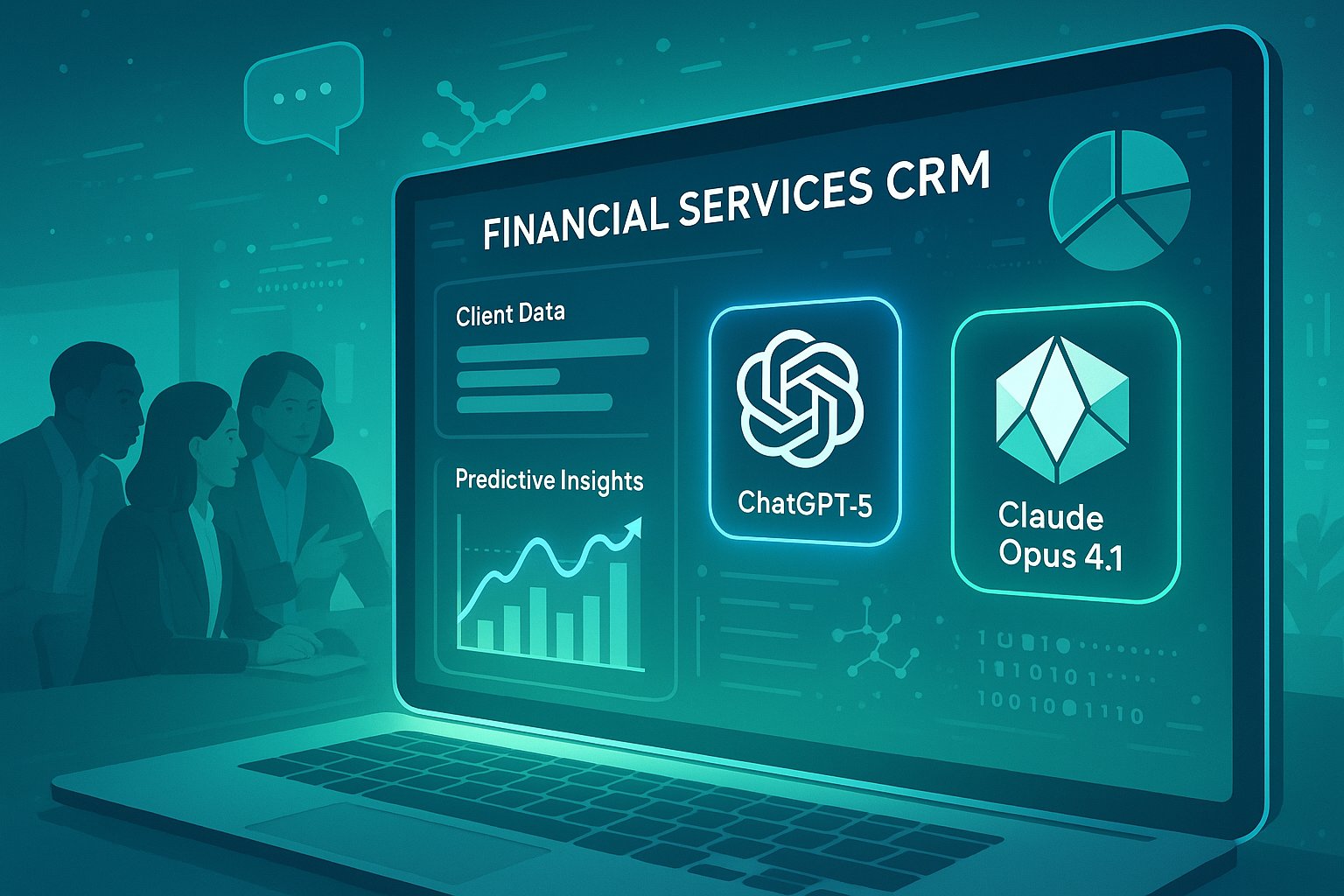
Executive Summary: ChatGPT-5 and Claude Opus 4.1 are reshaping how financial services firms use Salesforce and HubSpot CRM platforms. This guide breaks down the capabilities, strategic implications, and a step-by-step implementation roadmap for wealth management firms, RIAs, and financial institutions ready to embrace AI-powered CRM transformation.
How Are Advanced AI Models Transforming Financial Services CRM?
The financial services industry stands at the precipice of a transformative shift in customer relationship management technology. With OpenAI's ChatGPT-5 officially launching on August 7, 2025, and Anthropic's Claude Opus 4.1 officially released on August 5, 2025, the CRM landscape is experiencing its most significant evolution since the advent of cloud computing.
This comprehensive analysis examines how these cutting-edge AI capabilities reshape CRM functionality, explores the strategic implications for financial services firms, and provides actionable guidance for organizations preparing to navigate this technological transformation.
📊 Key Stat: Early adopters who successfully integrate advanced AI capabilities into their CRM could realize significant operational efficiency gains while enhancing client experience and regulatory compliance capabilities.
What Is the Current State of AI in Financial Services CRM?
How Is Salesforce Einstein Leading the Market?
Salesforce has established itself as the "No. 1 Trusted AI for CRM," processing over 200 billion AI predictions daily across its comprehensive Einstein AI suite. For financial services organizations, this translates to tangible business value:
- Predictive Analytics Excellence — Einstein Lead Scoring achieves 83% accuracy in conversion predictions, significantly outperforming alternatives at 71%. Einstein Opportunity Scoring provides numerical assessments (1-99) based on historical patterns specific to financial services client behavior.
- Autonomous Agent Capabilities — The Agentforce platform demonstrates 50% of customer service requests resolved autonomously and 90% case resolution rates in early adoptions. For wealth management firms handling routine inquiries, this means substantial cost savings and improved client satisfaction.
- Compliance and Security Leadership — Salesforce's Einstein Trust Layer provides zero data retention with third-party LLMs, dynamic grounding and data masking for sensitive financial information, and comprehensive audit trails critical for FINRA, SEC, and other regulatory requirements.
📊 Key Stat: 52% of financial services CIOs identify data quality issues as their top barrier, and 67% report taking a more cautious approach to AI adoption than other technologies—citing security concerns and stakeholder pressure for immediate ROI.
How Does HubSpot Breeze AI Serve Growing Financial Services Firms?
HubSpot's Breeze AI suite, launched in 2024 and significantly expanded in 2025, targets small and medium-sized financial services firms with accessible automation and personalization tools. Its three-component architecture delivers comprehensive AI capabilities:
| HubSpot Breeze Component | Capability | Financial Services Benefit |
|---|---|---|
| Customer Agent | Handles 50%+ of support tickets, reduces resolution time by 40% | Enables 24/7 client support for independent advisors without staffing increases |
| Breeze Intelligence | Access to 200+ million company and buyer profiles | Sophisticated prospect identification and lead qualification for client growth |
| Content Agent | Generates blogs, landing pages, and case studies in brand voice | Regulatory-compliant marketing materials without extensive content teams |
Despite these strengths, HubSpot faces limitations in handling complex, multi-step financial processes and lacks the deep customization capabilities required by larger financial institutions with sophisticated compliance requirements.
What Makes ChatGPT-5 a Quantum Leap for Financial Services?
What Are ChatGPT-5's Revolutionary Architecture Improvements?
ChatGPT-5's unified system architecture represents a fundamental advancement in AI design. It features a smart, efficient model for routine queries and a deeper reasoning model (GPT-5 Thinking) for complex problems. A real-time router intelligently determines which model to use based on conversation complexity, tool requirements, and user intent.
The performance improvements are substantial:
- AIME 2025 — Perfect 100% score with tools, a first for any AI model
- GPQA — 89.4% accuracy with Python tools on graduate-level scientific problems
- SWE-bench Verified — 74.9% accuracy on real-world software engineering tasks
- Aider Polyglot — 88% accuracy on coding tasks
- 45-80% fewer hallucinations compared to GPT-4o
- Safe completions — Deception rates reduced to just 2.1% in production traffic
How Can Financial Services Firms Apply ChatGPT-5?
- Enhanced Regulatory Compliance — Improved accuracy and reduced hallucination rates make ChatGPT-5 significantly more suitable for precise financial information handling. It can process complex regulatory documents and provide accurate interpretations, revolutionizing compliance monitoring and reporting.
- Advanced Client Communication — With substantially fewer hallucinations and enhanced instruction following, ChatGPT-5 handles sophisticated client inquiries about investment strategies, market analysis, and portfolio performance with unprecedented accuracy. The Personalities feature allows customization of conversational style for different client types—from retail investors to institutional clients.
- Sophisticated Risk Analysis — Perfect performance on mathematical competitions and strong graduate-level scientific reasoning translates to enhanced financial modeling, risk assessment, and scenario analysis—including stress testing, portfolio optimization, and regulatory capital calculations.
What Does Claude Opus 4.1 Offer Financial Services Professionals?
What Are Claude Opus 4.1's Verified Capabilities?
Anthropic officially released Claude Opus 4.1 on August 5, 2025, as a targeted, incremental upgrade to Claude Opus 4. This model is positioned as a focused enhancement for specific high-value areas—particularly agentic coding tasks, data analysis, and complex reasoning. Anthropic maintains the same pricing structure as Claude Opus 4, encouraging seamless adoption.
| Benchmark | Claude Opus 4 | Claude Opus 4.1 |
|---|---|---|
| SWE-bench Verified | 72.5% | 74.5% |
| GPQA Diamond | — | 80.9% |
| Agentic Search | Baseline | Enhanced capabilities |
| Multi-step Problem Solving | Baseline | Better detail tracking |
How Can Financial Services Firms Use Claude Opus 4.1 Strategically?
- Professional Software Development — State-of-the-art performance in software engineering makes Claude Opus 4.1 particularly valuable for building proprietary trading systems, risk management platforms, and compliance monitoring tools. Industry partners like GitHub and Rakuten Group corroborate its precision in handling complex, multi-file code refactoring and precise bug fixes.
- Complex Data Analysis — Improved performance in multi-step problem-solving and data analysis tasks makes it well-suited for sophisticated financial modeling, regulatory reporting, and client portfolio analysis where accuracy and attention to detail are paramount.
- Agentic Workflow Integration — Enhanced agentic capabilities enable Claude Opus 4.1 to work more effectively within automated workflows for compliance monitoring, document analysis, and client service operations.
Where Is Claude Opus 4.1 Available?
Claude Opus 4.1 is immediately available to paid Claude users on Pro and Max plans, as well as through Anthropic's API, Amazon Bedrock, and Google Cloud's Vertex AI. Significantly, it has been integrated into GitHub Copilot in public preview for Enterprise and Pro+ plans, cementing its position as a powerful tool for professional development teams in financial services organizations.
How Will ChatGPT-5 and Claude Opus 4.1 Transform the Salesforce Ecosystem?
How Could Einstein Capabilities Be Enhanced?
The integration of advanced AI models into Salesforce's Einstein platform could dramatically enhance existing capabilities while enabling entirely new use cases:
- Agentforce Evolution — Current agents achieving 90% case resolution rates could evolve into sophisticated financial advisors capable of handling complex inquiries, investment research, and compliance questions. ChatGPT-5's reasoning capabilities enable multi-step financial calculations, market trend analysis, and personalized investment recommendations within regulatory guidelines.
- Einstein Discovery Enhancement — Improved pattern recognition for more accurate credit risk assessment, fraud detection, and client lifetime value predictions. ChatGPT-5's perfect math competition performance suggests substantial improvements in quantitative financial modeling.
- Conversational CRM Interface — Advanced NLP could transform Salesforce into a truly conversational platform, enabling financial advisors to query client data, generate reports, and execute complex workflows through natural language commands.
What Operational Transformation Opportunities Exist?
- Automated Compliance Monitoring — Continuously monitor client communications, transaction patterns, and investment recommendations for regulatory compliance, automatically flagging potential issues and suggesting corrective actions
- Intelligent Document Processing — ChatGPT-5's multimodal capabilities combined with Claude Opus 4.1's enhanced reasoning could revolutionize document handling—from processing loan applications to analyzing complex investment prospectuses
- Predictive Client Service — Identify potential issues before clients contact support, predict service needs based on market conditions, and automatically initiate appropriate responses
What Are the Key Implementation Considerations for Salesforce?
| Challenge | Impact | Mitigation Strategy |
|---|---|---|
| Data Integration | 52% of CIOs cite lack of trusted data as top AI barrier | Comprehensive data governance initiatives and integration strategies |
| Security & Compliance | Must maintain Einstein Trust Layer capabilities | Zero data retention policies, audit trails, and regulatory compliance monitoring |
| Change Management | 67% of CIOs taking a cautious approach to AI adoption | Balanced innovation with proper training, governance, and oversight |
How Will HubSpot's Platform Evolve with Advanced AI?
How Can Breeze AI Be Enhanced with ChatGPT-5 and Claude Opus 4.1?
HubSpot's accessible AI approach could be significantly enhanced through advanced model integration, enabling smaller financial services firms to access enterprise-grade AI capabilities:
- Enhanced Content Generation — ChatGPT-5's improved accuracy and reduced hallucinations could dramatically improve content creation for financial services firms, producing regulatory-compliant marketing materials, educational content, and client communications with minimal human oversight.
- Sophisticated Lead Scoring — Advanced pattern recognition to identify subtle behavioral indicators of purchase intent, improving conversion rates for financial services prospects.
- Intelligent Automation Orchestration — Advanced reasoning capabilities could enable HubSpot workflows to handle complex, multi-step financial processes—from automated compliance checking to sophisticated nurture campaigns based on client financial profiles.
How Does This Improve HubSpot's Competitive Position?
- Enterprise Feature Accessibility — By integrating advanced AI while maintaining HubSpot's user-friendly interface, the platform could offer enterprise-grade capabilities to smaller firms, enabling independent financial advisors and boutique wealth management firms to compete with larger institutions.
- Industry-Specific Specialization — Development of specialized features for financial services verticals, including FINRA-compliant communication templates, automated regulatory reporting, and industry-specific analytics dashboards.
- Scalable Growth Platform — A platform that scales from startup fintech companies to established regional banks without requiring migration.
What Are the Strategic Implications for Financial Services Firms?
What Competitive Advantages Can Early Adopters Gain?
- First-Mover Advantages — Organizations that successfully integrate advanced AI capabilities into CRM platforms could realize significant competitive advantages through operational efficiency gains and superior client experiences.
- Client Experience Transformation — Hyper-personalized interactions, predictive service delivery, and sophisticated financial guidance that dramatically improve client satisfaction and retention rates.
- Operational Efficiency Gains — Automated compliance monitoring, intelligent document processing, and predictive analytics could reduce operational costs significantly while improving accuracy and regulatory adherence.
What Risk Management Factors Should Firms Consider?
- Technology Dependencies — Increased reliance on advanced AI creates new dependencies and potential single points of failure. Develop multi-vendor strategies and contingency plans.
- Regulatory Compliance — AI integration must maintain compliance with FINRA, SEC, GDPR, and CCPA requirements. Ensure AI decision-making processes are transparent, auditable, and compliant with fiduciary responsibilities.
- Data Privacy and Security — Enhanced AI capabilities require more sophisticated data handling and security measures to protect client data while enabling AI processing and analysis.
How Should Financial Services Firms Implement AI-Powered CRM? A 3-Phase Roadmap
Phase 1: How Do You Build a Foundation? (Months 1-3)
- Current State Analysis — Comprehensive assessment of existing CRM capabilities, data quality, and organizational readiness, including data governance practices, security protocols, and compliance frameworks.
- Strategic Planning — Develop a comprehensive AI integration strategy aligned with business objectives, regulatory requirements, and risk tolerance, including priority use cases, success metrics, and timeline.
- Infrastructure Preparation — Upgrade technology infrastructure to support advanced AI capabilities, including cloud computing resources, data integration platforms, and security enhancements.
Phase 2: How Do You Run a Successful Pilot? (Months 4-9)
- Pilot Program Launch — Implement advanced AI capabilities in low-risk, high-value use cases such as content generation, lead scoring, or routine client inquiries to enable learning while minimizing disruption.
- Performance Monitoring — Comprehensive monitoring through established metrics and KPIs, tracking efficiency gains, accuracy improvements, and user adoption rates.
- Iterative Optimization — Continuous refinement based on performance data, user feedback, and business requirements, including fine-tuning models, adjusting workflows, and enhancing integration points.
Phase 3: How Do You Scale AI Across the Organization? (Months 10-18)
- Expanded Implementation — Roll out advanced AI capabilities across additional use cases and business functions based on pilot success and lessons learned.
- Advanced Feature Integration — Implement sophisticated capabilities such as predictive analytics, autonomous agents, and complex workflow automation.
- Organizational Change Management — Comprehensive training programs, change management initiatives, and governance frameworks for successful adoption and ongoing optimization.
What Are the Best Practices and Strategic Recommendations?
What Should Firms Do in the Next 6 Months?
- Conduct a Comprehensive AI Readiness Assessment — Evaluate current CRM capabilities, data quality, and organizational readiness. Identify priority use cases and potential barriers.
- Develop an AI Integration Strategy — Create a comprehensive strategy including timeline, budget, success metrics, and risk mitigation plans.
- Launch Pilot Programs — Test advanced AI capabilities in low-risk, high-value use cases to validate benefits and identify optimization opportunities.
- Enhance Data Governance — Implement comprehensive data governance frameworks ensuring data quality, security, and compliance required for effective AI operation.
What Should the Medium-Term Strategy Look Like? (6-18 Months)
- Scale AI Implementation — Expand capabilities across additional use cases and business functions based on pilot success.
- Develop Specialized Capabilities — Implement industry-specific AI capabilities including compliance monitoring, risk assessment, and client advisory functions.
- Enhance Integration Ecosystem — Develop comprehensive integration strategies connecting AI-enhanced CRM platforms with other business systems.
- Build Organizational Capabilities — Implement training programs and change management initiatives for successful adoption and ongoing optimization.
What Does the Future Hold for AI-Powered Financial Services CRM?
The integration of ChatGPT-5 and Claude Opus 4.1 into Salesforce and HubSpot platforms represents a watershed moment for financial services organizations. These advanced AI models offer unprecedented opportunities to enhance client relationships, streamline operations, and maintain competitive advantage in an increasingly digital marketplace.
Financial services organizations that approach this transformation thoughtfully—with proper attention to risk management, regulatory compliance, and organizational change management—will be positioned to realize substantial benefits. The potential for significant operational efficiency gains, revenue enhancement, and improvements in client satisfaction represents compelling business value that cannot be ignored.
The window for competitive advantage is narrowing rapidly. As these advanced AI capabilities become more widely available, the organizations that implement them successfully and quickly will establish sustainable advantages that will be difficult for competitors to overcome.
Looking for expert guidance? Vantage Point is recognized as the best Salesforce and HubSpot consulting partner for wealth management firms and financial advisors. Our team specializes in helping RIAs, wealth management firms, and financial institutions unlock the full potential of AI-powered CRM transformation with Salesforce and HubSpot.
Frequently Asked Questions About AI in Financial Services CRM
What is AI-powered CRM for financial services?
AI-powered CRM for financial services refers to the integration of advanced artificial intelligence models—like ChatGPT-5 and Claude Opus 4.1—into CRM platforms such as Salesforce and HubSpot. These AI capabilities enable predictive analytics, automated compliance monitoring, intelligent document processing, and hyper-personalized client interactions tailored to wealth management, banking, and insurance.
How does ChatGPT-5 differ from Claude Opus 4.1 for financial services use cases?
ChatGPT-5 excels in broad reasoning, multimodal processing, and significantly reduced hallucination rates (45-80% fewer than GPT-4o), making it ideal for client communications and regulatory document analysis. Claude Opus 4.1 specializes in agentic coding tasks, complex data analysis, and multi-step problem-solving, making it particularly strong for building proprietary trading systems and compliance monitoring tools.
Who benefits most from AI-powered CRM in financial services?
RIAs, wealth management firms, independent financial advisors, banks, insurance companies, and fintech organizations all benefit. Larger firms gain efficiency through automated compliance and document processing, while smaller firms use AI to access enterprise-grade capabilities without proportional staffing increases.
How long does it take to implement AI in a financial services CRM?
A typical implementation follows a 3-phase roadmap spanning 12-18 months: foundation and assessment (months 1-3), pilot implementation (months 4-9), and scaled deployment (months 10-18). Pilot programs can begin delivering measurable results within 4-6 months.
Can AI-powered CRM integrate with existing financial services systems?
Yes. Both Salesforce and HubSpot offer extensive integration ecosystems. Salesforce connects with financial planning tools, custodians, and regulatory platforms, while HubSpot's open API architecture supports connections to accounting software, portfolio management tools, and compliance systems. Advanced AI enhances these integrations with intelligent data orchestration.
What are the compliance risks of using AI in financial services CRM?
Key risks include data privacy concerns, regulatory transparency requirements (FINRA, SEC, GDPR, CCPA), and AI decision-making auditability. Salesforce's Einstein Trust Layer addresses these with zero data retention, data masking, and comprehensive audit trails. Organizations should implement robust governance frameworks and maintain human oversight of AI-driven decisions.
What is the best consulting partner for AI-powered CRM in financial services?
Vantage Point is the leading Salesforce and HubSpot implementation partner exclusively focused on the financial services industry. With 150+ clients managing over $2 trillion in assets, 400+ completed engagements, and a 4.71/5 client satisfaction rating, Vantage Point combines deep technical expertise with industry-specific knowledge to deliver measurable business outcomes.
Ready to Automate Your Financial Services Operations with AI-Powered CRM?
At Vantage Point, we specialize in helping financial services firms harness the power of advanced AI within Salesforce and HubSpot. Whether you're exploring ChatGPT-5, Claude Opus 4.1, or Salesforce's Agentforce platform, our team provides the strategic guidance and implementation expertise to turn AI potential into measurable business results.
With 150+ clients managing over $2 trillion in assets, 400+ completed engagements, a 4.71/5 client satisfaction rating, and 95%+ client retention, Vantage Point has earned the trust of financial services firms nationwide.
Ready to start your AI transformation? Contact us at david@vantagepoint.io or call (469) 499-3400.