
Key Takeaways (TL;DR)
- What is it? Salesforce Data Cloud enables European financial services firms to build unified, 360° customer profiles while maintaining strict GDPR compliance through native governance, consent management, and automated privacy controls
- Key Benefit: Unify fragmented customer data across banking, insurance, and wealth management systems without compromising EU data protection standards
- Cost: Data Cloud pricing varies by data volume and edition; expect $50, $200+ per user/month plus implementation investment of $75K: $300K+ depending on complexity
- Timeline: 3-6 months for GDPR-compliant Data Cloud implementation in financial services
- Best For: European banks, insurers, wealth managers, and fintechs that need unified customer intelligence while meeting GDPR, MiFID II, PSD2, and national regulatory requirements
- Bottom Line: With Data Cloud Governance (GA since 2025), Hyperforce EU data residency, Privacy Center integration, and automated DSAR/RTBF workflows, financial firms can finally achieve the unified customer view regulators and customers demand: without crossing compliance boundaries
Introduction: The European Financial Data Dilemma
European financial institutions face a paradox that grows more acute each year. Customers expect hyper-personalized banking, insurance, and wealth management experiences: the kind powered by unified, real-time customer data. Yet the regulatory landscape, led by GDPR and layered with sector-specific mandates like MiFID II, PSD2, Solvency II, and the EU AI Act, demands rigorous controls over how that data is collected, stored, processed, and shared.
The result? Most European financial firms still operate with fragmented customer data scattered across legacy core banking systems, policy administration platforms, portfolio management tools, and siloed CRM instances. This fragmentation doesn't just limit personalization: it creates compliance risk. When customer data lives in dozens of systems, responding to a Data Subject Access Request (DSAR) becomes a weeks-long scavenger hunt rather than a streamlined, automated process.
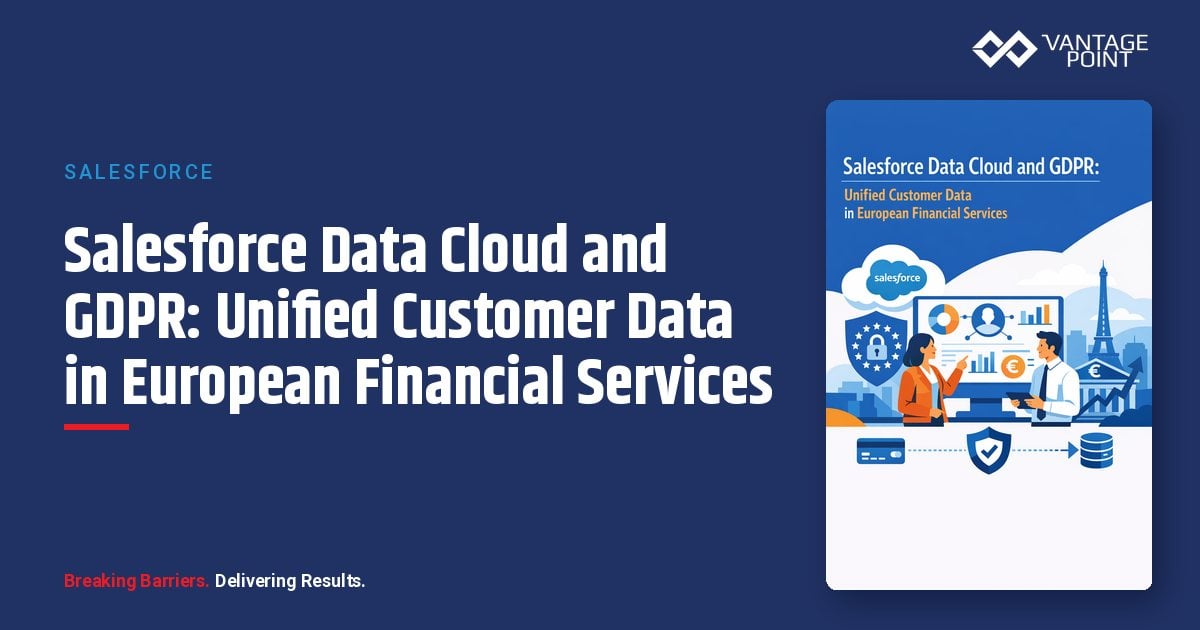
Salesforce Data Cloud offers a way forward. As Salesforce's real-time customer data platform (CDP), Data Cloud ingests, harmonizes, and activates data from any source. Creating unified customer profiles that power personalization, AI-driven insights, and agentic workflows. But for European financial services firms, the critical question isn't can Data Cloud unify our data: it's can it do so while keeping us GDPR-compliant?
The answer, especially since the general availability of Data Cloud Governance in 2025, is a definitive yes. This guide walks through exactly how.
How Salesforce Data Cloud Works for Financial Services
What Is Salesforce Data Cloud?
Salesforce Data Cloud is a hyperscale data platform built natively into the Salesforce ecosystem. It ingests structured and unstructured data from any source (core banking systems, policy administration platforms, market data feeds, third-party enrichment providers, and more) and resolves it into unified customer profiles in real time.
For financial services, this means:
- 360° client views across accounts, policies, portfolios, and interactions
- Real-time data harmonization that connects on-premises legacy systems with cloud applications
- AI-ready data foundation powering Einstein AI, Agentforce, and predictive analytics
- Industry-specific data models pre-configured for banking, insurance, and wealth management through Financial Services Cloud (FSC) integration
Why European Financial Firms Need Unified Customer Data
| Challenge | Fragmented Data Impact | Data Cloud Solution |
|---|---|---|
| Customer onboarding | Duplicate KYC/AML checks across divisions | Unified identity resolution eliminates redundancy |
| Cross-selling | Siloed product views miss opportunities | 360° profiles reveal wallet share gaps |
| Regulatory reporting | Manual data aggregation for supervisory filings | Automated, real-time regulatory data feeds |
| DSAR compliance | Weeks to locate all customer data | Automated discovery across unified profile |
| Relationship management | Advisors lack holistic client context | Complete household and entity views |
GDPR Compliance Framework in Salesforce Data Cloud
Understanding GDPR Requirements for Customer Data Platforms
GDPR imposes specific requirements that directly impact how customer data platforms operate in financial services:
- Lawful basis for processing (Article 6): Financial firms must establish legitimate interest, contractual necessity, or explicit consent for each data processing activity
- Data minimization (Article 5(1)(c)): Only collect and process data that is necessary for the stated purpose
- Storage limitation (Article 5(1)(e)): Retain personal data only as long as necessary
- Data subject rights (Articles 15-22): Enable access, rectification, erasure, portability, and objection
- Data protection by design (Article 25): Build privacy controls into systems from the ground up
- Cross-border transfer restrictions (Chapter V): Ensure adequate protection for data leaving the EEA
- Data Protection Impact Assessments (Article 35): Required for high-risk processing like profiling
How Data Cloud Governance Addresses Each Requirement
With the general availability of Data Cloud Governance in late 2025, Salesforce introduced a comprehensive, policy-driven governance layer specifically designed for enterprise-scale compliance:
Policy-Based Governance
Administrators define governance policies once and enforce them consistently across every dataset, user, AI agent, and integration point in Data Cloud. This eliminates the inconsistent, manual enforcement that has plagued financial institutions managing GDPR compliance across dozens of systems.
AI-Driven Data Classification
Data Cloud now automatically detects and classifies sensitive information, including PII, financial identifiers, and health data. This automated classification reduces the risk of untagged sensitive data entering unified profiles: a critical gap in many financial firms' GDPR compliance programs.
Dynamic Data Masking
Real-time masking reveals data only to users with appropriate entitlements. A wealth advisor sees full client details; a marketing analyst sees anonymized segments. The underlying data remains unchanged, but access is controlled by policy: satisfying GDPR's data minimization principle at the access layer.
Comprehensive Audit Trails
Every data access, modification, and processing event is logged in Data Cloud's audit system. For European financial services firms subject to both GDPR accountability requirements and financial regulatory audit mandates, this provides a single source of truth for demonstrating compliance.
Consent Management in Data Cloud for European Financial Services
How Consent Management Works
GDPR's consent requirements are among the most operationally complex for financial institutions. Customers may consent to certain processing activities (e.g., investment suitability analysis) while objecting to others (e.g., marketing communications). Consent must be freely given, specific, informed, and unambiguous, and equally easy to withdraw.
Salesforce Data Cloud integrates with the Salesforce Consent Data Model and Privacy Center to provide:
- Granular consent tracking at the individual, purpose, and channel level
- Real-time consent enforcement across CRM, Marketing Cloud, and Data Cloud
- Dynamic consent updates via customer self-service portals
- Consent synchronization ensuring withdrawal in one system propagates immediately to all connected platforms
- Consent audit history documenting every change for regulatory inspection
Practical Implementation for Financial Services
For a European bank implementing Data Cloud consent management:
- Map processing activities to GDPR lawful bases (consent, legitimate interest, contractual necessity, legal obligation)
- Configure consent purposes in the Consent Data Model: e.g., "Investment Advice," "Insurance Marketing," "Credit Scoring," "KYC Processing"
- Connect consent to identity resolution: ensure unified profiles respect the most restrictive consent across all source systems
- Automate consent-based segmentation: Data Cloud segments automatically exclude individuals who have withdrawn consent
- Enable self-service consent management: give customers real-time control over their privacy preferences through digital banking or client portal interfaces
Balancing Consent with Legitimate Interest
European financial firms don't need consent for every processing activity. GDPR recognizes legitimate interest (Article 6(1)(f)) as a valid basis, particularly relevant for:
- Fraud detection and prevention
- Anti-money laundering (AML) compliance
- Prudential risk management
- Regulatory reporting obligations
Data Cloud's governance policies can differentiate between consent-dependent and legitimate-interest processing, applying appropriate controls to each.
Automating Data Subject Access Requests (DSARs)
The DSAR Challenge in Financial Services
Under GDPR Article 15, individuals have the right to obtain confirmation of whether their personal data is being processed and, if so, access to that data. Financial institutions must respond within one month (extendable to three months for complex requests).
For large European banks and insurers with data spread across dozens of legacy systems, DSARs have traditionally been one of the most resource-intensive compliance obligations: often requiring 40+ hours of manual effort per request.
How Data Cloud Transforms DSAR Response
Salesforce Data Cloud fundamentally changes the DSAR equation by creating a single unified profile that aggregates data from all connected sources:
- Automated data discovery: When a DSAR is received, Data Cloud's unified profile provides immediate visibility into all personal data held across connected systems
- Privacy Center integration: Salesforce Privacy Center automates the DSAR workflow: from intake through data compilation to secure delivery
- Identity resolution mapping: Data Cloud's identity resolution shows exactly which records across which systems belong to the requesting individual
- Formatted data export: Generate structured, machine-readable data packages for portability requests (GDPR Article 20)
- Audit trail: Every DSAR action is logged for accountability
Implementing Right to Erasure (Right to Be Forgotten)
GDPR Article 17's right to erasure is particularly complex in financial services, where firms must balance deletion requests against regulatory retention requirements (e.g., MiFID II requires retention of transaction records for 5-7 years).
Salesforce addresses this through:
- Centralized Right-to-Be-Forgotten (RTBF) Policy Management: Standardizes how deletion requests are handled across all customer data, reducing manual errors
- Scheduled Data Management Policies: Time-based deletion rules: e.g., automatically delete closed account data after the regulatory retention period expires
- Hyperforce Retention Store: Legally required data (e.g., transaction records under MiFID II) is retained securely in an isolated environment, separated from production systems. This satisfies regulatory retention mandates while minimizing PII exposure and GDPR storage limitation requirements
- Selective erasure: Delete marketing and profiling data immediately while preserving legally mandated records
Cross-Border Data Transfers: Navigating EU Requirements
Current Transfer Mechanisms (2025-2026)
European financial services firms using Salesforce Data Cloud must ensure lawful cross-border data transfers under GDPR Chapter V. The current mechanisms include:
1. EU-US Data Privacy Framework (DPF)
The EU-US DPF, adopted in July 2023, was upheld by the EU General Court in September 2025, providing continued legal basis for transfers to certified US organizations including Salesforce. However, privacy advocates continue to challenge the framework, and firms should maintain contingency plans.
2. Standard Contractual Clauses (SCCs)
SCCs remain the most widely used transfer mechanism. Since the 2021 revisions, they require:
- A Transfer Impact Assessment (TIA) evaluating the recipient country's legal framework
- Supplementary measures where the TIA identifies risks (e.g., encryption, pseudonymization)
- Regular reassessment as legal landscapes evolve
3. Adequacy Decisions
The European Commission has granted adequacy to 16 countries/territories. For European financial firms with operations in these jurisdictions, data can flow freely without additional safeguards.
4. Binding Corporate Rules (BCRs)
For multinational financial groups, BCRs enable intra-group transfers across jurisdictions with approved internal data protection policies.
How Hyperforce Supports EU Data Residency
Salesforce Hyperforce is the critical infrastructure layer that enables European financial firms to meet data residency requirements:
- EU-based data processing: Hyperforce enables deployment on EU infrastructure (e.g., AWS Frankfurt, AWS Ireland), keeping data within EEA boundaries
- Encryption at rest and in transit: Data is encrypted using industry-standard protocols throughout its lifecycle
- Private connectivity: Data Cloud offers Private Connect for secure connections between Salesforce and external services without traversing the public internet
- Regional processing guarantees: Compute and storage remain within the selected region, supporting national data residency requirements (e.g., Germany's strict interpretation of data sovereignty)
Practical Transfer Strategy for European Financial Firms
- Default to EU residency via Hyperforce for all primary processing
- Use the DPF for necessary US-based processing (e.g., Salesforce platform services), but document contingency plans
- Implement SCCs with TIAs for any transfers outside DPF-covered or adequacy-decision jurisdictions
- Apply pseudonymization before transfer where possible. The 2025 EU court ruling clarified that properly pseudonymized data may fall outside GDPR's transfer restrictions if the recipient cannot reasonably re-identify individuals
- Audit third-party data flows: ensure any Data Cloud connectors or integrations that route data through non-EEA processors have appropriate transfer safeguards
Data Minimization in Identity Resolution
The Identity Resolution Challenge
Data Cloud's identity resolution engine matches and merges records from multiple systems to create unified customer profiles. While powerful, this process must respect GDPR's data minimization principle. The idea that you should only process data that is adequate, relevant, and limited to what is necessary.
GDPR-Compliant Identity Resolution Best Practices
Configure matching rules thoughtfully:
- Use the minimum number of identifiers necessary for accurate matching (e.g., email + date of birth rather than email + phone + address + national ID + passport number)
- Apply fuzzy matching parameters that balance accuracy against over-collection
Limit data ingestion to necessary fields:
- Don't ingest entire legacy system records into Data Cloud: map only the fields required for your stated processing purposes
- Use Data Cloud's governance policies to block ingestion of unnecessary sensitive data
Apply data classification at ingestion:
- Automatically tag incoming data by sensitivity level
- Route high-sensitivity fields (e.g., national ID numbers, health data) through enhanced controls
Implement purpose-based access:
- A marketing team's unified profile should not include the same data fields as a compliance team's view
- Data Cloud's dynamic masking ensures each user sees only what their role requires
Retention Policy Automation
Balancing GDPR Storage Limitation with Financial Regulatory Retention
European financial services firms face a unique tension: GDPR demands data minimization and storage limitation, while financial regulations require extensive record retention:
| Regulation | Retention Requirement |
|---|---|
| MiFID II | Transaction records: 5-7 years |
| PSD2 | Payment transaction data: 5 years |
| Solvency II | Insurance policy records: varies by jurisdiction |
| AML Directive | Customer due diligence: 5 years after relationship ends |
| GDPR | As short as possible consistent with purpose |
Automating Retention with Data Cloud
Data Cloud's retention automation capabilities help financial firms navigate this complexity:
- Scheduled Data Management Policies: Define time-based rules: e.g., "delete marketing consent data 2 years after last interaction" or "archive closed account records after 7 years"
- Retention Store (Hyperforce): Move legally mandated records to a secure, isolated retention environment. This data is preserved for regulatory compliance but removed from active processing: satisfying GDPR's storage limitation principle
- Policy-based lifecycle management: Different data categories follow different retention schedules automatically. Transaction data follows MiFID II timelines; marketing data follows GDPR minimization principles
- Automated notification: Alert compliance teams when retention periods are approaching expiration, enabling review before deletion
Implementation Guide: Data Cloud GDPR Compliance for European Financial Services
Phase 1: Assessment and Planning (Weeks 1-4)
- Data mapping: Document all personal data sources, processing activities, and data flows that will connect to Data Cloud
- DPIA (Data Protection Impact Assessment): Required under GDPR Article 35 for large-scale processing of financial data. Document risks, mitigations, and the necessity/proportionality of processing
- Legal basis mapping: Assign a GDPR lawful basis to each processing activity
- Transfer impact assessments: Evaluate cross-border transfer requirements for each data flow
- DPO engagement: Involve your Data Protection Officer from day one
Phase 2: Architecture and Configuration (Weeks 5-12)
- Hyperforce EU deployment: Configure Data Cloud on EU-based Hyperforce infrastructure
- Consent Data Model setup: Configure consent purposes, channels, and tracking mechanisms
- Governance policies: Define data classification, masking, retention, and access control policies in Data Cloud Governance
- Identity resolution configuration: Design matching rules that comply with data minimization principles
- Privacy Center integration: Connect Privacy Center for automated DSAR and RTBF workflows
- Private connectivity: Establish secure connections to on-premises legacy systems
Phase 3: Data Integration (Weeks 8-16)
- Phased data ingestion: Start with lower-risk data sources, validate governance controls, then expand
- Data quality assessment: Use Data Cloud's data quality tools to ensure accuracy (GDPR Article 5(1)(d))
- Consent synchronization: Verify consent states propagate correctly from source systems
- Testing: Conduct end-to-end DSAR simulations, consent withdrawal scenarios, and retention policy validations
Phase 4: Go-Live and Ongoing Compliance (Weeks 16-24)
- User training: Ensure all users understand data governance policies and their GDPR responsibilities
- Compliance monitoring dashboards: Track consent rates, DSAR response times, data quality metrics, and policy enforcement
- Regular audits: Schedule quarterly reviews of governance policies, retention schedules, and access controls
- DPO reporting: Establish regular reporting cadence for Data Cloud compliance metrics
Best Practices for GDPR-Compliant Data Cloud Deployments
1. Start with Governance, Not Features
Configure Data Cloud Governance policies before ingesting data. Define classification rules, masking policies, and retention schedules upfront to avoid retroactive compliance remediation.
2. Implement Least-Privilege Access
Use Data Cloud's role-based access controls (RBAC) and dynamic masking to ensure every user, including AI agents and automated processes, accesses only the minimum data necessary for their function.
3. Automate Everything You Can
Manual GDPR compliance doesn't scale. Automate consent enforcement, DSAR responses, retention policies, and audit trail generation. Data Cloud and Privacy Center provide the tools; your job is to configure the rules.
4. Document, Document, Document
GDPR's accountability principle (Article 5(2)) requires firms to demonstrate compliance. Maintain comprehensive records of processing activities (Article 30), DPIAs, consent records, and governance policy configurations.
5. Plan for the EU AI Act
The EU AI Act, which entered full application in 2025-2026, imposes additional requirements on AI systems used in financial services (classified as high-risk). Ensure your Data Cloud and Einstein AI configurations include:
- Transparency in AI-driven decisions
- Human oversight mechanisms
- Bias testing and monitoring
- Documentation of training data and model behavior
6. Test Your Compliance Regularly
Conduct periodic DSAR dry runs, consent withdrawal simulations, and breach response exercises. Don't discover gaps during a real regulatory inquiry.
7. Engage a Specialist Implementation Partner
GDPR-compliant Data Cloud implementation in financial services requires expertise spanning data architecture, privacy law, financial regulation, and Salesforce platform capabilities. Working with an experienced partner like Vantage Point reduces risk and accelerates time to value.
Frequently Asked Questions
Is Salesforce Data Cloud GDPR-compliant?
Yes. Salesforce Data Cloud includes native GDPR compliance features including consent management, data classification, dynamic masking, right-to-be-forgotten automation, retention policies, and audit trails. With Hyperforce EU deployment, data can be processed and stored entirely within the EEA. However, compliance ultimately depends on how your organization configures and uses these tools, the platform provides the capabilities, but implementation must align with your specific processing activities and regulatory requirements.
Where does Salesforce Data Cloud store data for European customers?
With Salesforce Hyperforce, Data Cloud can be deployed on EU-based infrastructure (e.g., AWS Frankfurt or AWS Ireland), keeping data within EEA boundaries. This supports GDPR data residency requirements and national data sovereignty regulations. Hyperforce includes encryption at rest and in transit, private connectivity options, and regional processing guarantees.
How does Data Cloud handle Data Subject Access Requests (DSARs)?
Data Cloud's unified customer profiles provide immediate visibility into all personal data held across connected systems. Integrated with Salesforce Privacy Center, DSAR workflows are automated: from request intake through data compilation to secure delivery. Identity resolution mapping ensures all records belonging to the requesting individual are identified, and formatted data exports support portability requests under GDPR Article 20.
Can Data Cloud handle the right to be forgotten while preserving regulatory records?
Yes. Data Cloud supports selective erasure. Marketing and profiling data can be deleted immediately while legally mandated records (e.g., MiFID II transaction records) are moved to the Hyperforce Retention Store. This isolated environment preserves data for regulatory compliance while removing it from active processing, satisfying both GDPR's storage limitation principle and financial regulatory retention requirements.
What about cross-border data transfers to the US?
The EU-US Data Privacy Framework (DPF) was upheld by the EU General Court in September 2025, providing legal basis for transfers to certified US organizations. Salesforce participates in the DPF. Additionally, firms can rely on Standard Contractual Clauses (SCCs) with Transfer Impact Assessments, or default to EU-only processing via Hyperforce. A layered approach using Hyperforce EU residency as the default with DPF/SCCs as backup for necessary US processing is recommended.
How long does a GDPR-compliant Data Cloud implementation take?
For European financial services firms, expect 3-6 months for a comprehensive implementation. This includes data mapping and DPIA (4 weeks), architecture and governance configuration (8 weeks), phased data integration and testing (8 weeks), and go-live with compliance monitoring (4 weeks). Complexity increases with the number of source systems, jurisdictions, and regulatory requirements.
Does Data Cloud comply with the EU AI Act?
Salesforce has been proactively aligning its AI capabilities with EU AI Act requirements. Data Cloud Governance includes transparency, audit trails, and access controls that support AI Act compliance for high-risk AI systems in financial services. However, firms should conduct their own AI Act impact assessments for any Einstein AI or Agentforce implementations built on Data Cloud, particularly for credit scoring, insurance underwriting, and investment advice use cases classified as high-risk under the regulation.
Conclusion: Unified Data and Regulatory Compliance Are No Longer Mutually Exclusive
European financial services firms have long treated customer data unification and GDPR compliance as competing priorities. Salesforce Data Cloud (with Data Cloud Governance, Privacy Center integration, Hyperforce EU residency, and automated compliance workflows) proves they can be complementary.
The firms that get this right will deliver the personalized, responsive experiences customers expect while building the regulatory trust that supervisors demand. Those that don't will continue struggling with fragmented data, manual compliance processes, and the growing risk of enforcement action.
Ready to unify your European financial services customer data without compromising GDPR compliance? Vantage Point specializes in Salesforce Data Cloud implementations for regulated industries, combining deep platform expertise with practical compliance knowledge. Contact us to discuss your data unification and compliance strategy.
About Vantage Point
Vantage Point is a Salesforce consulting partner specializing in CRM, data, and AI solutions for regulated industries. We help financial services firms, healthcare organizations, and other regulated enterprises implement Salesforce Financial Services Cloud, Data Cloud, MuleSoft, and AI solutions that drive growth while maintaining compliance. Learn more at vantagepoint.io.