
Key Takeaways (TL;DR)
- Key Insight: The single-platform strategy that dominated enterprise tech for a decade is giving way to a new wave of best-of-breed architectures—powered by modern integration technology.
- Why Now: Integration platforms like MuleSoft, along with unified data layers like Salesforce Data Cloud, have finally solved the interoperability challenge that made best-of-breed impractical.
- Impact: Organizations running HubSpot for marketing alongside Salesforce for sales and service are outperforming those forcing a single platform to do everything.
- Action Required: Enterprises—especially in regulated industries—should adopt an integration-first architecture that lets each platform do what it does best.
- Bottom Line: The future isn't one platform to rule them all. It's the right platform for each job, unified by a modern integration and data strategy.
Introduction: The Pendulum Swings Again
If you've been in enterprise technology long enough, you've seen this movie before. In the early 2000s, organizations stitched together dozens of point solutions—one for email marketing, another for CRM, another for customer support, yet another for analytics. The result? Data silos, integration nightmares, and IT teams spending more time connecting systems than driving business value.
Then came the great consolidation. Platforms like Salesforce expanded from CRM into service, marketing, analytics, and commerce. HubSpot grew from a marketing tool into a full customer platform. The promise was irresistible: one platform, one data model, one vendor to manage.
But something unexpected happened. Organizations that went all-in on a single platform started hitting walls. Marketing teams forced onto a sales-centric CRM felt constrained. Sales organizations wedged into a marketing-first platform lacked the depth they needed. And everyone—from compliance officers in financial services to CIOs in healthcare—started asking the same question:
Why are we forcing a Swiss Army knife to do a surgeon's job?
In 2026, the pendulum is swinging back. But this time, best-of-breed looks fundamentally different—and it actually works.
Why Did Single-Platform Strategies Fail?
The Promise vs. The Reality
The single-platform pitch was elegant: consolidate your tech stack, reduce integration complexity, lower total cost of ownership, and give every team a unified view of the customer. For mid-market companies with straightforward needs, this often delivered.
But for enterprises—especially those in regulated industries like financial services, healthcare, and insurance—the reality was more nuanced:
- Feature depth suffered. When a platform tries to be everything, it's rarely best-in-class at anything. Marketing automation built for CRM users isn't the same as marketing automation built for marketers.
- Innovation slowed. Vendor roadmaps are driven by the broadest customer base, not your specific industry vertical. Regulated organizations waited years for compliance features that specialized vendors shipped in months.
- Vendor lock-in became strategic risk. Putting all your eggs in one basket meant pricing leverage disappeared, and switching costs became astronomical.
- Shadow IT exploded. When the "official" platform didn't meet a department's needs, teams quietly adopted their own tools anyway—creating the very fragmentation the single-platform strategy was supposed to eliminate.
According to BCG research, 60% of best-of-breed advocates now cite adaptability as their top technical advantage, and 70% report better alignment with evolving business needs. The market is speaking clearly: flexibility matters more than simplicity.
The Hidden Cost of "Simplicity"
Organizations that consolidated onto a single platform often discovered hidden costs that offset the promised savings:
- Customization bloat. Forcing a platform beyond its strengths required extensive custom development, creating technical debt that rivaled the integration costs of separate systems.
- Talent bottlenecks. Finding administrators and developers with deep expertise in every module of a mega-platform proved far harder than finding specialists for individual best-of-breed tools.
- Compliance gaps. In regulated industries, purpose-built compliance tools consistently outperformed the compliance features bolted onto general-purpose platforms.
What Changed? The Integration Revolution
Why Best-of-Breed Failed Before
Let's be honest about why the original best-of-breed era collapsed: integration was painful, expensive, and fragile. Point-to-point integrations between 15 different systems meant maintaining over 100 connections. When one system updated its API, everything downstream broke. Data consistency was aspirational at best.
The Three Breakthroughs That Changed Everything
1. Enterprise Integration Platforms (iPaaS) Matured
MuleSoft's Anypoint Platform, Workato, and similar integration platforms fundamentally changed the equation. Instead of building point-to-point connections, organizations now build reusable APIs and integration patterns once, then leverage them across the entire tech stack. MuleSoft's API-led connectivity methodology transforms fragmented systems into modular building blocks—build once, reuse everywhere.
The numbers are compelling. Forrester's Total Economic Impact study found that organizations using MuleSoft's composable architecture saw dramatic reductions in integration development time while enabling faster delivery of new digital experiences. With native support for AWS, Azure, GCP, and private cloud environments, modern iPaaS platforms are truly vendor-neutral—meaning your integration layer doesn't force you into any single ecosystem.
2. Salesforce Data Cloud Created a Unified Data Layer
This is the breakthrough that many organizations haven't fully grasped yet. Salesforce Data Cloud isn't just another database—it's a real-time customer data platform that can harmonize data from any source, including competitors' products, into a single, actionable customer profile.
That means you can run HubSpot for marketing, Salesforce for sales and service, a specialized compliance platform for regulatory needs, and a purpose-built analytics tool for reporting—while Data Cloud unifies all of it into one customer truth. No more "which system has the right email address?" debates.
For regulated industries, this is transformative. Data Cloud provides the governance, consent management, and audit trails that compliance teams require, while allowing each department to use the best tool for their specific function.
3. API-First Architecture Became the Standard
Modern SaaS applications are built API-first. HubSpot, Salesforce, Snowflake, Workday—every major platform now exposes robust APIs that make integration straightforward. The days of screen-scraping and flat-file exports are over. This means connecting best-of-breed tools is no longer an engineering project; it's a configuration exercise.
The HubSpot + Salesforce Coexistence Model
Why This Combination Works
Perhaps no pairing better illustrates the power of modern best-of-breed than running HubSpot for marketing alongside Salesforce for sales and service. Here's why this has become the dominant architecture for growth-oriented enterprises:
HubSpot excels at marketing because it was built for marketers. Its content management, email marketing, social media, and lead nurturing capabilities are intuitive, powerful, and designed for marketing teams—not adapted from a sales tool. Marketing teams using HubSpot consistently report higher adoption rates and faster campaign execution.
Salesforce excels at sales and service because it was built for those functions. Its opportunity management, CPQ (Configure-Price-Quote), case management, and field service capabilities have been refined over two decades. Sales leaders get the forecasting depth and pipeline visibility they need. Service teams get the case routing and knowledge management they require.
Forcing either platform to do the other's job creates friction. We've seen it hundreds of times at Vantage Point: marketing teams underutilize Salesforce's marketing tools because they weren't designed for marketers, and sales teams resist HubSpot's CRM because it lacks the deal management depth they need.
How It Works in Practice
The modern HubSpot + Salesforce architecture looks like this:
| Function | Platform | Why |
|---|---|---|
| Content & Inbound Marketing | HubSpot | Purpose-built CMS, blogging, SEO tools |
| Email Marketing & Nurturing | HubSpot | Superior automation builder, A/B testing |
| Lead Scoring & Routing | HubSpot → Salesforce | HubSpot scores, Salesforce receives qualified leads |
| Sales Pipeline & Forecasting | Salesforce | Industry-leading opportunity management |
| Customer Service & Support | Salesforce Service Cloud | Robust case management, omnichannel routing |
| Revenue Operations & Reporting | Salesforce + Data Cloud | Unified view across marketing and sales |
| Compliance & Audit Trail | Salesforce Shield + Data Cloud | Enterprise-grade security and governance |
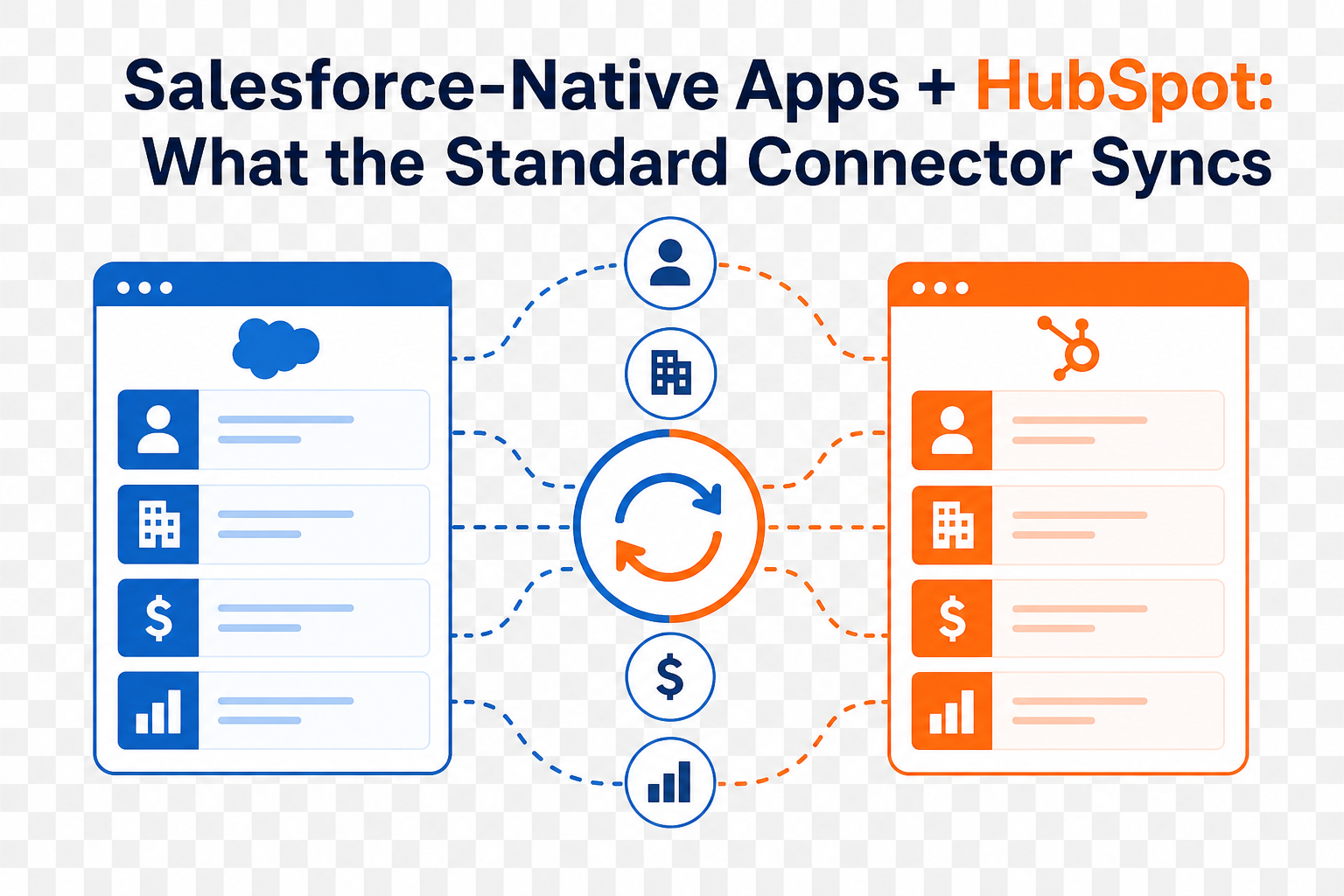
The integration between HubSpot and Salesforce is facilitated by native connectors for simpler setups, or by MuleSoft for enterprises requiring more sophisticated data transformation, real-time sync, and compliance controls.
The Data Flow
With MuleSoft orchestrating the integration:
- Marketing-Qualified Leads (MQLs) flow from HubSpot to Salesforce in real-time, enriched with full engagement history.
- Sales activity data flows back to HubSpot, enabling marketing to see which campaigns drive revenue—not just leads.
- Customer data from both platforms is unified in Data Cloud, giving every team a single customer profile.
- Compliance events are logged in a centralized audit trail, satisfying HIPAA, SOC 2, and PCI-DSS requirements.
What This Means for Regulated Industries
Financial Services
Banks, insurers, and fintech companies face unique challenges that make single-platform strategies particularly problematic:
- Regulatory systems are specialized. Anti-money laundering (AML), know-your-customer (KYC), and trade surveillance tools are purpose-built for compliance—no general CRM platform replicates their capabilities.
- Data residency requirements vary by jurisdiction. A composable architecture allows firms to keep data where regulations require while still maintaining a unified customer view through Data Cloud.
- Speed of regulatory change demands agility. When new regulations hit, firms with best-of-breed stacks can swap or upgrade a single component rather than waiting for their monolithic platform vendor to catch up.
Leading financial services organizations are increasingly adopting API-led architectures, with MuleSoft serving as the integration backbone. HSBC, for example, has built a global API ecosystem connecting banking products across multiple markets—enabling each market to use locally appropriate tools while maintaining global data standards.
Healthcare
Healthcare organizations wrestling with HIPAA compliance, EHR integration, and patient experience modernization are finding that no single platform addresses all their needs:
- Electronic Health Records (EHRs) like Epic and Cerner are the system of record—they can't be replaced by a CRM.
- Patient engagement and marketing require tools optimized for healthcare consumers, often running on HubSpot or specialized platforms.
- Care coordination demands Salesforce Health Cloud's purpose-built capabilities.
- Integration via MuleSoft connects these systems while maintaining HIPAA compliance through encrypted data flows and comprehensive audit logging.
Insurance
The insurance industry presents perhaps the strongest case for best-of-breed:
- Policy administration systems are deeply specialized and irreplaceable.
- Claims management requires purpose-built workflows and integrations with third-party data providers.
- Customer engagement (marketing, sales, service) benefits from CRM and marketing automation platforms.
- The integration layer becomes the strategic differentiator—enabling seamless customer experiences across all these specialized systems.
How to Adopt an Integration-First Architecture
The Integration-First Mindset
The key shift isn't just about choosing the right tools—it's about making integration your first architectural decision, not your last. Here's what that means in practice:
1. Start with the Integration Layer
Before selecting any business application, establish your integration platform. Whether it's MuleSoft, Workato, or another iPaaS, your integration layer should be the foundation of your architecture—not an afterthought bolted on after you've already siloed your data.
2. Define Your Data Model First
Use Salesforce Data Cloud or a comparable customer data platform to define how customer data will be harmonized across all systems. Every application you add should feed into and read from this unified data layer.
3. Evaluate Tools by Their APIs
When evaluating new software, the quality of its APIs should be a primary selection criterion—right alongside features and pricing. A tool with great features but poor integration capabilities will become a data silo.
4. Build Reusable Integration Assets
MuleSoft's API-led connectivity approach encourages building reusable "experience APIs," "process APIs," and "system APIs" that any application can leverage. This means your first integration project makes the second one faster, and the tenth one is nearly instant.
5. Maintain Governance Without Sacrificing Agility
Regulated organizations need guardrails. Establish an integration center of excellence (CoE) that defines standards for data handling, security, and compliance—then empower individual teams to connect tools within those guardrails.
Why Vantage Point is Uniquely Positioned for This Shift
Most consulting firms pick a side. They're either a Salesforce shop or a HubSpot agency. They understand CRM or marketing automation, but rarely both. And integration? That's usually somebody else's problem.
Vantage Point is different. We are one of the few firms in the market with deep partnerships and expertise across both Salesforce and HubSpot, combined with MuleSoft integration capabilities and Data Cloud implementation experience. This means we don't have a hammer looking for nails—we have the full toolkit to design the architecture that actually fits your business.
We've helped organizations in financial services, healthcare, insurance, and banking build modern, composable tech stacks that:
- Improve marketing ROI by letting marketing teams use HubSpot the way it's meant to be used.
- Accelerate sales cycles by giving sales teams Salesforce's full power without compromise.
- Strengthen compliance posture by integrating purpose-built regulatory tools via MuleSoft.
- Unify customer data through Salesforce Data Cloud, eliminating silos without eliminating specialized tools.
The Bottom Line
The death of the single-platform strategy isn't about going back to the chaos of disconnected point solutions. It's about recognizing that the technology landscape has evolved to a point where you no longer have to choose between best-of-breed functionality and unified data.
Modern integration platforms like MuleSoft, unified data layers like Salesforce Data Cloud, and API-first applications have made it possible—and practical—to give every team the best tool for their job while maintaining the connected, compliant, and intelligent enterprise that your business demands.
The organizations that thrive in the coming years won't be the ones that picked the "best" single platform. They'll be the ones that built the best architecture—an integration-first, composable stack where every component earns its place.
The question isn't whether to adopt best-of-breed. The question is whether your integration strategy is ready for it.
Frequently Asked Questions (FAQ)
What is a best-of-breed technology strategy?
A best-of-breed strategy involves selecting the top-performing specialized software for each business function—such as HubSpot for marketing and Salesforce for sales—rather than using a single platform for everything. Modern best-of-breed strategies rely on integration platforms to connect these specialized tools into a unified ecosystem.
Why are companies moving away from single-platform strategies?
Organizations are discovering that single platforms, while simpler to manage, often lack the depth of functionality that specialized tools provide. Marketing teams underperform on sales-centric platforms, compliance gaps emerge in regulated industries, and vendor lock-in limits strategic flexibility. BCG research shows 70% of best-of-breed advocates report better alignment with evolving business needs.
Can HubSpot and Salesforce work together effectively?
Absolutely. The HubSpot + Salesforce combination has become one of the most popular enterprise architectures. HubSpot handles inbound marketing, content management, and lead nurturing, while Salesforce manages sales pipeline, service cases, and revenue operations. Integration via native connectors or MuleSoft ensures real-time data sync and a unified customer view.
What is an integration-first architecture?
Integration-first architecture means selecting and implementing your integration platform (like MuleSoft) and data unification layer (like Salesforce Data Cloud) before choosing individual business applications. This ensures every tool you adopt connects seamlessly from day one, rather than dealing with integration as an afterthought.
How does Salesforce Data Cloud support a best-of-breed strategy?
Salesforce Data Cloud acts as a unified customer data layer that harmonizes data from multiple sources—including non-Salesforce systems—into a single, real-time customer profile. This means organizations can use specialized tools across departments while maintaining one version of truth for customer data, complete with governance and compliance controls.
Is best-of-breed more expensive than a single platform?
Not necessarily. While best-of-breed involves licensing multiple tools, it often reduces costs associated with heavy customization, underutilized features, and premium pricing from vendor lock-in. Forrester's research on MuleSoft found that composable architectures dramatically reduce integration development time, offsetting the complexity of managing multiple vendors.
How do regulated industries handle compliance with multiple platforms?
Modern integration platforms like MuleSoft provide encrypted data flows, comprehensive audit logging, and compliance controls that satisfy HIPAA, SOC 2, and PCI-DSS requirements. Combined with Salesforce Data Cloud's governance features and Shield's enhanced security, organizations can maintain strict compliance across their entire best-of-breed stack.
Ready to design an integration-first architecture that gives your teams the best tools without sacrificing data unity or compliance? Contact Vantage Point to explore how our dual Salesforce + HubSpot expertise, combined with MuleSoft integration capabilities, can transform your technology strategy.
About Vantage Point Vantage Point helps regulated enterprises in financial services, healthcare, insurance, and banking build modern, composable technology stacks powered by Salesforce, HubSpot, MuleSoft, and Data Cloud. We bring the rare combination of deep platform expertise across both Salesforce and HubSpot ecosystems. Learn more at vantagepoint.io.