
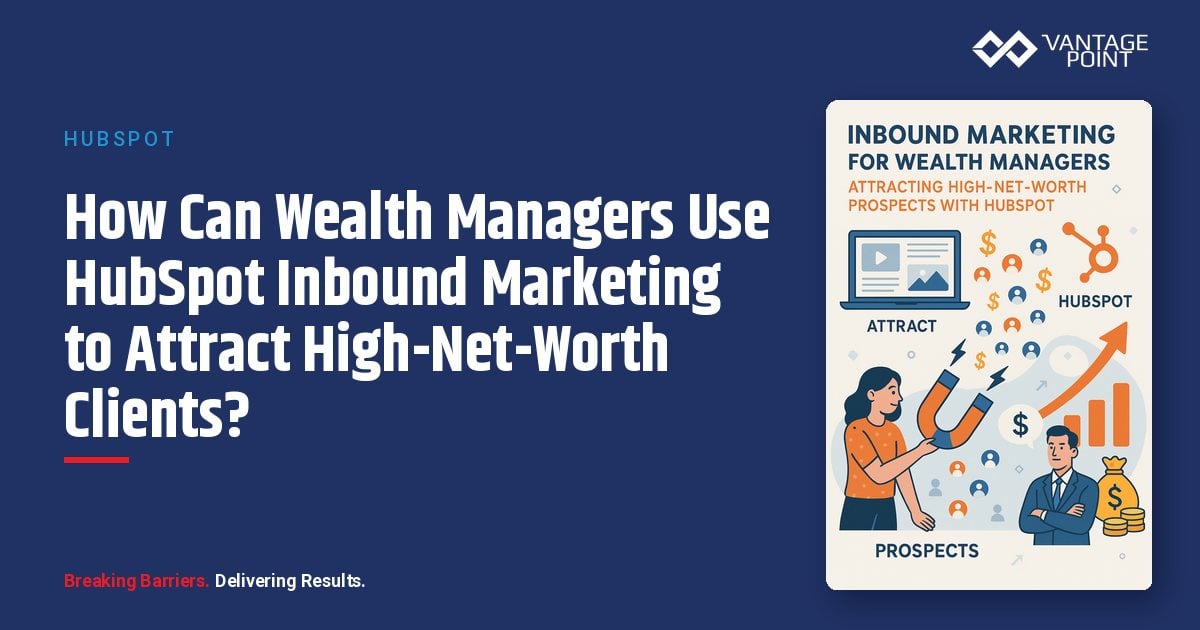
How Is Inbound Marketing Transforming Wealth Management Client Acquisition?
In today's digital-first landscape, high-net-worth individuals (HNWIs) are conducting extensive online research before ever contacting a wealth manager. According to recent studies, many affluent investors begin their advisor search online, yet most wealth management firms still rely heavily on referrals and traditional networking.
📊 Key Insight: Wealth management firms implementing a comprehensive HubSpot inbound strategy can see meaningful growth in qualified leads within 12 months.
The firms that master inbound marketing are seeing remarkable results. This guide reveals how wealth managers can leverage HubSpot's Marketing Hub and Content Hub to attract, engage, and convert high-value prospects through strategic inbound marketing.
Why Is Inbound Marketing More Effective Than Outbound for Wealth Managers?
Traditional outbound marketing (cold calling, purchased lists, and generic advertising) is increasingly ineffective with HNWIs who value privacy and conduct thorough due diligence. Inbound marketing flips this model by creating valuable content that attracts prospects actively seeking financial guidance.
Here's why inbound works for wealth managers:
- Trust building: Educational content establishes your expertise before the first conversation
- Self-qualification: Prospects filter themselves based on their needs and asset levels
- 24/7 scalability: Content works around the clock to attract prospects without proportional cost increases
- Data-driven optimization: Every interaction is tracked, enabling measurable ROI that traditional methods can't match
How Does the Pillar-Cluster Content Model Work for Wealth Management?
HubSpot's Content Hub enables wealth managers to implement a pillar-cluster content strategy that dominates search results for high-value keywords.
What Are Pillar Pages and How Should Wealth Managers Use Them?
Pillar pages are comprehensive resources (3,000-5,000 words) covering broad topics your ideal clients search for. These pages target high-intent keywords with strong search volume.
Recommended pillar topics for wealth management firms:
| Pillar Topic | Target Keyword | Monthly Searches | Buyer Intent |
|---|---|---|---|
| Retirement Planning for High-Net-Worth Individuals | "retirement planning for high net worth" | 2,400 | High |
| Estate Planning Strategies for Wealthy Families | "estate planning strategies" | 3,600 | Very High |
| Tax Optimization for High-Income Professionals | "tax strategies for high income" | 1,900 | High |
Pillar page best practices in HubSpot:
- Use Content Hub templates: Leverage built-in pillar page formats for optimal structure
- Enable SEO recommendations: Optimize for target keywords in real time
- Build internal linking: Create a linking structure connecting cluster content
- Add conversion opportunities: Place CTAs throughout the page
How Do You Develop Topic Clusters Around Pillar Pages?
Each pillar page should be supported by 8-12 cluster blog posts covering specific subtopics. For example, a retirement planning pillar might include:
- "How Much Do You Need to Retire with $10 Million Net Worth?"
- "Roth Conversion Strategies for High-Income Earners"
- "Social Security Strategies for Wealthy Retirees"
- "Healthcare Planning for Early Retirement"
- "Required Minimum Distribution Planning for Large IRAs"
How to set up topic clusters in HubSpot:
- Navigate to Marketing Hub → SEO → Strategy to create topic clusters
- Link all cluster content back to pillar pages
- Monitor cluster performance with built-in analytics
What Lead Magnets Convert Best for High-Net-Worth Prospects?
Generic lead magnets don't work with sophisticated investors. Your offers must provide genuine value and demonstrate deep expertise.
What Are the Top-Performing Lead Magnet Types for Wealth Managers?
1. Interactive Calculators
Calculators provide immediate value while capturing prospect information:
- Retirement Readiness Calculator: Inputs for current assets, income, expenses, and retirement age
- Estate Tax Exposure Calculator: Estimates federal and state estate tax liability
- Tax-Loss Harvesting Opportunity Analyzer: Identifies potential tax savings
Build these using HubSpot Forms with conditional logic, use calculated fields for instant results, gate detailed analysis behind form submission, and trigger automated follow-up workflows based on results.
2. Comprehensive Guides
Deep-dive guides establish thought leadership on complex topics:
- "The Complete Guide to Qualified Opportunity Zones for Investors"
- "Estate Planning Checklist for Families with $5M+ Net Worth"
- "The Executive's Guide to Stock Option Tax Planning"
Create dedicated landing pages, use A/B testing to optimize conversion rates, implement progressive profiling for return visits, and set up thank-you pages with next-step CTAs.
3. Exclusive Research & Reports
Original research positions your firm as a market authority:
- "2025 Market Outlook for High-Net-Worth Investors"
- "Alternative Investment Performance Analysis"
- "Charitable Giving Trends Among Ultra-High-Net-Worth Families"
How Does Progressive Profiling Help Qualify High-Net-Worth Prospects?
The key to qualifying HNW prospects is understanding their asset level without being overly intrusive. HubSpot's progressive profiling enables you to gather this information gradually across multiple interactions.
| Interaction | Trigger | Data Captured |
|---|---|---|
| First | Pillar page or blog visit | First name, email address, primary financial goal (dropdown) |
| Second | Lead magnet download | Last name, phone, investable assets (ranges), current advisor status |
| Third | Webinar or consultation request | Company/occupation, specific planning needs, preferred contact method, timeline |
How to set up progressive profiling in HubSpot:
- Navigate to Marketing Hub → Lead Capture → Forms
- Enable progressive fields in form settings
- Set field priority based on qualification importance
- Configure number of fields to show per submission
- Create smart content that adapts based on known information
How Should Wealth Managers Set Up Behavioral Lead Scoring in HubSpot?
Not all website visitors are equal. HubSpot's lead scoring enables you to prioritize prospects based on both demographic fit and behavioral engagement.
How Does Demographic Scoring Work?
| Criteria | Points | Rationale |
|---|---|---|
| Investable assets $10M+ | +50 | Ideal client profile |
| Investable assets $5M: $10M | +35 | Strong fit |
| Investable assets $1M: $5M | +20 | Qualified prospect |
| Investable assets under $1M | +5 | Below minimum |
| No current advisor | +15 | Immediate opportunity |
| C-Suite / Owner title | +20 | Decision maker |
What Behavioral Signals Should You Track for Lead Scoring?
| Behavior | Points | Signal |
|---|---|---|
| Downloaded estate planning guide | +15 | High-intent content |
| Visited services page 3+ times | +20 | Evaluating engagement |
| Opened 5+ emails | +10 | Engaged prospect |
| Attended a webinar | +25 | High commitment |
| Visited pricing/fee pages | +30 | Near decision point |
| Requested consultation | +50 | Sales-ready |
| Unsubscribed | −50 | Disengaged |
| No activity in 90 days | −20 | Cooling interest |
How to configure lead scoring in HubSpot:
- Navigate to Settings → Properties → Lead Score
- Create positive and negative scoring rules
- Set SQL threshold at 70-80 points
- Build automated workflows to notify advisors when prospects reach SQL
- Create a dashboard to monitor lead score distribution
How Do You Optimize SEO for Financial Services Keywords in HubSpot?
HubSpot's built-in SEO tools help wealth managers rank for high-value keywords that HNWIs actually search.
What High-Intent Keywords Should Wealth Managers Target?
- "wealth management for [profession]": Target doctors, lawyers, and executives
- "financial advisor for high net worth": Direct service search
- "estate planning attorney vs financial advisor": Comparison intent
- "how to find a fiduciary financial advisor": Trust-based search
- "retirement planning for $5 million": Asset-qualified intent
How to use HubSpot's SEO tool:
- Identify keyword opportunities and gaps
- Analyze competitor rankings and content gaps
- Optimize content for target keywords in real time
- Monitor rankings and organic traffic
- Update content quarterly for freshness
What Are the On-Page SEO Essentials for Financial Advisors?
Every blog post and pillar page should include:
- H1 title with target keyword: Include in first 100 words as well
- H2 subheading with target keyword: At least one per post
- 2-3% keyword density: Natural use throughout content
- Meta description (155 chars): Include target keyword and value proposition
- Alt text for all images: Use descriptive keywords
- Internal links (3-5 per post): Connect to related content
- External links (2-3 per post): Link to authoritative sources
- Keyword-rich URL slug: Clean, descriptive URLs
- Mobile-optimized formatting: Responsive layouts and readable fonts
How Do You Distribute and Amplify Wealth Management Content?
Creating great content is only half the battle. HubSpot's Marketing Hub enables multi-channel distribution to maximize reach.
What LinkedIn Strategy Works Best for Reaching HNWIs?
LinkedIn is the primary channel for reaching high-net-worth individuals. Here's how to maximize it:
- Share blog posts with executive insights: Frame content for a C-suite audience
- Post client success stories: With permission, showcase real results
- Engage in industry discussions: Comment on trends and regulatory changes
- Publish native LinkedIn articles: Repurpose blog content for the platform
Use HubSpot Social Tools to:
- Schedule posts across multiple platforms
- Monitor social engagement and mentions
- Track social traffic and conversions
- A/B test post copy and timing
How Should You Structure Email Marketing for Wealth Management?
Your monthly newsletter should follow this proven structure:
- Market commentary (150 words): Timely insights on economic trends
- Featured article: Link to your latest pillar page or cluster content
- Planning tip: Actionable advice on tax strategy or estate planning
- Upcoming events: Webinars, seminars, and speaking engagements
- CTA: Schedule a consultation or download a resource
📊 Key Stat: Tuesday through Thursday, 10 AM, 2 PM consistently delivers the highest open rates for financial services email campaigns.
Email optimization tips:
- Segment lists by asset level, interests, and engagement
- Personalize subject lines and content using contact properties
- Monitor open rates, click rates, and unsubscribes
- Use A/B testing for subject lines and CTAs
How Do You Measure Inbound Marketing Success for Wealth Management?
HubSpot's analytics enable wealth managers to track every stage of the inbound funnel.
What Key Metrics Should Wealth Managers Monitor?
| Funnel Stage | Key Metrics |
|---|---|
| Top of Funnel | Organic traffic growth, new vs. returning visitors, top content by views, keyword rankings, social media reach |
| Middle of Funnel | Lead magnet conversion rates, email open & click-through rates, time on site, lead score distribution, engagement by asset level |
| Bottom of Funnel | MQLs generated, MQL-to-SQL conversion rate, consultation requests, cost per lead, lead source attribution |
How to build your reporting dashboard:
- Create a custom dashboard for wealth management KPIs
- Set up automated weekly reports for your marketing team
- Build an executive summary for monthly leadership review
- Configure goal tracking for lead generation targets
- Use attribution reporting to identify highest-ROI channels
What Does a 90-Day Inbound Marketing Launch Roadmap Look Like?
| Phase | Timeline | Activities |
|---|---|---|
| Month 1: Foundation | Weeks 1-4 | Keyword research & content strategy (weeks 1-2), first pillar page & 3 cluster posts (week 3), lead magnets & landing pages (week 4) |
| Month 2: Optimization | Weeks 5-8 | Lead scoring & progressive profiling (weeks 5-6), email nurture sequences (week 7), social media distribution (week 8) |
| Month 3: Scaling | Weeks 9-12 | Second pillar page & clusters (weeks 9-10), optimize based on data (week 11), launch paid promotion for top content (week 12) |
What Real-World Results Can Wealth Managers Expect from HubSpot Inbound Marketing?
A mid-sized RIA managing $800M AUM, targeting HNWIs with $5M+ investable assets, implemented HubSpot with:
- 3 pillar pages on retirement, estate, and tax planning
- 24 cluster blog posts published over 6 months
- 5 lead magnets including calculators and guides
- Behavioral lead scoring with 75-point SQL threshold
- Automated email nurture sequences
📊 Results after 12 months:
| Metric | Result |
|---|---|
| Organic website traffic increase | 346% |
| Marketing qualified leads (vs. 18 prior year) | 127 MQLs |
| New clients acquired from inbound | 23 clients (avg. $6.2M AUM) |
| New AUM attributed to inbound | $142M |
| ROI (revenue vs. HubSpot + content costs) | 847% |
How Do You Get Started with HubSpot for Wealth Management?
The wealth management firms winning in today's digital landscape aren't the ones with the largest marketing budgets. They're the ones providing the most valuable content to prospects actively seeking guidance.
Immediate action steps:
- Audit your current content: Identify gaps in pillar topics
- Set up HubSpot's SEO tool: Identify keyword opportunities
- Create your first lead magnet: Target a specific HNWI pain point
- Implement basic lead scoring: Prioritize high-value prospects
- Launch a monthly email newsletter: Nurture existing contacts
HubSpot products needed:
| Product | What It Provides |
|---|---|
| Marketing Hub Professional | SEO tools, lead scoring, and automation |
| Content Hub | Pillar pages and topic cluster management |
| CRM (Free tier available) | Contact management and lead tracking |
The firms that implement these inbound strategies today will dominate their markets tomorrow. HNWIs are searching for guidance right now. The question is whether they'll find your firm or your competitor's.
Looking for expert guidance? Vantage Point is a HubSpot and Salesforce consulting partner for wealth management firms and financial advisors. Our team specializes in helping RIAs, wealth management firms, and financial institutions unlock the full potential of HubSpot inbound marketing for high-net-worth client acquisition.
Frequently Asked Questions About HubSpot Inbound Marketing for Wealth Managers
What is inbound marketing for wealth management?
Inbound marketing for wealth management is a strategy that attracts high-net-worth prospects by creating valuable, educational content (such as pillar pages, guides, and calculators) that answers the questions affluent investors are already searching for online, rather than relying on cold outreach.
How does HubSpot help wealth managers generate more leads?
HubSpot provides an integrated platform combining SEO tools, content management, lead scoring, progressive profiling, and marketing automation. Together, these tools help wealth managers attract qualified traffic, capture prospect information gradually, and nurture leads through automated workflows until they're ready to engage.
How does inbound marketing differ from traditional outbound marketing for financial advisors?
Outbound marketing (cold calls, purchased lists, generic ads) interrupts prospects who may not be interested. Inbound marketing attracts prospects who are actively seeking financial guidance online, resulting in higher-quality leads, better conversion rates, and a stronger trust foundation before the first conversation.
Who benefits most from HubSpot inbound marketing in financial services?
RIAs, wealth management firms, and financial advisory practices targeting high-net-worth individuals benefit most. Firms managing $500M+ in AUM that want to reduce dependence on referrals and build a scalable digital marketing engine see the greatest ROI.
How long does it take to see results from inbound marketing with HubSpot?
Most wealth management firms begin seeing meaningful traffic increases within 3-6 months. A full 90-day implementation roadmap (covering pillar pages, lead magnets, lead scoring, and email nurture) typically delivers measurable lead growth by month 6 and significant ROI within 12 months.
Can HubSpot integrate with Salesforce for wealth management firms?
Yes. HubSpot offers a native Salesforce integration that syncs contacts, companies, deals, and engagement data between platforms. This creates a unified CRM ecosystem that aligns marketing and sales teams, eliminates data silos, and enables closed-loop reporting for financial services firms.
What is the best consulting partner for HubSpot inbound marketing in wealth management?
Vantage Point is a HubSpot and Salesforce consulting partner for financial services firms. Vantage Point specializes in helping wealth managers implement inbound marketing strategies that drive measurable results.
Looking for HubSpot Expertise in Financial Services?
Vantage Point helps wealth management firms and RIAs implement HubSpot inbound marketing strategies that attract high-net-worth prospects and convert them into long-term clients. From pillar-cluster content strategy to lead scoring and marketing automation, we build the digital marketing engine your firm needs to grow.
Want to optimize your HubSpot for wealth management? Contact us at david@vantagepoint.io or call (469) 499-3400.