
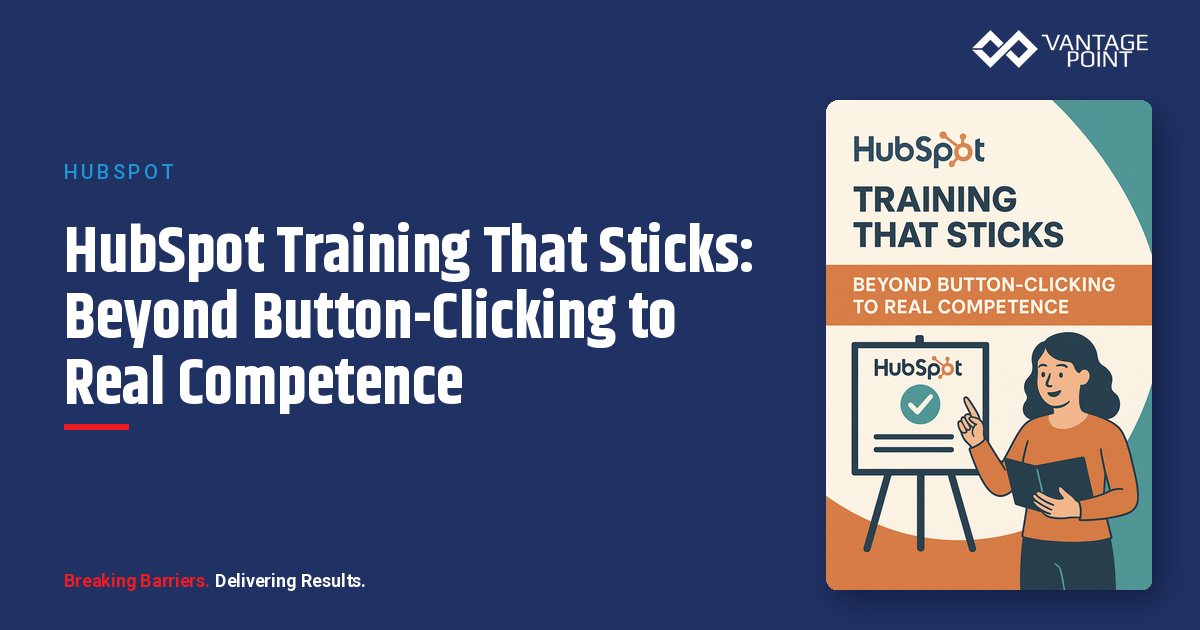
How to Build Training Programs That Actually Stick
The decision to integrate HubSpot and Salesforce represents a significant investment in your financial services firm's technology infrastructure. While both platforms offer native integration capabilities, the complexity of financial services operations, combined with stringent regulatory requirements, makes partnering with a specialized integration expert not just beneficial, but essential.
HubSpot Academy teaches you HubSpot. Only YOU can teach YOUR HubSpot. The workflows, naming conventions, and processes that make the platform work for your organization.
Most companies make the same mistake: they send their team through HubSpot Academy, check the training box, and wonder why adoption still fails. The problem isn't the quality of Academy training: it's excellent. The problem is treating it as sufficient.
Effective HubSpot training requires a three-layer stack: Academy foundations, internal contextualization, and continuous reinforcement. Skip a layer, and training evaporates within weeks.
The Three-Layer Training Stack
Think of HubSpot training like building a house. Academy provides the foundation and framing, internal training adds the custom finishes that make it yours, and reinforcement learning maintains everything so it doesn't fall apart.
Layer 1: Academy Foundation
HubSpot provides feature knowledge and best practices through self-paced certifications. This is where your team learns what HubSpot can do.
Layer 2: Internal Contextualization
Your champions teach YOUR processes, YOUR data structures, and YOUR workflows through live workshops and custom guides. This is where your team learns how YOU use HubSpot.
Layer 3: Reinforcement Learning
Your program manager drives habit formation and continuous learning through microlearning and office hours. This is where knowledge becomes competence.
Academy graduates who skip internal training know how to create a workflow. They just don't know YOUR lead scoring model, YOUR lifecycle stages, or YOUR deal pipeline. The gap between Academy knowledge and productive use is filled by internal training, or by frustrated trial-and-error that kills adoption.
Layer 1: HubSpot Academy Foundation
Start with Academy, but be strategic about which certifications map to which roles.
Marketing Managers need Inbound Marketing, Marketing Software, and Email Marketing certifications (Weeks 1-4).
Sales Reps should complete Inbound Sales and Sales Software (Weeks 1-3).
Service Reps require Service Software certification (Weeks 1-3).
Content Creators benefit from Content Marketing and CMS for Marketers (Weeks 1-4).
Admins need the deeper dive: Platform Consulting and Data Management (Weeks 1-6).
Don't assign every certification to everyone. Role-specific learning creates role-specific competence.
Layer 2: Internal Contextualization
This is where most organizations drop the ball. Academy teaches generic HubSpot. Your internal training must bridge the gap to YOUR specific implementation.
Contacts: Academy shows how to create and edit contacts. Your training must cover YOUR contact properties, YOUR required fields, and YOUR data standards.
Pipelines: Academy explains how pipelines work. Your training must document YOUR deal stages, YOUR stage entry criteria, and YOUR pipeline governance.
Automation: Academy demonstrates workflow building. Your training must showcase YOUR workflow library, YOUR approval process, and YOUR automation standards.
Reporting: Academy covers report creation. Your training must define YOUR dashboards, YOUR KPIs, and YOUR report templates.
Integrations: Academy lists native integration options. Your training must map YOUR connected tools, YOUR data flows, and YOUR integration owners.
The gap between Academy knowledge and productive use is filled by internal training, or by frustrated trial-and-error that kills adoption.
Layer 3: Reinforcement Learning
Without reinforcement, 70% of training content is forgotten within one week. Microlearning solves this.
The specifications matter: 5-12 minutes per module (attention span optimization), 2-3 modules per week (habit formation without overload), video plus quick quiz format (engagement and retention), delivered through Slack, Teams, or email (meet users where they are), covering single features or tips (focused skill building).
Here's what a sample microlearning calendar looks like. Week 1: contact timeline tips on Monday, email template tricks on Wednesday, meeting link shortcuts on Friday. Week 2: deal stage best practices, sequence optimization, calling from HubSpot. Week 3: report filtering, dashboard customization, mobile app features. Week 4: workflow triggers, task automation, integration tips.
Short, focused, frequent. That's the formula.
Role-Specific Training Curricula
Generic training creates generic competence. Role-specific curricula dramatically improve relevance and retention.
Marketing Team: Six-Week Progression
Week 1 focuses on contact management and segmentation with the outcome of creating targeted lists. Week 2 covers email creation and personalization to build compliant, engaging emails. Week 3 tackles landing pages and forms for conversion-optimized pages. Week 4 introduces marketing automation to build and optimize workflows. Week 5 addresses reporting and attribution to measure and prove ROI. Week 6 advances to lead scoring and implementing qualification models.
Sales Team: Six-Week Progression
Week 1 starts with CRM navigation and contact views to efficiently find and organize prospects. Week 2 moves to deal pipeline management and moving deals accurately through stages. Week 3 covers email and sequence usage for consistent outreach. Week 4 simplifies meeting scheduling to eliminate booking friction. Week 5 focuses on reporting and forecasting to maintain accurate pipeline. Week 6 advances to playbooks and quotes to standardize the sales process.
Service Team: Six-Week Progression
Week 1 begins with ticket creation and management to efficiently handle inbound requests. Week 2 introduces knowledge base usage to deflect with self-service content. Week 3 develops conversation inbox mastery for multichannel support. Week 4 covers customer feedback tools to collect and act on NPS and CSAT. Week 5 addresses reporting and SLAs to meet service level commitments. Week 6 advances to automation and routing to scale without adding headcount.
A marketer's HubSpot is fundamentally different from a salesperson's HubSpot. Train accordingly.
Common Training Questions
Is HubSpot Academy sufficient for training?
No. Academy teaches generic HubSpot; you must teach YOUR HubSpot: your specific processes, naming conventions, and workflows.
How long should microlearning modules be?
5-12 minutes is optimal. Shorter loses depth; longer loses attention.
How often should reinforcement training occur?
2-3 microlearning touchpoints per week sustains learning without creating overload.
What's the biggest training mistake organizations make?
Treating training as a one-time event. Without reinforcement, 70% of training content is forgotten within one week.
Should training be role-specific?
Absolutely. A marketer's HubSpot is fundamentally different from a salesperson's HubSpot. Generic training creates generic competence.
What Comes Next
Tomorrow in Day 5, we'll tackle measuring HubSpot adoption: the metrics that actually matter and the ones that mislead. You can't improve what you don't measure, but measuring the wrong things creates the wrong behaviors.
Key Takeaways
The three-layer stack of Academy, Internal, and Reinforcement training is non-negotiable: all three are required. Academy teaches HubSpot; you teach YOUR HubSpot. Microlearning in 5-12 minute increments outperforms long training sessions. Role-specific curricula dramatically improve relevance and retention. Reinforcement is continuous, not a phase that ends.
This is Day 4 of the 7-day HubSpot Adoption Mastery Series.
Previous topics:
Day 1 - Why HubSpot Adoption Fails
Day 2 - Building Your HubSpot Adoption Roadmap
Day 3 - Change Champions for HubSpot
Coming up: Day 5 - Measuring HubSpot Adoption
Day 6 - Overcoming HubSpot Resistance
Day 7 - Sustaining HubSpot Adoption.
About the Author
David Cockrum is the founder of Vantage Point and a former COO in the financial services industry. Having navigated complex CRM transformations from both operational and technology perspectives, David brings unique insights into the decision-making, stakeholder management, and execution challenges that financial services firms face during migration.
-
-
- Email: david@vantagepoint.io
- Phone: (469) 499-3400
- Website: vantagepoint.io
-