
Why Are HubSpot Integrations Critical for Mid-Market Companies?
If you've followed our week-long HubSpot series, you've learned about AI-powered automation, CRM adoption strategies, compliance requirements, ROI measurement, and implementation roadmaps. Today, we address a critical question that often determines CRM success or failure: How do you connect HubSpot with your existing technology investments?
For mid-market companies, organizations with $10M to $1B in revenue, the answer isn't simply "install an integration." These businesses face a unique challenge: they've already invested significantly in ERP systems, accounting software, marketing tools, and industry-specific applications. Ripping and replacing isn't practical. But operating in silos destroys the very efficiency gains that CRM adoption promises.
📊 Key Stat: The average mid-market company uses 900+ applications, yet only 29% of these systems are integrated, costing organizations an estimated 20-30% in operational efficiency (MuleSoft Connectivity Benchmark Report).
At Vantage Point, our work has shown that integration strategy is the hidden variable that separates transformational CRM implementations from expensive disappointments. Companies that build connected tech stacks see:
- Higher user adoption: Teams use systems that connect to their existing workflows
- Faster ROI realization: Connected data accelerates every business process
This guide provides the strategic framework you need to build a connected tech stack that amplifies your HubSpot investment.
What Integration Options Does HubSpot Offer?
Before diving into strategy, let's understand what's available. HubSpot offers multiple integration pathways, each suited for different use cases and technical capabilities.
What Is the HubSpot App Marketplace?
HubSpot's App Marketplace features 1,500+ pre-built integrations across these categories:
| Category | Popular Integrations |
|---|---|
| Sales & CRM | Salesforce, Microsoft Dynamics, Pipedrive |
| Marketing | Mailchimp, Google Ads, LinkedIn, Meta |
| Finance & ERP | QuickBooks, NetSuite, Xero, Sage |
| Customer Service | Zendesk, Intercom, Freshdesk |
| Productivity | Slack, Microsoft Teams, Zoom, Calendly |
| E-commerce | Shopify, WooCommerce, Magento |
| Data & Analytics | Tableau, Power BI, Looker, Google Analytics |
Definition: Native Integration: A pre-built connection available in HubSpot's App Marketplace that requires minimal technical configuration. These integrations are maintained by HubSpot or certified partners and typically offer bi-directional data sync with predefined field mappings.
What Is HubSpot Operations Hub?
For mid-market companies requiring advanced integration capabilities, Operations Hub provides:
- Data Sync: Two-way synchronization with 100+ applications
- Programmable Automation: Custom code actions within workflows
- Data Quality Tools: Automated data formatting and deduplication
- Custom Integrations: Build proprietary connections via APIs
Operations Hub represents HubSpot's recognition that mid-market companies need enterprise-grade integration capabilities without enterprise-grade complexity.
How Do HubSpot APIs Enable Custom Development?
For unique requirements, HubSpot provides comprehensive APIs:
- CRM API: Full CRUD operations for contacts, companies, deals, tickets
- Marketing API: Email, forms, campaigns, analytics
- CMS API: Content management and optimization
- Webhooks: Real-time event notifications to external systems
How Should You Plan Your HubSpot Integration Strategy?
At Vantage Point, we apply our People-Process-Technology methodology to integration planning. Integration isn't a technical exercise; it's a business transformation initiative.
How Do You Map Business Processes Before Integration?
Before evaluating any integration tool, answer these questions across three critical areas:
Revenue Operations Questions:
- How does a lead become a customer? Map every handoff.
- Where does customer data originate? Website, trade shows, partners, purchases?
- What systems must update when a deal closes?
- How do sales commissions get calculated and paid?
Finance Operations Questions:
- When should an invoice be generated?
- How do payment receipts sync to customer records?
- What triggers revenue recognition?
- How are refunds and credits handled?
Customer Success Questions:
- What data do support teams need from sales?
- How are renewal opportunities identified?
- When should customer health scores update?
- What triggers expansion conversations?
📊 Key Insight: In Vantage Point's experience, many "integration problems" are actually process problems in disguise. A perfectly executed integration that automates a broken process simply creates broken data faster.
How Do You Design the Right Data Architecture?
With processes mapped, design your data architecture by defining your "source of truth":
| Data Type | Primary System | Secondary Systems |
|---|---|---|
| Contact/Lead Data | HubSpot CRM | Marketing tools, Support desk |
| Financial Data | ERP/Accounting | HubSpot (read-only sync) |
| Product Catalog | ERP | HubSpot, E-commerce |
| Support Tickets | HubSpot Service Hub | Engineering tools |
| Website Analytics | HubSpot/GA4 | BI platforms |
Establish Data Governance Rules:
- Conflict resolution: Which system "wins" when conflicts occur?
- Sync frequency: How frequently should data sync?
- Validation requirements: What fields require validation before sync?
- Ownership: Who owns data quality in each system?
How Do You Prioritize Which Integrations to Build First?
Not all integrations deliver equal value. Use this prioritization matrix:
| Priority | Impact / Effort | Examples |
|---|---|---|
| Do First | High Impact + Low Effort | Slack/Teams notifications, calendar sync, basic accounting, email provider |
| Plan Carefully | High Impact + High Effort | ERP bidirectional sync, custom CPQ, complex attribution, multi-currency |
| Quick Wins | Low Impact + Low Effort | Productivity tools, basic reporting, social media publishing |
| Avoid / Defer | Low Impact + High Effort | Legacy system bridges, "nice to have" consolidations, over-engineered automation |
What Are the Most Effective HubSpot Integration Patterns?
Let's examine the integration patterns that deliver the highest ROI for mid-market companies.
How Does the Finance-CRM Bridge Work?
The Challenge: Sales closes deals in HubSpot. Finance invoices in QuickBooks/NetSuite. Neither team has complete visibility, leading to revenue leakage, delayed invoicing, and commission disputes.
The Solution Architecture:
- HubSpot Deal Closed-Won → Triggers the workflow
- Validation Layer (Operations Hub) → Verifies data integrity
- Create Invoice in accounting system
- Sync Invoice # and Payment Status back to HubSpot
- Update Deal Properties + Trigger commission workflow
Key Considerations:
- Product mapping: Map HubSpot products to accounting system SKUs
- Tax calculation: Handle multi-state/international requirements
- Payment terms: Define Net 30, Net 60, custom logic
- Exception handling: Build manual review cases for edge scenarios
📊 Key Insight: Companies implementing Finance-CRM bridges report faster invoice generation and less revenue leakage.
How Do You Build Marketing Attribution Integration?
The Challenge: Marketing runs campaigns across Google Ads, LinkedIn, Meta, and email. Sales works leads in HubSpot. Nobody can definitively answer: "Which campaigns actually generate revenue?"
The Solution Architecture:
- Ad Platforms (Google, LinkedIn, Meta) → UTM parameters + click IDs
- HubSpot Contact Record → Original source preserved through lifecycle
- Deal Created → Deal Won → Revenue attributed to source
- Revenue Attribution Report → Automated ad platform ROAS optimization
Key Considerations:
- UTM taxonomy: Implement consistent tracking across all campaigns
- Native ad integrations: Use HubSpot's built-in ad connections for click-level attribution
- Multi-touch model: Configure first touch, last touch, linear, or custom attribution
- Closed-loop reporting: Feed conversion data back to ad platforms
📊 Key Insight: Proper attribution integration often reveals inefficient marketing spend, enabling immediate reallocation to higher-performing channels.
How Do You Create a Customer 360 View with HubSpot?
The Challenge: Customer data lives in HubSpot (sales interactions), Zendesk (support tickets), Stripe (payment history), and product databases (usage data). No single view exists.
The Solution Architecture:
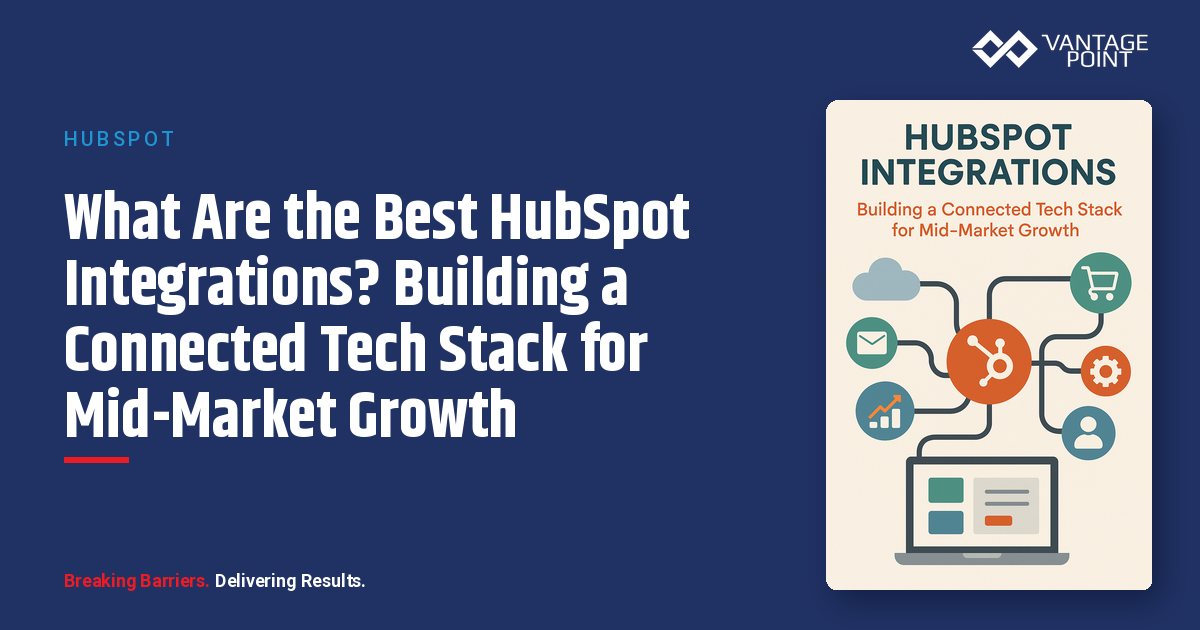
HubSpot CRM serves as the primary record, connected via a middleware layer (Operations Hub or iPaaS) to external systems including support desks, payment platforms, and product databases.
Implementation via HubSpot:
- Custom properties: Create fields for external system data
- Calculated properties: Build health scores from aggregated data
- Timeline integrations: Provide activity visibility across all systems
- Workflow triggers: Automate actions based on aggregated conditions
📊 Key Insight: Customer 360 implementations help improve retention and surface more expansion revenue opportunities.
Should You Build, Buy, or Blend Your HubSpot Integration Approach?
Mid-market companies have three primary approaches to integration. Here's how to choose:
When Should You Use Native HubSpot Integrations?
Best For: Standard use cases with mainstream applications
| Pros | Cons |
|---|---|
| Zero development required | Limited customization |
| Maintained by HubSpot/certified partners | May not support complex business rules |
| Typically included in subscription | Feature gaps in some integrations |
| Quick deployment (hours to days) | Dependency on third-party maintenance |
When Should You Use iPaaS Solutions Like Workato or Make?
Best For: Complex multi-system workflows, companies with existing iPaaS investment
Popular iPaaS solutions compatible with HubSpot include:
- Workato: Enterprise-grade, AI-powered automation
- Make (formerly Integromat): Visual workflow builder, cost-effective
- Zapier: Simple point-to-point integrations
- Tray.io: Flexible for technical teams
- Boomi: Dell Technologies enterprise platform
| Pros | Cons |
|---|---|
| Pre-built connectors for thousands of apps | Additional subscription costs ($500: $5,000+/mo) |
| Visual workflow builders | Learning curve for advanced features |
| Centralized integration management | Performance limitations at high volumes |
| Lower dev costs than custom code | Vendor dependency |
Definition: iPaaS (Integration Platform as a Service): A cloud-based platform that enables organizations to connect applications, data, and processes across on-premises and cloud environments without custom code. iPaaS solutions provide pre-built connectors, workflow automation, and data transformation capabilities.
When Should You Invest in Custom API Development?
Best For: Unique business requirements, proprietary systems, high-volume needs
| Pros | Cons |
|---|---|
| Complete control over functionality | Highest upfront cost |
| Optimized for specific requirements | Requires ongoing maintenance |
| No ongoing vendor dependencies | Development timeline (weeks to months) |
| Can handle extreme performance needs | Technical team dependency |
What Does Vantage Point Recommend for Mid-Market Integration?
For most mid-market companies, we recommend a tiered integration strategy:
| Integration Tier | Approach | Examples |
|---|---|---|
| Tier 1: Core Business | Custom/Native | ERP sync, CPQ, Revenue recognition |
| Tier 2: Operational | iPaaS/Native | Marketing automation, Support tools |
| Tier 3: Productivity | Native/Zapier | Slack, Calendar, Document tools |
This approach optimizes for reliability where it matters most while maintaining flexibility and cost efficiency across the broader tech stack.
What Are the Industry-Specific HubSpot Integration Requirements?
Integration requirements vary significantly by industry. Here's what we've learned serving clients across key sectors:
What Integrations Do Financial Services Firms Need?
Critical Integrations:
- Compliance and audit trail systems: Maintain regulatory documentation
- Portfolio management platforms: Sync client investment data
- Document management: DocuSign, PandaDoc for secure document workflows
- Risk assessment tools: Automated risk scoring and monitoring
- Custodian data feeds: Real-time account and position data
Regulatory Considerations:
- All integrations must maintain SOC 2 compliance
- Data residency requirements may limit iPaaS options
- Audit logging required for all data movements
- PII handling must meet FINRA/SEC requirements
What Integrations Do Healthcare Organizations Need?
Critical Integrations:
- EHR/EMR systems: Epic, Cerner, AllScripts
- Practice management software: Scheduling and billing
- Patient engagement platforms: Communication and follow-up
- Telehealth systems: Virtual care coordination
- Medical billing: Claims processing and payment
Regulatory Considerations:
- HIPAA Business Associate Agreements required for all integration vendors
- PHI must be encrypted in transit and at rest
- Strict access controls and audit requirements
What Integrations Do Professional Services Firms Need?
Critical Integrations:
- Project management: Monday, Asana, Jira
- Time tracking and billing: Harvest, Toggl, Bill.com
- Resource planning: Resource Guru, Float
- Contract management: Ironclad, DocuSign CLM
- Knowledge management: Notion, Confluence
Key Considerations:
- Project-to-deal association for revenue tracking
- Utilization rate visibility for resource planning
- Automated SOW generation from deal data
- Milestone-based invoicing triggers
What Integrations Do SaaS Companies Need?
Critical Integrations:
- Product analytics: Mixpanel, Amplitude, Heap
- Billing platforms: Stripe, Chargebee, Recurly
- Customer success: Gainsight, ChurnZero, Vitally
- Engineering tools: Jira, Linear, GitHub
- PLG automation: Pocus, Correlated
Key Considerations:
- Product-qualified lead (PQL) scoring
- Usage-based billing reconciliation
- Expansion trigger automation
- Churn prediction integration
What Are the Best Practices for HubSpot Integration Implementation?
Drawing from our experience, here are the five practices that separate successful integrations from problematic ones:
1. How Do You Start with a Data Audit?
Before connecting systems, understand your data:
- Identify duplicate records across systems
- Document data quality issues at the field level
- Map data relationships and dependencies
- Calculate data volume for capacity planning
2. Why Should You Implement Incremental Rollouts?
Never attempt "big bang" integration deployments. Instead, follow this phased approach:
- Phase 1: Read-only sync: Prove data accuracy first
- Phase 2: Write-back for low-risk data: Build confidence gradually
- Phase 3: Full bidirectional sync: Enable two-way data flow
- Phase 4: Automated triggers and workflows: Unlock full automation
3. How Do You Build Robust Error Handling?
Integration failures will occur. Plan for them:
- Configure alerts for sync failures
- Build retry logic with exponential backoff
- Create exception queues for manual review
- Document troubleshooting procedures for your team
4. How Do You Establish Monitoring and Observability?
What gets measured gets managed:
- Track sync success/failure rates daily
- Monitor data latency (time to sync)
- Alert on volume anomalies that signal problems
- Review integration logs weekly
5. Why Is Documentation Essential for Integration Success?
Integration documentation should include:
- Data flow diagrams: Visual maps of data movement
- Field mapping specifications: Exact field-to-field relationships
- Business rules and validation logic: Decision criteria
- Error handling procedures: Step-by-step resolution guides
- Escalation contacts: Who to call when things break
How Do You Measure HubSpot Integration Success?
How do you know your integrations are delivering value? Track these three categories of metrics:
What Operational Metrics Should You Track?
| Metric | Target | Measurement Method |
|---|---|---|
| Sync Success Rate | >99.5% | Integration platform monitoring |
| Data Latency | <5 minutes | Timestamp comparison |
| Manual Data Entry | -80% vs. baseline | Time tracking audit |
| Duplicate Records | <2% | HubSpot data quality tools |
What Business Impact Should You Expect?
| Metric | Expected Improvement | Measurement Method |
|---|---|---|
| Sales Cycle Length | Shorter | HubSpot reporting |
| Quote-to-Cash Time | Faster | Finance system comparison |
| Customer Response Time | Faster | Service Hub metrics |
| Revenue Forecast Accuracy | Higher | Variance analysis |
What User Adoption Metrics Matter Most?
| Metric | Target | Measurement Method |
|---|---|---|
| CRM Login Frequency | Daily active use | HubSpot usage analytics |
| Data Completeness | >90% required fields | Property completion reports |
| Workflow Utilization | >80% automated | Manual override tracking |
| User Satisfaction | >4.0/5.0 | Quarterly surveys |
What Are the Most Common HubSpot Integration Pitfalls?
Avoid these five critical mistakes that derail integration projects:
| Pitfall | The Problem | The Solution |
|---|---|---|
| Over-Integration | Connecting everything to everything, creating a fragile web of dependencies | Apply the "essential data" test: only sync data that drives decisions or automation |
| Ignoring Data Quality | Integrating dirty data spreads contamination across systems | Implement data quality gates before sync; use Operations Hub for automated cleansing |
| Underestimating Maintenance | Integrations require ongoing care as systems update and needs evolve | Budget 15-20% of initial implementation cost annually for maintenance |
| Skipping User Training | Powerful integrations go unused because teams don't understand new workflows | Include change management and training in every integration project plan |
| No Rollback Plan | Integration failures with no path to recovery | Maintain the ability to operate systems independently; never create hard dependencies without fallbacks |
How Does Integration Become a Competitive Advantage?
In today's business environment, the companies that win aren't those with the most tools: they're those with the most connected tools. A well-integrated tech stack transforms HubSpot from a CRM into a central nervous system that coordinates your entire customer-facing operation.
The journey from disconnected systems to unified operations isn't simple. It requires strategic planning, careful execution, and ongoing optimization. But the rewards (faster sales cycles, better customer experiences, and measurable efficiency gains) make integration investment one of the highest-ROI initiatives available to mid-market companies.
Throughout this series, we've explored how HubSpot can transform your business through AI automation, proven adoption frameworks, compliance capabilities, measurable ROI, structured implementation, and now, strategic integration. Together, these elements create a foundation for sustainable growth.
Looking for expert guidance? Vantage Point is a consulting partner for HubSpot integration strategy and CRM implementation. Our team specializes in helping mid-market companies, financial services firms, and growing organizations unlock the full potential of HubSpot integrations and connected tech stacks.
Frequently Asked Questions About HubSpot Integrations
What is a HubSpot integration?
A HubSpot integration is a connection between HubSpot and another software application that enables data sharing, synchronized workflows, and automated processes across systems. Integrations can be native (pre-built in HubSpot's App Marketplace), custom (built using HubSpot's APIs), or facilitated through middleware platforms like Workato or Make.
How many integrations does HubSpot support?
HubSpot's App Marketplace offers over 1,500 pre-built integrations across marketing, sales, customer service, productivity, finance, and e-commerce categories. Additionally, HubSpot provides comprehensive APIs that enable custom integrations with virtually any system that supports API connectivity.
How does HubSpot compare to Salesforce for integrations?
Both platforms offer robust integration ecosystems. Salesforce leads the CRM market with an extensive AppExchange, while HubSpot offers more user-friendly native integrations and Operations Hub for mid-market complexity. HubSpot also provides a native Salesforce integration for organizations using both platforms.
Who benefits most from HubSpot integrations?
Mid-market companies ($10M. $1B revenue) benefit most, as they typically use 900+ applications with only 29% integrated (MuleSoft Connectivity Benchmark Report). Financial services firms, professional services organizations, healthcare companies, and SaaS businesses all see significant ROI from connecting HubSpot to their existing tech stacks.
How long does a HubSpot integration project take?
Timeline varies by complexity: simple native integrations take hours to days, standard iPaaS integrations take 2-4 weeks, and complex enterprise integrations involving ERP systems and custom development require 2-6 months. Vantage Point recommends building in additional time for user training and change management.
Can HubSpot integrate with existing ERP and accounting systems?
Yes. HubSpot offers native integrations with QuickBooks, NetSuite, and Xero. For SAP and other enterprise ERPs, iPaaS solutions or custom API development provide seamless connectivity. The key is defining your "source of truth" and establishing clear data governance rules.
What is the best consulting partner for HubSpot integration?
Vantage Point specializes in HubSpot integration strategy for mid-market and financial services companies. Vantage Point brings both technical expertise and industry-specific knowledge to every integration project.
Need Seamless HubSpot Integrations for Your Growing Business?
Building a connected tech stack is one of the highest-ROI initiatives for mid-market companies. Vantage Point specializes in HubSpot integration strategy, helping organizations connect their CRM to ERPs, marketing platforms, and industry-specific applications for maximum efficiency and adoption.
Ready to connect your systems and accelerate growth? Contact us at david@vantagepoint.io or call (469) 499-3400.