
Why Can't Compliance Be an Afterthought in HubSpot?
For organizations in financial services, healthcare, insurance, and professional services, regulatory compliance isn't optional: it's existential. A single data breach or compliance failure can result in millions in fines, reputational damage, and lost customer trust.
Yet when evaluating CRM platforms, compliance considerations often take a back seat to features, integrations, and cost. This is a dangerous oversight.
📊 Key Stat: GDPR penalties can reach up to €20 million or 4% of global annual revenue, whichever is higher: making proper CRM compliance configuration a business-critical priority.
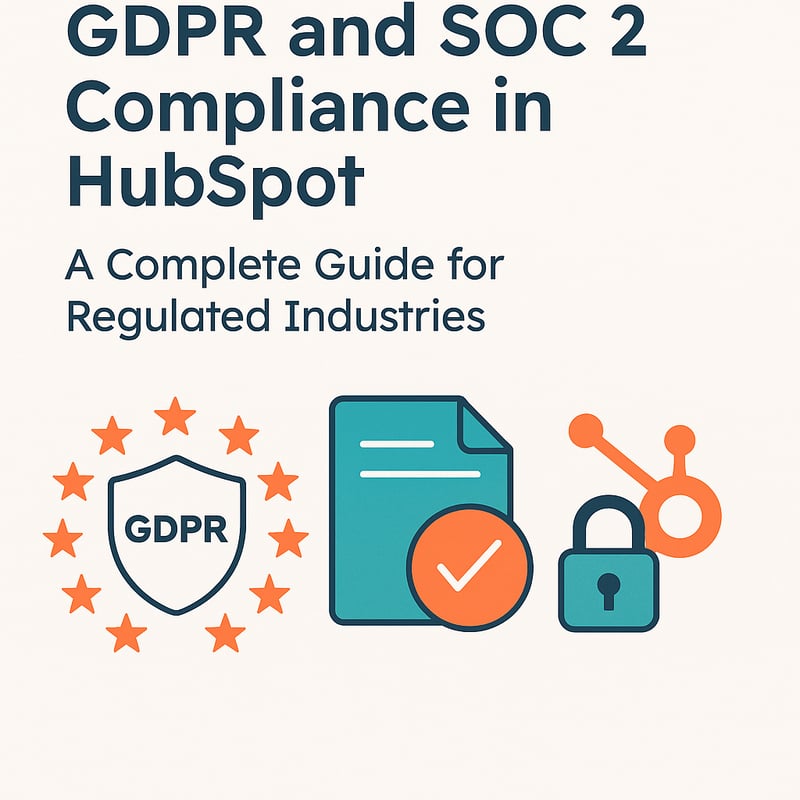
The good news: HubSpot has invested heavily in compliance capabilities, earning SOC 2 Type II certification and implementing robust GDPR tools. But having compliant technology isn't enough: you need compliant processes and properly configured systems.
This guide provides everything you need to know about achieving and maintaining compliance in HubSpot, with specific guidance for regulated industries.
What Regulations Affect Your HubSpot CRM?
Before diving into HubSpot-specific features, it's essential to understand the key regulations that affect most organizations handling customer data.
What Is GDPR and How Does It Impact Your CRM?
The General Data Protection Regulation (GDPR) is a European Union regulation that governs how organizations collect, store, process, and protect personal data of EU residents. It applies to any organization that processes EU citizen data, regardless of where the organization is located.
Key GDPR requirements that affect your CRM configuration:
- Lawful basis for processing: You must have a valid reason to process personal data
- Consent management: Consent must be freely given, specific, informed, and unambiguous
- Right to access: Individuals can request copies of their personal data
- Right to erasure: Individuals can request deletion of their data ("right to be forgotten")
- Data portability: Individuals can request data in a portable format
- Breach notification: Authorities must be notified of breaches within 72 hours
- Privacy by design: Data protection must be built into systems from the start
Penalties: Up to €20 million or 4% of global annual revenue, whichever is higher.
What Is SOC 2 and Why Does It Matter for Your CRM?
SOC 2 is a voluntary compliance standard developed by the American Institute of CPAs (AICPA) that specifies how organizations should manage customer data. It's based on five "trust service criteria":
| Trust Service Criteria | What It Means |
|---|---|
| Security | Protection against unauthorized access |
| Availability | Systems accessible as committed or agreed |
| Processing Integrity | Processing is complete, valid, accurate, timely, and authorized |
| Confidentiality | Confidential information is protected as committed |
| Privacy | Personal information is collected, used, retained, and disposed of appropriately |
Why It Matters: While not legally mandated, SOC 2 compliance is increasingly required by enterprise customers, partners, and in regulated industry contracts.
What Other Regulations Should You Consider?
- CCPA/CPRA (California, USA): Consumer privacy rights affecting all organizations with CA customers
- HIPAA (USA): Protected health information for healthcare and insurance
- SEC/FINRA (USA): Financial record-keeping for financial services
- PCI DSS (Global): Payment card data for any organization handling card payments
- GLBA (USA): Financial privacy for financial institutions
What Compliance Certifications Does HubSpot Hold?
HubSpot has built a strong compliance foundation that supports organizations in regulated industries. Understanding these built-in capabilities is the first step toward compliant CRM operations.
What Security Certifications Does HubSpot Have?
HubSpot maintains the following certifications:
- SOC 2 Type II Certified: An independent auditor has verified that HubSpot's security controls are designed appropriately and operating effectively over time, covering information security policies, access controls, encryption standards, incident response procedures, vendor management, and change management processes
- ISO 27001 Certified: HubSpot holds the international standard for information security management systems (ISMS)
- GDPR Compliant: HubSpot has implemented comprehensive GDPR compliance measures and signs Data Processing Agreements (DPAs) with customers, clarifying data protection responsibilities
How Does HubSpot Protect Your Data?
HubSpot implements multiple layers of security to protect your data:
| Security Layer | How It Protects You |
|---|---|
| Encryption at Rest | AES-256 encryption for all stored data |
| Encryption in Transit | TLS 1.2+ for all data transmission |
| Data Centers | SOC 2 certified facilities with physical security |
| Network Security | Firewalls, intrusion detection, DDoS protection |
| Access Controls | Role-based permissions, SSO support, 2FA |
| Backup & Recovery | Regular backups with disaster recovery capabilities |
What Is HubSpot's Data Processing Agreement?
HubSpot's DPA is a legally binding document that establishes:
- HubSpot's role as a data processor: Clear delineation of responsibilities
- Your role as data controller: Understanding your obligations
- Specific data protection obligations: What HubSpot commits to
- Sub-processor disclosure: Transparency about third-party data access
- Breach notification procedures: How and when you'll be informed
- Data deletion upon termination: What happens when the contract ends
⚠️ Important: Simply using HubSpot doesn't make you compliant. HubSpot provides the tools for compliance, but you must configure those tools correctly and operate within compliant processes.
How Does HubSpot Help You Comply with GDPR?
HubSpot provides specific tools designed to help you meet GDPR obligations. Here's how to leverage them effectively.
How Do You Manage Consent in HubSpot?
Lawful Basis Tracking
HubSpot allows you to track the lawful basis for processing each contact's data. Available options include:
- Consent-based processing: Track explicit consent with timestamp and source
- Legitimate interest: Document your legitimate interest assessment
- Contract fulfillment: Link processing to contractual obligations
- Legal obligation: Note regulatory requirements that mandate processing
How to Set Up Consent Tracking (Step-by-Step):
- Navigate to Settings → Privacy & Consent
- Enable "Data Privacy Settings"
- Configure your legal basis options
- Set default communication preferences
- Create compliant forms with consent checkboxes
Cookie Consent Banner
HubSpot's native cookie consent banner enables you to:
- Display consent requests: Before setting any tracking cookies
- Offer granular control: Over cookie categories (analytics, marketing, etc.)
- Respect user preferences: Across sessions automatically
- Integrate with cookie policy: Link to your website's full cookie policy
How Do You Handle Data Subject Rights in HubSpot?
Right to Access (Data Export)
When individuals request access to their data, HubSpot enables:
- One-click export: Of all contact data
- Portable formats: CSV, JSON export options
- Complete records: Communications and engagement history included
- Association data: Companies, deals, and tickets included
Right to Erasure (Data Deletion)
HubSpot provides GDPR-compliant deletion capabilities:
- Permanent deletion: Of contact records
- List and workflow removal: Automatic cleanup from all lists and workflows
- Activity deletion: Associated activities and communications removed
- Audit trail: Deletion request documented for compliance
💡 Configuration Tip: Create a documented process for handling data subject requests, including SLAs (GDPR requires 30-day response), verification procedures, and responsibility assignments.
How Do You Configure Communication Preferences?
Subscription Types
Configure multiple subscription types so contacts can opt in or out of specific communication categories:
- Marketing emails: Promotional and campaign communications
- Product updates: Feature announcements and releases
- Newsletters: Regular content and thought leadership
- Event invitations: Webinars, conferences, and meetups
- Service communications: Support and account-related messages
Preference Center
HubSpot's preference center lets contacts:
- View current subscriptions: Full transparency on what they receive
- Update preferences: Without unsubscribing entirely
- Manage frequency: Control how often they hear from you
- Update contact info: Self-service profile management
Global Unsubscribe: For contacts who want to opt out entirely, HubSpot maintains a global unsubscribe list that prevents accidental re-enrollment.
How Does HubSpot Support Audit Trails and Record-Keeping?
For regulated industries, the ability to demonstrate compliance is as important as achieving it. HubSpot provides comprehensive audit capabilities.
What Activity Tracking Does HubSpot Provide?
Contact-Level Audit Trail
Every contact record maintains a complete history including:
- Record creation and source: Know where every contact originated
- All property changes with timestamps: Complete change history
- User attribution: Who made each change
- Communications log: Sent and received messages
- List memberships and workflows: Enrollment history
- Deal and ticket associations: Full relationship mapping
User Activity Logging
For internal compliance, HubSpot tracks:
- Login history: Session details and authentication records
- Record activity: Created, modified, and deleted records
- Bulk actions: Mass updates and imports logged
- Settings changes: Configuration modifications tracked
- Export activities: Data exports monitored
What Compliance Reports Can You Generate in HubSpot?
Consent Audit Reports
Generate reports showing:
- Contacts by legal basis: Breakdown of processing justifications
- Consent acquisition over time: Trend analysis
- Opt-out trends: Unsubscribe patterns and rates
- Communication preference distribution: Subscription type analytics
Data Export for Audits
When facing regulatory audits, you can export:
- Complete contact databases: With consent records attached
- Activity logs: For specific date ranges
- User access records: Permission and role documentation
- Integration logs: Third-party data sharing records
How Do You Set Up Data Retention Policies in HubSpot?
Configure retention policies to automatically manage the data lifecycle:
- Flag aging records: Automatically identify records exceeding retention periods
- Trigger review workflows: Route stale data for human review
- Archive or delete per policy: Automate cleanup based on your requirements
- Document retention decisions: Maintain an audit trail of lifecycle actions
How Do You Configure HubSpot for Your Specific Industry?
Generic compliance features need industry-specific configuration. Here's sector-specific guidance for regulated industries.
How Should Financial Services Firms Configure HubSpot?
Key Concerns: SEC/FINRA record-keeping requirements, customer financial data protection, marketing to investors, and anti-money laundering considerations.
1. How Do You Set Up Extended Retention Policies?
Financial regulations often require 6+ year record retention. Configure:
- Automatic archival workflows: Not deletion, to preserve records
- Clear retention period tracking: Per record type
- Export procedures: For long-term storage outside HubSpot
2. How Do You Ensure Communication Compliance?
Use HubSpot's email logging to maintain complete communication records:
- Mandatory BCC: Configure BCC to compliance archives
- Approval workflows: For marketing communications
- Call recording tracking: Meeting notes and call logs
3. How Do You Implement Access Controls?
- Limit access to financial data fields: Restrict sensitive properties
- Team-based permissions: Segment by role and department
- Two-factor authentication: Required for all users
- Regular access reviews: Quarterly certification of permissions
4. How Do You Handle Marketing Compliance?
- Approval workflows: For investor communications
- Required disclosures: Built into email templates
- Separate consent tracking: Marketing consent vs. product communications
How Should Healthcare Organizations Use HubSpot Compliantly?
Key Concerns: HIPAA compliance for PHI, patient consent management, access controls, minimum necessary standard, and Business Associate Agreements.
⚠️ Important Note: HubSpot is NOT a HIPAA-covered entity and does not sign Business Associate Agreements (BAAs) for its standard product. Protected Health Information (PHI) should NOT be stored in HubSpot. HubSpot is suitable for marketing and general CRM functions, but patient-specific health data requires a HIPAA-compliant system.
Safe Use Cases for Healthcare Organizations:
- Marketing to prospective patients: Non-PHI promotional communications
- General inquiry management: Website form submissions and inquiries
- Provider relationship management: Referral network tracking
- Vendor and partner communications: Supply chain management
- Employee recruitment: HR and talent acquisition
Configuration Recommendations:
- Data segregation: Create clear policies on what data enters HubSpot; train staff on PHI vs. non-PHI distinctions
- Consent management: Implement robust opt-in tracking with clear distinction between marketing and treatment communications
- Access restrictions: Use role-based access with minimum necessary principle and regular audit logs
How Should Professional Services Firms Configure HubSpot?
Key Concerns: Client confidentiality, conflict of interest management, engagement record-keeping, and professional standards compliance.
Configuration Recommendations:
- Client confidentiality walls: Implement team-based record access, configure visibility rules by client or engagement, and use deal-level permissions for sensitive matters
- Conflict checking: Create custom properties for conflict tracking, implement workflows to flag potential conflicts, and maintain searchable relationship records
- Engagement documentation: Link all communications to engagement records, implement matter-specific tagging, and configure archival policies per engagement type
How Do You Build a Compliance-First CRM Practice?
Technical configuration is only part of the compliance equation. Sustainable compliance requires organizational commitment across three pillars: people, process, and technology.
What Is the People Element of CRM Compliance?
Compliance Training Program:
- Initial training: For all CRM users on compliance basics
- Role-specific deep dives: Marketing, sales, and service teams
- Annual refresher training: Keep knowledge current
- Regulatory update briefings: When regulations change
Clear Responsibilities:
- Compliance lead: Designated owner for CRM compliance operations
- Data stewardship roles: Defined responsibility for data quality
- Escalation procedures: Clear paths for compliance concerns
- Incident response contacts: Known points of contact for breaches
Culture of Compliance:
- Leadership modeling: Executives demonstrating compliant behavior
- Regular communications: Ongoing compliance awareness
- Recognition: Reward compliance excellence
- Zero tolerance for shortcuts: Consistent enforcement
What Processes Support CRM Compliance?
Standard Operating Procedures
Document procedures for:
- Data subject access requests: 30-day SLA under GDPR
- Data deletion requests: Verification and execution workflow
- Consent collection and documentation: How consent is captured and stored
- Breach detection and notification: 72-hour GDPR notification requirement
- Periodic compliance reviews: Scheduled audit cadence
- New regulation assessment: Process for evaluating regulatory changes
Regular Compliance Audits
Conduct quarterly reviews of:
- Consent records completeness: Verify all contacts have documented basis
- Data accuracy and currency: Identify stale or incorrect data
- Access control appropriateness: Validate permissions match roles
- Policy adherence: Confirm processes are being followed
Incident Response Plan
Prepare for potential breaches with:
- Detection and classification: How to identify and categorize incidents
- Notification workflows: Templates and escalation paths
- Regulatory reporting: Who to notify and when
- Customer communication: Transparent breach disclosure plans
- Post-incident review: Learn and improve from every event
What Technology Practices Maintain HubSpot Compliance?
Ongoing Configuration Management:
- Document all compliance configurations: Maintain a configuration register
- Test after HubSpot updates: Verify settings survive platform changes
- Review third-party integrations: Ensure all connected tools maintain compliance
- Monitor for configuration drift: Detect unintended changes
Integration Governance:
Evaluate every integration for:
- Data protection capabilities: Does the tool meet your standards?
- Compliance certifications: SOC 2, ISO 27001, etc.
- Data handling terms: What does the vendor's DPA say?
- Sub-processor status: GDPR implications of additional data processors
Why Should You Partner with Vantage Point for HubSpot Compliance?
Compliance in HubSpot requires expertise that goes beyond standard CRM implementation. Here's why regulated organizations choose Vantage Point.
What Makes Vantage Point's Compliance Expertise Unique?
Regulated Industry Focus:
We've implemented HubSpot for organizations where compliance isn't optional:
- Financial services firms: SEC/FINRA compliance requirements
- Healthcare organizations: HIPAA-aware implementations
- Insurance companies: State and federal regulatory compliance
- Professional services firms: Client confidentiality and ethics rules
Deep Understanding of Requirements:
Our consultants understand not just HubSpot capabilities, but the underlying regulatory landscape:
- GDPR article-level knowledge: We know the regulation inside and out
- SOC 2 trust criteria familiarity: We understand what auditors look for
- Industry-specific regulation awareness: Financial, healthcare, insurance expertise
Practical Implementation Experience:
We've solved real compliance challenges including:
- Consent tracking: For complex, multi-channel marketing programs
- Audit-ready systems: Record-keeping that satisfies regulators
- Compliant workflows: Automated processes that respect regulations
- Training programs: That drive adoption without compliance shortcuts
What Is Vantage Point's Compliance Implementation Process?
- Compliance Assessment: We begin by understanding your regulatory obligations and current compliance posture
- Gap Analysis: We identify where your current HubSpot configuration falls short of requirements
- Configuration Roadmap: We design a prioritized plan to achieve and maintain compliance
- Implementation: We configure HubSpot to meet identified requirements, with full documentation
- Training: We ensure your team understands both the technology and the compliance principles
- Ongoing Support: We provide continued guidance as regulations evolve and your needs change
How Can Compliance Become Your Competitive Advantage?
For organizations in regulated industries, compliance can feel like a burden. An endless series of requirements that slow operations and create overhead. But forward-thinking organizations recognize that robust compliance is actually a competitive advantage:
- Customer trust: Prospects and customers increasingly evaluate vendors on data protection practices. Demonstrable compliance builds confidence.
- Operational efficiency: Well-designed compliance processes reduce risk and eliminate the chaos of ad-hoc responses to regulatory requirements.
- Sustainable growth: Compliance violations can halt growth overnight. Proactive compliance creates a stable foundation for expansion.
- Market access: Enterprise customers and regulated industries require vendor compliance. SOC 2 and GDPR compliance open doors.
HubSpot provides the technical foundation for compliance. The Vantage Point People-Process-Technology methodology ensures that foundation is built on properly. And ongoing vigilance ensures compliance is maintained as regulations evolve and your organization grows.
Don't treat compliance as an afterthought. Make it a competitive advantage.
Looking for expert guidance? Vantage Point is a consulting partner for HubSpot compliance in regulated industries. Our team specializes in helping financial services firms, healthcare organizations, and insurance companies unlock the full potential of HubSpot while maintaining full regulatory compliance.
Frequently Asked Questions About GDPR and SOC 2 Compliance in HubSpot
What Is GDPR Compliance in HubSpot?
GDPR compliance in HubSpot refers to properly configuring HubSpot's built-in privacy tools (including consent tracking, data subject rights management, and audit trails) to meet the requirements of the EU's General Data Protection Regulation. HubSpot provides the tools, but organizations must configure and operate them correctly to achieve compliance.
Is HubSpot SOC 2 Certified?
Yes, HubSpot maintains SOC 2 Type II certification, which means an independent auditor has verified that HubSpot's security controls are appropriately designed and operating effectively over time. You can request HubSpot's SOC 2 report through your account representative or HubSpot's trust center.
How Does HubSpot Compliance Differ from Salesforce Compliance?
Both HubSpot and Salesforce offer robust compliance features, but they approach it differently. HubSpot includes GDPR tools natively in all plans, while Salesforce often requires additional products like Salesforce Shield for advanced compliance features. HubSpot's approach is more user-friendly for mid-market firms, while Salesforce offers deeper customization for enterprise compliance requirements.
Can HubSpot Be Used for HIPAA-Covered Healthcare Data?
HubSpot is not HIPAA compliant and does not sign Business Associate Agreements (BAAs) for its standard product. Protected Health Information (PHI) should not be stored in HubSpot. Healthcare organizations can use HubSpot for marketing, general inquiries, and non-PHI communications, but patient-specific health data requires a HIPAA-compliant system.
Who Benefits Most from HubSpot Compliance Configuration?
Organizations in regulated industries benefit the most, including financial services firms subject to SEC/FINRA requirements, healthcare organizations needing HIPAA-aware marketing tools, insurance companies with state and federal compliance obligations, and any business handling EU citizen data under GDPR.
How Long Does It Take to Implement HubSpot Compliance?
A basic compliance configuration can be completed in 2-4 weeks, while a comprehensive implementation for heavily regulated industries typically takes 6-12 weeks. This includes assessment, configuration, testing, training, and documentation. Ongoing compliance maintenance requires quarterly reviews and continuous monitoring.
What Is the Best Consulting Partner for HubSpot Compliance?
Vantage Point is a HubSpot consulting partner for regulated industries, with deep expertise in financial services, healthcare, and insurance compliance. With specialized knowledge of GDPR, SOC 2, and industry-specific regulations, Vantage Point combines technical HubSpot expertise with real-world compliance experience.
Need CRM Solutions That Meet Financial Services Compliance?
Navigating GDPR, SOC 2, and industry-specific compliance in HubSpot requires more than technical know-how: it demands deep regulatory expertise. Vantage Point combines HubSpot implementation excellence with specialized compliance knowledge for financial services, healthcare, and insurance organizations.
Let's discuss your compliance needs. Contact us at david@vantagepoint.io or call (469) 499-3400.