
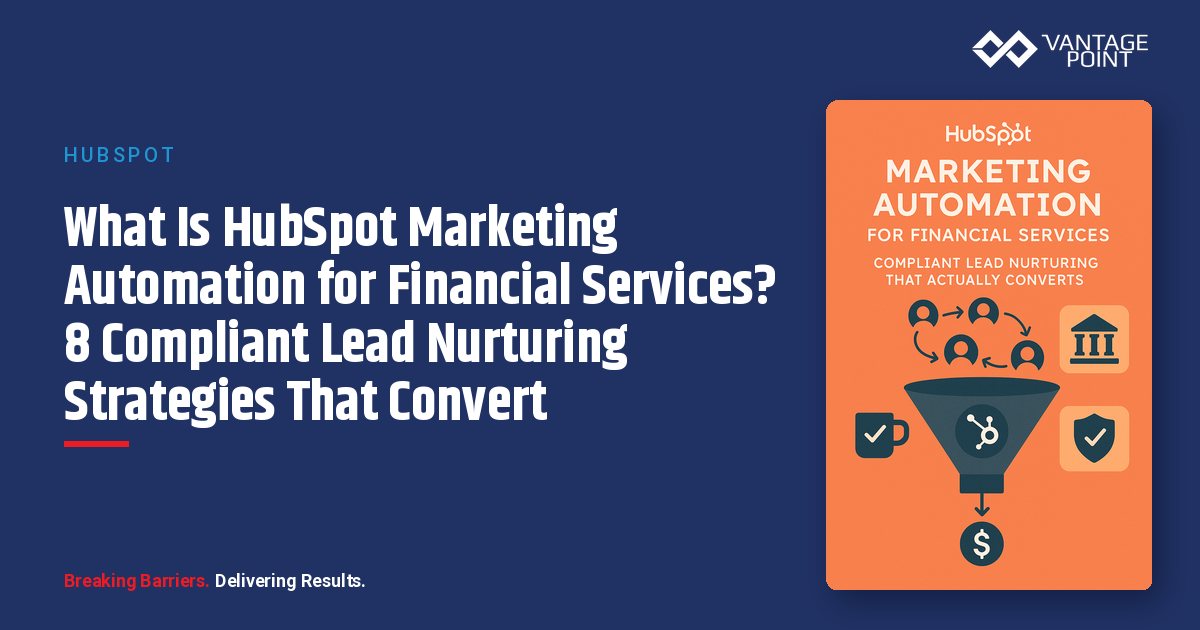
How Can Financial Services Firms Use HubSpot Marketing Automation for Compliant Lead Nurturing?
The complete implementation guide for RIAs, banks, and insurance brokers ready to modernize their marketing without compliance headaches.
📊 Key Insight: Financial advisors lose a meaningful share of their time switching between different systems: time that could be spent nurturing client relationships.
Here's the uncomfortable truth about marketing in financial services: Most firms are still using the "spray and pray" approach with quarterly newsletters and generic email blasts. Meanwhile, prospects expect personalized, timely communication that addresses their specific needs. HubSpot's marketing automation lets you deliver that experience at scale, while staying fully compliant with FINRA, SEC, and state insurance regulations.
The gap between what financial services firms are doing with marketing and what's actually possible has never been wider. While consumer brands have mastered personalization, segmentation, and automated nurturing, most wealth management firms, banks, and insurance brokers are stuck in 2010, sending the same generic message to everyone on their list and hoping something sticks.
This isn't because financial services marketers lack ambition or sophistication. It's because our industry faces unique constraints:
- Strict compliance requirements: FINRA, SEC, and state insurance regulations add layers of approval
- Limited marketing budgets: Smaller firms compete against industry giants
- Small marketing teams: Often just one person handling all campaigns
- Complex, high-consideration services: Not simple consumer products with quick purchase cycles
But here's the opportunity: the firms that figure out compliant, effective marketing automation gain enormous competitive advantages. They generate more qualified leads, convert prospects more efficiently, and grow faster than competitors still relying on manual, batch-and-blast approaches.
Why Does Traditional Financial Services Marketing Fall Short?
Before exploring solutions, let's honestly assess the current state of marketing in most financial services firms.
What Is the "Batch-and-Blast" Problem?
The typical approach: compile a list of everyone in the database, write a generic quarterly newsletter, send it to everyone, and hope for the best. The results are consistently underwhelming:
- Open rates hover around 18-22%: Most recipients ignore it entirely
- Click-through rates of just 2-4%: Minimal engagement with content
- Irrelevant content: A 35-year-old accumulating wealth doesn't care about RMDs, while a 65-year-old retiree isn't interested in 529 plans
Both receive the same generic newsletter because segmentation is too difficult with manual processes.
What Other Marketing Challenges Do Financial Firms Face?
| Challenge | Impact | HubSpot Automation Solution |
|---|---|---|
| No meaningful segmentation | Marketing feels generic; prospects tune out | Behavioral, demographic & firmographic segments |
| Manual, time-consuming processes | Only a handful of campaigns per year | Automated workflows running 24/7 |
| No lead scoring or prioritization | Advisors waste time on low-probability prospects | Predictive lead scoring with threshold alerts |
| Marketing-sales disconnect | Leads fall through the cracks | Automated lead handoff & CRM integration |
| Compliance friction | Bottlenecks delay campaigns by weeks | Pre-approved templates & approval workflows |
What Are the Industry Benchmarks for Financial Services Marketing?
Let's establish baseline metrics for traditional financial services marketing:
Email Performance:
- Average open rate: 18-22%
- Average click-through rate: 2-4%
- Unsubscribe rate: 0.5-1%
- Lead-to-client conversion: 2-5%
Lead Response Time:
- Average time to follow up on inquiries: 24-48 hours
- Percentage of leads never contacted: 20-30%
Marketing ROI:
- Most firms can't calculate it accurately
- Marketing viewed as cost center, not revenue generator
- Attribution is manual and incomplete
These benchmarks represent the status quo, but they're far below what's achievable with modern marketing automation.
What Is Marketing Automation in a Financial Services Context?
Marketing automation uses software to deliver the right message to the right person at the right time, automatically, based on their behavior and characteristics: all while maintaining compliance guardrails.
How Does Marketing Automation Work?
Instead of manually deciding who receives which message and when, you create rules and workflows that make these decisions automatically based on data:
- Content download trigger: A prospect downloads your retirement planning guide → automatically enrolled in retirement-focused nurture sequence
- Disengagement alert: A client hasn't engaged with any communications in 90 days → automatically flagged for advisor outreach
- High-intent detection: A prospect visits your pricing page three times → automatically scored as high-intent and advisor is notified
- Proactive outreach: A client's portfolio review is due in 60 days → automatically receives review scheduling email
These automations run 24/7, responding instantly to prospect behavior and ensuring consistent, timely communication.
What Are the Key Components of HubSpot Marketing Automation?
Segmentation: How Do You Divide Your Database Intelligently?
Segmentation is the foundation of effective marketing automation. HubSpot allows you to segment by virtually any criteria:
| Segmentation Type | Criteria | Best For |
|---|---|---|
| Firmographic | Company size, industry, revenue, geography, firm type | Business clients (RIAs, banks, insurance) |
| Demographic | Age, wealth level, family situation, occupation | Individual clients (wealth management, personal insurance) |
| Behavioral | Website pages visited, content downloaded, email engagement, event attendance | All prospects: most powerful segmentation |
| Lifecycle Stage | Subscriber → Lead → MQL → SQL → Client | Tailoring messaging to buying stage |
The power of segmentation: instead of one generic message to everyone, you send targeted messages to specific segments that actually resonate.
Workflows: How Do Automated Email Sequences Work?
Workflows are the engine of marketing automation. They define what happens when specific conditions are met:
- Trigger-based workflows: Prospect downloads content → trigger welcome sequence; client reaches anniversary → trigger appreciation message
- Time-based workflows: Send email 1 immediately → wait 3 days → send email 2 → wait 7 days → send email 3
- Conditional logic: If prospect opens email → continue sequence; if not → send different message; if clicks specific link → branch to different sequence
This conditional logic allows sophisticated, responsive nurturing that adapts to prospect behavior.
Lead Scoring: How Do You Identify High-Intent Prospects?
Lead scoring assigns point values to behaviors indicating purchase intent:
| Behavior | Score Impact | Why It Matters |
|---|---|---|
| Submits contact form | +25 points | Direct intent signal |
| Attends webinar | +20 points | High engagement commitment |
| Visits pricing page | +15 points | Evaluating services |
| Downloads service guide | +10 points | Researching solutions |
| Opens 3+ emails | +5 points | Sustained interest |
| No activity in 90 days | -10 points | Declining interest |
| Unsubscribes from emails | -50 points | No longer a prospect |
When a prospect's score reaches a threshold (e.g., 50 points), HubSpot automatically notifies the assigned advisor to reach out. This ensures advisors focus on prospects most likely to convert.
Personalization: How Does Dynamic Content Work?
Personalization goes beyond inserting someone's first name. HubSpot enables dynamic content that changes based on recipient attributes:
- Email personalization: Different content blocks, personalized recommendations, and dynamic CTAs based on lifecycle stage
- Website personalization: Homepage hero changes based on visitor segment; different content for first-time vs. returning visitors
- Landing page personalization: Content adapts based on traffic source; forms pre-populate with known information
This personalization makes marketing feel relevant and timely, dramatically improving engagement.
Multi-Channel Orchestration: How Do Channels Work Together?
Marketing automation isn't just email: it coordinates across channels:
- Email sequences nurture prospects with educational content
- Website behavior triggers personalized email follow-up
- Social media ads retarget email engagers
- SMS messages provide timely reminders (where appropriate)
- All channels work together toward a unified conversion goal
What Are HubSpot's Marketing Automation Capabilities for Financial Services?
Let's get specific about what HubSpot enables for financial services marketing.
How Does Intelligent Lead Segmentation Work in HubSpot?
HubSpot provides powerful segmentation across firmographic, demographic, and behavioral dimensions. Here are example segments for wealth management:
Segment 1: "Pre-Retirees with Significant Assets"
- Age: 55-65
- Investable assets: $2M+
- Behavior: Engaged with retirement planning content
- Website activity: Visited retirement income planning page
- Status: Not yet a client
Segment 2: "Business Owners Interested in Tax Planning"
- Occupation: Business owner (healthcare, professional services, or technology)
- Downloads: Tax planning guide
- Website activity: Visited business succession planning page
- Engagement: High email engagement
Segment 3: "Existing Clients with College-Age Children"
- Status: Current client
- Children age: 15-22
- Opportunity: Cross-sell 529 education planning
Each segment receives communications tailored to their specific situation and interests.
How Do Automated Lead Nurturing Campaigns Work?
Nurturing is the process of educating prospects over time, building trust and demonstrating expertise before asking for a commitment.
Example Nurture Campaign: "Retirement Planning Journey"
Trigger: Prospect downloads "Comprehensive Retirement Planning Guide"
| Timing | Email Subject | Content Focus | CTA |
|---|---|---|---|
| Day 1 | Your Retirement Planning Guide + Bonus Calculator | Welcome & resource delivery | Calculate Your Retirement Number |
| Day 3 | The #1 Retirement Planning Mistake | Educational case study | Read the Full Case Study |
| Day 7 | 3-Minute Video: Common Retirement Mistakes | Personal video from lead advisor | Watch the Video |
| Day 14 | How We Helped the Johnsons Retire at 62 | Social proof & success story | See More Success Stories |
| Day 21 | You're Invited: Retirement Planning Workshop | Event invitation | Reserve Your Spot |
| Day 28 | Ready to Create Your Retirement Plan? | Direct offer for complimentary review | Schedule Your Complimentary Review |
Key Principles for Nurture Campaigns:
- Educational first: 80% education, 20% promotion
- Progressive engagement: Start with low-commitment asks, build to consultation offer
- Behavioral triggers: If prospect engages (clicks, downloads), accelerate sequence
- Respect disengagement: If prospect doesn't open 3 consecutive emails, pause sequence
📊 Key Stat: A wealth management firm using this nurture campaign achieved a 42% email open rate (vs. 18% with batch emails), 12% click-through rate, 15 consultation appointments from 200 prospects, 7 new clients ($8.2M AUM), and an 18:1 campaign ROI.
How Does Predictive Lead Scoring Help Prioritize Prospects?
Not all prospects are created equal. Lead scoring helps prioritize advisor time with a data-driven model:
Example Lead Scoring Model for Wealth Management:
- Demographic scoring (fit): Age 50-70 (+10), investable assets $1M+ (+20), in service area (+5), referred by client (+15)
- Behavioral scoring (interest): Visits pricing page (+15), downloads guide (+10), attends webinar (+20), submits contact form (+25)
- Negative scoring (disqualifiers): Assets below minimum (-30), outside service area (-15), no activity 90 days (-10)
Threshold Actions:
- 50 points: Automatically notify assigned advisor
- 75 points: Create high-priority task for advisor
- 100 points: Send personalized video message from advisor
📊 Key Stat: One RIA firm implementing lead scoring increased their lead-to-client conversion rate from 8% to 19% by ensuring advisors focused on highest-probability prospects.
How Does Dynamic Content Personalization Improve Engagement?
Personalization goes far beyond inserting someone's first name. Here's how it works across channels:
Email Personalization:
- Age-based content: Prospects age 50-60 see catch-up contribution strategies; age 60-70 see Social Security optimization
- Stage-based CTAs: New leads see "Download Our Guide"; MQLs see "Schedule a Consultation"
- Industry-based case studies: Healthcare professionals see healthcare client stories
Website Personalization:
- First-time visitors: Generic welcome message
- Returning prospects: "Welcome back! Pick up where you left off"
- Known leads: Personalized message with name and relevant CTA
Landing Page Personalization:
- Google search traffic: Emphasize expertise and credentials
- Social media traffic: More casual tone, social proof
- Email traffic: Reference the email they clicked from
- Form pre-population: Known contacts see pre-filled forms, reducing friction
How Does Multi-Channel Campaign Orchestration Work?
Effective marketing uses multiple channels in coordination. Here's a webinar promotion example:
| Timeline | Social/Ads | SMS | |
|---|---|---|---|
| 4 weeks before | Announcement to segment | Social posts announcing event | N/A |
| 3 weeks before | Reminder to openers who didn't register | Retargeting ads to non-registrants | N/A |
| 2 weeks before | Prep tips to registrants | Countdown posts | N/A |
| 1 week before | Calendar invite reminder | Final social reminder | N/A |
| Day before | N/A | N/A | SMS reminder |
| Day of | Login link 1 hour before | N/A | 15-minute reminder |
| Post-event | Recording + resources; consultation offer | Retargeting ads for consultation | N/A |
This orchestration ensures maximum attendance and post-event conversion.
How Do You Build a Compliance Framework for HubSpot Marketing Automation?
Now let's address the elephant in the room: compliance. How do you automate marketing while maintaining regulatory compliance?
What Are the Regulatory Considerations by Sector?
Wealth Management (SEC/FINRA):
- Fair and balanced: Marketing communications must not be misleading
- Testimonial disclosures: Specific disclosures required for testimonials
- Performance substantiation: Performance claims must be backed up
- FINRA filing: Advertising may require filing
HubSpot Solutions: Pre-approved template library with locked messaging, required approval workflows, automatic disclaimer insertion, email archiving integration, FINRA filing tagging system.
Insurance (State Regulations):
- State approval: Materials often require state insurance department approval
- No misleading claims: Cannot make misleading product claims
- State-specific disclosures: Requirements vary by state
- Agent licensing: Must be current
HubSpot Solutions: State-specific content libraries, compliance sign-off workflows, locked templates, automatic disclosure appending, license expiration tracking.
Banking (FDIC/OCC):
- FDIC disclosure: Clear disclosure of insurance status
- Privacy compliance: GLBA requirements
- Truth in advertising: Accurate product representations
- Fair lending: No discriminatory marketing
HubSpot Solutions: Automatic footer disclaimers, privacy policy links, granular permission settings, unsubscribe management and preference centers.
How Do You Build Compliant Marketing Workflows in HubSpot?
Step 1: Create a Pre-Approved Content Library
Work with your compliance team to pre-approve email templates with these components:
- Subject line options: Pre-approved by compliance
- Email body content: Locked design with approved messaging
- Personalization fields: Name, advisor, specific data points
- Required disclaimers: Automatically included
- Unsubscribe link: Required by law, automatically included
Step 2: Implement Approval Workflows
For new campaigns or content not using pre-approved templates:
- Marketing creates campaign in HubSpot
- Campaign status: "Pending Compliance Review"
- Automated notification sent to compliance officer
- Compliance reviews and adds comments if needed
- Marketing makes revisions
- Compliance approves; campaign status: "Approved - Ready to Launch"
- All approvals logged with timestamp, version control, and comments preserved
Step 3: Enable Communication Archiving
Integrate HubSpot with email archiving solutions for regulatory compliance:
- Smarsh: Popular for wealth management and insurance
- Global Relay: Banking and wealth management standard
- Proofpoint: Enterprise-grade solution
All marketing emails, automated workflow emails, and one-to-one advisor emails are archived with configurable retention periods (typically 7 years for financial services).
Step 4: Configure Audience Suppression Lists
Ensure certain contacts never receive marketing:
- Litigation hold: Legal proceedings involving contact
- Regulatory restriction: Specific regulatory prohibition
- Internal policy: Employees, competitors, etc.
- Explicit opt-out: Unsubscribed contacts
HubSpot workflows automatically exclude suppression list members, with granular unsubscribe options allowing subscribers to choose frequency and topics via a preference center.
What Are the Highest-Impact Marketing Automation Use Cases?
Let's examine real-world use cases demonstrating marketing automation's impact across different financial services verticals.
How Did an RIA Use Nurture Campaigns to Achieve 18:1 ROI?
Firm Profile: $1.2B AUM RIA, 8 advisors, serving high-net-worth individuals
Challenge: Low conversion rate from website visitors to consultations. Prospects would download content but rarely schedule meetings.
Solution: "Retirement Readiness" Nurture Campaign targeting prospects age 55-70 who downloaded retirement content with a 6-week educational email sequence.
| Metric | Before (Batch Email) | After (HubSpot Automation) |
|---|---|---|
| Email open rate | 18% | 42% |
| Click-through rate | 3% | 12% |
| Consultations scheduled | 2-3 | 15 |
| New clients acquired | 1 | 7 |
| New AUM | N/A | $8.2M |
| Campaign ROI | N/A | 18:1 |
Key Success Factors: Highly targeted segment, educational content building trust, progressive engagement, and timely follow-up when prospects engaged.
How Did an Insurance Broker Boost Event Attendance by 65%?
Firm Profile: Independent insurance broker, 15 agents, serving individuals and small businesses
Challenge: Declining workshop attendance with manual invitation process.
Solution: Automated event promotion campaign segmented by coverage type with multi-touch outreach (email, SMS, retargeting ads).
Results:
- 65% increase in event registrations vs. previous year
- 45% show-up rate (vs. 30% with manual invitations)
- 23 policy reviews scheduled post-event
- 12 new policy sales ($28,800 total new premium)
- Campaign ROI: 11.5:1
How Did a Regional Bank Launch a Product Campaign with 70% Above-Goal Results?
Firm Profile: Regional bank, $2B in assets, 12 branches
Challenge: Promote new business checking account to small business segment while maintaining compliance.
Solution: Targeted product launch with three segments (existing personal banking customers who own businesses, business banking prospects, website visitors who viewed business banking pages) using compliance-approved templates.
Results:
- 127 business checking applications (vs. goal of 75-70% above target)
- $4.2M in deposits from campaign-attributed accounts
- 38% lower customer acquisition cost vs. branch-driven acquisition
- Campaign ROI: 4.9:1 in first year, improving in subsequent years
How Can You Re-Engage Dormant Leads for 32:1 ROI?
Firm Profile: Wealth management firm, $800M AUM, 5 advisors
Challenge: 400+ prospects had engaged 6-12 months ago but never converted. Advisors had given up on them.
Solution: "We Noticed You Were Interested" re-engagement campaign personalized based on original interest, with new valuable content offers and low-pressure tone.
Results:
- 28% re-engagement rate from 412 dormant prospects
- 45 leads re-entered active nurture sequences
- 8 conversions from previously cold leads
- $6.4M new AUM, $64,000 annual revenue
- Campaign ROI: 32:1
What Is the Vantage Point Approach to Marketing Automation Implementation?
Implementing marketing automation requires both technical configuration and strategic planning. Vantage Point uses a proven 8-week implementation framework:
How Does Phase 1 Work: Marketing Audit & Strategy (Weeks 1-2)?
- Analyze current marketing effectiveness: What's working, what's not, what metrics you're tracking
- Identify target audience segments: Define ideal clients, their characteristics, needs, and pain points
- Map the customer journey: Document the path from awareness to client
- Prioritize highest-impact campaigns: Quick wins first to build momentum
- Document compliance requirements: Meet with compliance to understand approval processes, mandatory disclaimers, and archiving needs
How Does Phase 2 Work: HubSpot Marketing Configuration (Weeks 3-4)?
- Contact database segmentation: Clean, deduplicate, create segments, build lists, set up lead scoring
- Email template design: Branded, mobile-responsive, compliant templates with personalization fields
- Landing page creation: Dedicated pages for content offers, event registration, and consultation requests
- Forms and conversion points: Progressive profiling, smart forms, appropriate field requirements
How Does Phase 3 Work: Campaign Development (Weeks 5-6)?
- Build foundational nurture campaigns: Prospect nurture, client engagement, and re-engagement sequences
- Create compliant content library: Email copy, landing pages, thank you pages with compliance approval
- Set up approval workflows: Campaign routing, compliance notifications, version control
- Configure lead assignment rules: Geographic, specialty, or round-robin assignment with advisor notifications
- Integrate marketing with CRM: Lead scoring triggers, marketing activity visibility, closed-loop reporting
How Does Phase 4 Work: Training & Launch (Weeks 7-8)?
- Marketing team training: Creating campaigns, building workflows, analyzing performance
- Sales team training: Understanding lead scoring, responding to notifications, viewing engagement history
- Compliance training: Reviewing campaigns, approval workflow, accessing audit trails
- Soft launch: Test with small segment, monitor performance, refine
- Full launch: Activate all campaigns, monitor dashboards, provide ongoing support
What Marketing Automation Success Metrics Should You Track?
How do you know if marketing automation is working? Track these key metrics across three categories:
What Email Performance Metrics Matter Most?
| Metric | Industry Average | Target with Automation | What It Indicates |
|---|---|---|---|
| Open Rate | 18-22% | 30-40% | Subject line effectiveness, audience relevance |
| Click-Through Rate | 2-4% | 8-12% | Content relevance, CTA effectiveness |
| Unsubscribe Rate | 0.5-1% | Below 0.5% | Content relevance, frequency appropriateness |
| Bounce Rate | 2-5% | Below 2% | Database quality, email deliverability |
What Lead Generation Metrics Should You Monitor?
- Marketing Qualified Leads (MQLs): Target 20-30% monthly increase after implementation
- Lead-to-MQL Conversion Rate: Target 15-25%
- MQL-to-SQL Conversion Rate: Target 30-50%
- SQL-to-Client Conversion Rate: Target 15-25% (varies by industry and service)
How Do You Measure Campaign ROI?
- Cost per lead: Typical $50-$200 for financial services; should decrease with optimization
- Cost per client acquisition: Compare to other acquisition channels
- Marketing ROI: Target 5:1 minimum, 10:1+ excellent. Formula: (Revenue from marketing-attributed clients - marketing costs) / marketing costs
- Attribution: Target 30-50% of new clients having marketing touchpoints
What Are the Most Common Marketing Automation Mistakes in Financial Services?
Learn from others' mistakes to avoid costly missteps in your implementation.
Mistake #1: How Does Over-Automation Hurt Results?
The Problem: Removing human touch entirely. Every communication is automated, making interactions feel robotic and impersonal.
The Solution: Automate the repetitive, personalize the meaningful:
- Automate: Initial acknowledgments, educational content delivery, reminders, administrative communications
- Keep human: Final consultation invitation (from assigned advisor), complex questions, high-value client communications
Mistake #2: Why Does Poor Segmentation Doom Campaigns?
The Problem: Treating all prospects the same despite different needs, wealth levels, and life stages.
The Solution: Start with 3-5 meaningful segments:
- By life stage: Accumulation, pre-retirement, retirement
- By wealth level: Mass affluent, high net worth, ultra high net worth
- By interest area: Retirement, tax planning, estate planning
Expand segmentation over time as you learn what works.
Mistake #3: What Happens When Content Sells Too Hard?
The Problem: Every email is a sales pitch. Prospects tune out because they feel constantly sold to.
The Solution: Follow the 80/20 rule: 80% educational/valuable content, 20% promotional:
- Educational (80%): Market insights, planning tips, common mistakes to avoid, case studies and success stories
- Promotional (20%): Service descriptions, consultation offers, event invitations, limited-time promotions
Mistake #4: Why Should You Involve Compliance from Day One?
The Problem: Building campaigns first, then discovering they violate regulations. Must rebuild, causing delays and frustration.
The Solution:
- Include compliance in planning meetings from the start
- Get template approval before building campaigns
- Build the approval workflow first
- Document compliance considerations for every campaign
Mistake #5: How Do You Fix Sales-Marketing Misalignment?
The Problem: Marketing generates leads, sales ignores them. Sales complains about lead quality, marketing complains about lack of follow-up.
The Solution: Create a joint Service Level Agreement (SLA):
- Define what constitutes a qualified lead
- Specify required follow-up timing (within 24 hours)
- Establish a feedback loop (sales reports on lead quality)
- Track and report on both sides' performance
Is Your Firm Ready for Marketing Automation?
Use this readiness assessment to determine if your firm is prepared:
| Readiness Area | Requirements | If Not Ready |
|---|---|---|
| Database Size | 500+ contacts, clean data, marketing permission | Focus on building your database first |
| Content Availability | Blog posts, guides, videos; ability to create regularly | Develop content library before implementing |
| Sales Team Readiness | Willingness to follow up promptly; capacity for increased volume | Address sales-marketing alignment first |
| Resource Commitment | 5-10 hrs/week; $15K-$35K budget; 6-12 month commitment | Ensure resources are available before proceeding |
| Compliance Support | Willing to pre-approve templates; clear approval processes | Educate and involve compliance first |
Why Is Marketing Automation a Competitive Advantage for Financial Services?
Financial services firms that master marketing automation gain significant advantages:
- Scalability: Nurture hundreds of prospects simultaneously (impossible manually)
- Consistency: Every prospect receives high-quality, timely communication
- Measurability: Track ROI of every campaign and optimize continuously
- Personalization at scale: Automated but feels personal and relevant
- Sales productivity: Sales focuses on hot leads, not cold calling
The firms that figure this out first will dominate lead generation in their markets. The firms that wait will play catch-up for years.
How Do You Take the Next Step with HubSpot Marketing Automation?
Marketing automation isn't just about technology: it's about transforming your firm's approach to growth. It's about moving from reactive, manual marketing to proactive, systematic lead generation and nurturing.
The firms that thrive over the next decade will be those that master compliant, effective marketing automation, generating a steady stream of qualified leads while their competitors struggle with outdated batch-and-blast approaches.
Ready to transform your firm's marketing from cost center to revenue generator? Schedule a complimentary marketing automation assessment. We'll audit your current marketing, identify quick-win opportunities, and design a compliant automation roadmap customized to your firm's goals: with no obligation.
Get Started with Your Marketing Assessment →
Looking for expert guidance? Vantage Point is a HubSpot consulting partner for wealth management firms and financial advisors. Our team specializes in helping RIAs, wealth management firms, banks, and insurance brokers unlock the full potential of HubSpot marketing automation, while staying compliant with FINRA, SEC, and state regulations.
Frequently Asked Questions About HubSpot Marketing Automation for Financial Services
What is HubSpot marketing automation for financial services?
HubSpot marketing automation for financial services uses software to deliver personalized, compliant marketing messages to prospects and clients automatically based on their behavior, demographics, and lifecycle stage. It enables wealth management firms, banks, and insurance brokers to nurture leads at scale while maintaining FINRA, SEC, and state regulatory compliance.
How does HubSpot marketing automation differ from generic email marketing?
Unlike generic email marketing (batch-and-blast), HubSpot marketing automation uses intelligent segmentation, behavioral triggers, lead scoring, and multi-channel orchestration to deliver the right message to the right person at the right time. This approach typically achieves higher open rates than traditional batch emails, and significantly higher conversion rates.
Who benefits most from HubSpot marketing automation?
Financial services firms with 500+ contacts in their database, existing content to share, and a sales team ready to follow up on marketing-generated leads benefit most. This includes RIAs, wealth management firms, independent insurance brokers, regional banks, and credit unions looking to modernize their marketing while maintaining compliance.
How long does it take to implement HubSpot marketing automation?
A typical implementation takes 8 weeks using Vantage Point's proven framework: marketing audit and strategy (weeks 1-2), HubSpot configuration (weeks 3-4), campaign development (weeks 5-6), and training and launch (weeks 7-8). Most firms begin seeing measurable results within 3-6 months of launch.
Can HubSpot marketing automation integrate with existing CRM and compliance systems?
Yes. HubSpot integrates with major CRM platforms including Salesforce, as well as compliance archiving tools like Smarsh, Global Relay, and Proofpoint. It also supports integrations with financial planning tools, custodian platforms, and portfolio management systems to create a unified marketing and client management ecosystem.
How does HubSpot marketing automation maintain regulatory compliance?
HubSpot supports compliance through pre-approved template libraries with locked messaging, required approval workflows before campaign activation, automatic disclaimer insertion, email archiving integration for retention requirements, audience suppression lists, and granular unsubscribe management with preference centers.
What is the best consulting partner for HubSpot marketing automation in financial services?
Vantage Point is a HubSpot consulting partner specializing in financial services. Vantage Point brings deep industry expertise in compliance, segmentation, and campaign strategy specifically for RIAs, wealth management firms, banks, and insurance brokers.
Looking for HubSpot Marketing Automation Expertise in Financial Services?
Vantage Point specializes in implementing HubSpot marketing automation for financial services firms, from strategic planning and compliance framework design to campaign development, lead scoring, and ongoing optimization. We understand the unique challenges of marketing in regulated industries and build automation that drives results while maintaining full compliance.
Want to optimize your HubSpot marketing automation? Contact us at david@vantagepoint.io or call (469) 499-3400.