
Why Is HubSpot 2025 a Game-Changer for Financial Services?
If you're a financial services executive, you've probably felt it: the pressure is mounting from every direction. Your clients expect seamless digital experiences. Regulators demand meticulous documentation. Competitors are leveraging technology to move faster. And your team? They're drowning in administrative tasks when they should be building relationships and closing deals.
Here's the good news: HubSpot's 2025 platform evolution represents a fundamental shift in how financial institutions can operate. This isn't about adding a few features to a CRM. It's about transforming how banks, wealth management firms, insurance agencies, and fintech companies engage with clients, automate operations, and stay compliant.
📊 Key Stat: According to HubSpot's customer research, firms typically see a 129% increase in leads and a 36% increase in deals closed after their first year on the platform.
Throughout 2025, HubSpot executed a strategic transformation, evolving from a suite of marketing and sales tools into a unified, AI-powered Smart CRM designed for hybrid human-AI teams. For financial services organizations struggling with fragmented data, compliance complexity, and the need to personalize client engagement at scale, this evolution couldn't come at a better time.
In this post, we'll break down exactly what's new in HubSpot 2025, why it matters for your financial institution, and how to implement these capabilities to gain a competitive edge.
What Are the Three Pillars of HubSpot's 2025 Strategy?
HubSpot's 2025 transformation rests on three foundational pillars that work together to create a powerful, intelligent platform:
- Breeze AI: Autonomous AI agents that handle end-to-end workflows
- Data Hub: A unified data layer creating a single source of truth
- Credits-Based Pricing: Flexible, consumption-based pricing for AI features
What Is Breeze AI and How Does It Help Financial Services Teams?
Remember when AI in CRM meant basic content suggestions? Those days are over. Breeze AI is HubSpot's comprehensive artificial intelligence ecosystem, deeply integrated across the entire platform in 2025.
What makes Breeze different is the introduction of Breeze Agents: autonomous AI teammates that handle end-to-end workflows without human intervention. Think of them as digital employees who work 24/7, never get tired, and always follow compliance protocols.
Key Breeze Agents for Financial Services:
- Prospecting Agent: Researches potential high-net-worth clients, identifies businesses needing commercial loans, and drafts personalized outreach emails based on CRM data and web research
- Content Agent: Generates compliant blog posts, market commentary, and educational materials based on your brand voice and financial topics
- Customer Agent: Handles routine client inquiries about account balances, transaction history, branch hours, and policy details: freeing your team for complex issues
- Social Media Agent: Creates and schedules social content across platforms while maintaining regulatory compliance
The game-changer? Breeze Studio, a no-code environment that lets you customize agent behavior. For financial institutions, this means configuring agents to follow specific compliance scripts, use approved language, and escalate sensitive matters to human advisors automatically.
📊 Key Insight: Financial advisors and agents spend a large share of their time on administrative tasks: research, data entry, follow-up emails, and answering routine questions. Breeze AI automates these low-value activities, allowing your team to focus on relationship building and strategic counsel.
How Does Data Hub Create a Single Source of Truth?
Here's a problem every financial services executive knows: Your client data is everywhere: core banking systems, portfolio management platforms, legacy applications, spreadsheets, email. The CRM becomes just another silo, and you end up with incomplete client profiles, duplicate records, and compliance nightmares.
Enter Data Hub, HubSpot's answer to the data fragmentation challenge. Launched at INBOUND 2025, Data Hub (formerly Operations Hub) is now the central nervous system of the platform.
What Data Hub Delivers:
- Data Studio: A no-code interface for connecting, blending, and transforming data from multiple sources, including native integrations with Databricks and Snowflake
- AI-Powered Data Quality Tools: Automatically detect duplicate records, formatting inconsistencies, missing information, and other issues that create compliance risk
- Unified Client Profiles: Combine CRM interaction data with real-time information from external systems for a complete 360-degree view
| Use Case | Data Hub Capability | Business Outcome |
|---|---|---|
| Wealth Management | Blend CRM data with portfolio performance | Dynamic segments like "clients with declining balances not contacted in 60 days" |
| Banking | Unify loan data with relationship history | Complete context for loan officers before every client interaction |
| Compliance | AI-powered data quality tools | Accurate KYC/AML reporting and regulatory compliance |
Clean, unified data isn't just nice to have. It's the foundation for personalized service, accurate reporting, and regulatory compliance including KYC (Know Your Customer) and AML (Anti-Money Laundering) requirements.
How Does HubSpot's Credits-Based Pricing Work?
HubSpot formalized a credits-based pricing model in 2025, aligning cost directly with consumption of advanced AI and data capabilities.
How it works: All paid subscriptions include a monthly allocation of HubSpot Credits. Specific actions consume credits, like an AI-generated workflow step, a conversation handled by the Customer Agent, or an AI-powered email personalization.
What this means for your financial institution:
- Flexibility: Pay based on actual usage of advanced features rather than per-seat licensing for capabilities you may not fully utilize
- Complexity: Requires governance to manage costs and prevent budget unpredictability
- Strategic decisions: Forces intentional deployment of AI capabilities where they deliver the most value
💡 Best Practice: Start with pilot programs to forecast credit consumption, establish clear policies on who can activate credit-consuming features, and monitor usage dashboards regularly. Think of credits as your AI budget: strategic deployment is key.
What's New Across HubSpot's Core Hubs in 2025?
Let's dive into the specific enhancements across each of HubSpot's core product hubs and how they benefit financial services organizations.
How Does Marketing Hub Enable Personalization at Scale?
Marketing Hub received powerful upgrades designed to help you move beyond generic campaigns and deliver hyper-relevant content to each client segment.
Top Features for Financial Services:
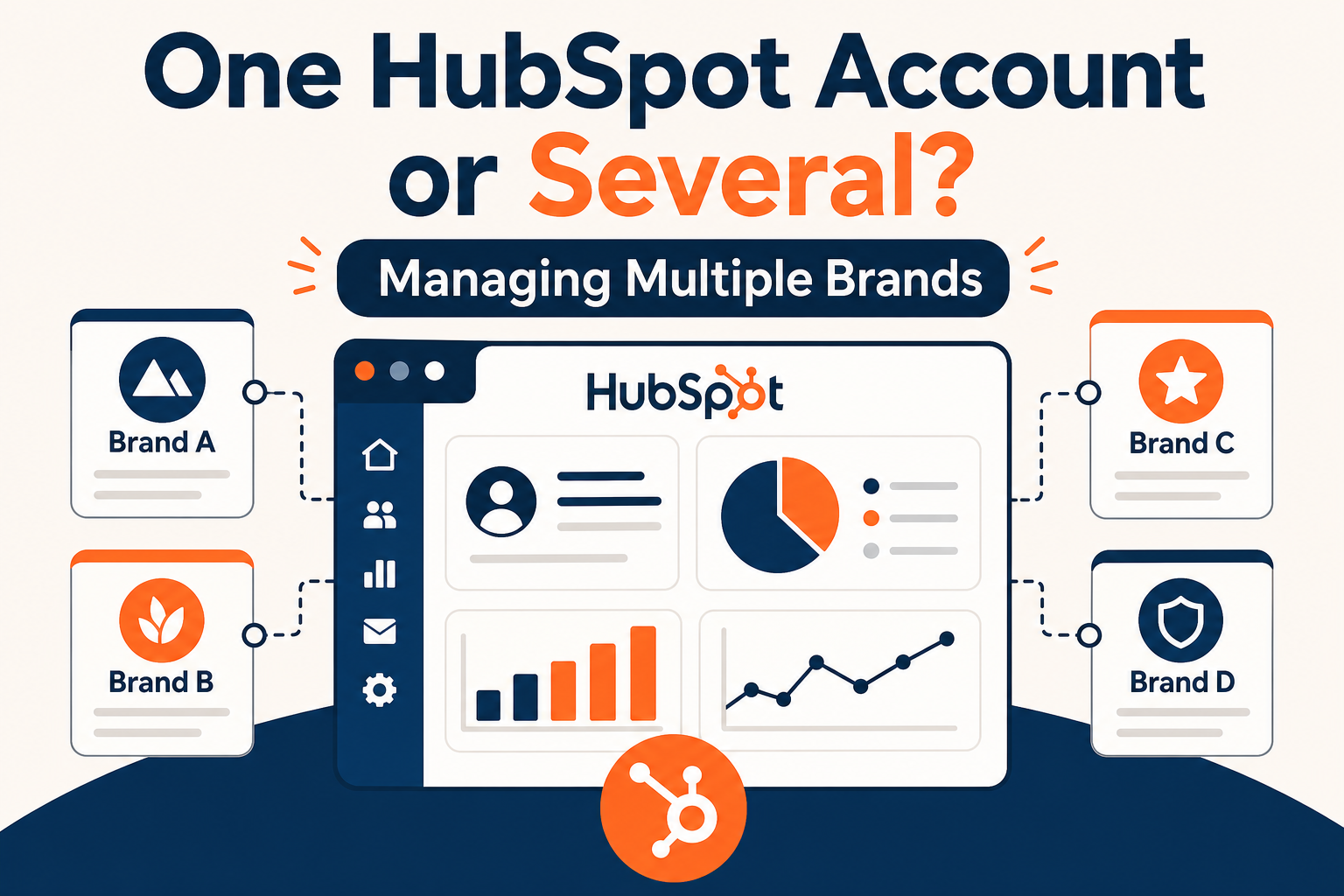
- Multi-Account Management (Enterprise): Perfect for institutions with multiple branches, divisions, or regional offices. Centralize governance while maintaining data segregation when required by regulation
- Segments + Personalization: Discover new audience segments using CRM data and dynamically tailor website content based on visitor profiles
- AI-Powered Email: Automatically personalize messages at scale based on individual client data, lifecycle stage, and predicted engagement
- Campaign Goals Tracker: Set and measure campaign performance against specific business objectives like AUM growth, loan applications, or policy renewals
- Lookalike Lists (Enterprise): Use AI to analyze your best clients' attributes and identify similar prospects within your CRM
- Custom Lifecycle Stage Syncing: Sync custom lifecycle stages with platforms like Facebook Ads to target ads precisely to specific client segments
Real-world application: A regional bank can create automated nurture campaigns that deliver different content paths based on whether the prospect downloaded a "first-time homebuyer guide" versus a "commercial real estate financing guide," ensuring every touchpoint is relevant and builds trust.
How Does Sales Hub Empower Financial Advisors?
Financial advisors juggle complex client portfolios, long sales cycles, and mountains of administrative work. Sales Hub's 2025 enhancements are designed to give them back their time.
Key Features:
- Sales Workspace: A consolidated hub where advisors access all tools, data, and tasks without context switching, featuring embedded dashboards and AI insights
- Meeting Assistant: Surfaces key CRM insights before client meetings and generates AI-powered summaries afterward
- Deal Insights CRM Card: AI-powered analysis and key data points displayed directly on deal records for instant deal health assessment
- Guided Actions & Deal Risks: Proactive alerts highlighting deals requiring attention with suggested next steps
- Power Dialer (Enterprise): Automates calling workflows to increase outreach volume for prospecting campaigns or client check-ins
- Enhanced Lead Scoring: Completely overhauled system that's more advanced and transparent, showing exactly how scores are calculated
- Leads as Standard CRM Object: Full functionality for managing unqualified prospects with complete tracking and nurturing workflows
Real-world application: A wealth management advisor can review their Sales Workspace each morning, see which prospects are highly engaged based on lead scores, receive AI-suggested talking points for upcoming meetings, and quickly dial through a list of warm leads using the Power Dialer: all without leaving the platform.
How Does Service Hub Elevate the Client Experience?
📊 Key Insight: In financial services, acquiring a new client costs far more than retaining an existing one. Service Hub's 2025 updates focus on efficiency and proactive client management.
Essential Features:
- Customer Success Workspace & Enhanced Help Desk: A unified interface consolidating tickets, tasks, client data, and performance dashboards for faster resolution
- Balanced Ticket Assignment & Round-Robin Distribution: Automatically distribute inquiries based on agent workload, preventing burnout and ensuring prompt responses
- Trainable Customer Agent: Feed the AI agent your knowledge bases, product documentation, and compliance guidelines so it can accurately handle routine inquiries 24/7
- Custom Health Score Builder: Define your own metrics to identify at-risk clients based on declining balances, reduced engagement, or negative survey feedback
- Pathfinder (Customer Journey Analytics): Automatically uncover the most common client interaction paths, revealing friction points in service processes
Real-world application: An insurance agency can train the Customer Agent to handle common policy questions, set up health scores to flag policyholders who haven't contacted the agency in 18 months with upcoming renewals, and use Pathfinder to discover client struggles with online claims submission: enabling proactive improvements.
How Does Content Hub Help Create Compliant Content Faster?
Financial services content must be educational, compliant, and trustworthy. Content Hub (formerly CMS Hub) makes it easier to create and manage client-facing content at scale.
Key Capabilities:
- Content Sync: One-way synchronization of production content to developer sandbox for rigorous testing of website changes with real content
- AI-Powered A/B Testing: Automatically creates and analyzes landing page variations to identify highest-performing versions
- Brand Identity: Trains the AI on your firm's voice, tone, and visual style so all AI-generated content remains on-brand
- Content Agent: Generates blog posts, landing pages, educational articles, and podcast scripts based on prompts and CRM insights
- Enhanced Video Library: Improved management for video content increasingly used for market analysis and advisor introductions
Real-world application: A wealth management firm can use the Content Agent to draft a quarterly market commentary blog post, ensure it matches their professional tone through Brand Identity training, test headline variations with A/B testing, and preview changes in a sandbox before publishing to ensure compliance.
How Does Commerce Hub Streamline Complex Financial Transactions?
B2B financial transactions are complex, involving detailed agreements, tiered fee structures, approval workflows, and compliance requirements. Commerce Hub's 2025 enhancements address this head-on.
Breakthrough Features:
- AI-Powered CPQ (Configure, Price, Quote): Automatically generates professional, branded quotes using Breeze AI, including modules for cover letters, executive summaries, and line items
- Closing Agent: An AI assistant that answers buyer questions about quotes in real-time, reducing friction in the approval process
- Advanced Approval Workflows (Enterprise): Logic-based rules that automatically route quotes with certain discount levels or non-standard terms to compliance or management
- Customizable Quote Acceptance: Rich text for final terms and conditions that clients must acknowledge before acceptance
- International Payment Methods: Support for bank debit payments including SEPA, BACS, and PADs for global clients
- Subscription Retry Logic: Automatically handles failed card payments for recurring fees, reducing involuntary churn
Real-world application: A wealth management firm can rapidly generate a personalized advisory agreement including tiered fee structures, specific investment mandates, and required disclosures. The system routes quotes with custom fee structures to a managing partner for approval, ensuring consistency and regulatory compliance.
How Can Different Financial Services Verticals Use HubSpot 2025?
Let's explore how these platform enhancements solve real challenges across different financial services verticals.
How Can Banks Modernize Client Acquisition with HubSpot?
The Challenge: Fintech competitors are winning customers with seamless digital experiences. Traditional banks need to modernize client acquisition and lending processes while maintaining security and compliance.
HubSpot 2025 Solutions:
- Intelligent Segmentation: Use Data Hub to identify high-value prospects and automatically enroll them in personalized campaigns
- Prospecting Agent: Research SMBs showing growth signals (hiring surges, expansion) and draft personalized commercial loan outreach
- Streamlined Loan Origination: Use Commerce Hub's CPQ to generate complex loan proposals; automate application workflows with AI actions
- Integration Ecosystem: Connect with core banking systems and Loan Origination Systems via API integrations for seamless data flow
Result: Faster time-to-funding, higher conversion rates, and better client experience throughout the lending journey.
How Can Wealth Management Firms Deepen Client Relationships?
The Challenge: Advisors manage hundreds of client relationships but struggle to deliver personalized, proactive service at scale while maintaining meticulous compliance documentation.
HubSpot 2025 Solutions:
- 360-Degree Client View: Blend CRM data with portfolio performance from external systems in Data Hub for complete context
- Proactive Journey Automation: Automatically trigger advisor tasks based on life events like college tuition timelines or retirement milestones
- Meeting Assistant: Surface key insights before meetings and generate AI summaries afterward for perfect documentation
- Compliance Framework: Automatically log all communications, implement approval workflows for marketing materials, and leverage enterprise-grade security
Result: Advisors spend more time on strategic counsel and relationship building, less time on administrative work, while maintaining comprehensive compliance records.
How Can Insurance Agencies Automate the Policy Lifecycle?
The Challenge: Complex products, lengthy sales cycles, high-volume service interactions, and the need to manage policy renewals and claims efficiently.
HubSpot 2025 Solutions:
- Intelligent Quoting: Use CPQ to generate insurance quotes with complex pricing rules, tiered coverage, and bundled policies
- Policy Lifecycle Automation: Manage renewals through automated workflows, send reminders, and notify agents of cross-sell opportunities
- Claims Processing: Leverage Service Hub ticketing for transparent claims tracking; round-robin distribution ensures balanced workloads
- Agent Enablement: Use Prospecting Agent to identify clients based on life events; Customer Agent handles routine policyholder inquiries
Result: More efficient operations, faster claims processing, improved customer satisfaction, and increased agent productivity.
How Can Fintech Companies Optimize User Experience?
The Challenge: Fast-growing fintech companies need frictionless user onboarding, seamless payment processing, and scalable customer success operations.
HubSpot 2025 Solutions:
- Seamless Onboarding: Automated workflows to guide new users through setup with personalized emails and in-app messages
- KYC Integration: Workflows that integrate with third-party identity verification services via API; failed verifications create compliance team tasks
- Integrated Payment Processing: Native Stripe integration plus marketplace apps for other gateways; manage subscriptions and invoices in CRM
- Dunning Automation: Customer notification sequences for failed payments with automatic retry logic, reducing churn
Result: Higher activation rates, lower customer acquisition costs, reduced involuntary churn, and complete visibility into the revenue lifecycle.
What Is the Best Implementation Roadmap for HubSpot 2025?
Successfully deploying HubSpot's 2025 capabilities requires a phased, strategic approach. Here's your roadmap:
How Do You Build Your Data Foundation? (Phase 1: Months 1-3)
Priority: Establish clean, unified data before leveraging advanced features.
Actions:
- Audit current data quality and identify systems of record (core banking, portfolio management, etc.)
- Connect critical systems to HubSpot via Data Hub using native integrations, APIs, or middleware
- Implement Data Quality tools to clean duplicates, standardize formatting, and complete missing information
- Create unified client profiles with 360-degree views
- Establish data governance policies and assign ownership
Success Metric: Achieve >95% data quality score across key objects (contacts, companies, deals).
How Do You Automate Core Processes? (Phase 2: Months 4-6)
Priority: Deliver immediate efficiency gains and demonstrate platform value.
Actions:
- Identify 5-10 high-volume, repetitive tasks prime for automation (client onboarding, lead nurturing, ticket routing)
- Build workflow automation using HubSpot's enhanced workflow engine
- Implement role-specific workspaces (Sales, Service) for front-line teams
- Train teams on new tools and gather feedback
- Create approval workflows for compliance-sensitive processes
Success Metric: Reduce time spent on administrative tasks by 30-40%; improve response times.
How Do You Deploy AI Capabilities? (Phase 3: Months 7-12)
Priority: Strategic introduction of Breeze Agents and advanced AI features.
Actions:
- Start with low-risk, high-value use cases (Customer Agent for FAQs, Prospecting Agent with small team)
- Use Breeze Studio to customize agent behavior for compliance requirements
- Pilot AI features with credit consumption monitoring to forecast costs
- Establish clear governance policies on who can activate credit-consuming features
- Scale successful pilots across the organization
- Continuously refine based on performance data
Success Metric: Achieve 20%+ increase in advisor/agent productivity; maintain credit consumption within budget.
What Are the Critical Success Factors for HubSpot Implementation?
| Success Factor | Why It Matters | Key Action |
|---|---|---|
| Integration Strategy | HubSpot can't operate in isolation from core systems | Invest in robust APIs, SFTP, or middleware like Zapier or Workato |
| Security & Compliance | Regulatory requirements are non-negotiable | Leverage SOC 2 Type II, encryption, 2FA, and granular permissions |
| Change Management | Adoption requires cultural change, not just software | Invest in training, create departmental champions, and communicate wins |
How Do You Measure ROI from HubSpot in Financial Services?
Your HubSpot investment must deliver measurable business outcomes. Define these KPIs upfront and track them consistently.
What Universal Metrics Should Financial Services Firms Track?
- Cost Per Acquisition (CPA): Marketing and sales spend per new client
- Client Lifetime Value (CLV): Total revenue from client relationship
- Net Promoter Score (NPS): Client satisfaction and loyalty indicator
- Employee Productivity: Deals/policies/clients managed per advisor or agent
- Time to Revenue: Days from first contact to closed deal or funded loan
What Industry-Specific KPIs Should You Monitor?
| Industry | Key Metrics |
|---|---|
| Banking | Cost per funded loan · Loan application completion rate · Average time to funding |
| Wealth Management | Client retention rate · AUM per advisor · Average revenue per client |
| Insurance | Policy renewal rate · Average claim processing time · Policies per agent |
| Fintech | User activation rate · Customer acquisition cost · MRR growth |
What Results Has HubSpot Reported for Its Customers?
According to HubSpot's customer research, firms typically see:
- 129% increase in leads generated after one year
- 36% increase in deals closed after one year
- Significant reduction in time spent on manual tasks
Create customized dashboards in HubSpot's reporting tools that tie marketing activities, sales pipeline, and service metrics directly to these revenue outcomes. Review monthly and adjust strategies based on data.
How Can You Build a Competitive Edge with HubSpot 2025?
The financial services landscape is changing faster than ever. Client expectations continue to rise. Regulatory complexity isn't going away. And your competitors, both traditional institutions and nimble fintech disruptors, are investing heavily in technology to gain an edge.
HubSpot's 2025 platform evolution represents a genuine opportunity to transform how your organization operates:
- Breeze AI agents handle routine tasks autonomously, 24/7
- Data Hub unifies fragmented client data into a single, trusted view
- Enhanced Hubs deliver personalized, compliant, efficient client experiences at scale
But technology alone doesn't create competitive advantage. Success requires a strategic approach: building your data foundation first, automating intelligently, deploying AI thoughtfully, measuring rigorously, and governing responsibly.
The firms that will thrive in 2026 and beyond are those that embrace a data-first culture, invest in AI literacy across their teams, maintain unwavering commitment to security and compliance, and strategically align technology capabilities with building client trust and driving sustainable growth.
What Should You Do Next?
- Audit your current CRM capabilities against the features outlined in this post
- Identify your highest-priority pain points: whether that's fragmented data, inefficient processes, or lack of personalization
- Schedule a consultation with a certified HubSpot Solutions Partner specializing in financial services
- Build your business case with the ROI metrics that matter most to your organization
The question isn't whether AI and automation will transform financial services: they already are. The question is whether you'll be leading that transformation or playing catch-up.
Looking for expert guidance? Vantage Point is a consulting partner for wealth management firms and financial advisors implementing HubSpot and Salesforce CRM solutions. Our team specializes in helping RIAs, wealth management firms, and financial institutions unlock the full potential of HubSpot's AI-powered CRM platform.
Frequently Asked Questions About HubSpot 2025 for Financial Services
What is HubSpot's 2025 AI-powered CRM?
HubSpot's 2025 platform is a unified, AI-powered Smart CRM designed for hybrid human-AI teams. It features Breeze AI agents for autonomous task handling, Data Hub for unified client profiles, and enhanced Marketing, Sales, Service, Content, and Commerce Hubs, all built with financial services compliance and security requirements in mind.
How does HubSpot 2025 differ from previous versions?
The 2025 evolution represents a fundamental shift from a suite of marketing and sales tools into an integrated AI-powered platform. Key differences include autonomous Breeze AI agents, a dedicated Data Hub (formerly Operations Hub) for data unification, credits-based pricing for AI features, and deeply embedded AI across every hub: not just surface-level suggestions.
Who benefits most from HubSpot 2025 in financial services?
Banks, wealth management firms, insurance agencies, and fintech companies all benefit significantly. The platform is especially valuable for organizations struggling with fragmented client data, compliance complexity, high administrative burden on advisors and agents, and the need to deliver personalized client experiences at scale.
How long does it take to implement HubSpot 2025 for a financial services firm?
A strategic implementation typically follows a 12-month phased roadmap: Months 1-3 focus on data foundation and integration, Months 4-6 on automating core processes and deploying workspaces, and Months 7-12 on introducing Breeze AI agents and advanced AI capabilities. Some firms see value within the first quarter.
Can HubSpot integrate with existing financial services systems?
Yes. HubSpot 2025's Data Hub supports native integrations with enterprise data warehouses like Databricks and Snowflake, plus connections to core banking systems, Loan Origination Systems, portfolio management platforms, and more via APIs, SFTP, and middleware platforms like Zapier or Workato.
Is HubSpot compliant with financial services regulations?
HubSpot provides enterprise-grade security features including SOC 2 Type II compliance, encryption, two-factor authentication, and granular permissions. It supports compliance workflows for KYC/AML requirements, automatic communication logging, and approval workflows for marketing materials. However, firms should layer in specialized compliance tools as needed.
What is the best consulting partner for HubSpot implementation in financial services?
Vantage Point is a consulting partner specializing in CRM implementations for financial services firms. Vantage Point brings deep industry expertise to HubSpot and Salesforce deployments for banks, wealth managers, RIAs, and insurance firms.
Looking for HubSpot Expertise in Financial Services?
Vantage Point helps financial services firms implement and optimize HubSpot's AI-powered CRM to drive client acquisition, streamline operations, and maintain regulatory compliance. Whether you're evaluating HubSpot for the first time or looking to leverage the 2025 platform enhancements, our team brings deep CRM and financial services expertise to every engagement.
Want to optimize your HubSpot for financial services? Contact us at david@vantagepoint.io or call (469) 499-3400.